
The Banner Specs Worth Confirming Before You Approve a Quote


Most banner quotes hide the four specs that decide whether the piece survives its season. Here are the questions to ask, the answers that mean something, and the ones that mean a printer is guessing.
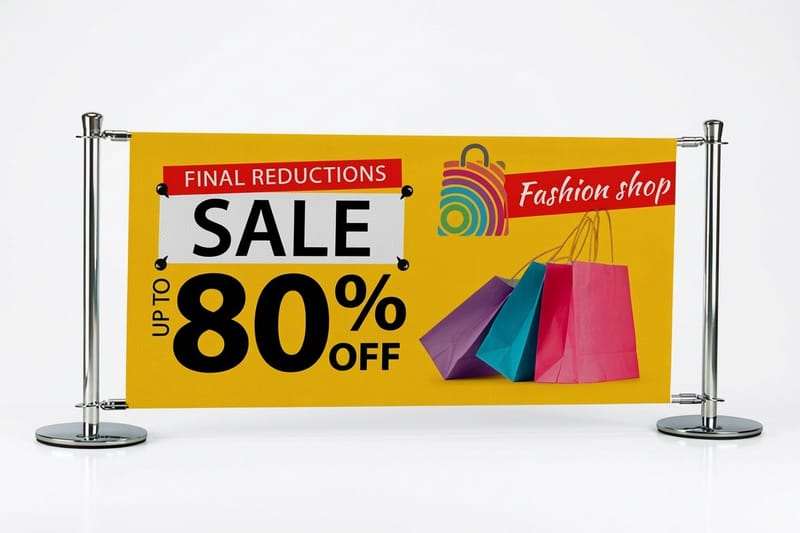
Before you approve a banner quote, get four specs in writing: the vinyl weight in ounces, how the hem is finished, how far apart the grommets sit, and whether your finished size needs a welded seam. A printer who answers with 13 oz scrim, welded hems, grommets every 24 to 36 inches and a named roll width is quoting a real product. One who answers heavy duty vinyl with finished edges is quoting a price.
Quick answer
Four specs, and what a real answer sounds like
Weight, hem, grommet spacing, seam. Ask for the vinyl weight in ounces and expect 13 oz scrim as the outdoor default. Ask how the hem is made and expect heat welded rather than taped. Ask the grommet interval and expect corners plus one every 24 to 36 inches. Ask whether your size clears the printer's roll width, because past it the banner is two panels welded together and the seam is permanent. Everything else in a banner quote is negotiable. These four decide whether it is still hanging straight in month six.
Seven Questions That Separate Printers From Price Quotes

Send the same artwork to five shops and you get five prices with nothing attached to them. These are the questions that turn a number back into a product, and the phrasing on the right is what a printer who knows their own equipment sounds like.
| Ask this | Weak answer | Answer you want | Why it matters |
|---|---|---|---|
| What weight is the vinyl? | Heavy duty outdoor material. | 13 oz scrim as standard, 15 or 18 oz if you need more than one season. | Weight is the one number that predicts sag, ripple and tear resistance. |
| How is the hem finished? | Finished edges included. | Heat welded return on all four sides, sewn on request, tape only on same day rush. | A tape hem softens in summer heat and creeps open, usually at a top corner. |
| How far apart are the grommets? | Grommets included. | All four corners plus one every 24 to 36 inches. | Spacing decides whether wind load spreads or concentrates on one ring. |
| Does my size need a seam? | We can print any size. | Our roll prints to a set width, so this banner is one panel, or it carries one welded seam here. | A seam through a face or a logo is visible forever and cannot be undone. |
| What ink, and rated for how long outdoors? | Outdoor ink. | Latex or eco solvent, with a stated unlaminated outdoor life. | Unrated ink fades in magenta first, so reds and purples go dull before anything else. |
| Do I see a proof before it prints? | We will take care of it. | A PDF proof showing bleed, hem allowance and grommet positions. | Grommets punched through artwork are the most common avoidable reprint. |
| What is the finished visible size? | The size you ordered. | Trim size, minus hem return, minus any pole pocket allowance. | A 3 foot drop with a 4 inch pocket shows well under 3 feet of artwork. |
You do not need all seven answered in writing. You need to hear how the shop handles being asked. A printer who answers the seam question by naming their roll width has stood in front of the machine. One who says any size is possible is quoting from a spreadsheet. Our own configurator for custom vinyl banners puts weight, hem and grommet choices in front of you before checkout, which is the same information in a different order.
Vinyl Weight and Scrim Count, and What Each One Survives

Banner vinyl is PVC coated onto a woven polyester mesh called scrim, and the ounce figure is the weight of a square yard of the finished material. Scrim count, written as something like 9 by 9, is how many threads run each direction per inch. More thread and more coating means a face that resists tearing and holds its shape in wind, and a piece that is heavier to hang.
| Weight | Typical build | Where it belongs | What ends it |
|---|---|---|---|
| 8 to 10 oz | Light scrim, sometimes smooth with no scrim at all. | Indoor, trade shows, step and repeat backdrops, short promotions. | Any real wind, and repeated rolling that creases a smooth face. |
| 13 oz scrim | The default. Scrim reinforced, matte or gloss face. | Most outdoor banners hung on a wall, fence or frame for a season. | Sustained exposure past a year, or corner stress with too few grommets. |
| 15 to 18 oz | Heavier scrim, often with a blockout core for double sided work. | Long term outdoor, double sided, and large spans that would ripple in lighter stock. | Mounting hardware that was sized for a lighter banner. |
| Mesh | Perforated vinyl, lighter than solid scrim of the same class. | Fences, scaffolds, building faces and anywhere gusts are constant. | Nothing quickly, but it never matches solid vinyl for color density. |
The trade is straightforward once you say it out loud. Lighter vinyl costs less, ships cheaper and looks identical on day one. Heavier vinyl is the only thing that still looks right in month eight. If the banner is going up once for a weekend event, paying for 18 oz is money spent on a property nobody will ever see. Our banner material guide goes deeper on scrim, mesh and fabric faces if you are choosing between them rather than checking a quote.
Hems, Grommets and Seams, Which Is Where Banners Actually Fail

Banners almost never fail in the middle of the print. They fail at an edge, and there are only three edges worth inspecting.
The hem is the folded return around the perimeter that gives a grommet something thick to bite into. Heat welding melts the fold into a single piece of material and is the standard on production banners. Sewing works and looks traditional, though a stitch line is a row of small holes that can pull in a gale. Double sided tape is the third method, and it is genuinely fine for an indoor banner used for a weekend. Left on a south facing wall through July, tape adhesive softens and the hem starts opening at the top corners, which is where the load sits.
The grommets are where the wind actually pulls. A ring set through hem material has two layers of vinyl and a welded fold resisting it. A ring set slightly off, through single thickness vinyl, tears out on the first serious gust. Ask for corners plus one every 24 to 36 inches, and on any banner over 8 feet wide say the interval out loud rather than assuming it. Sending your file with a 2 inch clear margin from trim protects you either way, since a grommet through a phone number is a reprint nobody pays for happily.
The seam shows up when your finished size exceeds the printer's roll width. Two panels are welded together, and on a well run job the seam falls in dead space. On a badly run one it crosses a face, a logo or a line of type. This is why the seam question belongs in the first email rather than the complaint email. If you are still deciding on a size, the complete banner size guide lists the standard dimensions that print as a single panel almost everywhere, and the print ready setup guide covers scale and resolution for large format files.
Two more things belong on the list. Pole pockets are sewn or welded sleeves along the top and bottom for a rod, and every inch of pocket is an inch of artwork you stop seeing, so quote the pocket depth and design around it. And wind slits, still offered by some shops, are a bad trade: they cut the printed face, hand a tear a starting point, and do less for wind than the mesh they are trying to imitate.
When the Job Is Not Actually a Banner

Half the banner quotes we see are for jobs a banner does poorly. Two situations come up constantly, and both have a better answer.
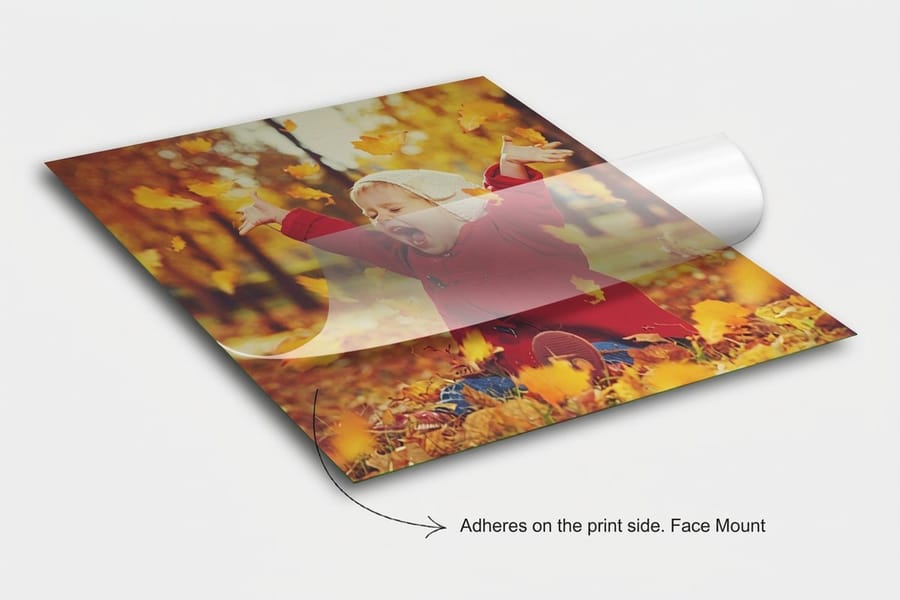
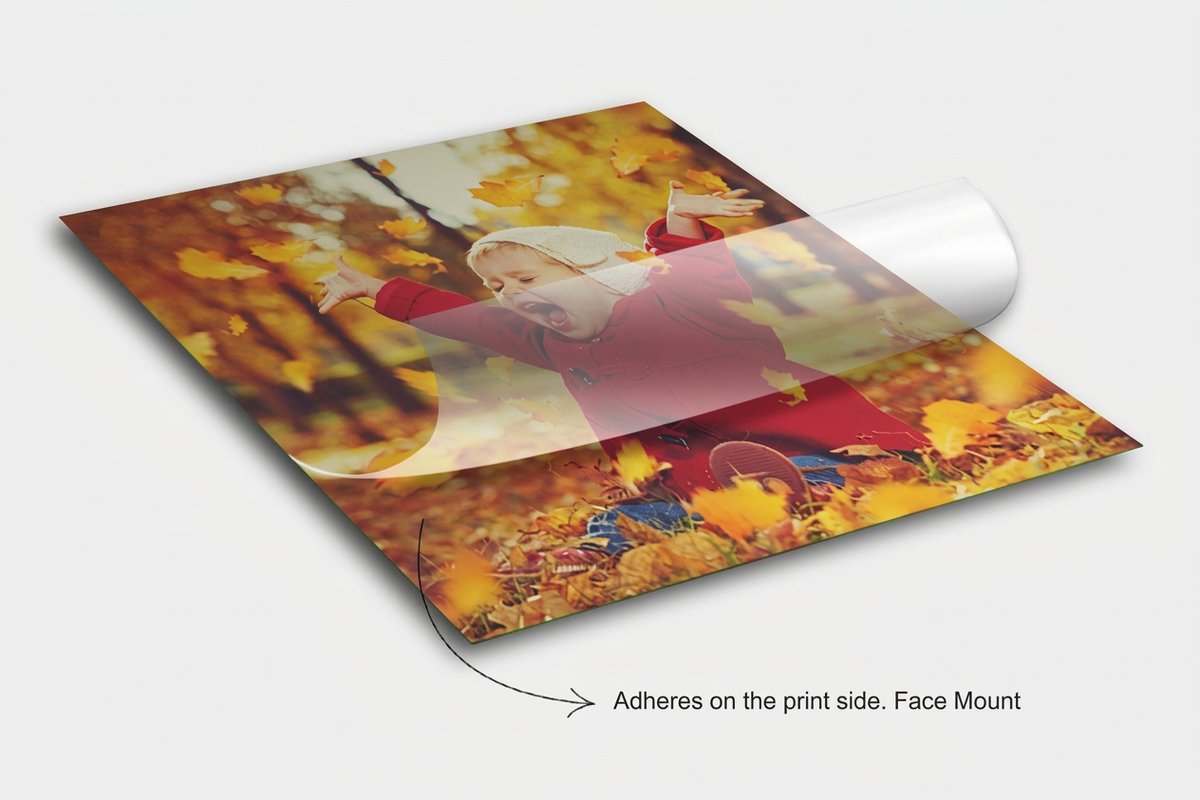
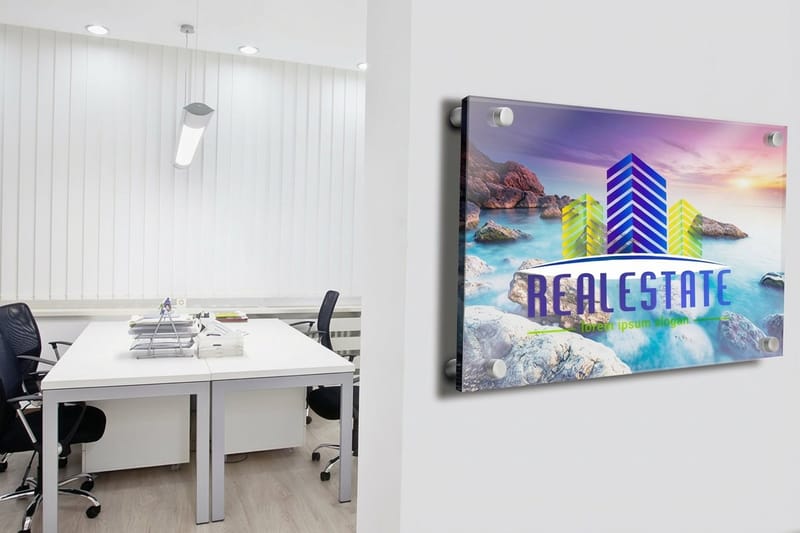
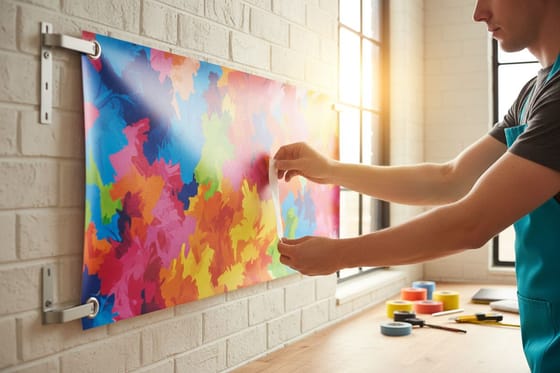
The first is glass. If the message is going on a storefront window or a glass partition, a banner hung behind the glass looks like a banner hung behind glass. Printed vinyl applied to the surface reads as part of the building. Clear adhesive vinyl starts at $25 and leaves the background visible, front adhesive vinyl at $25 applies to the outside face when the inside is inaccessible, and frosted etched vinyl at $25 mimics acid etched glass for privacy bands and conference room panels. Translucent adhesive vinyl at $25 is the one to ask for on a lightbox, since it is built to be lit from behind rather than in front.
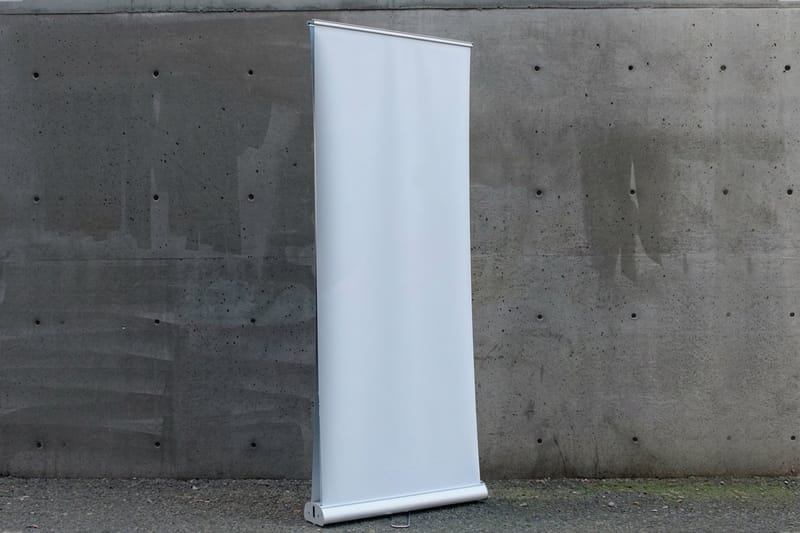
The second is indoor events with nothing to tie to. A banner needs two anchor points and a trade show booth often gives you none. That is what retractable banner stands exist for: the graphic travels in its own base and stands up in under a minute. And when the piece is small and applied rather than hung, you are in vinyl label territory, not banner territory.
None of this rules out a banner. A wall, a fence, a stage front or a railing is exactly what 13 oz scrim was made for. It is worth thirty seconds of honesty about the surface before you pay for hems and grommets you will never use. If the surface is right, price it in the vinyl banner configurator, and read where to hang it for maximum impact before you commit to a size.
Wally checks the quote
Weight, hem, grommets, seam, in that order
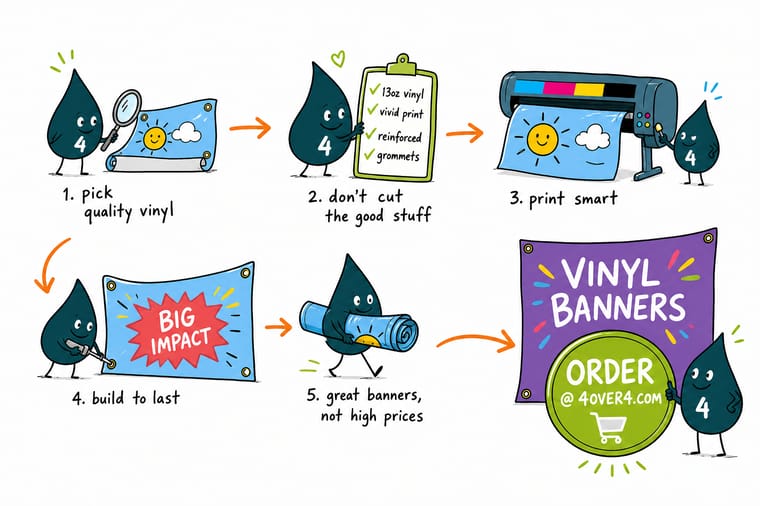
Wally reads a banner quote the way a printer does. He looks for the ounce figure first, because heavy duty is not a spec. Then he runs a thumb along the hem to see whether it was welded or taped. Then he counts grommets, because corners only on a long banner means the wind gets one place to pull. Last he asks where the seam falls, since a weld through a logo never goes away. Four answers and he knows what he is buying.
Configure a custom vinyl banner →Specs and pricing
Large format vinyl, sizes and starting prices
The same wide format vinyl family, configured live. Sizes, finishing choices and starting prices come straight from the 4OVER4.COM configurator, so you can see exactly what a spec change costs before you commit.


Print it
Vinyl that goes on the glass instead of over it

Explore more
Where to go next
By the numbers
Large format printing you can hold us to
Common Questions
Your banner vetting questions, answered
What vinyl weight should I ask for on an outdoor banner?
13 oz scrim vinyl covers most outdoor work and it is what a quote should say by default. Step down to 8 or 10 oz only for indoor and trade show pieces that get hung, photographed and rolled back up. Step up to 15 or 18 oz when the banner stays outside past one season, when it is double sided and needs a blockout core, or when it is large enough that a lighter face would visibly ripple in the wind. Heavier vinyl also means a heavier finished piece, so confirm the mounting points can carry it before you order the upgrade.
How many grommets does a 3 by 8 foot banner need?
Ten is the normal count. Four corners, two more spaced across the 8 foot top edge, two matching them along the bottom, and one in the middle of each 3 foot side. That works out to roughly one every 2 to 3 feet, which is the spacing most sign shops use. If the printer quotes corners only on a banner that size, ask them to add the intermediate rings. It is a cheap change at order time and impossible to fix once the hem is welded shut.
Should I ask for wind slits?
No. Slits cut through the printed face, remove material and give a tear an obvious place to begin, and they do far less for wind load than people expect because the flaps still catch air. A banner that has to live on an exposed fence or a building face should be printed on mesh vinyl instead, which is perforated across the whole sheet. Mesh gives up some color density and looks slightly open when backlit, and that is the honest trade you are making for a piece that survives a gusty site.
Is lamination worth paying for on a banner?
Usually not. A laminate on banner vinyl mostly buys scratch and scuff resistance for a piece that gets rolled, transported and rehung repeatedly, and it adds a little fade protection. For a single season on a wall or a fence, the money is better spent on heavier vinyl and better hems. Ask instead what outdoor life the printer rates their ink for unlaminated, and remember that magenta is the first pigment to go, so a design built on reds and purples shows fading before one built on blues and blacks does.
Can a vinyl banner be printed on both sides?
Yes, but ask which method the quote uses. The good version prints on a blockout vinyl with an opaque core so neither side ghosts through the other. The cheap version prints two single sided banners and welds them back to back, which doubles the weight and can trap moisture between the layers. The third version, printing both sides on ordinary 13 oz vinyl, produces a faint reverse image showing through and is worth refusing.
What should I check the moment the banner arrives?
Unroll it flat and look at four things before you hang it. Run a thumb along the hem to confirm the weld or stitch is continuous with no open gaps at the corners. Check that every grommet is set through the hem material, not through single thickness vinyl next to it. Hold it up to a light and look for a seam, then check nothing important sits on it. Last, compare the finished size against your order, since hems and pole pockets eat into the visible area and a banner measured before finishing can arrive an inch or two short of what you planned around.
Get Started
Ready to order a banner with the specs written down?
Choose your size, vinyl weight and finishing in the configurator, see the price change as you go, and get a proof before anything prints.
Legal Disclaimer
Gold Standard guarantees apply to all standard orders placed through 4over4.com. Price match requires verifiable proof of a competitor's published price for an equivalent product with matching specifications and turnaround time. Satisfaction guarantee covers manufacturing defects and print quality issues. Contact support with order number and documentation. On-time delivery rate based on tracked orders 1999 to 2026. Individual results may vary based on shipping carrier performance.
