
The Smart Homebuyer’s Playbook From First Budget to Closing Day


Six stages, in the order they actually happen. What to settle before you tour, which approval letter wins an offer, what a home inspection never covers, and the mail you have to fix in the first month.
Buying well comes down to six decisions: the monthly payment you will accept, the loan program, the strength of your approval letter, the contingencies you keep, the inspections you order beyond the standard one, and the records you update after closing. Price is the number people argue about. Payment, contingencies and the inspection scope are the ones that decide whether the purchase goes well.

Quick answer
Payment first, contingencies second, everything else after
Set the monthly payment you will accept before you tour anything, then protect the deposit that backs your offer. The payment includes property tax reassessed at your purchase price, insurance you have actually been quoted, mortgage insurance, and HOA dues. The deposit stays refundable only while the inspection, appraisal and financing contingencies are live, which is why a waiver is a cash decision rather than a paperwork one. Everything else on this page follows from those two.
Start With the Monthly Payment, Not the Asking Price
The price on the listing is the number everyone talks about and the number that matters least. What you are actually buying is a monthly payment, and four things ride on it: principal and interest, property tax, homeowners insurance, and mortgage insurance if you put down less than twenty percent. Add HOA dues if the property has them, because a lender counts those against you even though they never touch your loan.
The trap is the tax line. In most states the county reassesses the property at the price you paid, so the seller’s current tax bill is a historical figure and not a forecast. A house that has been in one family for two decades can carry a tax figure that doubles the month after you close. Ask the county what a sale at your price would produce before you decide the payment is affordable.
Insurance has become the second surprise. In wildfire and coastal counties, availability now drives the number more than the coverage does, and a quote you assumed would be nine hundred dollars can come back at four thousand. Get a real quote during your inspection window, not after. Your lender has to see a bound policy before it will fund, so a house you cannot insure is a house you cannot buy.
Underwriting looks at all of it as a ratio. Conventional automated approvals commonly stretch the back-end debt-to-income ratio into the mid forties when the rest of the file is strong, and FHA can go higher with compensating factors. That is the lender’s limit, not yours. Decide your own ceiling first, write it down, and treat the pre-approval number as the maximum you are allowed to spend rather than the amount you should.
Know Which Approval Letter You Are Holding
Three documents get called a pre-approval and they are not remotely equal. Sellers in a busy market can tell them apart in seconds, and so can a listing agent who has seen a hundred of them.
| Document | What the lender did | What it proves | How much it helps an offer |
|---|---|---|---|
| Pre-qualification | Took your numbers over the phone or through a form. | That you can do arithmetic. | Almost nothing. Some listing agents will not read past the heading. |
| Pre-approval | Pulled credit, collected income and asset documents, ran the file through automated underwriting. | That your credit and stated income support the loan. | The working minimum. Enough to tour and to write in most markets. |
| Underwritten approval | A human underwriter cleared the file. Only the property and a final credit check remain. | That the money is real and the delay is short. | Substantial. It lets you offer a shorter financing contingency without inventing risk. |
Get the third one if your market moves quickly. It takes a few extra days up front and it converts into leverage later, because a fourteen-day financing contingency backed by a cleared file is a genuine concession rather than a gamble.
One habit protects all of it: from the day you apply to the day you fund, change nothing. Lenders re-pull credit shortly before closing. A new card, a car loan, a job change, even a large unexplained deposit can send a cleared file back into underwriting and push the closing date.
Pick the Loan Before You Pick the House
The loan you qualify for shapes which houses you can even bid on, so choose it first. Four programs cover almost every first purchase in the United States, and the differences that matter are the entry cost and how long the mortgage insurance sticks around.
| Loan | Minimum down | Mortgage insurance | The catch |
|---|---|---|---|
| Conventional | 3 percent on first-time buyer programs, 5 percent typically. | PMI until the loan reaches 80 percent of value on request, 78 percent automatically. | The strictest credit and debt ratios of the four. |
| FHA | 3.5 percent with a credit score of 580 or above, 10 percent below that. | Upfront premium plus an annual premium that lasts the life of the loan under 10 percent down. | Property condition standards, and escaping the premium usually means refinancing. |
| VA | Zero, for eligible service members and veterans. | None. A one-time funding fee instead, waived for some disabled veterans. | Eligibility, and appraisers apply their own minimum property requirements. |
| USDA | Zero, in eligible rural and semi-rural areas. | Upfront guarantee fee plus a smaller annual fee. | Both the address and your household income have to qualify. |
Discount points are the other lever and the one most often misused. A point costs one percent of the loan amount and buys the rate down. Divide the cost by the monthly saving to get the break-even month. If that lands past the point where you realistically expect to sell or refinance, you are paying for a benefit you will not collect.
Lock the rate once you are under contract and note the expiry. Locks commonly run thirty to sixty days, extensions cost money, and a lock that lapses two days before funding turns a settled payment into a negotiation.
Tour With a Scoring Sheet Instead of a Memory

After the fourth showing in a weekend the houses blur, and the one you remember is the one with the best staging rather than the best bones. Fix that with a fixed sheet of questions you fill in before you leave the driveway, every time, in the same order.
Keep it short enough to actually use. Age and condition of the roof, furnace and water heater. Panel amperage and whether it is a brand with a recall history. Which way the lot drains. Cell signal in the back bedroom. Traffic and noise at the hour you would actually be home. Then one honest line at the bottom: what would have to be true for this to be worth the asking price.
Photograph the utility labels rather than trusting your notes on them. The manufacture date is usually on the data plate, and a furnace stamped fifteen years ago is a negotiating point long before the inspector confirms it.
If you are touring a handful of houses, a phone note does the job. If you are seeing dozens, or you are the agent handing sheets to clients, a printed pad is faster and everyone fills it in the same way. Custom notepads start at $93.37 at 4OVER4.COM, which is a real cost that only makes sense at volume, so be honest about which situation you are in. Agents building a full client kit usually fold it into a real estate agent starter pack alongside cards and signage.
Write an Offer That Survives Underwriting
A strong offer is not simply the highest one. Sellers weigh price against the odds of actually closing, which is why a slightly lower bid backed by an underwritten approval and a clean timeline often wins.
Earnest money is your good-faith deposit, commonly one to three percent of the price and higher where competition is fierce. It goes into escrow, it is credited to you at closing, and it stays refundable only while your contingencies are alive. That is the whole mechanism, and it is the reason a waiver is not the small courtesy it is presented as.
- Inspection contingency. Your right to look, then renegotiate or leave. The last one to give up on any house built more than fifteen years ago.
- Appraisal contingency. Your protection if the lender values the house below your offer. If you replace it with an appraisal gap clause, cap the amount in writing.
- Financing contingency. Your exit if the loan falls through. Shorten it only when an underwriter has already cleared your file.
- Sale of your current home. The weakest term you can attach in a competitive market, and the first thing a seller looks for a reason to reject.
Escalation clauses raise your bid automatically up to a ceiling. They work, and they expose your true maximum, so use them where multiple offers are certain rather than as a default. Flexibility on the closing date is free and underrated: a seller who needs three extra weeks in the house will often take less money for them.
The Inspection, the Appraisal, and the Thirty Days That Decide It
A general home inspection is visual and non-invasive. The inspector looks, tests what is accessible, and writes up what can be seen without opening walls. Understanding what that excludes is worth more than reading the report twice.
Order separately, and early enough to use the results: a sewer lateral scope on any house with mature trees or clay pipe, radon testing where the region warrants it, a chimney inspection if there is a working fireplace, a wood-destroying insect report, and a scan for a buried oil tank on older properties in oil-heat regions. Each is modest against the repair it can reveal, and each falls outside a standard inspection.
Read the report for systems, not for the list length. Twenty cosmetic items are noise. One item about the foundation, the roof deck, the main panel or evidence of long-term water intrusion is the report. Ask for a credit rather than a repair where you can, because a seller motivated to be finished will hire the cheapest contractor available.
Then the quiet phase: title search, survey where required, the lender clearing conditions. Buy the owner’s title policy, which is a one-time premium that protects your ownership against defects the search missed, and is separate from the lender policy you are already paying for. Do the final walkthrough with the utilities on, run every tap, open every window, and confirm the agreed repairs were done rather than promised.
The First Month in the House, Mail Included

The keys are the halfway point. The week after closing is when the boring items either get done or get forgotten for a year, and mail is the one that quietly costs people money.
File the official USPS change of address and understand what it does. First-class mail forwards for twelve months, periodicals for sixty days, and most marketing mail is not forwarded at all. Forwarding is a safety net that buys you a year to update the real records: bank and payroll, insurance, DMV and voter registration, brokerage and retirement accounts, doctors and schools, and every subscription that bills a card. Anything still arriving under forwarding at month ten is a record you never fixed.
Forwarding also tells nobody who matters. Friends, family, and the people who send you a card in December are not on any USPS list. A single run of moving announcement postcards clears the whole list in one afternoon, and postcard postage is the cheapest class the post office sells. Standard postcards start at $16.48, and our guide to change of address postcards covers the wording and the layout rules that keep them mailable. If you would rather hand the whole mailing over, direct mail postcards from $89.68 include printing and delivery in one order, and the cost per piece breakdown shows where the money goes.
Two small things finish the job. Premium address labels from $29.16 put the new address on outgoing mail immediately, which is faster than waiting on printed stationery and stops the old one going out by habit. And label the boxes by room rather than by contents, using custom labels from $25 or anything with a wide flat face, because the movers are asking which room, not what is inside. Browse the full range in postcard printing and address label printing when you are ready to order.
Wally explains the homebuyer playbook
Payment, contingencies, inspections, then the mail
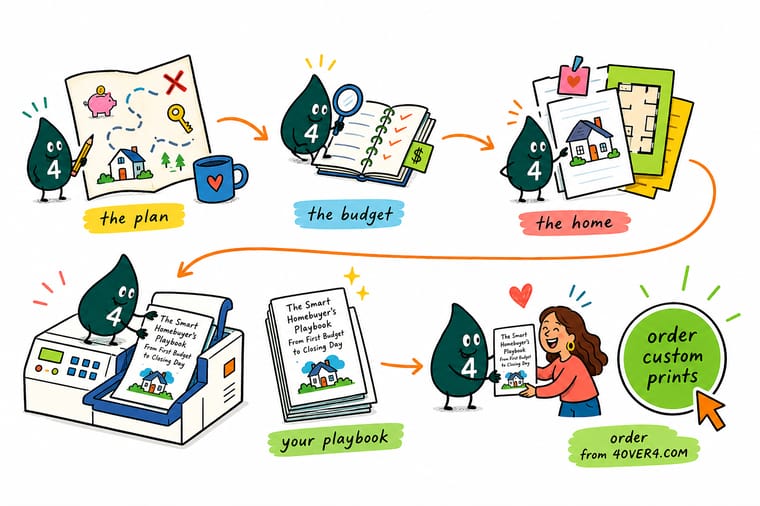
Wally works out the monthly payment before he looks at a single listing, because the tax bill is reset to what he paid, not what the seller paid. He keeps his inspection and appraisal contingencies, since those are the only things holding his deposit. He orders the sewer scope the general inspector never runs. And on the week he gets the keys, he mails announcement postcards to everyone the post office will never tell, because forwarding runs out and friends were never on the list.
Print moving announcement postcards →Specs and pricing
Move-in printing, sizes, and starting prices
The three formats that carry a move: announcement postcards, address labels for outgoing mail, and a pad for tour notes. Live configuration options and starting prices from the 4OVER4.COM configurator.



Print it
Tell everyone where you live now



Explore more
Where to go next






By the numbers
Printing you can count on at 4OVER4
Common Questions
Your home buying questions, answered
How much money do I actually need saved to buy a house?
Four separate piles, not one. The down payment is the visible one and can be as low as zero on a VA or USDA loan, 3.5 percent on FHA, and 3 to 5 percent on many conventional programs. Closing costs are the second pile and usually land between two and five percent of the purchase price, covering lender fees, title, recording and the prepaid taxes and insurance that fund your escrow account. The third pile is reserves, because underwriters on some loans want to see a couple of months of payments still in the bank after closing. The fourth is the move itself: deposits, movers, the first repair. Buyers who only save the first pile are the ones who end up short a week before closing.
Is it worth putting down 20 percent?
It depends what the cash is doing otherwise. Twenty percent on a conventional loan avoids private mortgage insurance and usually earns a slightly better rate. But PMI is not permanent: under federal rules a lender must automatically drop it once the loan amortizes down to 78 percent of the original value, and you can request cancellation at 80 percent. FHA is different, because with less than 10 percent down the mortgage insurance stays for the life of the loan and the usual escape is a refinance. So the honest answer is that 20 percent is cheaper on paper, and putting every dollar you have into the house so that you close with no emergency fund is the more common mistake.
Should I waive the inspection to win a bidding war?
No, and there is a middle option most buyers do not know about. Ask to inspect before you write, so you go in with the information rather than the protection. Or keep the inspection as information-only, which means you can walk under a different contingency but you will not renegotiate repairs. Waiving outright means you have agreed to buy a furnace, a roof and a foundation you have never had anyone look at, and the seller keeps your earnest money if you change your mind. In an older house that is the single riskiest concession on the list.
What happens if the appraisal comes in below my offer?
The lender will only lend against the appraised value, so the difference becomes cash you bring to closing on top of your down payment. Three ways out: renegotiate the price with the seller, cover the gap in cash if you have it, or walk using your appraisal contingency and get the deposit back. An appraisal gap clause, where you agree in advance to cover a set amount, is a common way to strengthen an offer. Write a ceiling into it. An open-ended promise to cover any shortfall is a blank cheque with your savings on it.
How long does it take to close after my offer is accepted?
Thirty to forty-five days is the normal range on a financed purchase, and cash deals can close in two weeks. The clock is set by the appraisal order, the title search, and the lender’s final underwriting. The part buyers control is document turnaround: every day you sit on a request for a bank statement is a day added to the file. One more thing that catches people out is the final credit re-pull days before funding, so do not finance furniture, open a card, or change jobs between approval and closing.
What do I have to do about my mail and my address after closing?
File the official USPS change of address first, and treat it as a bridge rather than a fix. First-class mail is forwarded for twelve months and periodicals for sixty days, while most marketing mail is not forwarded at all, so anything you rely on has to be updated at the source: bank, payroll, insurance, DMV and voter registration, brokerage, doctor, school. Then tell people directly, because no forwarding service covers your friends and family. A short run of moving announcement postcards handles that in one pass, and standard postcards start at $16.48. Pair them with premium address labels from $29.16 so the new address goes on outgoing mail from day one.
Get Started
Got the keys? Tell everyone the new address.
Pick a postcard size, upload your artwork or start from a template, and we print the announcements that let friends and family find you at the new place.
Legal Disclaimer
Gold Standard guarantees apply to all standard orders placed through 4over4.com. Price match requires verifiable proof of a competitor's published price for an equivalent product with matching specifications and turnaround time. Satisfaction guarantee covers manufacturing defects and print quality issues. Contact support with order number and documentation. On-time delivery rate based on tracked orders 1999 to 2026. Individual results may vary based on shipping carrier performance.
