
How to Make Change of Address Postcards That Mail at Postcard Rate


Six pieces of information, one USPS size window, and a mailing date. Here is the layout that keeps the card at postcard rate and gets your new address into other people's records.
A change of address postcard carries six things: a line saying you moved, your new address with ZIP+4, the date mail should start arriving there, your old address in smaller type, anything else that changed, and your name. Print it at 4 by 6 inches and between 0.007 and 0.016 inch thick to hold the postcard postage rate, keep the right half of the back for the address and postage with the bottom 5/8 inch clear, and mail it so it lands the week before you move. Filing with USPS only forwards mail, for twelve months on First-Class and not at all on Marketing Mail, so the card is what actually updates the sender.

Quick answer
Six lines, one size window, one mailing date
Say you moved, give the new address with ZIP+4 and the date it takes effect, repeat the old address small, note what else changed, and sign it. Print at 4 by 6 inches on stock between 0.007 and 0.016 inch thick and the card stays at the postcard postage rate. Reserve the right half of the address side for the address and postage and leave the bottom 5/8 inch empty for the barcode. Then mail it so it arrives the week before the move, because forwarding covers First-Class Mail for twelve months and skips Marketing Mail entirely.
What Goes on the Card, and What to Leave Off

A change of address card is a record update, not an announcement. Everything on it should be something a person will copy into a system, an address book or a contact card.
- A short headline. We have moved. New address. Same people, new mailbox. One line is enough.
- The new address in full, including apartment or suite and ZIP+4. If you do not know the ZIP+4, look it up before you send the file to print; it is four digits that keep the card out of manual sorting.
- The effective date. The day mail should start arriving at the new address, written plainly. This is the field people get wrong most often, because they print the moving day instead of the day the mailbox is live.
- The old address, small. A clerk searches by what is already in the system.
- What else changed. Phone, email, hours. If nothing else changed, say so in five words.
- Your name, or the business name exactly as it appears on their invoices. A trading name that does not match the account is a card that gets filed under nobody.
Leave off the moving date itself if it announces an empty house, and skip anything you would not want a stranger to read. A postcard is open mail, handled by several people between your mailbox and theirs. If you are moving for privacy or safety reasons, the right format is a sealed envelope, not a card, and that trade-off is worth naming before you order 250 of them.
Business moves need four extra lines that a household card does not: the first day you are trading at the new place, whether the phone and suite number carry over, the nearest cross street, and where customers park. Our guide to writing a postcard covers the tone; the layout is the part that decides whether any of it gets read.
Size and Postage: Where the Postcard Rate Ends

Postage is decided by dimensions and thickness, not by what you call the piece. USPS charges the postcard rate for a rectangular card between 3.5 by 5 and 4.25 by 6 inches, at a thickness of 0.007 to 0.016 inch. Miss any one of those three and the card moves up to the First-Class letter rate.
| Trim size | Rate it mails at | What you gain | What it costs you |
|---|---|---|---|
| 4 x 6 in | Postcard rate | The cheapest postage on the board, and it fits a standard mail tray. | Roughly half a card for the message once the address half is reserved. |
| 5 x 7 in | First-Class letter | Room for a map, the hours, and a readable address block at once. | Letter postage on every piece, which adds up past a hundred cards. |
| 6 x 9 in | First-Class letter | It sits on top of the stack and does not get shuffled under a magazine. | Same letter rate, more paper, and a card people are less likely to keep. |
| Over 6.125 x 11.5 in | Flat rate | Nothing, for this job. | A large jump in postage for a message that fits on a quarter of the sheet. |
For a household move, 4 by 6 is the honest answer. For a business move where the card also has to work as a reminder on a noticeboard, the letter rate on a 6 by 9 oversized postcard buys real attention, and oversized postcards start at $51.62. The full rate picture by size lives in our postcard postage guide, and the trim dimensions of every common card are in the standard postcard sizes guide.
Laying Out the Address Side

Split the back down the middle and treat the right half as space you have rented to USPS. Postage goes in the top right corner. The delivery address block sits in the lower right, parallel to the long edge. The bottom 5/8 inch across the full width stays empty so the delivery barcode has somewhere to print.
Format the address the way the sorting equipment expects it: uppercase, no commas or periods, apartment or suite on the same line as the street where it fits, then a final line of city, state and ZIP+4. It looks blunt on screen and it reads perfectly at machine speed. That single formatting habit is what keeps a card out of the manual exception pile, and the line-by-line version is in our postcard addressing guide.
Everything else goes on the left half: your old address in small grey type, a line of message, and the effective date. Keep the two addresses visually different in size and weight so nobody transcribes the one you are leaving. If you want the exact clear zones and margins measured out, the address side layout rules page has the numbers.
Building the File and Choosing the Stock

Set the document up at final trim with a 0.125 inch bleed on every edge, keep type at least 0.125 inch inside the trim line, supply artwork at 300 dpi in CMYK, and outline the fonts. Start from a correctly sized layout in the blank template library rather than measuring a rectangle yourself, because the difference between 4 by 6 and 4.25 by 6 is the difference between two postage rates.
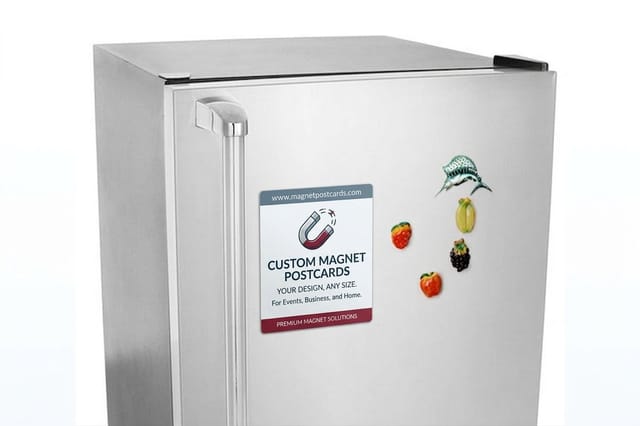
Stock is where the postage limit bites a second time. 14pt gloss cover, the standard stock on our standard postcards, measures about 0.014 inch, comfortably inside the 0.016 inch postcard-rate ceiling. Push into heavier boards and you leave that window: a 17pt indoor magnet card is thicker than the limit, so magnet postcards travel as letters or go inside an envelope. They are excellent for a business move, because a magnet with your new address on it lives on a fridge for years, but budget the postage as a letter from the start.
One trade-off nobody mentions until the cards arrive: a gloss or laminated surface beads ballpoint ink. If you plan to sign each card by hand, or want people to jot a note back, order uncoated or matte. If the cards are going out unsigned and you want the colour to snap, gloss laminated postcards hold up better in a mail tray. Our postcard paper and cardstock guide lays the point weights against each other.
Who Gets One, and How to Mail Them
Build the list from your own records, not from anywhere else. Everyone who sends you something physical: bank and card issuers, insurance, the state motor vehicle office, your employer's payroll or HR, doctors and dentists, schools, subscriptions, professional licence bodies, and the family and friends who still post cards. Count households rather than people, and add ten percent for the ones you will remember on moving day.
Marketing Mail is the reason this list matters. It is not forwarded, so a catalogue or a loyalty offer addressed to your old place is simply thrown away, and the sender never learns why you stopped ordering. Forwarding buys you twelve months on First-Class Mail and nothing on the rest.
Under about fifty cards, stamp them at the kitchen table. Past that, hand addressing turns into a lost evening and a handful of transcription errors. Direct mail postcards start at $89.68 with printing, addressing and the mail drop handled together, which is the sensible route for a business move with a customer list behind it. If you are assembling that list from scratch, our mailing list guide covers what a clean file looks like before it reaches the printer, and the full range of stocks and sizes is on the postcard printing page.
Wally explains the moving card
New address right, message left, bottom band empty
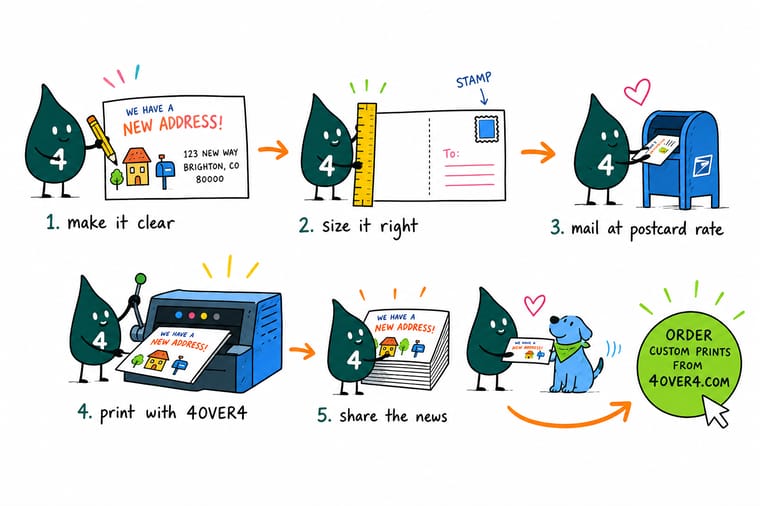
Wally draws a line down the back of the card. Everything on the right belongs to the post office: stamp in the corner, new address in the lower right in capitals with ZIP+4, and the bottom 5/8 inch left blank so the barcode has room. Everything on the left is his: we have moved, the date mail should switch over, and the old address in small type so the clerk can find the file. He keeps the card at 4 by 6 and under 0.016 inch thick, because one millimetre more and the postcard rate turns into letter postage.
Print change of address postcards →Specs and pricing
Postcard sizes, stocks and starting prices
Configure the card the way you will mail it, with live size, stock and quantity choices and starting prices straight from the 4OVER4.COM configurator.



Print it
Order the card that carries your new address


Explore more
Where to go next




By the numbers
Postcards printed and mailed by 4OVER4
Common Questions
Your change of address postcard questions, answered
Do I still need change of address postcards if I filed with USPS?
Yes, and they do two different jobs. The USPS filing forwards mail that is already addressed to your old place. It does not tell a single sender that you moved, and it does not last: First-Class Mail is forwarded for twelve months, periodicals for sixty days, and USPS Marketing Mail is not forwarded at all. The postcard is the part that gets your new address into a bank record, a client file, a family address book and a holiday card list, which is where it needs to be in month thirteen.
What size should a change of address postcard be?
Print at 4 by 6 inches if you want the postcard postage rate. USPS applies that rate to rectangular cards between 3.5 by 5 and 4.25 by 6 inches, with a thickness between 0.007 and 0.016 inch. A 5 by 7 or 6 by 9 card is perfectly mailable, it simply travels at the First-Class letter rate, so the choice is between the cheapest postage and a card people notice in the stack.
What do you write on a moving postcard?
Six things and nothing else: a short line saying you moved, your full new address with ZIP+4, the date mail should start going there, your old address in smaller type so the recipient can find your existing record, anything else that changed such as a phone number or email, and your name or business name. If the phone number did not change, say so directly. People assume everything moved and call the wrong number.
Should I put my old address on the card?
Put it on, in smaller type. A billing clerk or an office manager searches their system by the address they already have, and without it your card is one more piece of paper with a name they may have spelled differently. Keep it visually quiet so nobody copies the wrong one: old address small and grey on the left half, new address large and dark, with the effective date sitting next to it.
When should I mail change of address postcards?
Aim for the cards to land the week before you move. File the USPS change of address roughly two weeks ahead so forwarding is live on moving day, then mail the postcards so the two overlap. If a card arrives three weeks early it gets set aside and forgotten, and if it arrives after the move it lands in the same pile as forwarded mail with a yellow label, which is exactly the confusion you were trying to prevent.
Is it worth printing them for a business move?
For a business the card is usually the cheapest part of the move. Standard postcards start at $16.48 at 4OVER4.COM, and the cost of one customer driving to an address you no longer occupy is higher than the whole run. Add the details a household card leaves out: the first day you are open at the new place, whether the phone number and suite number carry over, the cross street, and where to park. If your list runs into the hundreds, direct mail postcards start at $89.68 with the mailing handled for you.
Get Started
Ready to tell everyone where you are?
Pick 4 by 6 for the postcard rate or 6 by 9 for a card people keep, upload your layout, and we print and ship it in time for the move.
Legal Disclaimer
Gold Standard guarantees apply to all standard orders placed through 4over4.com. Price match requires verifiable proof of a competitor's published price for an equivalent product with matching specifications and turnaround time. Satisfaction guarantee covers manufacturing defects and print quality issues. Contact support with order number and documentation. On-time delivery rate based on tracked orders 1999 to 2026. Individual results may vary based on shipping carrier performance.
