
7 Co-Branding Examples That Worked and What Made Them Work


Marcus is our print marketing voice, built from the knowledge of our production team, with over 20 years in printing.
Co-branding works when two brands share an audience but sell different things, and each side brings something the other could not have built alone. All seven co-branding examples below pass that test, from Betty Crocker and Hershey’s to Nike and Apple, and a local version starts with a two-logo flyer from $39.54. The ones nobody remembers usually failed it in the same way: one brand borrowed the other’s reputation and gave nothing back, so the second logo on the package was decoration rather than a reason to buy.
Seven co-branding partnerships at a glance
| Partnership | What each side brought | The co-branded object | Why it held |
|---|---|---|---|
| Betty Crocker and Hershey’s | A baking brand in the pantry, a chocolate brand people already trusted | Boxed brownie mix with Hershey’s syrup named on the front | The chocolate was the reason to pick that box off the shelf |
| Dr Pepper and Bonne Bell | A soft-drink flavour, a teen cosmetics line | Dr Pepper flavoured Lip Smacker balm | The flavour was the product, not a logo pasted onto one |
| GoPro and Red Bull | The camera that films the stunt, the events that create it | Shared footage, co-branded event coverage and sponsorship | Neither brand sells to the other, both sell to the same viewer |
| Eddie Bauer and Ford | Outdoor credibility, an SUV that needed it | Eddie Bauer trim editions of Ford SUVs | The badge told a buyer what kind of driver the truck was for |
| Kanye West and Adidas | Cultural attention, manufacturing and global retail | The Yeezy sneaker line, 2015 to 2022 | It held while the person and the product stayed aligned, and ended when they did not |
| Nike and Apple | Running shoes with a sensor pocket, the device runners already carried | Nike+ kit that fed pace and distance into an iPod | It solved a problem both audiences had at the same moment |
| Dawn and International Bird Rescue | A degreaser that removes oil, the people who wash oiled birds | Donated product plus on-pack cause marketing | The product genuinely does the job in the photograph |
Read the middle column first. If you cannot fill it in for your own partnership, there is nothing to announce yet. When you can, the campaign becomes a print job, usually a two-logo flyer, a sticker and a card: see print marketing examples that still win customers for the formats that carry an offer best.
What separates the co-brands that worked from the ones nobody remembers
Look at the seven partnerships in the table and one pattern runs through all of them: each side brought something the other could not have made on its own. Hershey’s could not put itself in a pantry next to the flour. Betty Crocker could not manufacture the reputation of that chocolate. The trade was real, and the customer could see it on the front of the box.
The partnerships people forget usually fail the same test in the same way. One brand had the audience, the other brand wanted it, and nothing was traded except a logo. A buyer reads that instantly. If the second mark on the package does not change what the product is or does, it is decoration, and decoration does not sell anything.
The second pattern is narrower and easier to check: the two brands shared an audience but sat on different shelves. Two coffee roasters in the same town co-branding a bag are not partners, they are splitting one customer. A roaster and a bakery share the same morning customer and sell different things, which is why that pairing works and the first one does not. Our guide to brand messaging is the place to settle what your own brand actually stands for before you attach someone else’s name to it.
The four gates a partnership passes before anything gets printed
One: each side brings something the other cannot build. Reach, a recipe, a manufacturing line, a mailing list, a reputation. Two: one partner owns delivery. Campaigns run by committee stall on the second decision, every time. Three: the lockup survives a business card, which means both marks stay legible at roughly one inch wide. Four: the end date and the artwork ownership are written down before the first print run.
Gate four is the one small businesses skip and then regret. Six months later somebody wants to keep using the co-branded design, or wants the shared customer list, and there is nothing on paper. Write two lines. It costs nothing and it saves the relationship.
Where co-branding is the wrong tool
If your brand is unclear on its own, a partner does not fix it. It doubles the confusion, because now a customer has two things to interpret instead of one. Co-branding also goes badly when the two audiences overlap only in your head. A test worth running: name three customers by name who buy from both of you already. If you cannot, the overlap is a hope, not a fact.
And it goes badly when one brand carries risk the other cannot absorb. The Adidas and Kanye West line is the clearest version of that. A partnership tied to one person inherits everything that person does, and the exit costs are paid by the brand with the factories.
The seven co-branding examples, and what each side actually traded
The table above is the summary. What follows is the part that is useful to copy: the specific trade each partnership made, and the thing about it you can reproduce at any size.
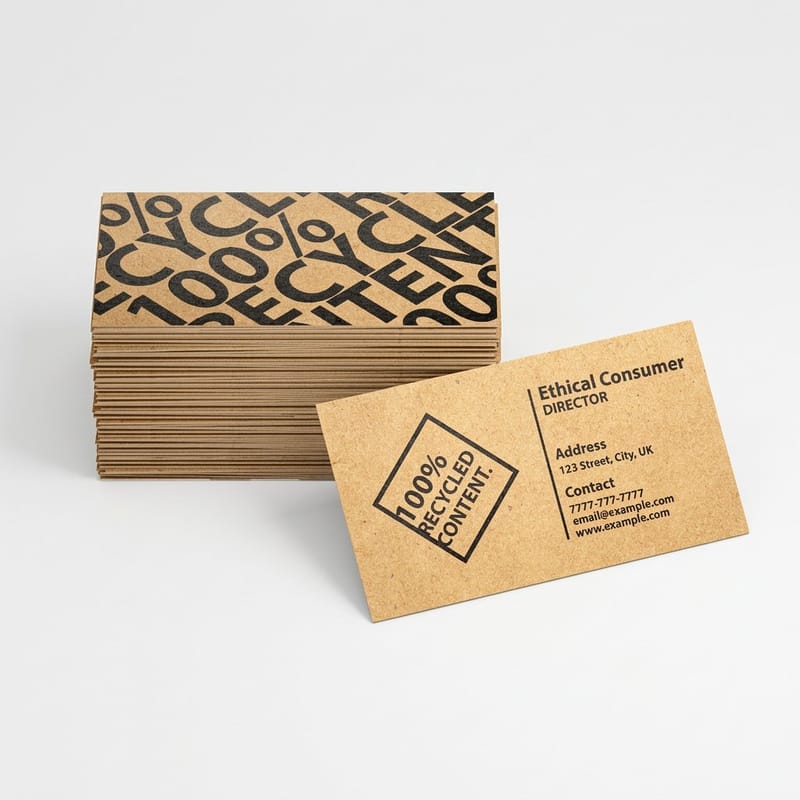
None of these needed a national budget to start. Two of them were, at the beginning, one product with two names on the front. That is a printing decision and an agreement, and both are within reach of a business that orders premium business cards at $17.57 and standard flyers at $39.54. Watch the short premium business cards video before you pick a stock.
One to four: the product carries both names
1. Betty Crocker and Hershey’s. A brownie mix that names Hershey’s syrup on the box. The trade is credibility for shelf space. Copy it by putting a partner’s named ingredient, product or service on the front of yours, not in the small print on the back.
2. Dr Pepper and Bonne Bell. Lip balm in a soft-drink flavour, from the mid-1970s, still remembered by the people who bought it at fourteen. The trade is flavour for a new category. The lesson is that the borrowed thing has to be the product itself, not a sticker on the tube.
3. GoPro and Red Bull. One brand makes the camera, the other makes the reason to point it at something. Neither sells to the other. They sell to the same person, at the same moment, and every piece of footage carries both. Copy it by co-producing something an audience wants to watch or attend rather than co-producing an advertisement.
4. Eddie Bauer and Ford. Trim editions of Ford SUVs badged with an outdoor clothing name. The trade is a story for a vehicle that needed one. It works because the badge told a buyer what kind of person the truck was built for, which is a job a specification sheet cannot do.
Five to seven: attention, utility and cause
5. Kanye West and Adidas. The Yeezy line ran from 2015 to 2022 and is worth studying for the ending as much as the beginning. A person-led co-brand grows fast because attention transfers instantly. It also ends fast, and the brand holding the inventory pays for it. If you tie your name to a person, agree the exit in the first contract.
6. Nike and Apple. The Nike+ kit put a sensor in a running shoe and sent pace and distance to the iPod the runner already carried. The trade is utility, not image. It is the hardest kind to build and the most durable, because it solves a problem neither brand could solve alone.
7. Dawn and International Bird Rescue. Dish soap used to clean oil off seabirds, with the maker donating product and putting the work on the pack. Cause partnerships fail when the product has nothing to do with the cause. This one holds because the soap is genuinely the thing doing the job in the photograph. Match the cause to what you actually make, the way the nonprofits in our nonprofit print roundup do.
Three more co-branding examples
Apple Card and Mastercard. Apple launched Apple Card in the United States on August 20, 2019, issued by Goldman Sachs and running on the Mastercard network. Apple brought the iPhone and the Wallet app, Mastercard brought acceptance at millions of counters, and each gained: Apple a payment product inside its own device, Mastercard a card its rivals did not carry. The small business lesson: put your service inside a tool your partner’s customers already use every day.
CoverGirl and Lucasfilm. In 2015 CoverGirl released a limited Star Wars collection, with looks designed by makeup artist Pat McGrath and split into Light Side and Dark Side, timed to the December release of The Force Awakens. The film gave the beauty brand a launch date the whole country knew, and the makeup line carried the film into drugstore aisles. The small business lesson: tie a product to a local event, a festival or a home game, and print the date on every piece.
Uber and Spotify. In November 2014 Uber let Spotify Premium riders play their own playlists through the car speakers when the driver opted in. Uber got a ride that felt personal, and Spotify got its app into the back seat of millions of trips. The small business lesson: put your partner inside your customer’s experience, such as a neighbor’s coupon handed out with every order.
Running a co-brand as a small business
A local co-brand is five decisions and one print order. Pick the partner whose customers already walk past your door. Agree what each side gives, in one sentence each. Name the person who runs it. Set a start and an end date. Then decide what gets printed, because until something carries both marks, nothing has actually happened.
Start with the offer, not the design. A co-branded piece that says both names and nothing else is a poster for a friendship. A co-branded piece that says "show this at either counter for a free pastry with any large coffee" is a campaign you can count. Track it by making the offer redeemable only on the printed piece, which is why flyers, postcards and stickers still beat a shared social post for this job.
The pieces that carry a two-brand offer well are the cheap, high-volume ones. Flyers at $39.54 for the counter and the noticeboard, postcards at $16.48 for a mailing or a bag stuffer, and premium stickers at $29.16 for the cup, the bag or the window. For a launch event, one retractable banner stand at $139 carries both logos at a size where the lockup finally has room to breathe. If you are handing flyers out rather than leaving them, the flyer distribution basics will save you a box of wasted print.
What to print for a two-brand campaign
Flyers. 5.5" x 8.5" or 8.5" x 11" on 100# Gloss Text, from $39.54, for the counter and the noticeboard at both shops.
Stickers. Premium stickers from $29.16, in sizes from 3" x 5" to 5" x 7" or any size, for bags and cups at both counters.
Cards. Premium business cards, 100 for $17.57, with both marks on the front and the joint offer on the back.
Upload one print-ready PDF per piece with both logos inside the safe area, and let one partner place the order so the file and the reorder stay in one account.
Splitting the cost without splitting the campaign
The simplest split is one that matches the benefit: whoever gets more foot traffic out of it pays more of the print bill. The second simplest is a straight fifty-fifty on one order, placed by one partner, which keeps the artwork and the reorder in one place. Two separate print orders of the same design is how you end up with two slightly different colors and one awkward conversation.
Order the run against the real distribution plan rather than the price break. A thousand flyers you will not hand out are more expensive than five hundred you will, and the artwork usually changes after the first month anyway.
Measuring whether it worked
Give each partner a different code, or print two versions with a different redemption mark, so you can see which side of the partnership is actually delivering. It is a small design change and it turns a vague sense that the campaign went well into a number you can act on when you decide whether to run it again.
The other measure is cheaper still: ask the staff on the counter. They know within a week whether people are arriving with the flyer in their hand, and they know which of the two offers people ask about first.
What the co-branded print run costs
Flyer pricing moves with size, stock, finish and quantity, from 4.25" x 5.5" to 11" x 25.5" on 100# Gloss Text up to 14pt Gloss Cover, and the per unit cost drops as the run grows. The numbers below come from the live configurator, so two partners can agree the split before either of them commits.
Quantity and price
Flyer pricing and specs
Real configurator numbers for the format most local co-brands start with, where a larger run drops the per unit cost.
| Quantity | Price Per Unit | Total |
|---|---|---|
| 50 | 79.1¢ | $39.54 |
| 100 | 57.1¢ | $57.11 |
| 200 | 37.3¢ | $74.69 |
| 300 | 28.6¢ | $85.68 |
| 400 | 24.4¢ | $97.76 |
| 500 | 21.8¢ | $108.75 |

You can also earn coins on every order and put them against the next run, which matters when two businesses are splitting a print bill.
Stock and finish for a two-logo piece
A co-branded piece has a harder job than a single-brand one: two marks, two color palettes and one offer all have to sit on the same sheet without fighting. Stock does more of that work than people expect. A heavier sheet, 100lb gloss cover rather than a text weight, gives a two-logo layout enough presence to survive being handed over a counter, and it stops the piece reading as a leaflet from one shop with a second name added.
Print it
Stickers that carry both marks
The cheapest way to put a partnership on a cup, a bag or a shop window.
Finish is the other half. Gloss lifts photography and brand color, which suits a food or drink partnership where the product has to look appetising. Matte reads calmer and keeps two competing palettes from shouting at each other, and it is easier to read under shop lighting. Uncoated stays writable, which is useful when a member of staff has to date or initial a redemption. Whatever you pick, print both partners on the same order and the same stock, because two separate orders of the same artwork come back as two slightly different reds. If the campaign carries the partner name into everyday brand pieces, the brand awareness ideas roundup covers the formats that keep it visible after launch week.
Co-branding pairings that work, by business type
The pairings below all pass the overlap test. Each one shares a customer and sells a different thing.
- Coffee shop and bakery. The same morning customer, two different counters. One flyer, one offer redeemable at both, printed once and split down the middle.
- Gym and physiotherapy clinic. Referral in both directions, on a card the front desk can hand over. The credibility transfer is the whole product.
- Brewery and food truck. The truck brings a menu the taproom cannot cook, the taproom brings the crowd. Co-branded stickers on the cans travel further than either brand alone.
- Salon and local boutique. Shared appointment-day offers on postcards, plus a window sticker at each shop so walk-ins see both names.
- Retailer and a local nonprofit. Works only when the product connects to the cause the way Dawn does. Otherwise it reads as borrowed goodwill and customers notice.
Blanks for a two-logo lockup
Two-logo layouts go wrong at the edges, where a mark ends up inside the trim. Start from a sized blank so both logos sit inside the safe area from the first draft, and test the lockup at one inch wide, the width it prints at on a 2" x 3.5" card. Grab a print-ready blank from the blank template library with bleed and trim already marked, or start from a free design template and drop both marks into it.
Start fast
Blanks for a two-logo lockup
Flyer design templates and exact-size blanks, so a two-logo lockup lands inside the cut line.


Wally checks a two-logo lockup before it prints
Same audience, different shelf, one owner, one end date
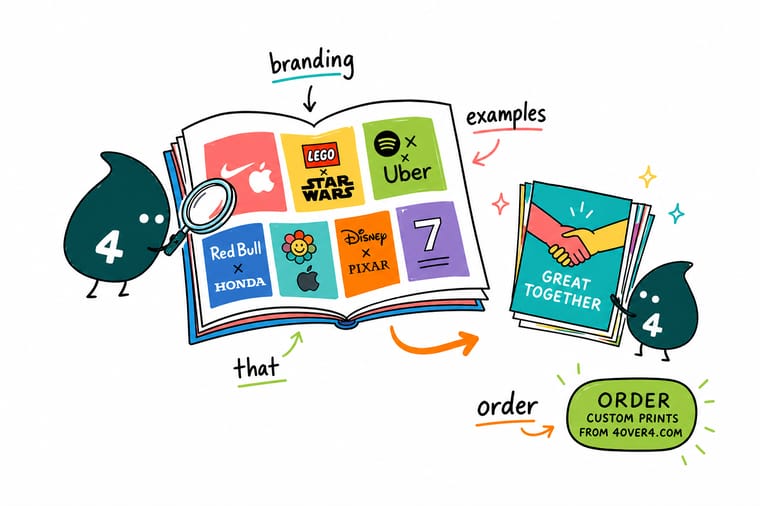
Scale both marks to the same cap height, not the same width, and print the lockup at one inch wide to see whether either turns to mud. Ask your partner for vector artwork instead of a website screenshot, agree the color pairing before the design starts, and place one order on one stock so both names come back the same red. 4OVER4.COM prints flyers, stickers and cards for co-branded campaigns with a free proof first.
Order co-branded flyers →What to remember about co-branding
Rules for a two-logo lockup
- Give the lockup one owner. One designer builds the two-logo lockup and both partners sign it off once. Two people editing the same lockup produces two versions in circulation within a month.
- Match cap height, not width. Scale both marks so the letterforms look the same size to the eye. Matching bounding-box widths makes the wider logo look dominant and starts an argument nobody needs.
- Test it at one inch. Print the lockup at business-card scale before you approve anything. If a mark turns to mud at an inch wide, it needs a simplified version for small formats.
- Agree the color pair before the artwork. Two brand palettes rarely sit together without a decision. Pick the pairing first, using color combinations that hold up in print, then design into it.
- Use the partner’s real logo file. Ask for vector artwork, not a logo pulled off their website. A screenshot logo enlarges into soft edges, and it will be your print run that looks cheap.
Explore more
Print the partnership, not just the poster
Flyers run 50 for $39.54 and postcards 50 for $16.48, the two sheets a joint offer travels on.
Product Standard Flyers The counter and noticeboard piece for a shared offer. Product Premium Stickers Two marks on a cup, a bag or a window. 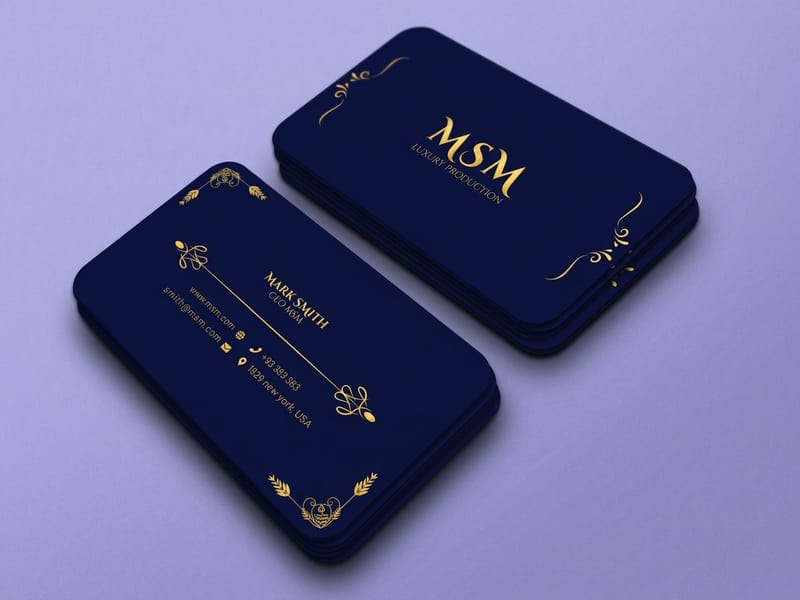 Product Premium Business Cards Where a two-logo lockup gets its hardest test.
  Product Standard Postcards Mailers and bag stuffers that carry a redeemable offer.
 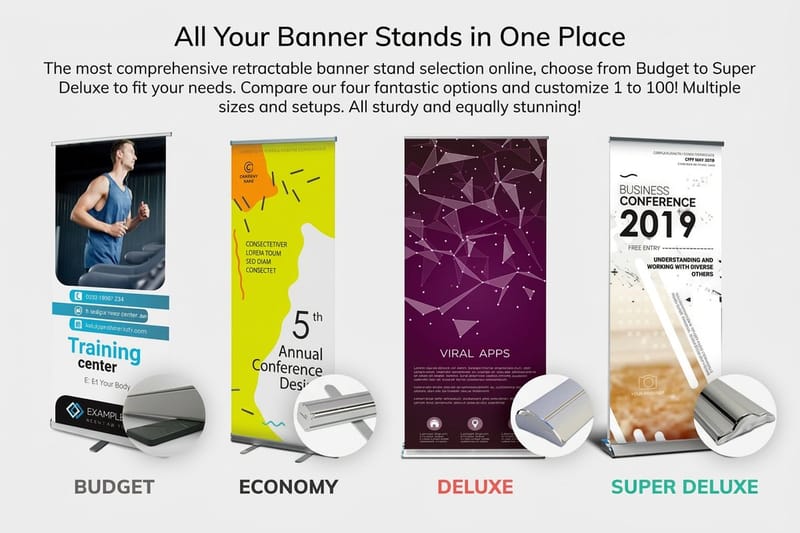 Product Retractable Banner Stands Both logos at launch-event size. Category Flyer Printing Every size, stock and fold in one place.
 Ready to print the partnership?
Pick the format, drop in the two-logo lockup or start from a free template, and 4OVER4.COM prints it sharp on premium stock, as fast as your launch date needs.
Common questions about co-branding
What is co-branding, and how is it different from a sponsorship?
Co-branding is two brands putting their names on one product, offer or campaign, with both sides contributing something to it. A sponsorship is money in one direction for exposure in the other. The difference shows up in the object itself: in a co-brand the second name changes what the thing is, the way Hershey’s syrup changes a brownie mix or a sensor changes a running shoe. In a sponsorship the second name sits beside the thing without altering it. Both are useful. They are not interchangeable, and mislabelling one as the other is how partners end up with mismatched expectations.
Whose logo goes first in a co-branded lockup?
Whoever owns the product or the venue usually goes first, with the partner second, because the reader needs to know what they are looking at before they know who helped make it. If the two sides are genuinely equal, decide by reading order and stick to it everywhere rather than alternating by piece. Scale both marks to the same cap height rather than the same width, keep clear space around each one, and print the lockup at one inch wide before approving it. Our guide to business cards carrying multiple businesses or logos covers the small-format version of this problem in detail.
What should a small-business co-branding agreement cover?
Five things, and it can fit on one page. What each side provides. Who runs the campaign day to day. The start date and the end date. Who pays for what, including the print bill. What happens to the shared artwork and any customer list when it ends. The agreements that go wrong locally are almost never about money; they are about a design one side keeps using after the partnership has quietly stopped. Two sentences on artwork ownership prevents that.
How much print does a local co-branding campaign actually need?
Less than most people order. For a two-shop offer, a run of flyers for each counter, a set of stickers for cups, bags or windows, and a small batch of postcards for a mailing or bag stuffer covers it. Standard flyers start at $39.54 and premium stickers at $29.16, so both counters can be stocked for well under the cost of a month of paid social. Order to the number you will genuinely distribute in the first four weeks, then reorder once you know which of the two offers people are asking about.
Why do most co-branding partnerships fail?
Three reasons, in order of frequency. The audiences never really overlapped, so neither side gained a customer. Nobody owned the campaign, so it never launched past a shared document. Or the trade was uneven, with one brand borrowing the other’s reputation without adding anything, which the stronger brand notices within one cycle. A fourth applies when a partnership is built on one person: it inherits everything that person does. Run the overlap test before anything else. Name three customers who already buy from both of you. If you cannot, the partnership has no foundation to print on.
