
How 100lb Text and 10pt Stock Differ in Paper Weight and Thickness


Emma is our prepress and print production voice, built from the knowledge of our production team, with over 20 years in printing.
Two measuring systems, one sheet of paper. Each number counts something different, the bigger one is often the thinner stock, and each weight has a job on cards, flyers and booklets.
Pounds and points measure two different things, so 100lb text and 10pt stock are not on the same ladder. A pound figure is the weight of 500 uncut parent sheets, which only compares within one paper family. A point figure is caliper: 10pt means exactly 0.010 inch on a micrometer. Coated 100lb text lands near 0.007 inch, so the 10pt sheet is the thicker one despite the smaller number.
Quick answer
One number weighs a ream, the other measures a sheet
Basis weight in pounds describes 500 uncut parent sheets; caliper in points describes one sheet under a micrometer. Because text stocks are weighed at 25 by 38 inches and cover stocks at 20 by 26 inches, a pound figure means nothing until you know the family it came from. A point figure needs no context at all. That is why 100lb text sits near 0.007 inch while 10pt sits at 0.010 inch, and why our card products are sold in points and our flyer and booklet stocks in pounds.
Why One Sheet Ends Up With Two Different Numbers
Paper picked up two measuring systems for the same reason inches and centimeters both survived: two industries solved the same problem separately and neither gave way. Mills sold paper by the ream, so they quoted what a ream weighed. Card converters cared about stiffness, so they quoted what a micrometer read.
Both numbers are honest. Neither one converts to the other without a third piece of information, and that missing piece is what trips people up at the ordering stage. A customer reads 100lb next to 10pt, assumes 100 beats 10, and orders a text stock for a job that needed a card stock.
The practical fix is small. Whenever you see a pound figure, ask which family it belongs to before you compare it with anything. Whenever you see a point figure, you already have everything you need. Our breakdown of cardstock against paper stock covers the material side of the same split.
What a Pound of Paper Actually Weighs
Basis weight is the weight in pounds of 500 sheets of that paper at its parent size, before it is cut down to anything you would recognize. The catch is that every family has its own parent size, fixed decades ago and never harmonized.
| Family | Parent size | What 100lb means there | Typical use |
|---|---|---|---|
| Text / book | 25 x 38 in | About 148 gsm, near 0.007 in | Flyer and brochure bodies, booklet interiors |
| Cover | 20 x 26 in | About 270 gsm, near 0.010 in | Booklet covers, sturdy flyers, folders |
| Bond / writing | 17 x 22 in | Rarely sold this heavy | Letterheads, forms, office paper |
| Index | 25.5 x 30.5 in | About 180 gsm | Tabs, dividers, filing card work |
Look at the first two rows together and the whole confusion resolves. A cover parent sheet is far smaller than a text parent sheet, so if 500 of each weigh the same 100 pounds, the cover sheet has to be much heavier per square inch. That is not a rounding difference. It is close to double.
This is not a theoretical trap either. Order standard flyers from us and the stock list includes 100# Silk/Matte Text and 100# Silk/Matte Cover, one under the other. Same number, same coating, and one of them folds while the other one wants to crack. If you want the individual stocks pulled apart, we have separate guides on 80lb gloss book paper and 100lb matte cover.
What a Point Actually Measures
A point is one thousandth of an inch of caliper. Nothing more. Put a single sheet in a micrometer, read 0.014 inch, and you have 14pt cover. There is no parent size, no ream, and no family to look up.
That simplicity is why every card product on the site is quoted in points. Our standard business cards list 73 stocks running from 14pt Gloss Cover through 15pt metallic pearl, 16pt uncoated soft touch, 17pt diamond glitter and 18pt premium white linen, up to 24pt and beyond. You can rank all of them by feel using one column of numbers.
The limit of caliper is that it says nothing about density or fiber. Two 14pt sheets can hold ink very differently: an uncoated 14pt with 30 percent post-consumer content absorbs and softens edges, while a 14pt gloss cover sits the ink on the surface and keeps it sharp. Thickness tells you how the piece will feel and stand up. It does not tell you how it will print. The 14pt gloss cardstock guide covers the coated side on its own. For that pairing, the point-by-point cardstock guide goes stock by stock.
100lb Text and 10pt Stock, Measured Against Each Other
Here they are on the same ruler, which is the only fair way to compare them.
| Property | 100lb text | 10pt stock |
|---|---|---|
| What the number means | 500 parent sheets weigh 100 lb | One sheet measures 0.010 in |
| Typical caliper | About 0.007 in coated | 0.010 in by definition |
| Approximate gsm | About 148 | About 250 |
| Folds without scoring | Yes, cleanly | Not reliably, score it first |
| Stands up on a counter | No, it flops | Yes |
| Cost per piece | Lower | Higher |
| Natural home | Flyers, brochures, booklet pages | Cards, mailers, light covers |
The trade-off is stiffness against cost and foldability, and it runs in one direction. Going up in caliper buys you a piece that survives a pocket, a mailbox and a week on a desk. It also raises the unit price and forces a score line anywhere you want a fold, because a 10pt sheet folded cold will crack along the spine of the fold.
Going down in caliper buys you volume and easy folding. It costs you presence. A 100lb text handbill handed out at a trade show is fine. The same weight used as a leave-behind at a client meeting reads as disposable, and people treat it that way. Our standard flyers deliberately carry both ends of that range, from 70# Uncoated Text up to 14pt cardstock, on one product. If you want the material distinction spelled out, cover stock against cardstock is the companion read.
Here is where each weight shows up on our order forms, so you can go from the comparison straight to a product.
| Stock | Where we print it | First run | Production |
|---|---|---|---|
| 100 lb gloss or silk text | Flyers in nine sizes from 4.25 x 5.5 to 11 x 25.5 in | 50 for $39.54 | 3 business days |
| 100 lb gloss text | Booklet inside pages, 8 to 60 pages | 25 for $240.55 | 7 business days |
| 10pt StarLustre Platinum cover | Postcards, one of 22 postcard stocks | From 50 postcards | 3 business days |
| 14pt gloss cover | The postcard default, and standard business cards | 50 postcards for $16.48, 100 cards for $17.57 | 3 business days |
Whichever you pick, upload a PDF at the finished size with bleed. The stock is chosen on the order form, never in the file.
Which Weight to Pick for Cards, Flyers and Booklets
Three product families cover most of the decisions, and each one has a default worth knowing before you open the configurator.
Business cards and postcards. Start at 14pt and only move for a reason. 16pt is the right call when the card carries a soft touch or matte laminate, because lamination adds surface but not stiffness, and a laminated 14pt can feel slightly limp. Standard postcards default to 14pt Gloss Cover at $16.48, which also survives the USPS automation equipment without curling. The soft touch postcards video overview shows that laminate on a finished card.
Flyers and brochures. Text weight is the default and it is the right default. 100# Gloss Text carries anything photo-heavy, 100# Silk/Matte Text reads better under office lighting because it kills glare, and 70# Uncoated Text is the one to pick when people will write on it. Move up to 80# Gloss Cover or 14pt only for a leave-behind that has to hold its shape. Standard brochures start at $57.11 on 100# Gloss Text for exactly this reason. We go deeper on the weight choice in the flyer paper weight guide, and the whole range sits under flyer printing.
Booklets. Here you pick twice, and the two picks pull in opposite directions. Interiors want text weight so the book lies flat and does not balloon at the spine, which is why standard booklets start on 100# Gloss Text at $240.55. Covers want cover weight so the front does not curl, and the options are 80# Gloss Cover, 14pt Gloss Cover or 14pt Uncoated Cover. Putting a heavy cover stock on the interior pages of a saddle stitched book is a common and expensive mistake: the page count pushes the spine open and the staples fight you.
Weight and Thickness Chart for the Stocks We Print
Every row below is a stock you can actually select in our configurator, sorted from thinnest to thickest so you can read it as one continuous scale.
| Stock | Family | Typical caliper | Approx. gsm | Where it fits |
|---|---|---|---|---|
| 70# Uncoated Text | Text | About 0.005 in | 104 | Handbills, forms, anything written on |
| 100# Gloss Text | Text | About 0.007 in | 148 | Flyers, brochures, booklet interiors |
| 100# Silk/Matte Text | Text | About 0.007 in | 148 | Low glare reading, text-heavy pieces |
| 80# Gloss Cover | Cover | About 0.009 in | 216 | Booklet covers, sturdier flyers |
| 10pt equivalent | Cover | 0.010 in | About 250 | The caliper other printers quote |
| 100# Silk/Matte Cover | Cover | About 0.010 in | 270 | Our closest match to a 10pt |
| 14pt Gloss Cover | Cover | 0.014 in | About 350 | Business cards, postcards, mailers |
| 16pt Uncoated Soft Touch | Cover | 0.016 in | About 400 | Premium cards that get handled a lot |
| 18pt Premium White Linen | Cover | 0.018 in | About 450 | Textured statement cards |
Two honest notes about this chart. Caliper varies a little between mills and between coated and uncoated versions of the same weight, so treat the text-weight figures as typical rather than exact. And the 10pt row is there as a reference point, not a product: we do not stock a sheet labeled 10pt, so if a quote elsewhere specifies one, the two rows on either side of it are what you are really choosing between.
Reading a chart only takes you so far, which is the reason we ship stock samples. Order free paper samples and the difference between 0.007 and 0.014 inch stops being an abstraction in about two seconds. For card stocks specifically, the business card thickness chart maps each point value to the kind of business it suits, and the full range lives under business card printing. At the far end of business card thickness, ultra thick velvet laminated cards show what the top of the chart feels like.
Wally explains pounds and points
One number for the stack, one number for the sheet
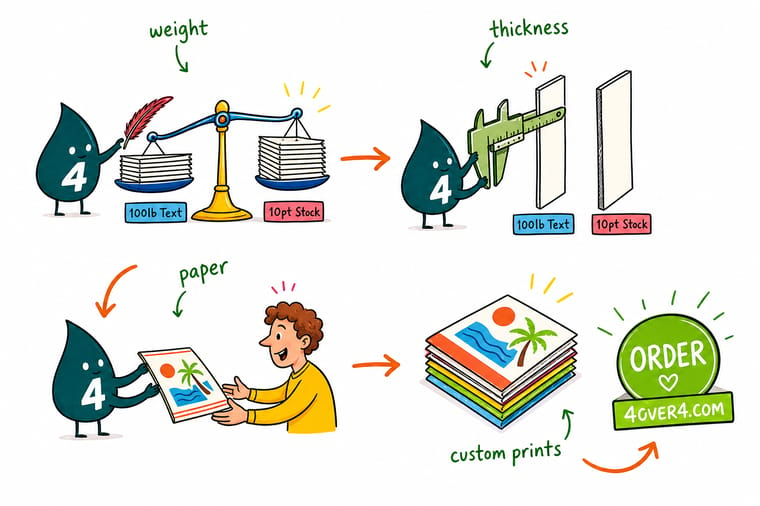
Wally puts 500 uncut sheets on a scale and reads 100 pounds, which is all a pound figure ever means. Then he closes a micrometer on one sheet and reads ten thousandths of an inch, which is what 10pt means. The scale answer changes if the parent sheet changes size, so 100lb text and 100lb cover are different animals. The micrometer answer never changes. When the two numbers argue, trust the micrometer.
Compare our card stocks →
Specs and pricing
Stocks, sizes, and starting prices
Open any product below to see the live stock list, with every text weight and point value priced straight from the 4OVER4.COM configurator. Business cards run from 14pt gloss to 32pt and heavier covers, flyers from 70 lb uncoated text to 14pt gloss cover on seven stocks, and postcards on 22 stocks from 10pt StarLustre Platinum to 24pt ultra thick gloss.


Print it
Order on the weight you actually need
A hundred 14pt business cards from $17.57, 50 flyers on 100 lb gloss text from $39.54, or 25 booklets from $240.55 when the pages need binding.

Explore more
Where to go next
Feel what 12pt to 18pt cardstock is like, read the full weight and caliper chart, match a card thickness to a business, and pick the flyer weight that suits the handout.

By the numbers
Sixty plus stocks, and every weight in this comparison
Common Questions
Your paper weight questions, answered
Is 100lb text thicker than 10pt stock?
No. Coated 100lb text measures roughly 0.007 inch, and 10pt means exactly 0.010 inch, so the 10pt sheet is around 40 percent thicker even though its number is ten times smaller. The two figures are not on the same scale. The pound number weighs 500 uncut parent sheets, the point number measures the caliper of one sheet, and nothing about the first tells you the second unless you also know the paper family.
Is 100lb cover the same as 100lb text?
No, and this is the single most expensive mix-up in paper ordering. Text and book stocks are weighed at a parent size of 25 by 38 inches, cover stocks at 20 by 26 inches. A cover sheet is therefore much smaller for the same 500-sheet weight, which means it has to be far heavier per square inch. In practice 100lb text runs about 148 gsm and 100lb cover about 270 gsm. Our standard flyers list both 100# Silk/Matte Text and 100# Silk/Matte Cover, and they feel nothing alike in the hand.
What does 10pt mean in paper?
One point is one thousandth of an inch of thickness, so 10pt stock is 0.010 inch thick, measured with a micrometer on a single sheet. It is a caliper measurement, not a weight, which is why it works across mills and coatings without a conversion. The same logic gives you 14pt at 0.014 inch and 16pt at 0.016 inch, and it is why business cards and postcards are quoted in points rather than pounds.
Does 4OVER4 print on 10pt stock?
We do not list a stock called 10pt, and it is worth saying plainly rather than steering you around it. Our lightest cover options sit either side of that thickness: 80# Gloss Cover is a little under ten thousandths, and 100# Silk/Matte Cover lands right about there. Above them, 14pt Gloss Cover is the default on business cards and postcards. If a supplier quoted you 10pt, ask for the caliper in inches and match it against those instead of matching the label.
What paper weight should a business card be?
14pt is the working standard and it is where our standard business cards start, at $17.57 per 100. Move to 16pt when the card is handled repeatedly or carries a soft touch laminate, since the extra two thousandths of an inch is what stops a laminated card feeling floppy. Above that, 18pt linen and 24pt ultra-thick cover are statement stocks rather than everyday ones. Anything under 12pt tends to read as a coupon, not a card.
How do I convert pounds to gsm?
There is no single multiplier, because the conversion depends on the parent size of the family. The useful anchors are 70lb uncoated text at about 104 gsm, 100lb gloss text at about 148 gsm, 80lb gloss cover at about 216 gsm, 100lb cover at about 270 gsm, and 14pt cover at about 350 gsm. If someone gives you a pound figure without saying text or cover, the number is not usable yet. Ask which family it belongs to first.
Get Started
Not sure which weight to commit to?
Hold the stocks before you buy them. Order a free sample pack, feel the gap between 0.007 and 0.014 inch, then configure the job on the weight you picked.
Legal Disclaimer
Gold Standard guarantees apply to all standard orders placed through 4over4.com. Price match requires verifiable proof of a competitor's published price for an equivalent product with matching specifications and turnaround time. Satisfaction guarantee covers manufacturing defects and print quality issues. Contact support with order number and documentation.
