
The Advertising Funnel Blueprint That Turns Reach Into Repeat Customers


Four stages, the single job each ad has to do, a budget split you can start from, and the way to find the stage that is losing your customers.
An advertising funnel splits the path from stranger to customer into four stages so each ad carries one job instead of four. Awareness buys reach against the right audience, interest earns a second look, decision answers the objection holding someone back, and action asks for the order with one offer and one deadline. Fund the stages nearest the order first, then move budget to whichever stage loses the highest share of people.

Quick answer
One job per ad, and money spent from the bottom up
The funnel is a device for giving each ad a single job. Awareness only has to be seen by the right kind of person. Interest has to earn a second look. Decision has to answer the objection out loud. Action has to ask, once, with a deadline. Every stage loses people, so the person still moving costs more to reach at each step down, which is the argument for funding the bottom of the funnel first and buying reach with what is left.
The Four Stages and the One Job Each Ad Has

Every stage of a funnel exists for one reason: it lets a single ad have a single job. That is the whole mechanism. Once an ad has one job you can write it properly, and you can tell whether it worked.
Awareness. The ad has to be seen by someone who could plausibly buy. It does not have to explain, persuade or sell. Judge it on how many of the right people saw it and how cheaply, not on orders. Awareness measured on orders always looks like failure, which is how good reach campaigns get killed in week two.
Interest. Now the ad has to earn a second look. It answers one question: is this for someone like me. The strongest interest creative names the customer rather than the product. A sign that says roof repairs beats a sign that says quality service, because the first one sorts the audience for you.
Decision. Here the ad stops introducing and starts answering. Price, turnaround, guarantee, the thing your competitor is beating you on. Decision stage creative is uncomfortable to write because it means naming the objection out loud, and that is precisely why it works.
Action. One offer, one deadline, one way to respond. Two offers in one ad is a request that the reader make a decision you should have made for them. If a piece carries a code or a date, print it once, large, and do not bury it under a paragraph.
Underneath all four sits a fifth thing that is not a stage: the buyers who come back and the ones who refer you. They re-enter at the top for free, which is why a business with a real retention habit can afford thinner advertising than a competitor who is renting every customer. The wider view of this sits in our guide to what funnels are in marketing.
How to Split the Budget, and When to Move It
The common instinct is to spend on reach first and worry about conversion later. It is backwards. Money at the bottom of the funnel collects demand that already exists, and money at the top creates demand you will then pay a second time to convert. If your budget is small enough that you have to choose, choose the bottom.
A business with no data yet can start from a fixed split, and each stage carries its own mistake.
| Stage | Share of a first budget | What that money buys | The usual mistake |
|---|---|---|---|
| Awareness | Around 15 percent | Reach against a defined audience, plus anything permanent such as signage. | Judging it on orders, then cutting it before it has done its job. |
| Interest | Around 30 percent | Creative that sorts the audience, and a second touch on people who reacted. | Talking about the business instead of naming the customer. |
| Decision | Around 35 percent | Comparison content, proof, and reaching people who looked but did not buy. | Avoiding the objection because it feels negative. |
| Action | Around 20 percent | A dated offer to people who are already close, on a list you own. | Running an open ended offer, so nothing forces a date. |
Treat those numbers as an opening position, not a rule. After a few weeks the split should be decided by the drop rates, and the largest drop gets the next dollar. Read the drops as ratios rather than totals: a thousand people who saw the ad and forty who came back is a top of funnel problem, while a thousand who came back and four who ordered is a decision problem no extra reach will fix.
One warning about the arithmetic. If your sales cycle runs weeks, a stage looks broken long before it is, because the people in it have not finished deciding. Match the reporting window to how long your customers actually take. Our guide to content marketing analytics and ROI covers the measurement side in more depth, and the whole funnel should sit inside a written plan, which is what our small business marketing plan guide walks through.
The Assets Each Stage Actually Needs

Stages fail more often for want of the right asset than for want of budget. An ad can only do the job of its stage if the thing it points at also does that job.
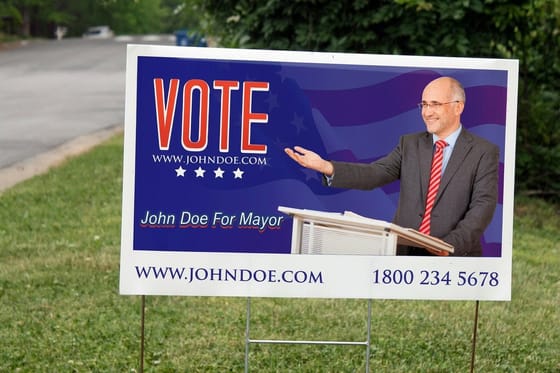
Awareness assets are permanent and cheap per day. A digital impression lasts a second. A sign outside the premises works every day for months, which is why it belongs in the awareness line of the budget rather than in overheads. Yard signs start at $25 and suit anything with a physical location or a job site, and a run of standard flyers from $39.54 covers a defined neighborhood at a cost per household that reach advertising rarely beats locally. Distribution decides whether that works at all, and our flyer distribution guide is blunt about which methods waste the run.
Interest assets sort people. Whatever the ad points at has to make the wrong reader leave quickly and the right one stay. That is a headline job more than a design job. Keep one idea per piece.
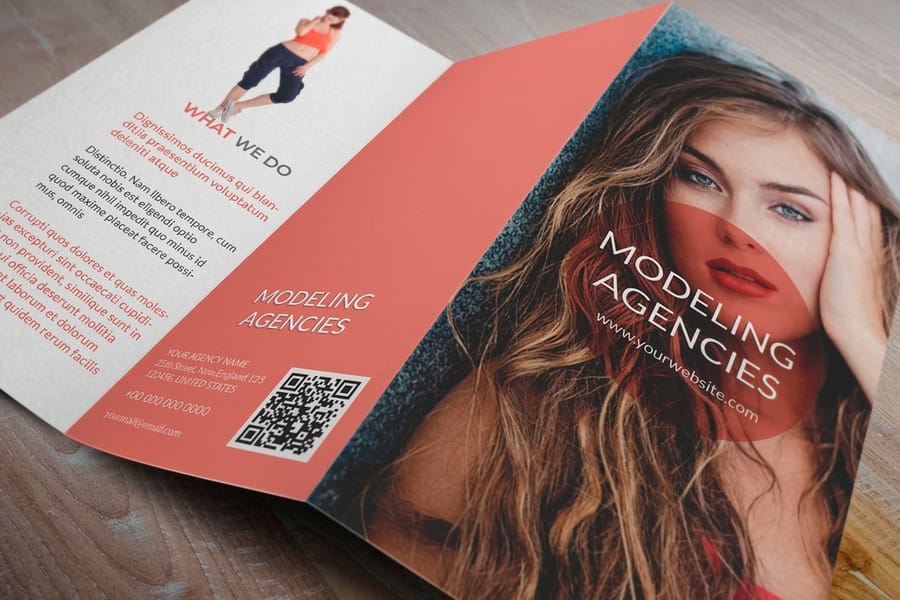
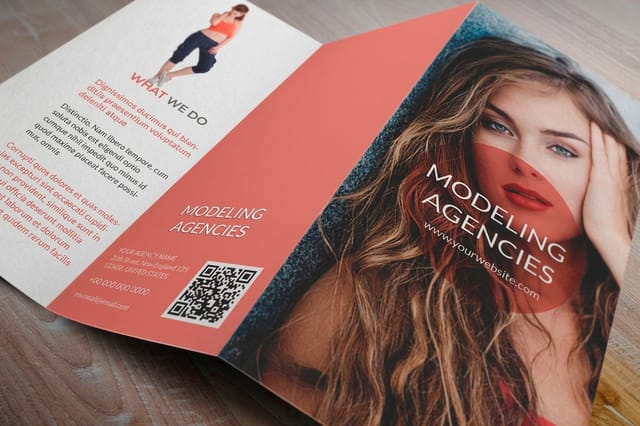
Decision assets answer questions. This is where a standard brochure from $57.11 still beats a web page in a room: it stays open on the table, the customer keeps it, and it holds the answers your salespeople repeat every single day. If you are unsure whether the piece should be a brochure, a booklet or a single sheet, our comparison of booklet against brochure against flyer makes the call on page count and use.
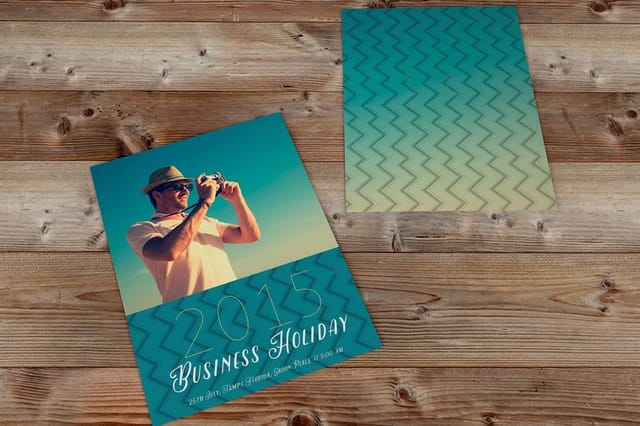
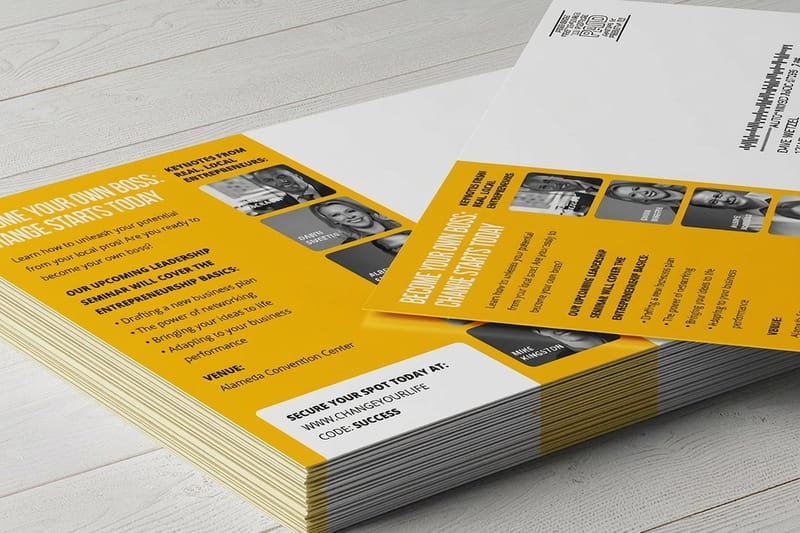
Action assets carry a date. Standard postcards start at $16.48 and remain the cleanest bottom of funnel piece there is, because a postcard needs no envelope opened, carries one offer, and lands on a list of people who already know you. The mechanics of sending one are in our guide to sending direct mail postcards, and the direct mail services collection prints, addresses and mails the run in a single order.
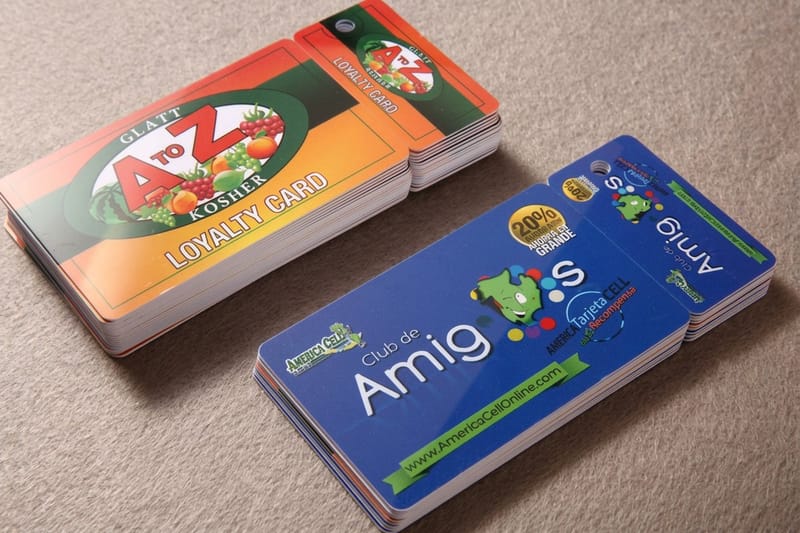
Retention assets keep the loop closed. Standard business cards from $17.57 are the least glamorous item on this list and the one most likely to produce a referral, because someone has to be able to pass your name on. A punch card or member card does the same work for repeat visits, and our guide on designing a loyalty card covers what makes one get used rather than binned.
Measuring a Funnel Without Fooling Yourself
Most funnel reporting flatters the last thing the customer touched. The final click gets credited with a sale that four earlier touches produced, so the branded search ad looks brilliant and the awareness campaign that created the search looks like waste.
Three habits fix most of it. First, report by stage, not by channel. The question is where people stop, and channels cut across stages. Second, keep at least one measurement that does not depend on tracking at all: a code on a postcard, a dedicated phone number on a sign, a question at the counter. Those give a hard floor under the numbers when the tracked figures move for reasons nobody can explain. Third, hold something back. Leave one area or one segment without the campaign for a few weeks and compare. It is the only method here that tells you what the advertising caused rather than what it accompanied.
Watch for the two false alarms. A stage looks dead when the reporting window is shorter than the buying decision, and a stage looks brilliant when it is harvesting demand another stage created. If your bottom of funnel results improve the week after an awareness push starts, the awareness push is doing its job, not the retargeting.
Email carries a lot of this because it costs almost nothing per contact once the list exists, which makes it the natural partner to a paid funnel. Our email nurture strategy guide covers the sequence that keeps people warm between the interest and decision stages.
The Build Checklist, Start to First Review

Work through this in order. Each step depends on the one above it, and skipping the first two is the reason most funnels end up as a pile of unrelated ads.
- Write down what one customer is worth. Average order, times how many times a typical customer buys. Every budget decision below is meaningless without this number, and it is the one most businesses have never actually calculated.
- Name the audience narrowly enough to exclude someone. If your description excludes nobody, it will sort nobody at the interest stage.
- Write the single objection. The real reason people do not buy, in the words a customer would use. Price, trust, timing, or a competitor. This sentence becomes your decision stage creative.
- Choose one channel per stage. Not three. One channel you can afford to run long enough to read a result.
- Build the action piece first. The offer, the deadline, the response method. Building the bottom first stops you from driving traffic into nothing.
- Set the reporting window to your buying cycle. Decide this before launch, so a slow start does not panic you into cancelling a stage that was working.
- Put one untracked measurement in place. A code, a number, a question at the till.
- Book the review date. Two full buying cycles out. At that review you move budget toward the leak, and you change nothing else, so you can still read what happened.
More strategy guides in the same series sit in our marketing strategy guides section, and the printed pieces named above are collected in the business basics collection.
Wally explains the advertising funnel
Four stages, four different jobs, one budget
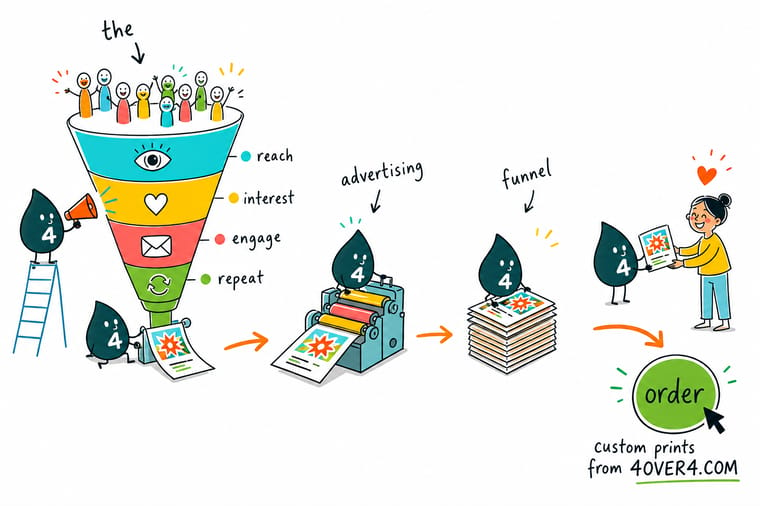
Wally puts a crowd in the top of the funnel and something falls out at every level. At awareness he only wants to be seen by people who could buy. At interest he says who it is for so the wrong people walk away early. At decision he names the thing holding people back and answers it. At action he gives one offer with one date on it. The people who reach the bottom and come back bring a friend, and those two start again at the top for free.
Print your action stage postcards →Specs and pricing
The pieces that carry the middle and bottom stages
Sizes, stocks and starting prices for the three printed pieces most funnels rely on, straight from the 4OVER4.COM configurator.



Print it
Order the pieces your funnel is missing

Explore more
Where to go next


By the numbers
The print partner behind the campaign
Common Questions
Your advertising funnel questions, answered
What is an advertising funnel?
An advertising funnel is the path a person takes from never having heard of you to buying, cut into stages so each ad has a single job. Most versions use four: awareness, where the ad only has to be seen by the right kind of person; interest, where it has to earn a second look; decision, where it has to answer the objection that is holding someone back; and action, where it asks for the order with one offer and one deadline. The word funnel describes the shape, because every stage loses people. It is not a promise that everyone moves down.
How many stages should my funnel have?
Four is enough for almost every small and mid sized business, and adding stages usually adds reporting rather than sales. The test is simple: a stage earns its place only if you would run a different ad for it. If your awareness ad and your interest ad would say the same thing to the same list, you have one stage, not two. Larger advertisers split the middle further because they can afford separate creative for each split. If you cannot fund separate creative, do not create the stage.
How should I split an advertising budget across the funnel?
When you are starting with no data, put the largest share on the stages closest to the order and the smallest on reach, because bottom of funnel spend collects demand that already exists while top of funnel spend creates demand you then have to pay again to convert. A workable starting point is roughly half on decision and action, a third on interest, and the remainder on awareness. Then move the money. Whichever stage loses the highest share of people is the stage that gets the next dollar, and that will rarely be the stage you assumed.
What is the difference between a marketing funnel and an advertising funnel?
The marketing funnel covers everything that moves a buyer, including your site, your pricing, your reviews, word of mouth and the way you answer the phone. The advertising funnel is the part you buy. That distinction matters when a stage leaks: if people click the ad and abandon the checkout, no amount of extra ad money fixes it, because the break is outside the part you are paying for. Our guide to what funnels are in marketing sets out the wider version.
How long should I keep paying to reach the same person?
Until the cost of reaching them again passes what a sale is worth to you, and no longer. Two practical limits: cap the number of times one person sees the same ad, because the fifth showing rarely does what the second did, and set a window matched to how long your buying decision actually takes. A roofing job and a coffee shop have very different windows. If you sell something people buy once every few years, a long window is fair. If they decide in a day, a long window is just paying to reach people who already chose someone else.
Do printed pieces still fit an advertising funnel?
They fit the middle and the bottom better than the top. A printed piece is expensive per person compared with an impression online, so it makes little sense as pure reach, but it is very hard to ignore once it is in a hand, which is exactly what the decision and action stages need. Standard postcards start at $16.48 and carry a dated offer to a list you already have. Standard brochures start at $57.11 and answer the questions a sales conversation keeps repeating. Both do a job a scrolling impression cannot.
Get Started
Postcards run 50 for $16.48 in three business days
Pick the piece that carries your offer, choose the stock and quantity, and we print and ship it fast enough to hit the date on the ad.
Legal Disclaimer
Gold Standard guarantees apply to all standard orders placed through 4over4.com. Price match requires verifiable proof of a competitor's published price for an equivalent product with matching specifications and turnaround time. Satisfaction guarantee covers manufacturing defects and print quality issues. Contact support with order number and documentation. On-time delivery rate based on tracked orders 1999 to 2026. Individual results may vary based on shipping carrier performance.
