
How to Create a Small Business Marketing Plan


Marcus is our print marketing voice, built from the knowledge of our production team, with over 20 years in printing.
Name one clear goal, research your customers, build the strategy around the Four Ps, give the budget a real number, then put the print that reaches people on a calendar. Six parts, and the budget is the one that decides whether the rest survives March. The print side comes down to a few pieces you size and stock yourself: door hangers at 4.25 x 11 inches for a route, postcards for repeat addresses, menus on 100 lb gloss or 70 lb uncoated text, and numbered gift certificates at 3 x 7 inches.
To create a small business marketing plan, write a one-page executive summary, run quick market research on your customers and competitors, set two or three measurable objectives, build the strategy around the Four Ps (product, price, place, promotion), give it a budget of roughly five to ten percent of revenue, and schedule the print and channels that reach your buyers. Then measure every tactic and sharpen the plan each quarter.
Quick start
The fastest way to start a marketing plan
Write one goal, pick two channels, set a budget. Name a single measurable target for the year, choose the two print or digital channels closest to your customers, commit five to ten percent of revenue, and schedule the first campaign. That rough draft beats a perfect plan you never finish. 4OVER4.COM customers who start small and measure each piece build sharper plans every quarter.
Why a small business needs a marketing plan

Most small businesses market by reflex. A slow week hits, so someone boosts a post or prints a stack of flyers, and then nothing gets measured. A marketing plan replaces that with a single page you can check. It says who you are going after, what you want them to do, and how much you will spend to make it happen: one goal such as thirty new local customers a month, two channels, five to ten percent of revenue, and a date for each print order.
The plan does not need to be long. Six moving parts, in order, cover almost everything a small firm needs. They connect from the research that starts it to the results that feed the next round.
You do not have to nail every part on day one. Draft it rough, launch, and tighten it each quarter. What matters is that the plan exists on paper, where you can mark it up at the end of each quarter. If you want the numbers behind why owners bother, the small business marketing statistics at 4OVER4.COM show how the firms that plan consistently outspend and outlast the ones that wing it.
Open with a one-page executive summary

The executive summary sits at the front of the plan but you write it last. It is the whole strategy squeezed onto one page: your headline goal for the year, the audience you are chasing, the one or two moves that will get you there, and the budget you are committing to.
Think of it as the version you would read to a busy partner in ninety seconds. If they walk away knowing what you are trying to do and roughly how, the summary works. If it reads like a list of tactics with no goal on top, go back and add the goal.
The one-page template. Eight fields, in the order the rest of this guide covers them. Write one or two lines against each and the plan is done. You can write it on one printed sheet.
- Goal. One number for the year, written as a rate you can check monthly, like thirty new local customers a month.
- Customer. Who buys, where they live or work, and the one reason they pick you over the place down the block.
- Competitors. The three closest, and the single thing each one does better than you today.
- Objectives. The goal split across four quarters, so you can tell in March whether you are behind rather than finding out in December.
- The Four Ps. One line each on product, price, place, and promotion.
- Budget. The dollar figure for the year and how it splits between print and everything else.
- Calendar. What runs in which month, with the print ordered far enough ahead that it lands before the promotion starts.
- Measurement. The one or two numbers you check every month, and exactly where you read them.
Keep it plain. No buzzwords, no forecasts you cannot defend. A good test: could you print this page, pin it above your desk, and have it still make sense in six months? A clean one-pager, much like a well-built sales sheet, earns its keep by being read, not admired.
Do the market research first

Market research sounds expensive. For a small business it is mostly listening. Read the reviews on your three closest competitors and note what customers praise and complain about. Ask your twenty best customers, in person or by email, why they chose you over the shop down the road. Pull your own order data and see which neighborhoods, days, and products carry your revenue.
That handful of inputs answers the three questions the rest of the plan depends on. Who exactly is buying. What message actually lands with them. And where they already look, so you know which channels are worth the print run. Guessing at those answers is how marketing budgets disappear.
Research also tells you where to physically show up. If your buyers are local, campaigns like local print marketing and a smart flyer distribution plan beat a broad online push every time. The point is to spend where your customers already are, not where marketing feels busiest. For the short version, read the marketing plan simplified into one page you will actually use.
Analyze your market and your competitors

Research gives you raw facts. Analysis turns them into a position. Start by sketching your ideal customer as a single person: their age range, what they earn, what problem sends them looking for what you sell, and what nearly stops them from buying. Write that persona in one line at the top of the plan and it points to a format: a homeowner on your delivery route points to a 4.25 x 11 inch door hanger, a weekday lunch crowd points to a menu and a counter flyer.
Then size up the competition honestly. List the two or three businesses you actually lose customers to and write one sentence on how each one wins, price, speed, location, reputation. The gap they leave open is your opening. Maybe nobody nearby offers same-week service, or a genuine local face, or a loyalty perk. That gap becomes the spine of your message.
This is also where you decide your positioning: the one thing you want to be known for. It should be true, hard for rivals to copy, and easy to say on a brochure or a counter card in a single line. If you need a sense of what strong print positioning looks like, the local business marketing benchmarks at 4OVER4.COM show how buyers actually choose between nearby options.
Set marketing objectives you can measure

Vague goals like grow the brand cannot be tracked, so they cannot be improved. Trade them for objectives with a number and a deadline. Thirty new local customers a month by the fall. A twenty percent lift in repeat orders by year end. Two hundred door hangers distributed every week in three target zip codes, which is 2,600 a quarter and also the size of the print run you order.
- Specific: name the exact result, not a feeling.
- Measurable: attach a number you can actually count.
- Time-bound: give it a date so the plan has a finish line.
- Tied to revenue: every objective should trace back to sales, not vanity metrics.
Two or three objectives is plenty for a small business. More than that and your attention, and your budget, get spread too thin to move any single number. Write them into the executive summary so the whole plan stays anchored to results you can check at the end of the quarter.
Build the strategy around the Four Ps
The Four Ps are an old framework because they still work. They force you to check that your marketing lines up with the rest of the business, not just the ads. Run a door hanger through all four: product is the service it sells, price is the offer printed on it, place is the three zip codes on the route, and promotion is the 4.25 x 11 inch piece on 14pt gloss cover. Do the same for your plan before you commit a budget.
Product is what you sell and how you frame its value. Price is what you charge and the story that justifies it, premium, fair, or budget. Place is where customers reach you, from your storefront and website to the flyer racks and mailboxes across town. Promotion is the message and the materials that carry it, the part most people mean when they say marketing.
The value of the grid is that it catches mismatches. A premium price with a cheap-looking flyer confuses buyers. A local product promoted only online misses the people walking past your door. When product, price, place, and promotion agree, each dollar of a small budget reaches the buyer it was meant for. For the promotion square, 4OVER4.COM marketing materials give you every format in one place.
Choose the print that carries the message

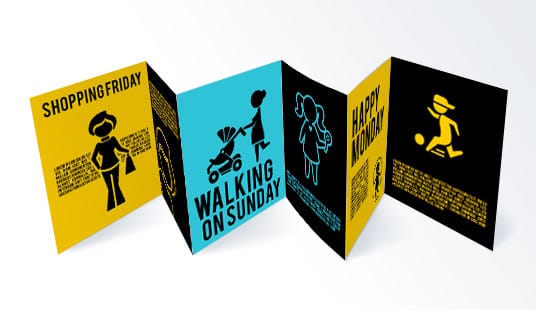
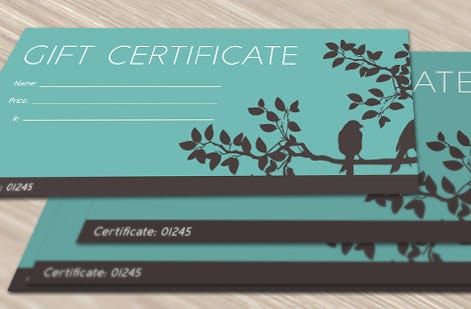
Promotion is where the plan turns physical. A digital ad is gone once someone scrolls past it, but a printed piece sits on a counter, a fridge, or a front door until it gets used. That staying power is why print still earns a line in most small business plans. Match the format to how your customers live: door hangers print at 4.25 x 11 or 4.25 x 14 inches from a run of 250, postcards from 4 x 6 to 6 x 11 inches on 14pt to 18pt cover, menus flat or folded from 4.25 x 11 to 11 x 25.5 inches, and gift certificates at 3 x 7 or 3.5 x 8.5 inches with optional sequential numbering.
- Local service business: door hangers for canvassing routes and repeat postcards for the addresses that already bought.
- Restaurant or cafe: menus, table tents, and a stack of flyers for the neighborhood counter drop.
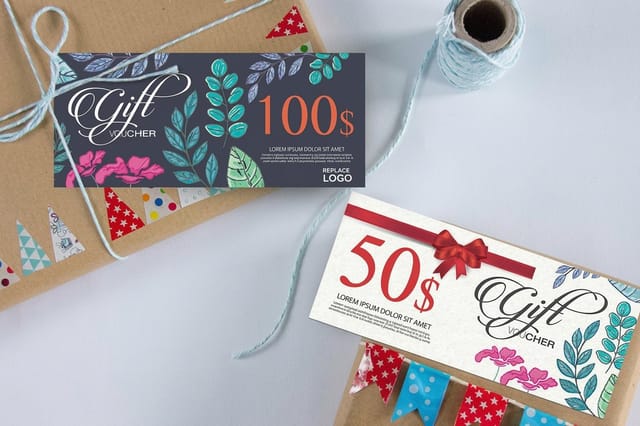
- Retail or boutique: gift certificates that put your brand in a wallet, plus brochures for the lookbook.
You do not need all of it. Pick the one or two formats closest to your buyers and print them well. If you are weighing which piece to lead with, our guides on how to make flyers and what a brochure is for walk through the choices, and the most effective direct mail formats break down which print pulls the strongest response.
Give the marketing budget a real number

A plan without a budget is a wish list. A common starting point for an established small business is five to ten percent of revenue, leaning higher when you are in a growth push and lower when you are steady. On $300,000 of revenue, five percent is $15,000 a year, or $1,250 a month. Pick your figure first, then divide it across the two or three channels your research pointed to. Do not spread it thin across ten.
Print earns its place in the budget partly because the math is predictable. At 4OVER4.COM the price is driven by the choices you make in the configurator: the product, the size, the paper stock, the finish, the quantity, and the turnaround. Larger runs drop the cost per piece sharply, so ordering a full quarter of a format at once usually costs less per customer reached than repeated small batches.
That means a budget-smart plan often front-loads print. Work out how many door hangers or flyers a quarter needs, order the run in one go, and your cost per contact falls. For the wider picture on what to allocate, the small business marketing budget benchmarks and the direct mail ROI data at 4OVER4.COM show where the returns tend to land.
Turn the plan into a calendar

A strategy nobody schedules is a strategy that never runs. Implementation is simply putting each tactic on a date. Map the quarter week by week: when the flyers get designed, when the print order goes in, when the door hangers hit the routes, when the follow-up postcard mails. Assign each task to a person, even if that person is you.
Order your print with lead time built in. A campaign that launches on the first of the month needs artwork approved and the order placed well before, so nothing waits on delivery. Building a small buffer into the calendar is the difference between a launch that goes out clean and one that slips.
If you are producing the artwork yourself, the free online designer lets you build a piece in the browser and send it straight to print, and design templates give you a head start on layout. Want to see how the pieces come together before you commit? Order free paper samples so you can feel the stock your customers will hold.
Measure results and skip the common mistakes

The last part of the plan is the one most owners skip, and it is the one that makes every future plan better. Attach a way to track each tactic before it launches. A unique promo code or a sequential number printed on each gift certificate, a dedicated phone extension on the door hanger, a specific landing page on the flyer. If you cannot tell what a piece produced, you cannot decide whether to run it again.
A few mistakes sink small business plans more often than a weak budget:
- Chasing every channel at once. Two done well beat six done badly.
- No goal on the page. Tactics without an objective are just spending.
- Print with no tracking. Add a code, a number, or a URL to every piece.
- Set and forget. Review the numbers each quarter and cut what is not paying off.
Compare your own results against the field so you know what good looks like. The print versus digital effectiveness data and the brand loyalty statistics at 4OVER4.COM give you honest benchmarks, and the self-promotion tips add tactics you can fold into next quarter. Rewrite the plan once a year and adjust it each quarter.
Wally explains the marketing plan
One page, two channels, a real budget, then measure
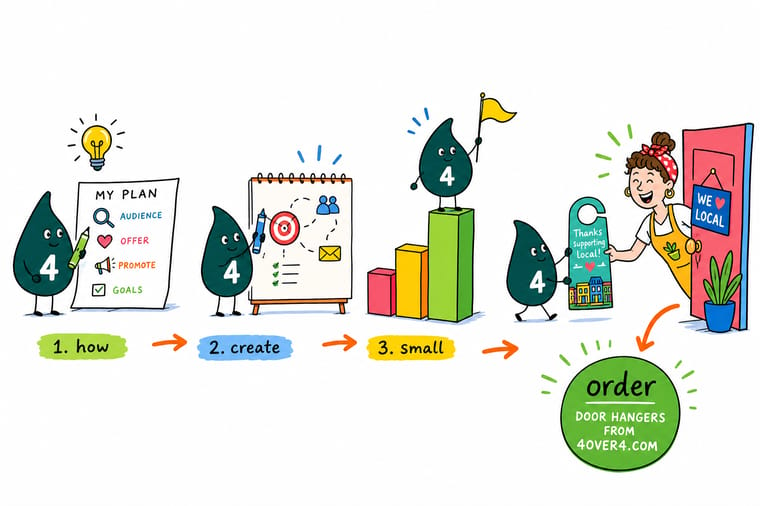
Wally keeps it simple: a marketing plan is one page that names your goal, your buyers, and the two channels closest to them, backed by a budget you actually set. Print is the part customers keep, a flyer on the counter or a door hanger on the handle outlives an ad they scroll past. Pick your formats, order the whole quarter at once so the cost per customer drops, then track every piece and sharpen the plan next round. 4OVER4 prints the materials that carry it.
Explore marketing materials →
Specs and pricing
Door hanger specs and live pricing
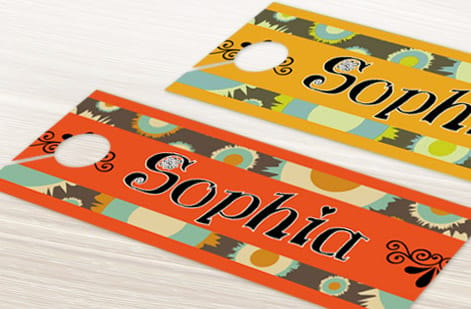
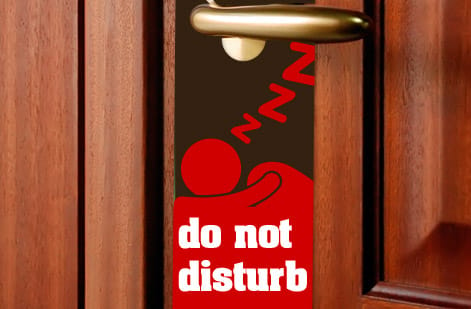
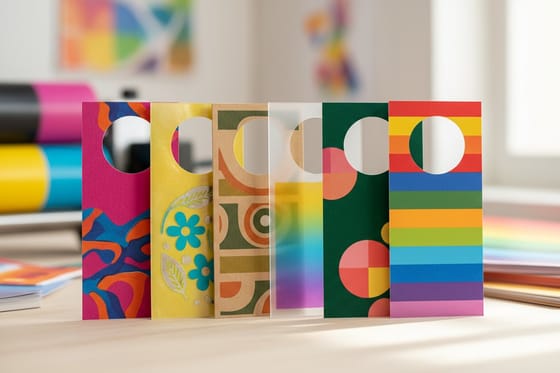
When your plan calls for a local, door-to-door push, here is what a made-to-order door hanger gives you at 4OVER4.COM, with live specs and price-per-unit straight from the configurator: 4.25 x 11, 4.25 x 14, 3.5 x 8.5 or 3.5 x 11 inches on 14pt or 16pt gloss cover with High Gloss UV, one side or both, an optional perforation 2 inches from the bottom, and runs from 250 to 25,000 on 7 business days of production. Order the whole route at once and the cost per door drops.

| Quantity | Price Per Unit | Total |
|---|---|---|
| 250 | $1.16 | $290.41 |
| 500 | 62.2¢ | $311.24 |
| 1,000 | 33.2¢ | $332.08 |
| 2,500 | 22.2¢ | $554.39 |
| 5,000 | 17.8¢ | $887.86 |
| 10,000 | 12.5¢ | $1,249.11 |
| 15,000 | 10.7¢ | $1,610.37 |
| 20,000 | 9.86¢ | $1,971.64 |
Print the plan
Marketing materials small businesses reach for
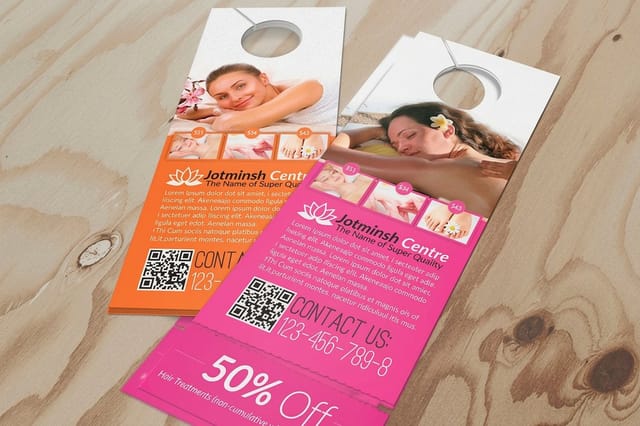
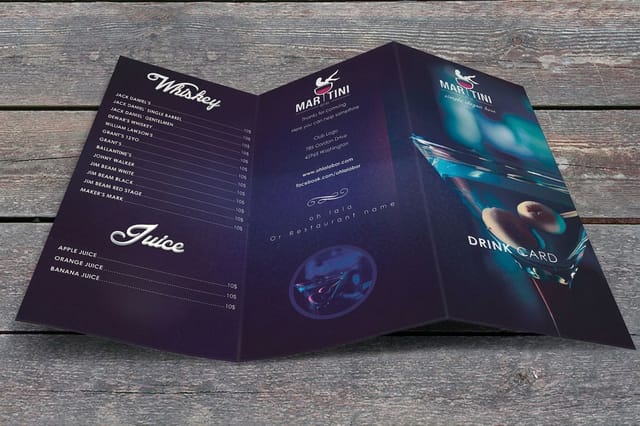
See it in use
Campaign pieces we printed against a plan


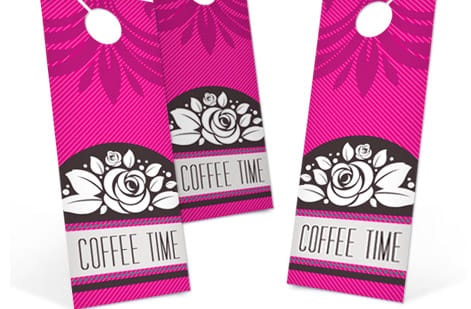
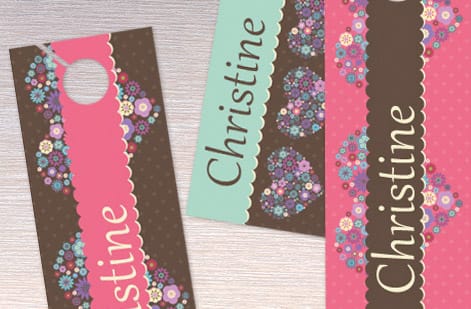



Explore more
Where to go next


By the numbers
Print built to carry your plan at 4OVER4
Common Questions
Common questions about small business marketing plans
What is a marketing plan for a small business?
A marketing plan for a small business is a short written document that says who you want to reach, what you want them to do, and how you will make that happen over the next quarter or year. It usually opens with a one-page executive summary, then covers your market research, your objectives, the strategy behind your product, price, place, and promotion, a budget, and a simple calendar. It is not a business plan and it is not a pitch deck. It is the map you check every month to see whether your marketing is actually pulling its weight.
What is market research and why does it matter?
Market research is the work you do to understand your customers and competitors before you spend money reaching them. For a small business it can be as simple as reading reviews of nearby competitors, asking your best twenty customers why they chose you, and checking which neighborhoods your orders come from. That evidence tells you who to target, what message lands, and which channels are worth printing for. Skip it and you end up guessing, which is the fastest way to waste a marketing budget.
What goes in the executive summary of a marketing plan?
The executive summary is the first page but the last thing you write. In a few short paragraphs it states your headline goal for the year, the audience you are going after, the one or two strategies that will get you there, and the budget you are committing. Anyone who reads that page alone, a partner, a lender, or you six months from now, should understand the whole plan without reading further. Keep it to a single page and write it in plain language.
How much of the budget goes to print versus digital?
Match the plan to how your customers find you, not to what a competitor is doing. A neighborhood cafe leans on menus, table tents, and local flyers. A home-service company lives on door hangers and repeat postcards. A retail shop runs on gift certificates and seasonal promotions. Start with your single goal, pick the two or three channels closest to your buyers, and cut everything else for now. You can always add a channel next quarter once the first ones are paying off.
What are the Four Ps in a small business marketing plan?
Product, price, place, and promotion. Product is what you actually sell and how it is positioned against the shop down the road. Price is what you charge, plus the discounts and packages you are willing to run. Place is where the sale happens, which for most small businesses is a counter, a delivery route, a booth, or a checkout page. Promotion is how people hear about any of it, and that is where print lives: the flyer on the counter, the door hanger on the handle, the menu, the gift certificate. Write one short paragraph per P. If the promotion does not line up with the price and the place, you have found the hole in the plan before it costs you money.
How often should I update my small business marketing plan?
Check the numbers monthly, revise the plan quarterly, rebuild it once a year. The monthly check is short: did calls, orders, or redemptions move toward the goal written at the top. The quarterly pass is where you cut a channel that is not paying and move that money to one that is, which usually means reprinting a piece with a sharper offer rather than starting from scratch. The annual rebuild is the only time the goal itself should change. Rewrite it more often than that and you are reacting, not planning.
What does small business marketing cost and how are print prices set?
A common benchmark is five to ten percent of revenue for an established small business, higher if you are in a growth push. Print costs at 4OVER4.COM are set by the choices you make in the configurator: the product, the size, the paper stock, the finish, the quantity, and the turnaround. Larger runs drop the price per piece sharply, so a plan that orders a full quarter of door hangers or flyers at once almost always costs less per customer reached than repeated small orders. You see the live price update as you pick each option.
How is a marketing plan different from a business plan?
A business plan covers the whole company, your product, operations, finances, and long-term vision, and it is often written once to raise money or set direction. A marketing plan is narrower and more frequent. It only deals with how you attract and keep customers, and you revisit it every quarter. Think of the marketing plan as one working chapter of the business plan that you actually open and update, rather than a document that sits in a drawer.
Get Started
Order 50 gift certificates from $42.84 to test an offer
Pick your formats, drop in your artwork, and 4OVER4.COM prints the flyers, door hangers, and cards that turn your marketing plan into customers.
Legal Disclaimer
Gold Standard guarantees apply to all standard orders placed through 4over4.com. Price match requires verifiable proof of a competitor's published price for an equivalent product with matching specifications and turnaround time. Satisfaction guarantee covers manufacturing defects and print quality issues. Contact support with order number and documentation.
