
What a Print Design Agency Costs and When DIY Wins


Agency, freelancer, or a template you fill in yourself. Here is what each route buys, where each one fails, and how to tell which piece deserves which.
A print design agency prices by project or retainer and sells strategy plus a team, which pays off on identity work that has to hold across many pieces; a freelancer sells hours and suits a single job. For a card, flyer or postcard that just needs a competent layout, a template in our free online designer costs nothing beyond the print run, and the free prepress check on every order catches the bleed, resolution and color mistakes that make DIY expensive.
Quick answer
Who carries the print-ready file decides the price
Agencies charge for decisions, freelancers charge for hours, and templates charge nothing because you do the layout. The step that separates them is the print-ready file: an agency hands it over finished, a freelancer usually hands it back to you, and a template plus our free prepress check covers it without a design fee at all. Match the route to the piece. Identity work that has to survive two years deserves a designer. A dated event flyer does not.
What a Print Design Agency Charges For
Almost nobody who asks for an agency quote is surprised by the number of hours. They are surprised by the line items around them.
An agency prices by project or by monthly retainer, and the fee covers discovery, two or three concept directions, an agreed number of revision rounds, the print-ready artwork, and usage rights written down. Attached to that are people who never open the file: a strategist who decides what the piece has to say, an account manager who keeps approvals moving, sometimes a copywriter. That team is the product. It is also why a single flyer quoted under an agency contract feels expensive, because you are paying for a process built to keep a whole identity consistent across a dozen pieces.
Where it earns the money is scope. When the same mark has to work on a business card, a trade show banner, a mailed postcard and a box, someone has to own the decisions that keep those from drifting apart, and that role does not exist in a freelance engagement. Our own design services page sits at the practical end of the same spectrum: a custom design team for the work that needs judgment, without a retainer wrapped around it.
Two things to settle before signing. Ask what the revision cap is, because rounds beyond it are billed and that is where budgets quietly break. Then ask, in writing, whether you receive the editable source files and the vector logo or only flattened PDFs. A brand you cannot edit without going back to its author is a subscription you did not know you bought.
What DIY Actually Costs Once You Count the Reprints

DIY is free in the same way a rental car is free before you look at the fuel. The design costs nothing. The mistakes cost a print run.
Four errors account for most of the reprints we see. A file built at the exact finished size with no bleed, so the trim leaves a white sliver down one edge. Text placed within a couple of millimeters of the cut, which looks fine on screen and looks like an accident on paper. Images pulled from a website at 72 dpi, which turn soft the moment they are printed at any size. And artwork left in RGB, so the vivid screen blue prints as a duller, greyer blue than the person who approved it expected.
Put a number on it. Standard business cards start at $17.57 and standard postcards at $16.48, so one avoidable reprint doubles the cheapest part of the job. On standard brochures, which start at $57.11, the same mistake costs more than most freelancers charge to set the file up correctly in the first place. The trade is not design fee against zero. It is design fee against the odds of running the job twice.
The mechanics are learnable in an afternoon, which is the honest argument for DIY. Bleed and trim takes ten minutes to understand, converting RGB to CMYK takes five, and starting from a correctly sized blank template removes the geometry entirely. What stays hard is taste, and no checklist fixes that.
The Four Routes, Side by Side
Cost is the wrong first question. Start with who carries the print-ready file, because that is the handoff where jobs actually go wrong.
| Route | How it prices | What you receive | Turnaround | Where it breaks |
|---|---|---|---|---|
| Design agency | Per project or monthly retainer, with a minimum engagement. | Strategy, concept directions, capped revision rounds, print-ready artwork, written rights. | Weeks, and longer when approvals sit with a committee. | Single small pieces. The process costs more than the flyer is worth. |
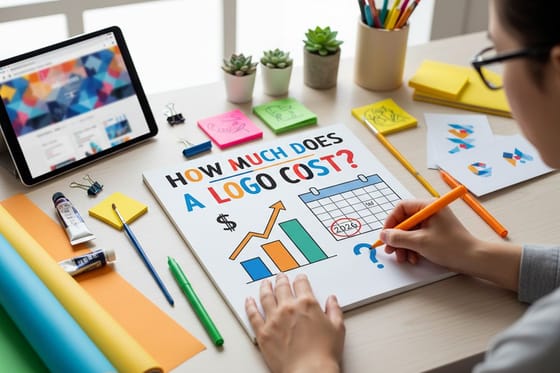
| Freelancer or small studio | Hourly or per piece. Our logo guide puts an original mark at $300 to $2,500. | One person from brief to revisions, usually the source files if you ask. | Days to a couple of weeks, subject to their queue. | Availability. One holiday or one illness and the deadline moves. |
| Template plus free online designer | Free. You pay for the print run only. | 10,000+ templates, a browser editor, downloadable files, and the free prepress check. | The same session you start it in. | Anything that must look unlike everyone else in your category. |
| In-house designer | A salary, so a fixed monthly cost regardless of volume. | Full control, unlimited iterations, and someone who learns the brand. | Immediate, until their queue fills. | Low print volume. Below a certain amount of work it never pays for itself. |
Read the last column before the second. Most bad choices here are not about money, they are about a mismatch: an agency retained for work that is really production, or a template stretched to carry a brand that has not been designed yet. The middle two rows cover the majority of small business print, and the deciding factor is usually whether the piece needs an original idea or just a competent layout.
How to Design a Print Piece Yourself in Six Steps
This is the whole DIY route, in the order that avoids rework. Do it in this sequence and the file check at the end is a formality.
- Choose the product and the size first. Format decides layout, not the other way round. Pick the product and quantity on postcards, flyers or business cards, note the finished size, and design to that. Deciding the size after the artwork is finished is how good layouts get cropped.
- Start from a template, not an empty canvas. Open the design template library and filter to your product. The margins, bleed and trim are already correct, which removes the single most common cause of reprints before you type a word.
- Or download a blank template if you work in Illustrator or InDesign. The blank template library gives you the same geometry as a layered file for your own software, so you keep full control and still inherit the correct setup.
- Keep live text inside the safety margin. Trimming has tolerance, so anything within about an eighth of an inch of the cut is at risk. Background art extends past the edge into the bleed; type, logos and page numbers stay well inside. The rules are short and worth reading once in our bleed and trim guide.
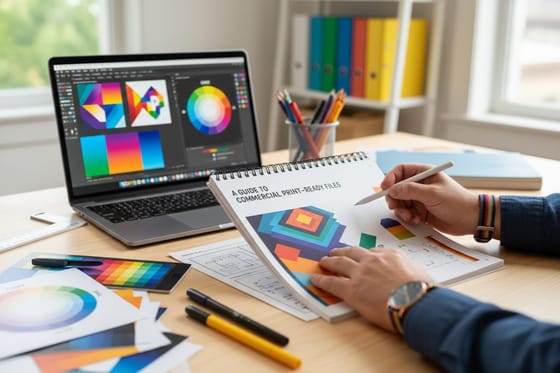
- Build in CMYK and place images at 300 dpi. Screens are RGB and presses are CMYK, so a conversion happens whether you control it or not. Do it yourself and you see the real color while you are still able to change it. The RGB to CMYK guide covers the conversion and which colors shift most.
- Upload, then read the proof properly. Every order gets a free prepress check, and you can add a free online proof at checkout. Look at it on paper terms rather than screen terms: check the trim edges, the smallest type, the phone number, and the spelling of your own name. More jobs are ruined by a typo than by a color shift.
If step one already feels like guesswork, the layout fundamentals in our layout principles guide are a faster fix than another hour in the editor.
Which Pieces Deserve a Designer and Which Do Not
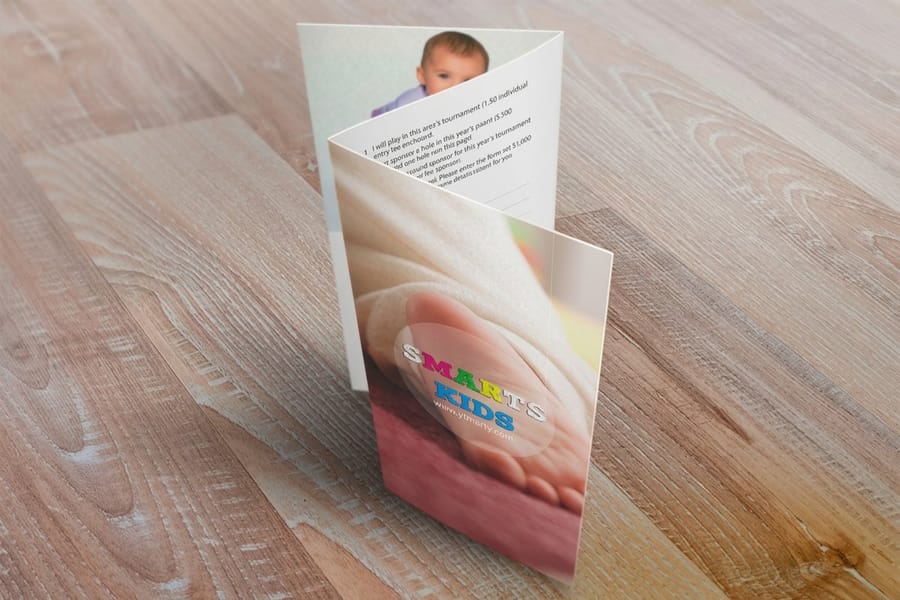
Sort by lifespan, not by importance. Everything feels important while you are making it.
Pay a designer for the pieces that outlive the campaign: the logo and its variations, a business card you will hand out for two years, packaging, a trade show display, and any brochure that has to explain a complicated offer. These are the jobs where a bad decision compounds, because every later piece inherits it. Our guide on logo design principles is a decent test of whether you can do it yourself, and for most people reading it is what settles the question.
Do it yourself for the dated and the disposable: an event flyer, a seasonal postcard mailer, a price list, a table sign, a menu insert. These live for weeks, the layout is a solved problem, and the money is better spent on the quantity or the paper. A heavier stock on a card people keep does more for you than a slightly cleverer arrangement of the same information.
Split the job when the budget is tight, which is what most small businesses actually do. Pay once for the identity, then produce everything else yourself from templates that carry it. That is the combination our design services are built around: a design team for the work that needs an original idea, a free editor and 10,000 templates for the production that follows, and a prepress check on both. If you are still weighing formats and quantities, the printing cost estimate guide and the brochure printing range are the practical next stops.
Wally explains agency versus DIY
Pay for the idea, do the production yourself
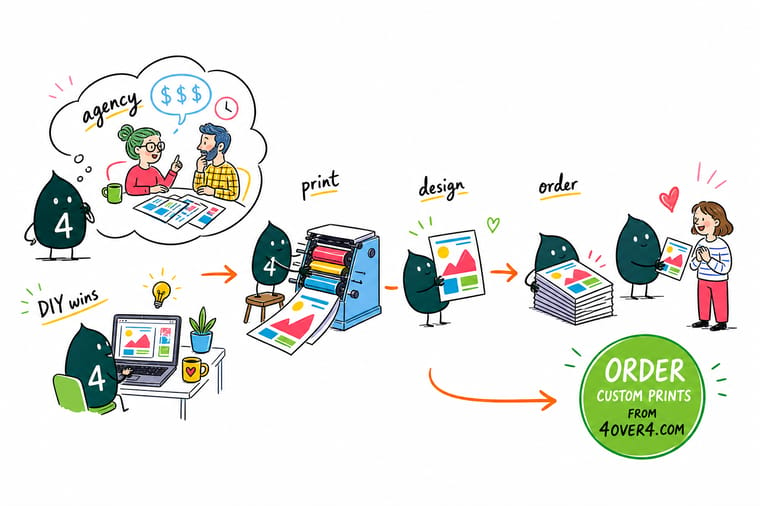
Wally hires a designer once, for the logo and the card he will hand out for two years. Everything after that he builds himself from a template, because the margins and the bleed are already right and the editor will not let him drift outside them. Then prepress checks the file before the press runs, so the mistake that would have cost him a second print run gets caught while it is still free to fix. Pay for the original idea. Do the production yourself.
Start from a free design template →Specs and pricing
What the print run costs while you decide who designs it
The three pieces most often caught between an agency quote and a template, with live options and starting prices straight from the 4OVER4.COM configurator.


Print it
Design it free, then print it properly
Explore more
Where to go next



By the numbers
Design help and print, under one roof at 4OVER4
Common Questions
Agency, freelancer and DIY questions, answered
How much does a print design agency charge for one flyer?
Agencies rarely quote a single flyer on its own. They price by project or by monthly retainer, with a minimum engagement, because the cost sits in discovery, concept rounds and account time rather than in the hours spent laying out the page. That is why a one-piece request usually comes back either as a small project fee that feels high for what you get, or as part of a larger scope. If the piece is genuinely one flyer with no identity work attached, a freelancer or a template is the better value, and you can spend the difference on the print run.
Is a DIY design good enough for business cards?
For a card that carries a name, a number and an existing logo, yes. The layout decisions on a business card are narrow, and a template that already carries the bleed and safety margins removes the part people get wrong. Where DIY falls down is when the card has to establish a brand that does not exist yet. If you are still choosing a typeface and a color and a mark at the same time as the layout, you are doing identity work, and that is worth a designer.
What is the actual difference between a freelancer and an agency for print work?
A freelancer sells you hours and one point of view. An agency sells you a team and a process, which includes people who never touch the file: a strategist, an account manager, sometimes a copywriter. Our guide on what a logo costs puts an original mark from a freelancer or small studio in the $300 to $2,500 band, with full branding agencies starting above that and climbing. The tell is scope. One piece, one deadline, one decision maker suits a freelancer. A system that has to hold across packaging, signage and mail suits an agency.
Do I still need a designer if I use a template?
Not for execution. A template already solves the trim, the margins and a workable type hierarchy, and the free online designer keeps you inside them. What a designer still adds is judgment: which of three layouts reads faster, whether the logo survives at postcard scale, when to cut half the copy. On a piece that will be printed once and handed out at one event, skip it. On something that represents you for two years, pay for an hour of a designer looking at it.
Who owns the design files when an agency makes them?
Only what the contract says. Plenty of agreements deliver flattened PDFs and keep the editable source, which means the next round of changes has to come back through the same agency. Ask for the working files, the fonts or the font licenses, and the vector logo in writing before the project starts. When you design in our free online designer the file stays in your account and you can download the print-ready PDF yourself, which removes the question entirely.
Does the free prepress check replace a designer?
No, and it is worth being clear about what it does. Prepress checks the mechanics: bleed, trim and safety, image resolution, color mode, fonts, and whether anything critical sits too close to the cut. It will not tell you the headline is weak or the hierarchy is upside down. Think of it as the last gate before the press rather than a design review, and it applies to agency files just as often as it does to DIY ones.
Get Started
Ready to design it and print it in the same afternoon?
Start from a free template, edit it in the browser, and let our prepress team check the file before it hits the press. No design fee, no minimum engagement.
Legal Disclaimer
Gold Standard guarantees apply to all standard orders placed through 4over4.com. Price match requires verifiable proof of a competitor's published price for an equivalent product with matching specifications and turnaround time. Satisfaction guarantee covers manufacturing defects and print quality issues. Contact support with order number and documentation. On-time delivery rate based on tracked orders 1999 to 2026. Individual results may vary based on shipping carrier performance.
