
How to Estimate Printing Costs Before You Order


Six variables decide almost every print price. Here is what each one does, how quantity breaks really behave, and a seven line worksheet that gets you close before you open a single price page.
Estimate a print job by pinning down six things: quantity, flat size, stock or substrate, sides and colors, finishing, and turnaround. Multiply a per piece price by quantity, then add shipping and a reprint contingency as separate lines. The per piece price falls steeply at low quantities because a fixed setup is being divided across the run, then flattens once material is all that is left. To convert the estimate into a real number, enter the same six answers in the product configurator and watch the price move as you change each one.
Quick answer
Six variables, one worksheet, two lines people forget
Fix quantity, flat size, material, sides, finishing, and turnaround, and you have priced roughly ninety percent of the job. Then add the two lines that sink budgets: shipping, quoted separately against your destination and brutal on anything rolled or oversized, and a contingency equal to reprinting the smallest quantity break. The chart below shows why per piece prices behave the way they do, and where ordering more stops earning its keep.
The Six Variables That Carry a Print Price

A print quote looks like a black box until you know which dials the estimator is actually turning. There are six, and once you fix them the number stops moving.
| Variable | Why it costs | The cheaper choice | The catch |
|---|---|---|---|
| Quantity | Divides the fixed setup across more pieces. | Order at a published break rather than just under one. | Past the flattening point you are buying inventory, not savings. |
| Flat size | Decides how many pieces fit on a press sheet, or how many square feet of vinyl you buy. | Stay on a standard size that ganges cleanly. | A custom size a quarter inch too big can push the job to the next sheet. |
| Stock or substrate | Paper weight, coating, and vinyl gauge are raw material. | Match the weight to the handling, not to the brochure. | Going too light on a piece that gets carried around reads as cheap. |
| Sides and colors | A second side is a second pass or a second setup. | Print one side when the back genuinely does nothing. | The back of a card is free real estate you paid for anyway if the sheet flips. |
| Finishing | Every extra pass is machine time: folding, drilling, rounding, grommets, laminating. | Decide the finishing before you price, never after. | One forgotten step is the single most common reason a quote jumps. |
| Turnaround | Speed buys priority on a press schedule. | Give the job its standard production window. | Rush is priced separately, so a bigger order does not dilute it. |
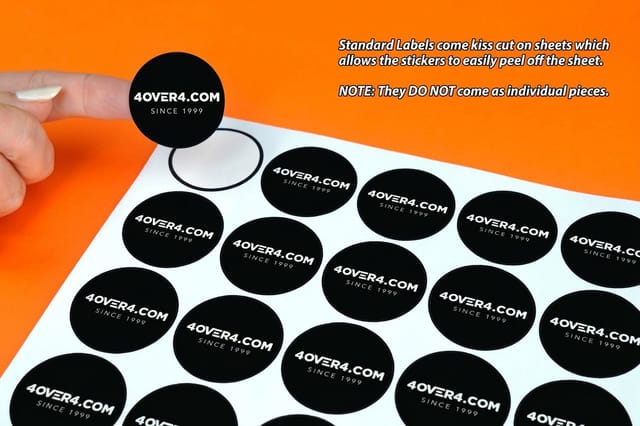
Notice what is not on the list. The design, the number of revisions, and the file format do not change the printing price at all, though a broken file will cost you a day. Neither does the number of different images on the sheet, since a modern press does not care whether it lays down one photo or forty. Estimate the six, ignore the rest, and check the result against a live configurator on a product like standard labels, which start at $23.88.
How Quantity Breaks Work, and Where They Stop Paying

Every print job splits into two kinds of cost. One kind happens once, whatever the quantity: the setup, the make ready sheets pulled while color comes up, the plate or the digital imposition, the cutter setup. The other kind repeats on every piece: paper, ink, and the finishing pass.
Divide the first kind by the run length and you get the whole shape of print pricing. At small quantities each piece is carrying a heavy share of a fixed charge, so adding pieces feels almost free. At large quantities the setup share has already collapsed and you are paying pure material, which has a hard floor no order size gets under. The diagram above plots that arithmetic: quadrupling from 25 to 100 pieces takes more than a dollar off each one, while going from 500 all the way to 2,500 saves six cents.
The practical move is to find the flattening point for your product and order at it, not past it. Ask one question before you round up: will these pieces still be correct and still be handed out inside their useful life? A dated invitation, a menu with a price on it, or a card carrying a number you are about to change all lose their value on a shelf. Greeting cards start at $56.02, so the jump from a small run to a mid run is genuinely cheap per piece. The jump to a huge run mostly buys a box in a closet.
Sample first when the stock is the thing you are unsure about. Ordering a proof or a sample pack costs a fraction of a reprint, and our guide to ordering samples before you print walks through it.
Build a Quote Worksheet You Can Reuse

Estimating gets fast once it is a form rather than a guess. Write these seven lines for every job, in this order, and fill each one before you open a price page.
- Line 1, the piece. Name the product and the flat size. "500 postcards, 4 by 6" is a spec. "Some postcards" is not.
- Line 2, the quantity. The number you will genuinely distribute, plus a small overage for damage and file copies.
- Line 3, the material. Stock weight and coating, or substrate and gauge for signage.
- Line 4, the finishing. Every pass after printing, written out. Fold, score, drill, round, laminate, hem, grommet.
- Line 5, the date. The date the pieces must be in your hands, then subtract transit to get the production deadline.
- Line 6, the shipping. A separate estimated number, especially for anything rolled, oversized, or heavy.
- Line 7, the contingency. The cost of reprinting the smallest quantity break, held in reserve.
Now anchor lines 1 through 4 against real starting prices so your arithmetic has a floor. These are the prices at 4OVER4.COM before you configure quantity, size, and finishing upward.
| Product | Starts at | What drives the price | Where estimates slip |
|---|---|---|---|
| T shirts | $21.96 | Ink colors and garment count. | Every extra ink color is another screen and another setup. |
| Standard labels | $23.88 | Label size, material, and quantity. | A custom die shape adds tooling that a stock shape does not. |
| Greeting cards | $56.02 | Folded size, stock weight, and run length. | Envelopes and any printing on them are a second item. |
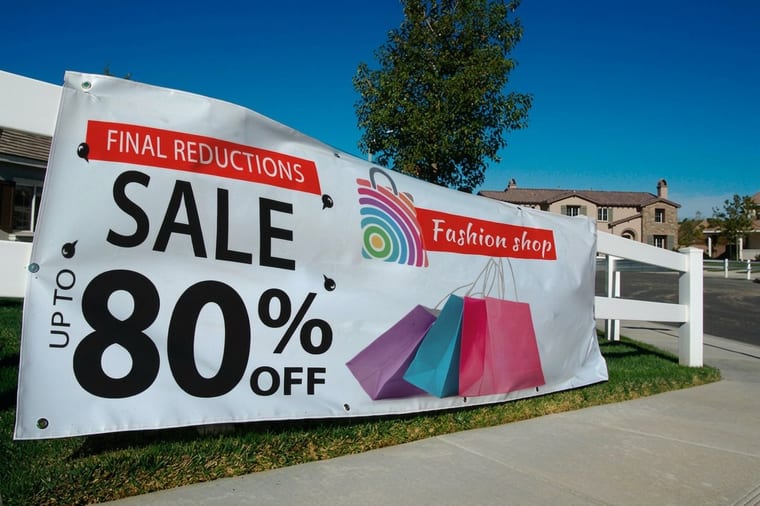
| Outdoor banners | $79.00 | Square footage first, then hems and grommets. | Doubling a dimension roughly doubles the material, and freight on a long roll is real. |
| Scratch off cards | $237.25 | The scratch off panel is an extra manufacturing step. | Specialty processes carry their own minimums, so small runs cost more per piece than you expect. |
Look at the spread. A specialty process like a scratch off panel starts near three times a folded greeting card, because the panel is applied in a separate operation with its own setup. That is the pattern to carry into any estimate: a process step costs more than a material choice, and a material choice costs more than a color. The breakdown of scratch off gift card printing shows what that extra step buys you.
The Four Places an Estimate Goes Wrong

Estimates rarely fail on the unit price. They fail on the lines nobody wrote down.
The size that is almost standard. A quarter inch over a standard trim can push a job to a bigger parent sheet, and you pay for the paper you throw away. If a size is not load bearing to the design, snap it to the nearest standard and keep the difference. Wide format has its own version of this, which is why sheet standards matter enough to have their own guide.
The finishing step remembered late. Drilling, folding, rounding corners, grommets, and lamination are each machine time added after printing. Adding one to a quote you already approved is not a repricing trick, it is a real second pass. Decide finishing at line 4 of the worksheet, before you look at any price.
The schedule compressed after the fact. Rush is a separate lever, and it does not get cheaper because the order is large. Work from the in hand date backward through transit to a production deadline. Our guide to printing turnaround times and order tracking lays out where each stage sits.
Shipping treated as an afterthought. A box of business cards ships for pocket change. A 10 foot rolled banner, a pallet of booklets, or an acrylic print in a protective crate do not. On low value bulky orders freight can approach the printing cost, so give it its own line rather than discovering it at checkout. If you need signage that ships flat and cheap, a-frame signs and rigid panels are usually kinder than large rolls. Booklets have their own quirk worth reading in the booklet printing guide, since page counts move in multiples of four.
None of these are exotic. They are the same four every week, and a worksheet catches all four before you spend anything. More cost and process explainers live in our printing basics guides, and if where a job is produced matters to your budgeting, US based printing covers what domestic production changes.
Wally estimates the job
Six lines on a worksheet beat a guess every time
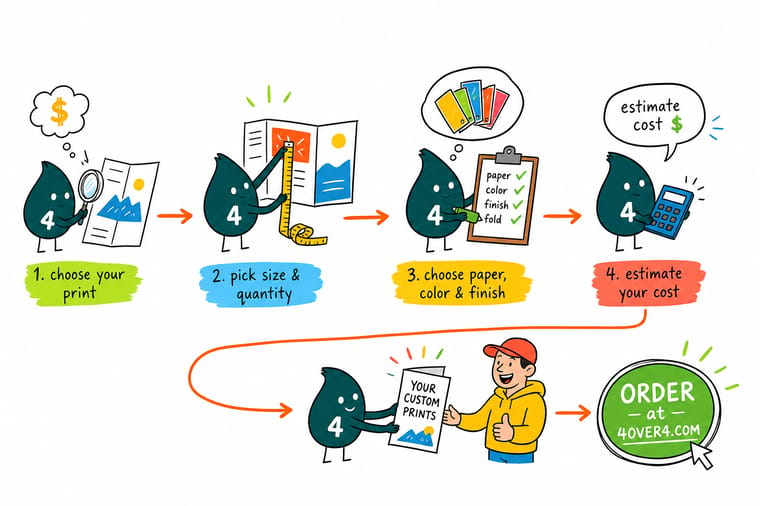
Wally writes down the piece and its flat size, the quantity he will genuinely hand out, the stock, the finishing passes, and the date it has to be in hand. Then he adds two lines most people skip: shipping, and the cost of reprinting the smallest break if something goes wrong. He orders at the quantity where the savings curve flattens, not past it, because a cheaper unit price on pieces nobody hands out is the most expensive order there is.
Configure outdoor banners and see a live price →Specs and pricing
Turn the estimate into a live number
Each configurator carries the same six variables from the worksheet. Change quantity, size, stock, and turnaround, and the price updates against the real 4OVER4.COM catalog rather than an average.



Print it
Price these three and you will recognize every pattern above


Explore more
Where to go next






By the numbers
Pricing you can plan against at 4OVER4
Common Questions
Your printing cost questions, answered
How do I estimate a printing cost before I get a quote?
Write down six things and the number falls out: how many pieces, the flat size, the stock or substrate, how many sides print, what finishing the job needs, and the date you need it in hand. Multiply your best guess at a per piece price by the quantity, add shipping, then add a contingency for one reprint of the smallest quantity break. That gets you within budgeting distance. To turn the estimate into a real number, put the same six answers into the configurator on the product page and the price updates as you change each one.
Why does the price per piece drop so much between 25 and 500?
Because a print job carries fixed costs that happen once no matter how many pieces you order. Plates or a digital setup, make ready sheets, a press wash, and the cutting setup are paid on the first piece and then divided across the rest. At 25 pieces you are each paying a large share of that. At 500 the share has shrunk to almost nothing, and what is left is paper and ink. That is why the savings curve flattens: past a certain quantity you are only buying material, and material has a floor.
Should I order more than I need to get the lower unit price?
Only up to the point where the curve flattens, and only if the piece will not go out of date. A dated event flyer or a card with a phone number you are about to change is worth nothing in a closet. The honest test is whether you will hand out the extra pieces within their useful life. If the answer is no, the cheaper unit price is a more expensive order.
How much does rush turnaround add to a print estimate?
It varies by product and by how far you compress the schedule, and it is priced separately from quantity, so it does not shrink as the order grows. The practical rule is to check the standard production time first and work backward from the date you need the pieces in hand, including transit. Our guide to printing turnaround times explains where production ends and shipping begins, which is the step most rushed orders get wrong.
Does shipping get included in a printing estimate?
Shipping is quoted at checkout against your destination, so it is not part of a product starting price. It matters most on anything bulky or oversized. A rolled 6 foot banner and a pallet of booklets ship very differently from a box of labels, and on a low value order freight can rival the printing itself. Estimate it as a line of its own rather than assuming it disappears into the unit price.
What makes a real print estimate come in higher than expected?
Four things, in order of how often they happen. A size that falls outside the standard cut, which pushes the job onto a larger sheet and wastes paper. A finishing step remembered late, such as rounded corners, drilling, folding, or grommets. A turnaround shortened after the fact. And artwork that fails preflight, which costs a day of schedule rather than dollars but blows the delivery date anyway. Three of the four are fixed by deciding the spec before you price it.
Get Started
Stop estimating and get the real number
Enter your quantity, size, stock, and turnaround in the configurator and the price updates line by line, with no quote request and no waiting.
Legal Disclaimer
Gold Standard guarantees apply to all standard orders placed through 4over4.com. Price match requires verifiable proof of a competitor's published price for an equivalent product with matching specifications and turnaround time. Satisfaction guarantee covers manufacturing defects and print quality issues. Contact support with order number and documentation. On-time delivery rate based on tracked orders 1999 to 2026. Individual results may vary based on shipping carrier performance.
