
High-Ticket Affiliate Marketing and the Ebook That Sells It


Fewer sales, bigger cheques, and a much slower buyer. Here is the arithmetic behind high-ticket offers, the ebook that earns the click, when the commission actually reaches your account, and the follow-up that closes it.
High-ticket affiliate marketing means promoting offers that pay $500 to $10,000 per sale rather than $20 to $100, so five conversions a month can replace two hundred. The trade-off is that a four-figure buyer needs proof before they commit, which is why the assets that work are long-form: an ebook that solves one problem completely, a nurture sequence, and often a call. Conversion rate drops, earnings per click still rises, and the commission usually reaches your account 45 to 75 days after the sale.
Quick answer
Fewer sales, bigger cheques, a slower buyer
High-ticket affiliate marketing trades volume for payout. Offers paying $500 to $10,000 a sale convert at a fraction of the rate a $50 product does, and still return more per click, because commission scales faster than conversion rate falls. What changes is the work. The buyer needs evidence rather than urgency, so the promotion runs on a long-form ebook, an email sequence and often a call, and the commission lands weeks after the refund window closes rather than the same day.
How High-Ticket Offers Actually Pay
Start with the arithmetic, because it is the only part of high-ticket affiliate marketing that is not opinion. Earnings per click is conversion rate multiplied by commission. A $50 offer converting at 3 percent pays $1.50 a click. A $1,000 offer converting at 0.5 percent pays $5.00 a click. The high-ticket offer converts six times worse and still returns more than three times the money, because commission scales faster than conversion rate falls.
That single relationship is why a 900-subscriber newsletter can out-earn a 90,000-follower account. It is also why the failure mode is different. With low-ticket you fail slowly, from thin margins. With high-ticket you fail in silence, waiting on a sale that does not close, with no volume to tell you whether the page or the offer is at fault.
| Offer type | Typical commission | What the buyer needs first | Where affiliates lose |
|---|---|---|---|
| Low ticket | $10 to $75 | A short review and a discount code. | Margin. Ad costs eat the commission. |
| Mid ticket | $100 to $400 | A comparison, a demo, a refund policy. | Attribution. Long consideration outlives the cookie. |
| High ticket | $500 to $10,000 | Proof you have done the thing yourself. | Patience. Three months of work before the first payout. |
| Recurring high ticket | $200 to $800 monthly | Evidence the tool survives a year of use. | Churn. A cancellation at month four erases the year. |
Read the last column before the second. Then check when the money actually moves. Most programs hold a commission until the refund window closes, commonly 14 to 30 days, and pay on a monthly or net-30 cycle after that, so cash lands 45 to 75 days after the sale. If you plan to fund the promotion with paid traffic, that gap is the number that decides whether the campaign is possible. The mechanics of stacking spend against delayed return are covered in the paid marketing strategy guide, and the wider structure of the journey in what funnels are in marketing.
Choosing an Offer You Can Defend in Public

You are lending someone your reputation for a commission. Pick badly once and the audience that took three years to build stops opening the emails. So the filter is not the payout, it is whether you would recommend the thing with no commission attached.
Six questions settle most decisions. Have you used the product yourself for at least a full billing cycle? Can you name a buyer it is wrong for, out loud, on the page? What is the refund rate, and will the merchant tell you? Does a refund claw back a commission you were already paid? How long is the cookie, and does the merchant credit you when the sale closes on their own booking calendar instead of your link? Is there a second tier, where affiliates you refer earn you a slice, and is that slice the actual reason you like the program?
That last one deserves suspicion. A program whose recruiting material talks more about recruiting affiliates than about the product is selling you the affiliate program, not the offer. The honest ones have a boring answer to every question above and a support team that answers email.
One more filter that costs nothing: read the refund page and the terms of service as if you were the buyer. A cancellation clause that requires 60 days written notice will produce angry emails, and they will arrive in your inbox rather than the merchant's. How the merchant priced the offer usually tells you how they will behave when someone asks for money back.
The Ebook Is the Trust Asset, Not the Lead Magnet

A lead magnet trades a checklist for an email address. A trust asset does something harder: it proves you have done the work, so a stranger will take your word on a $3,000 decision. For high-ticket promotion the ebook has to be the second kind, and the difference shows up in the structure rather than the length.
Build it around one complete method, start to finish, with the parts that go wrong left in. Forty pages that walk through a real project beats two hundred pages of survey. Include the numbers you actually have and skip the ones you do not, because an invented statistic is the fastest way to lose a reader who works in the field. Name the situations where your method does not apply. Readers trust a page that tells them the limit far more than one that claims none.
Where does the affiliate offer sit? Chapter five or six, as the tool you reached for at the step where it was genuinely needed, with the disclosure in plain sight before the link. Never chapter one. A reader who meets the pitch on page three stops reading and you lose the only asset you had. Writing at this length has its own discipline, and the long-form writing guide covers how to hold attention past the first thousand words.
- One method, fully worked. A reader should be able to follow it without buying anything.
- The failure cases named. Two or three situations where this approach is the wrong choice.
- Real artefacts. The actual spreadsheet, the actual email you sent, the actual invoice, redacted.
- The offer in context. Mentioned once, where it belongs in the process, with the disclosure above it.
- An ending that asks for one thing. A reply, a call, a download. Not four calls to action competing.
Then send it properly. A download link that arrives instantly and a first email that references the specific chapter someone opened does more for conversion than another rewrite of the cover. The email nurture guide lays out the sequence that follows the download.
Print the Ebook for the Thirty People Who Matter
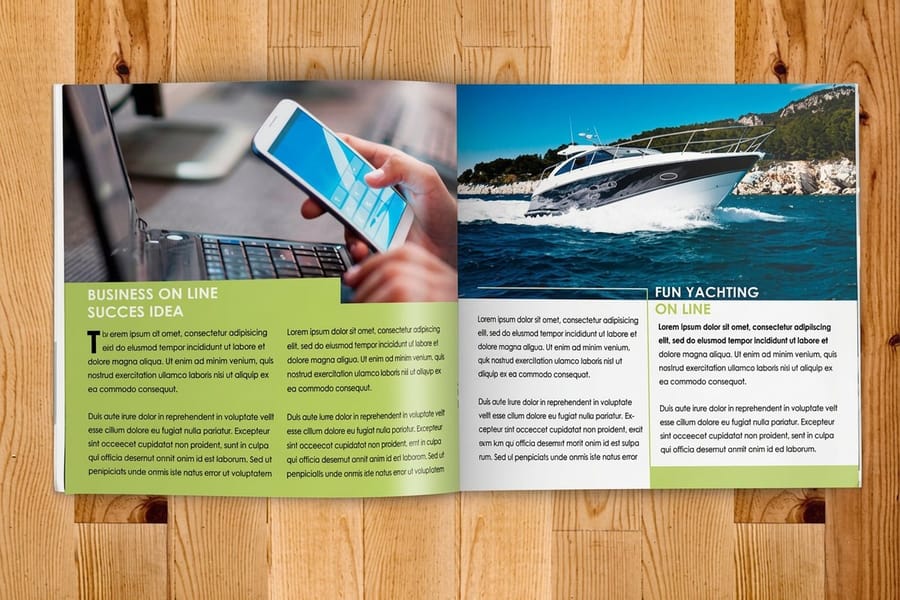
A PDF is free to send and easy to ignore. A book with your name on the spine, mailed to a named person with a handwritten note, gets opened, and it usually gets kept on a desk where other people see it. That is worth real money at four-figure commissions, and it is worth nothing at all if you mail it to a list.
The rule is simple: print for people you can name and would recognize on a call. Three groups qualify. Prospects already in conversation who are stuck at the decision. Podcast hosts, community owners and newsletter writers who could put you in front of a thousand of the right readers at once. Merchant partners deciding whether to move you to a higher commission tier or hand you a private offer.
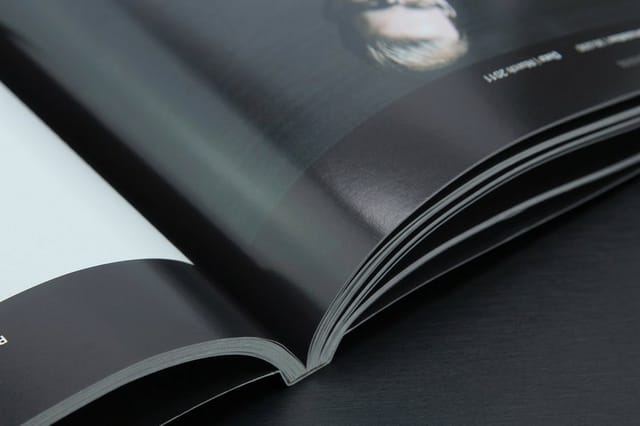
Perfect bound books start at $375.05 and give you the printed spine, which is what makes the object read as a book rather than a handout. Standard booklets start at $240.55 and suit a shorter piece, 16 to 48 pages, where a spine would be too thin to print on anyway. Page count decides for you more than budget does: below about 40 pages there is not enough bulk to bind flat, and the binding guide shows where each method stops working. Both formats live in the book printing collection.
Set the file up once and reuse it. Same trim size, fonts outlined, images at full size, a spine width calculated from the real page count and paper weight rather than guessed. Pages versus sheets is the detail that trips up most first-time book files, and how to print a book online covers the handoff end to end. Order five extra copies. You will hand two away in person within a month.
The Follow-Up That Closes a Four-Figure Sale

The download is not the sale. On a $2,000 offer the gap between reading the ebook and buying is typically two to six weeks, and almost nobody crosses it unprompted. What closes it is a sequence that keeps showing up with something useful rather than something urgent.
Five emails over three weeks is a sane shape. One delivers the ebook and names the single chapter to read first. Two answers the objection you know is coming, in full, without hedging. Three is a worked example with numbers. Four offers a short call with a clear agenda and a stated length, because an open-ended invitation reads as a sales trap. Five closes the loop and says what happens if they do nothing. Then stop. A sixth email that repeats the fourth costs more subscribers than it earns sales.
For the prospects who read everything and still went quiet, paper breaks the pattern. A printed postcard from $16.48 that references the specific thing they asked about lands on a desk instead of in a filtered tab, and it costs less than a single click on most business keywords. Keep it to one sentence and one link. The mechanics of doing this without wasting the run are in the postcard marketing guide, and there is more on sequencing the whole path in turning sales into predictable growth. The full range sits in postcard printing.
If the merchant closes on a call rather than a checkout, your job changes shape. You are handing over a warm prospect, so brief the closer: what the person downloaded, what they asked, what they are worried about. Affiliates who send that note get better close rates and, eventually, better commission terms. Running the call yourself is a separate skill worth learning if the merchant lets you.
Where This Goes Wrong, and the Rooms Where It Goes Right
Four failures account for most of the wreckage. Disclosure buried below the link, which the FTC treats as no disclosure at all and which readers experience as being tricked. Promoting an offer you have never used, which survives exactly until the first buyer emails you a question you cannot answer. Building the entire promotion on one platform account, then losing it. And spending on ads before you know your own earnings per click, which turns a 60-day payout gap into a hole.
The quieter failure is refund clawback. A merchant with a 30-day guarantee and a 12 percent refund rate means roughly one commission in eight comes back out of your account, sometimes after you have already spent it. Ask for the refund rate before you promote. A merchant who will not say has told you the answer.
The upside is that high-ticket buyers cluster in rooms, not feeds. Masterminds, industry conferences, paid communities, small dinners. One conversation in that setting is worth a month of posting, and the person you meet at the bar is not going to search for you afterward unless you make it easy. Standard business cards from $17.57 still do that job better than a phone screen, particularly with the specific thing you help with printed under your name instead of a job title. There is more on making the card carry weight in the business card printing collection and in how to use leave-behinds.
Last thing. Track by offer, not by month. One promotion that produced two sales and one that produced none look identical in a monthly total, and only one of them is worth running again. Reputation in this business compounds and so does its opposite, which is why social proof is the asset that outlives any single program.
Wally explains high-ticket affiliate marketing
Five sales, not five hundred
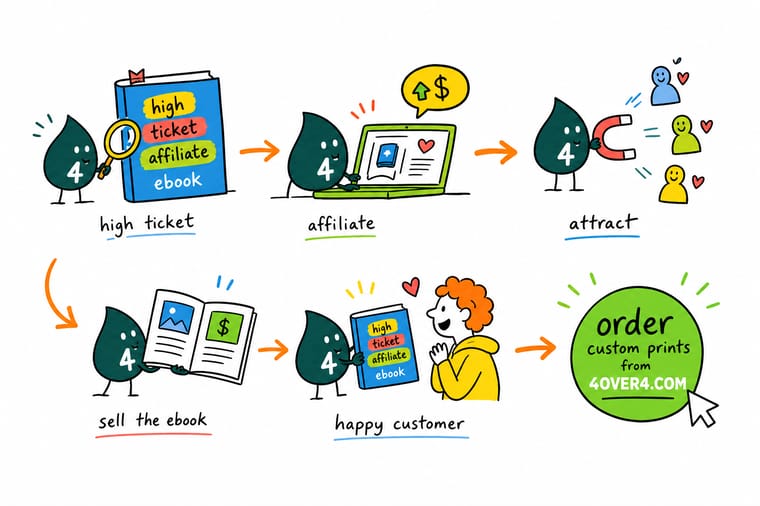
Wally sends the same 1,000 clicks to two offers. The cheap one converts thirty times at fifty dollars. The expensive one converts five times at a thousand. Five wins, and it is not close. But nobody hands over a thousand dollars because Wally posted a link, so he writes the whole method down in an ebook, gives it away, and mentions the tool in chapter six where it actually belongs. Then he prints thirty copies for the thirty people worth mailing.
Print a perfect bound book →Specs and pricing
Print formats for the ebook and the follow-up
Sizes, page counts and starting prices straight from the 4OVER4.COM configurator, for the printed edition and the direct mail that chases it.



Print it
Turn the ebook into something people keep


Explore more
Where to go next





By the numbers
The print side, handled by 4OVER4
Common Questions
Your high-ticket affiliate questions, answered
What counts as high-ticket affiliate marketing?
There is no official line, but in practice a high-ticket offer is one that pays the affiliate $500 or more per sale. That usually means the product itself sells for $2,000 to $25,000: coaching programs, agency retainers, enterprise software with annual contracts, certification courses, financed equipment. The defining feature is not the price tag, it is the buying process. Anything at that level involves a decision the buyer has to justify to a partner, a board, or their own bank account, so the sale takes days or weeks and needs proof rather than urgency.
How much traffic do you need for high-ticket affiliate marketing?
Far less than for low-ticket, which is the point. Run the arithmetic on your own numbers rather than on a promised figure. If an offer pays $1,000 and converts at half a percent, every 1,000 clicks returns roughly $5,000. If you can send 400 qualified clicks a month from an email list, a YouTube channel, or a single ranking article, that is a $2,000 month from a small audience. The catch is the word qualified: 1,000 clicks from a giveaway list converts at zero, and no commission size fixes that.
When do high-ticket affiliate programs actually pay?
Later than most people plan for. Merchants hold commissions until the refund or cancellation window closes, commonly 14 to 30 days, then pay on a monthly or net-30 cycle. That puts real money in your account 45 to 75 days after the sale in a normal program. Two clauses matter more than the headline rate. First, whether a refund inside the window claws back a commission already paid. Second, whether a sale closed by the merchant on a phone call is still credited to you when the buyer books through the merchant calendar rather than your link.
Why does an ebook work better than a review post for high-ticket offers?
Because the buyer is not comparing features, they are deciding whether you know what you are talking about. A review page can be skimmed in ninety seconds and forgotten. An ebook someone downloads, reads over two evenings, and comes back to has demonstrated a method, shown its limits, and answered the objection they had not voiced yet. That is what a four-figure decision runs on. The practical test: the ebook has to be genuinely useful to the reader who never buys anything, or it is a sales letter wearing a cover.
Should I print my affiliate ebook?
Only for a named short list. Printing is a closing move, not a distribution channel. The people worth a physical copy are the prospects already on a call with you, the podcast hosts who could put you in front of their audience, and the merchant partners deciding whether to give you a better rate. A short run of perfect bound books starts at $375.05 and standard booklets at $240.55, so the cost per prospect is only sane when each prospect is worth a four-figure commission.
How do I disclose an affiliate relationship without killing conversions?
Put it above the link, in plain words, in the same size type as the rest of the page. The FTC standard is clear and conspicuous, which rules out a footer line and a hover tooltip. In practice a short sentence saying you earn a commission if the reader buys through your link, and that it costs them nothing extra, does not measurably hurt a high-ticket audience. That audience assumes you are compensated. What damages trust is finding the disclosure after they clicked, not reading it before.
Get Started
Order 10 perfect bound books from $375.05
Pick a trim size, a page count and a binding, upload the file, and we print a short run you can hand to the thirty prospects worth a real conversation.
Legal Disclaimer
Gold Standard guarantees apply to all standard orders placed through 4over4.com. Price match requires verifiable proof of a competitor's published price for an equivalent product with matching specifications and turnaround time. Satisfaction guarantee covers manufacturing defects and print quality issues. Contact support with order number and documentation. On-time delivery rate based on tracked orders 1999 to 2026. Individual results may vary based on shipping carrier performance.
