
What Perfect Bound Book Printing Really Is And When To Use It


"Perfect binding wraps a printed cover around a glued page block to make a clean, flat spine you can print on. Here is exactly what it is, how it compares to saddle stitch, and when it is the right choice for your book."
Perfect bound book printing glues the pages and cover together along a flat spine, the same way a paperback is made. A strong adhesive binds the trimmed edge of the page block to a wrap-around cover, giving you a square, printable spine. It suits books and catalogs from roughly 28 pages up to around 500, and it looks more premium than stapled saddle stitch.
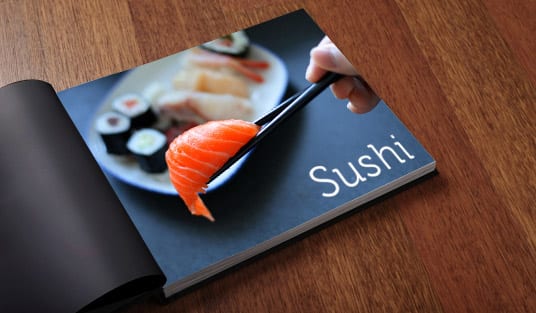
What perfect bound book printing actually is
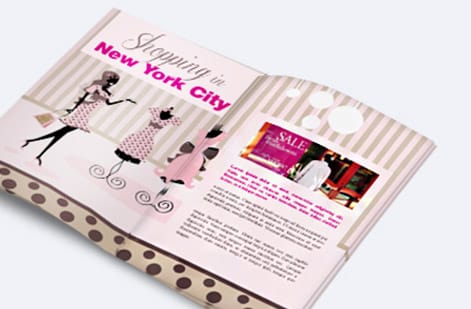
Perfect binding is the method behind almost every paperback you own. The interior pages are printed, collated in order, and stacked into a block. That block is then trimmed on the binding edge to expose fresh paper, and a strong flexible adhesive locks the pages to a single wrap-around cover. Once the glue cures and the other three sides are trimmed, you get a book with clean square edges and a flat, printable spine.
The result reads as finished in a way stapled pages never quite do. Because the spine is flat, it carries a title, so the book stands on a shelf and announces itself. That is why the format dominates novels, magazines, course catalogs, annual reports, lookbooks, and product manuals. If you are weighing formats, our companion guide on binding types for books and booklets lays every option side by side.
At 4OVER4 you can order perfect bound books directly, or browse the full booklets and catalogs category if you are still deciding on format. For longer sales pieces the closely related catalog printing uses the same binding to keep a thick page count tidy.
Perfect bound vs saddle stitch, and how to choose
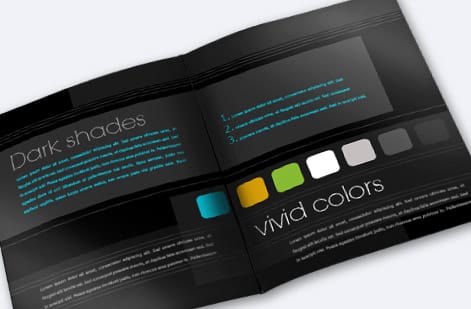
The honest answer to which binding to use comes down to page count and the feel you want. Saddle stitch folds sheets and staples them through the spine fold, which is fast, economical, and perfect for thin pieces. Perfect binding glues a flat spine, which costs a little more but looks and feels substantially more premium once the page count climbs.
Use saddle stitch when your piece runs from 8 to roughly 48 pages: event programs, short catalogs, thin magazines, and newsletters. Switch to perfect binding once you pass about 28 pages and want a real spine, and definitely by the time you reach 60 or more pages where staples would buckle. Our saddle stitch booklets cover the low end, while perfect bound books take over from the middle up. If you are torn between two formats entirely, the guide on booklets versus catalogs helps you match the piece to the job.
One practical tie-breaker: does your title need to be readable on a shelf or in a stack? Saddle stitch has no spine to print on, so a stapled piece disappears edge-on. If shelf presence matters, perfect binding wins before you even count pages.
Sizes, stocks, and page counts for perfect bound books
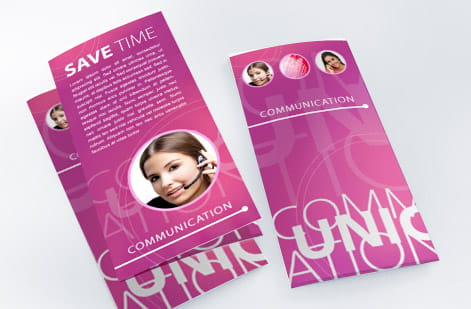
Popular trim sizes cover most projects: 5.5 by 8.5 inches for novels and pocket guides, 6 by 9 inches for trade paperbacks and reports, and 8.5 by 11 inches for catalogs, manuals, and lookbooks. Because the spine is glued rather than folded, your interior page count can run from about 28 pages all the way to roughly 500, and the spine simply gets thicker as the book grows.
Stock is where the book gets its feel. Interior pages are usually a text-weight stock chosen for readability and ink coverage, while the cover is a heavier card that can carry a gloss, matte, or soft-touch laminate for protection and hand-feel. Not sure what a stock feels like before you commit? Order free printing samples so you can judge weight and finish in hand, and preview real projects in our booklet printing showcase.
If your page count is on the fence or the format is unusual, our standard catalog sizes and booklet formats guide maps common dimensions to common uses so you order the right trim the first time.
Perfect binding specs in numbers
Everything a press needs to quote and print a perfect bound book comes down to a short list of numbers. Gather them before you open a layout file, because the trim size and the page count between them decide the spine width, and the spine width decides how the cover spread is built. These are the figures this page has been working through, in one place.
| Spec | Perfect bound book |
|---|---|
| Common trim sizes | 5.5 by 8.5, 6 by 9 and 8.5 by 11 inches |
| Interior page count | About 28 pages up to roughly 500 |
| Spine | Flat and printable, width set by page count and paper thickness |
| Cover file | One spread, back panel then spine panel then front panel |
| Bleed | 0.125 inch on every outside edge |
| Text back from the spine folds | 0.1875 inch |
| Images | 300 DPI at final size, CMYK |
| Crossover to saddle stitch | Below about 28 pages, staples cost less |
Setting up files for a perfect bound book
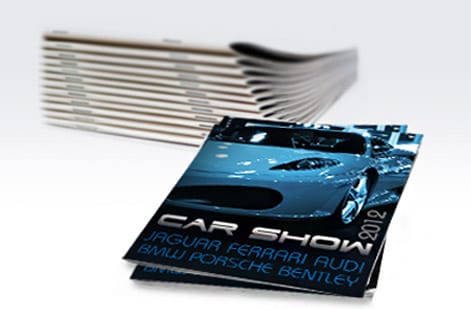
Perfect binding asks for a little more file discipline than a flat piece, because the cover is one continuous sheet that has to wrap the spine. Export the cover and the interior as separate files. The cover is built as a single spread with a back panel, a spine panel, and a front panel laid out left to right, and the spine width is calculated from your exact page count and paper thickness.
Everything you already know about print-ready files still applies. Keep art in CMYK, images at 300 DPI at final size, add 0.125 inch of bleed on every outside edge, and hold text 0.1875 inch back from the spine folds so nothing important gets lost where the cover bends. Our print-ready files guide walks the core rules, and our free file check catches spine and bleed mistakes before the press does.
No layout software or no time to build a cover spread? Our online design tool and ready-made design templates handle the spine math for you, so you can drop in your content and let the setup take care of itself.
What perfect bound printing costs and how long it takes
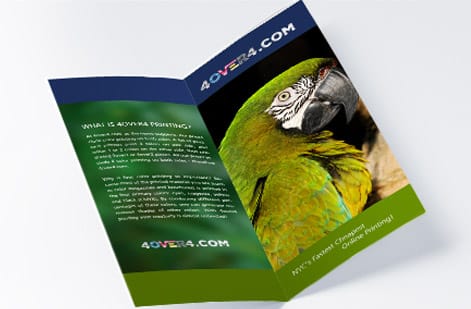
Price on a perfect bound book scales with the levers you would expect: quantity, trim size, page count, interior and cover stock, and finish. More pages and heavier stocks add cost, while larger quantities drop the unit price sharply. You set each option in the configurator and watch the total update live, so you can see exactly what a thicker book or a soft-touch cover does to the number before you commit.
Turnaround depends on the specs and quantity, and binding adds a step over a flat piece because the glue needs to cure before trimming. The product page shows current production time for your configuration, and you can pair it with our shipping options to hit an event or launch date. For a deeper look at what moves the number, see how pricing works across our booklets and catalogs range.
When you are ready, open the live specs and pricing panel below to build your exact book, or start from a proven layout in our design templates and let the configurator quote it instantly.
Wally shows how a perfect bound book is built
Glue the block, wrap the cover, print the spine
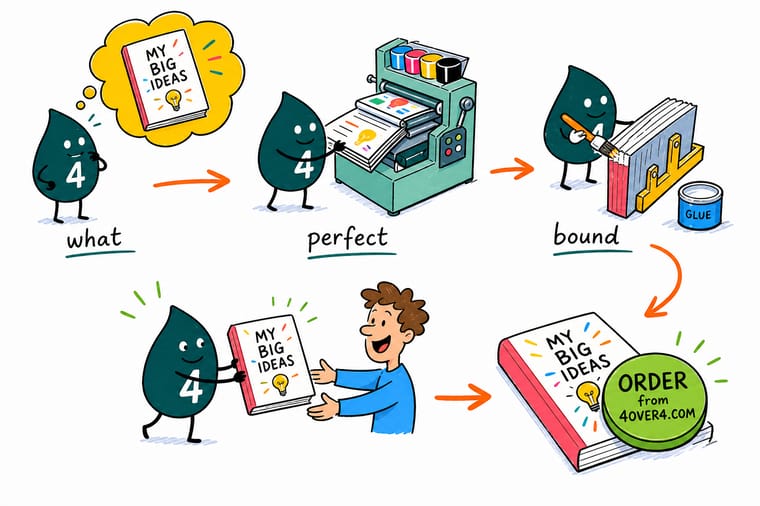
Wally stacks the trimmed pages, brushes the spine with adhesive, and wraps one printed cover around the whole block. Out comes a flat, square spine you can actually print a title on. That is perfect binding in one motion, and it is why the format reads as finished from about 28 pages up. Pick your size and page count, and 4OVER4 binds it clean.
Order perfect bound books →Quick reference
The key details, at a glance
| Detail | What to know | Why it matters |
|---|---|---|
| Binding method | Glued flat spine (PUR/EVA) | Locks pages to a wrap-around cover for a square, printable spine. |
| Page count | 28 to ~500 pages | Enough paper to glue at the low end, up to a thick book at the high end. |
| Popular sizes | 5.5x8.5, 6x9, 8.5x11 in | Covers novels, reports, catalogs, manuals, and lookbooks. |
| Cover | Heavier card, laminated | Gloss, matte, or soft-touch protects the book and sets the hand-feel. |
| Bleed | 0.125 in every outside edge | No white slivers if the trim shifts. |
| Spine text safe zone | 0.1875 in from each fold | Keeps titles off the bend where the cover wraps. |
| Files | Cover spread + interior, CMYK | Cover carries a spine panel sized to your page count and stock. |
Step by step
How to do it in 7 steps
- Confirm your final page countThe page count sets the spine width and decides whether perfect binding or saddle stitch is right, so lock it before you design the cover.
- Pick a trim size and stockChoose from standard sizes like 6 by 9 or 8.5 by 11, then select an interior text stock and a heavier cover stock with the finish you want.
- Build the interior in reader orderLay pages out sequentially at final size with 0.125 inch bleed, and keep body text inside a safe margin so nothing is trimmed.
- Lay out the cover as one spreadPlace the back, spine, and front panels left to right, size the spine to your page count and stock, and keep text off the spine folds.
- Export CMYK, print-ready PDFsSend the cover and interior as separate flattened PDFs in CMYK with fonts embedded and bleed included.
- Run the free file checkUpload your files and let our free check catch spine, bleed, and resolution issues before anything goes on press.
- Configure quantity and orderSet your quantity in the configurator, review the live price and turnaround, and place the order.
Specs and pricing
Live specs and pricing
Once your file is ready, the print decisions come down to size, stock, and finish. Here are the live specs and price per unit at 4OVER4.COM, straight from the configurator.

| Quantity | Price Per Unit | Total |
|---|---|---|
| 10 | $37.51 | $375.05 |
| 15 | $27.86 | $417.92 |
| 20 | $23.04 | $460.78 |
| 25 | $20.15 | $503.65 |
| 30 | $18.22 | $546.51 |
| 40 | $15.54 | $621.52 |
| 50 | $14.57 | $728.68 |
| 60 | $13.93 | $835.83 |
Order it
Bring your project to 4OVER4
Explore more
Where to go next



By the numbers
Page count range, stock choice, and the record for bound books
Common Questions
Common questions
Where can I get my book printed and bound?
You can order perfect bound books directly from 4OVER4, setting the trim size, page count, interior and cover stocks, finish and quantity on the product page while the price updates as you go. Ordering the printing and the binding together is also what keeps the spine right, since the spine width is calculated from your exact page count and paper thickness rather than guessed at.
Is perfect binding expensive?
It costs more than stapling and less than most people expect once the run grows. Perfect binding adds a gluing and curing step that saddle stitch does not have, so a thin booklet is always cheaper stapled. Past about 28 pages the comparison flips, because staples start to buckle and a flat printable spine does work no stapled piece can do. Quantity is the biggest lever either way, since a larger run drops the unit price sharply.
How much does it cost to get a spiral bound book printed?
Spiral and coil binding price by page count and coil size rather than by glue and curing, so on short runs and low page counts it usually undercuts perfect binding. What you give up is the spine. A coil leaves nothing to print a title on, so the book vanishes edge on in a stack or on a shelf. If shelf presence matters more than the lowest unit price, quote the perfect bound version before you decide.
What is perfect bound book printing?
Perfect bound book printing is a binding method that glues the trimmed edge of a stack of printed pages to a wrap-around cover, creating a flat, square spine. It is the same construction used for paperbacks and most magazines and catalogs. The flat spine can be printed with a title, which is why perfect bound books look finished on a shelf, and it handles far higher page counts than a stapled booklet.
How do I choose between perfect bound and saddle stitch?
Let page count and desired feel decide. Saddle stitch folds and staples sheets, which is ideal and economical for thin pieces from about 8 to 48 pages. Perfect binding glues a flat spine, which looks more premium and takes over once you pass roughly 28 pages or want a printable spine. If your title needs to read on a shelf edge-on, choose perfect binding regardless of count, because saddle stitch has no spine to print.
What does a perfect bound book cost and how is the price set?
Price scales with quantity, trim size, page count, interior and cover stock, and finish. Heavier stocks and more pages add cost, while larger runs lower the unit price. You set each option in the 4OVER4 configurator and the total updates live, so you can compare a thicker book or a laminated cover before you commit. There is no separate charge to prepare your own files, and the free file check is included.
What sizes, stocks, and page counts are available?
Common trim sizes are 5.5 by 8.5, 6 by 9, and 8.5 by 11 inches, with page counts from about 28 up to roughly 500. Interiors use a readable text-weight stock and covers use a heavier card that can take a gloss, matte, or soft-touch laminate. Order free samples first if you want to feel the stocks before choosing, since weight and finish change the whole impression of the book.
How long does a perfect bound book take to print and ship?
Turnaround depends on your quantity, page count, and finish, and perfect binding adds a curing step over a flat piece because the glue must set before the book is trimmed. The product page shows the current production time for your exact configuration, and you can add a faster shipping option to meet an event or launch date. Building your file correctly the first time avoids delays from reprints.
Get Started
Ready to print a book with a spine that stands out?
Build your perfect bound book on the size, page count, and cover finish your project calls for, then watch the price update live as you go.
Legal Disclaimer
Gold Standard guarantees apply to all standard orders placed through 4over4.com. Price match requires verifiable proof of a competitor's published price for an equivalent product with matching specifications and turnaround time. Satisfaction guarantee covers manufacturing defects and print quality issues. Contact support with order number and documentation. On-time delivery rate based on tracked orders 1999 to 2026. Individual results may vary based on shipping carrier performance.
