
6 Print Formats That Make Advertising Copy Worth Clicking
Advertising copy is not one skill. It is six, because a postcard read over a bin, a poster read at 20 feet and a brochure someone chose to open all impose different limits on what you are allowed to say. Here are the six formats, what each one lets you write, and what it costs to print.
The format decides the copy, not the other way round. Reading distance sets the size of your headline, headline size sets the word count, and word count sets what the piece can honestly promise. Postcards are for testing a line, flyers for arguing a case, brochures for answering objections, posters for the five-word version, door hangers for a local reason, business cards for one sentence carried in a wallet.
The picks
The 6 formats in this kit, priced live
Start with the postcard if you are still deciding what to say, and the poster if you already know. Every price below comes straight from the configurator and drops as your quantity climbs. Lay any of them out in the free online designer, or begin from a ready-made design template and replace the copy.
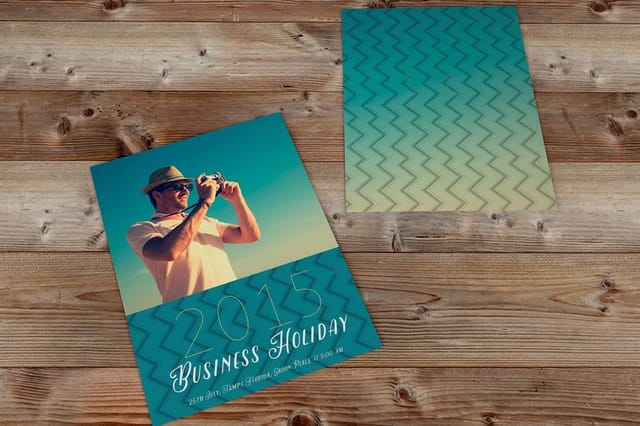
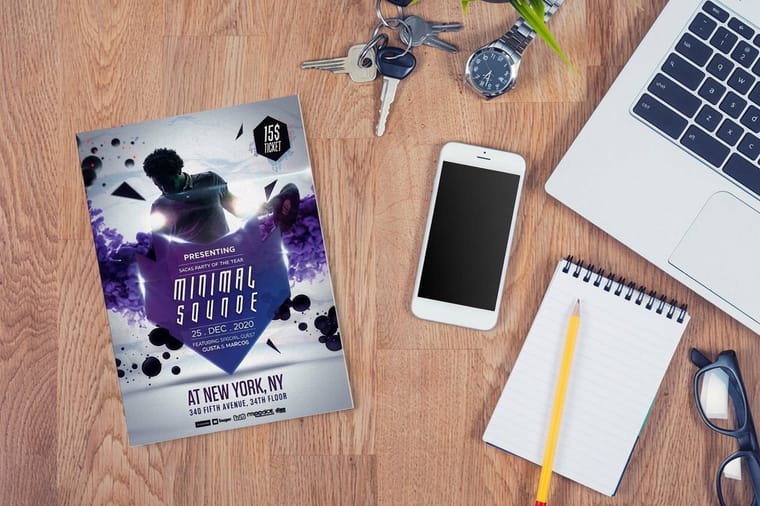
- Standard Postcards, from $16.48. The cheapest way to test a headline. Print two versions of the same offer, mail them to two halves of the same list, and the response tells you which line works before you commit the budget to anything larger.
- Standard Flyers, from $39.54. The only format in the kit with room for a headline, three proof points and a coupon on one side. Use it when the offer needs evidence, not just a promise.
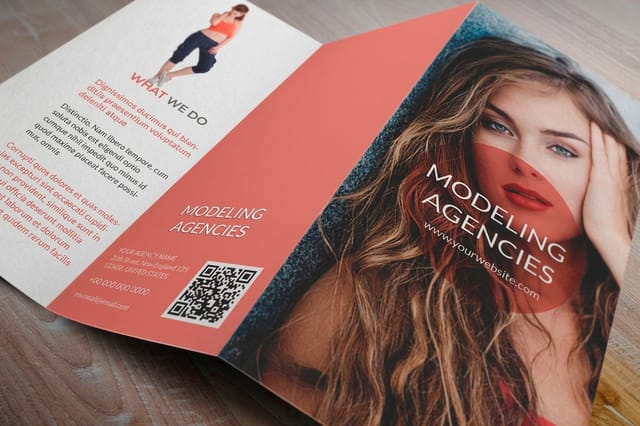
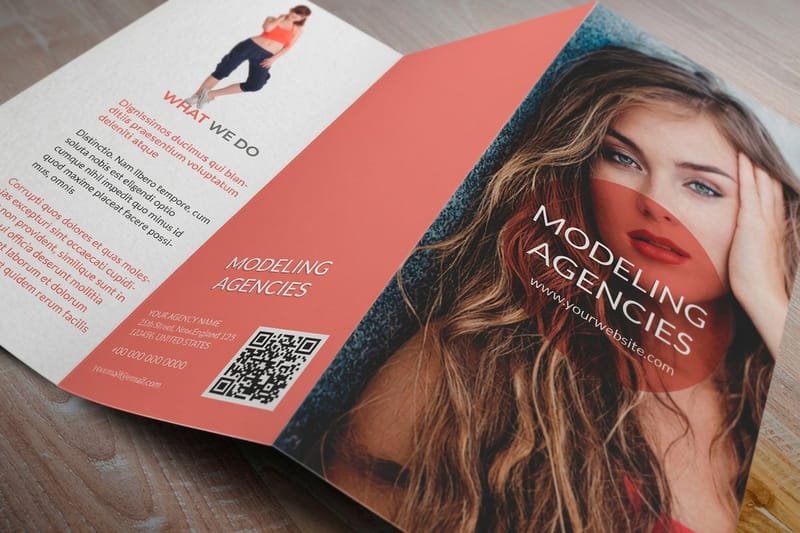
- Standard Brochures, from $57.11. For copy a reader has agreed to spend two minutes with. The folds do the outlining for you: one promise on the cover, one objection per inside panel, one ask on the back.
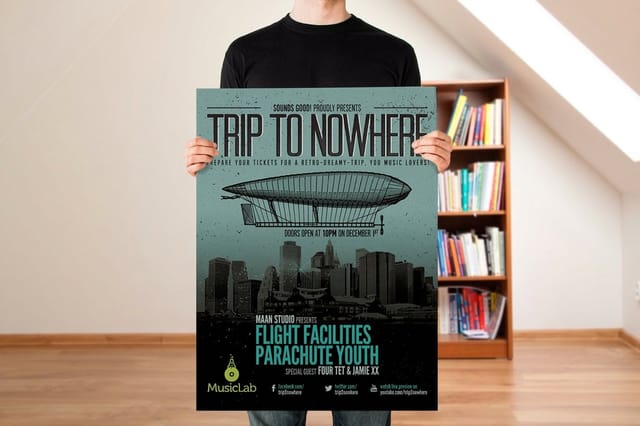
- Standard Posters, from $108.75. Headline only, read from across a room. This is where you find out whether your message survives being cut to five words.
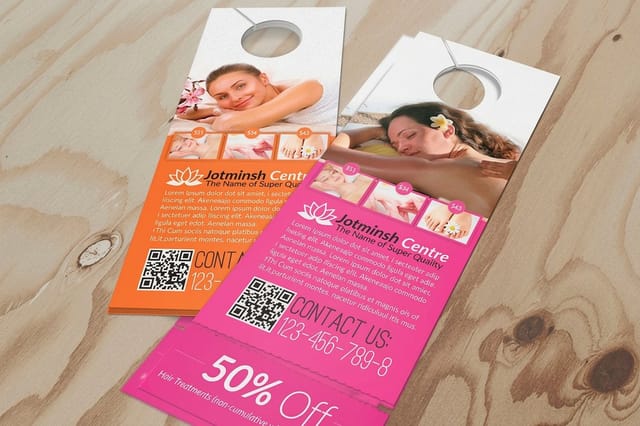
- Door Hangers, from $290.41. The one piece delivered without permission, so the first line has to earn the intrusion. Highest entry price in the kit, and it only makes sense once you are covering whole streets.
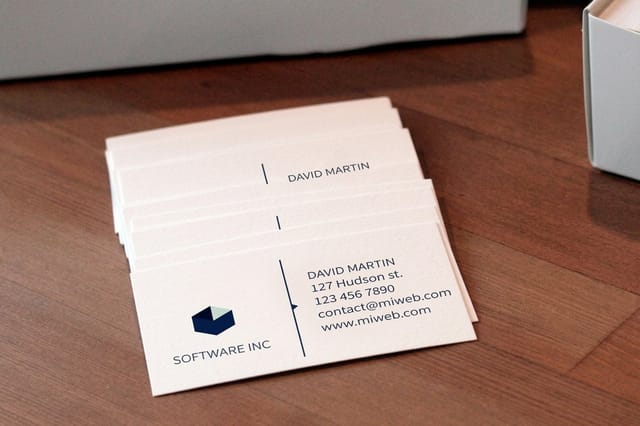
- Standard Business Cards, from $17.57. The shortest ad you will ever write is the line under your name. Get that one sentence right and the card outperforms most of what you mail.
Distance and word budget
What each format lets you write, and how it fails
The useful question is never "how much copy should I write". It is "from how far away will this be read". Answer that and the word budget answers itself. Read the row for the format you are printing, tap the name to jump to its section, and pay attention to the last column, because that is the failure we see most often on files coming in.
| Format | Read from | Word budget | How the copy fails |
|---|---|---|---|
| 1. Postcards | Arm’s length, roughly 2 ft, over a recycling bin | One headline of 5 to 8 words, one offer, one deadline | Two offers on one card. The reader picks neither and sorts it into the bin. |
| 2. Flyers | Arm’s length off a counter, windshield or hand | Headline, three proof lines, one call to action | A list of every service you sell. A flyer that says eight things says nothing. |
| 3. Brochures | In the hand, opened on purpose, 1 to 2 minutes | One idea per panel, 60 to 120 words per panel | Continuous prose written as if the folds were not there, so sentences break across panels. |
| 4. Posters | 10 to 30 ft, walking past, 2 seconds | Headline under 5 words plus one line of detail | A paragraph. At 20 ft a paragraph is gray texture, not language. |
| 5. Door hangers | Standing at the door, alone, no salesperson | One reason line, one offer, one local proof | A headline placed where the die-cut hole and tab remove the top of the panel. |
| 6. Business cards | 12 in, in the hand, then in a wallet for months | Name, one promise line, one way to reply | A blank back and a job title where the promise should be. |
1. Postcards: where you test the headline before you spend
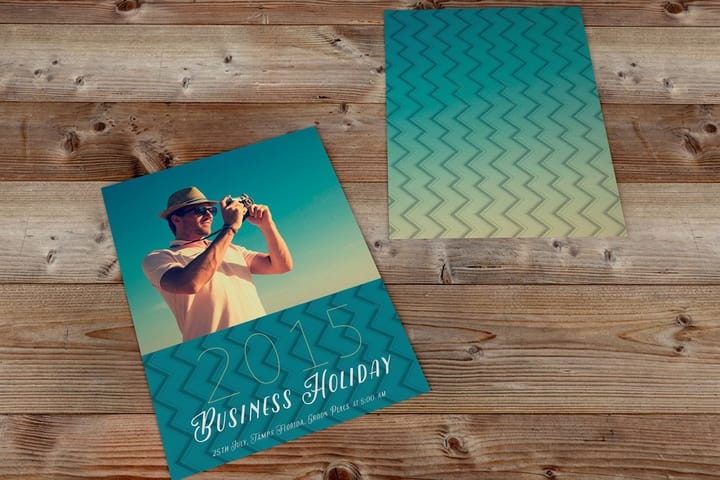
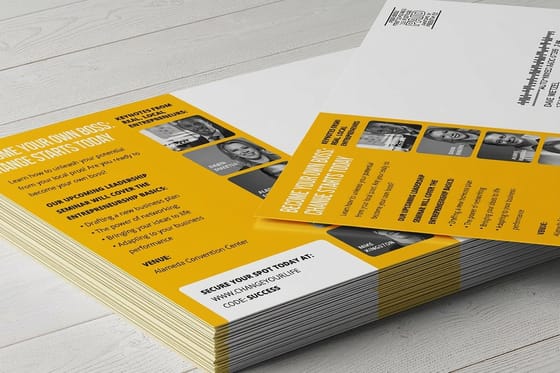
A postcard gets judged in about two seconds, standing over a recycling bin, and it either survives that sort or it does not. That short window is exactly why standard postcards are the best copy-testing tool a small advertiser has. Print the same offer with two different headlines, mail each version to half of the same list, count the calls. You now know something about your customers that no amount of arguing in a meeting would have settled.
Write the front as one promise. The reader has room in their head for a headline, a reason to believe it and a deadline, and nothing else. Save the address side for the offer detail and the response line, and plan for the post office taking the right-hand portion of that side for the address block, the barcode clear zone and the indicia. The exact zones are mapped in our breakdown of the parts of a postcard, and it is worth checking before you set type rather than after.
The limit is real: a postcard cannot carry proof. There is no room for three testimonials, a price table and a guarantee, so if your offer needs all of that to be believed, the postcard is the wrong format and a flyer is the right one. Where postcards do win is repetition. Three cards to the same list over six weeks beats one card three times the size. For campaign angles that suit the format, see our postcard marketing ideas, and for list and timing decisions, our direct mail design best practices.
2. Flyers: the format with room for evidence
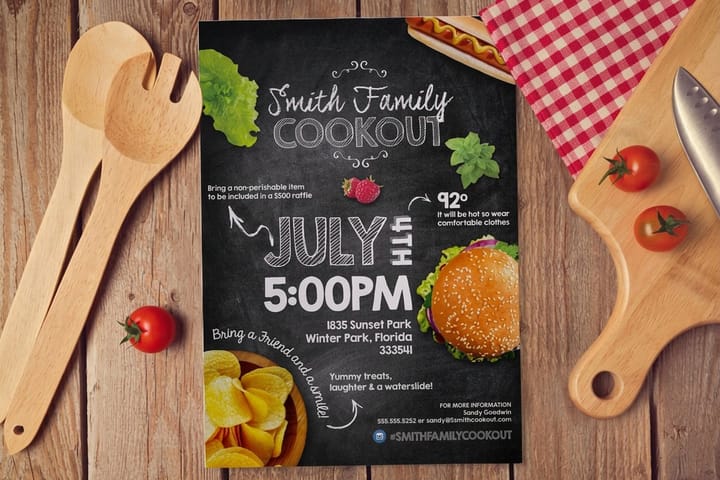
A flyer is the first format in this kit big enough to argue a case. On an 8.5 in by 11 in sheet you can run a headline across the top third, three proof lines in the middle, and one call to action at the bottom with a tear-off or a coupon code. That structure is not decoration. It is the order a sceptical reader asks questions in: what is this, why should I believe it, what do I do now.
Body type on a standard flyer is read at roughly arm’s length, so 10pt to 12pt is comfortable and 8pt is where people stop. Headlines have more freedom, but the font choice matters more than most people expect once you get above 40pt, because tight display faces that look sharp on screen close up at print size. Our flyer font guide covers the pairings that hold their spacing.
Here is the trade-off nobody mentions. The flyer that lists every service you offer converts worse than the flyer that names one, because a list gives the reader nothing to decide. Pick the service you actually want more of, write the flyer for that, and print a second flyer for the other one if it matters. Then think about how it reaches a hand, since a flyer read at a counter and a flyer pulled off a windshield need different opening lines. Our notes on flyer distribution go through the placements that respect the reader.
3. Brochures: the only place long copy still works
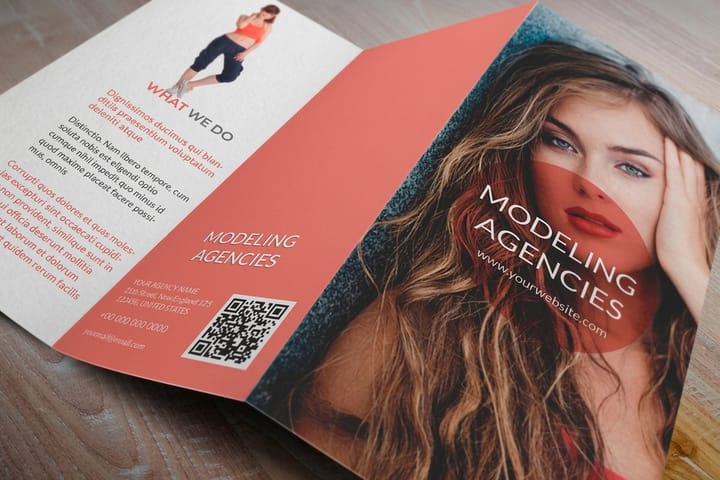
Long copy is not dead in print. It is just conditional. Someone who picks up a brochure has agreed to give you a minute or two, and that consent is what makes 600 words readable when the same 600 words on a postcard would be absurd. Standard brochures are where you answer the objections that a headline had no room for.
Let the folds write your outline. The cover carries one promise, each inside panel takes one objection and settles it, and the back panel carries the ask and the contact block. Panels run roughly 60 to 120 words before they feel dense, and a panel that spills its sentence onto the next one reads as a mistake because the reader has to physically move the paper mid-thought. That is the single most common brochure copy error we see on files coming in: prose written as though the sheet were flat.
The trade-off is cost and commitment. At $57.11 to start, a brochure costs more per piece than a flyer, and it goes obsolete faster because it usually carries prices, staff names or a service list. Print a shorter run than feels comfortable and reprint when something changes. For structure and what to put on each panel, read brochure content that makes readers act alongside our list of ways to improve brochure copy.
4. Posters: the five-word test your message has to pass
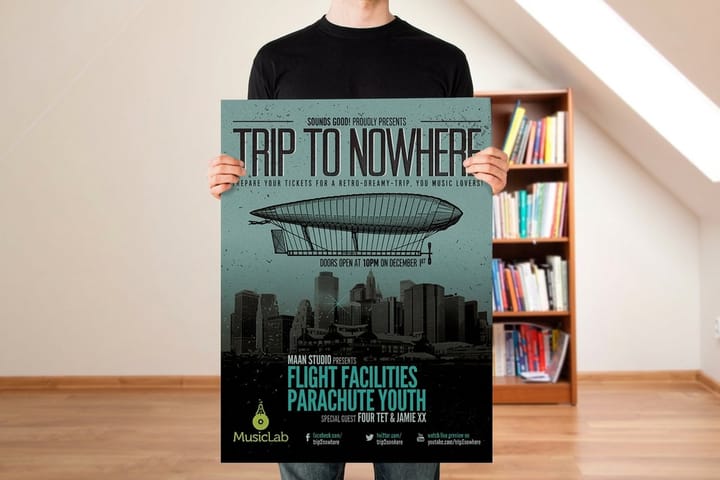
A poster is read on the move, from somewhere between 10 and 30 feet, in roughly the time it takes to walk past it. Printers work to a rule of thumb for that: about one inch of capital-letter height for every ten feet of viewing distance. At 20 feet you are setting two-inch caps, and two-inch caps across a 24 in wide standard poster leave room for about five words. That is the whole brief.
Which is why posters are a useful discipline even when you are not printing one. If your offer cannot be cut to five words plus a line of detail, the offer is still fuzzy, and a fuzzy offer will underperform on every other format in this kit too. Write the poster first, then let it become the headline on the flyer and the front of the postcard.
The limit worth naming: posters build recognition, they do not close. Nobody reads a phone number at 20 feet and dials it. A poster works when it is paired with something the reader can take away, which is why the strongest campaigns run a poster in the window and a stack of flyers on the counter under it. There is a spread of real examples in our roundup of print marketing that still wins customers.
5. Door hangers: copy that has to earn the intrusion
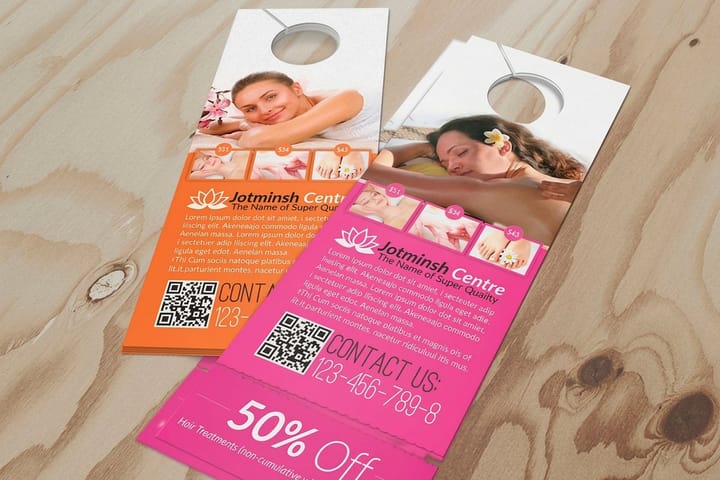
A door hanger arrives without being asked for, on someone’s front door, while they are out. That changes the first line completely. Every other format in this kit can open with an offer. A door hanger has to open with a reason it is there, and the reason that works is almost always local and specific: the crew was on this street today, the neighbours at number 14 had the same problem, the service window covers this postcode this month.
Watch the die. Door hangers lose the top of the panel to the hole and the slot, so a headline set at the top of a flat rectangle disappears into the cut. Set your artwork on the real die line, keep the top band clear, and put the headline where the hanger actually starts. Reversing that order costs a whole print run.
Be honest about the economics. At $290.41 to start, door hangers carry the highest entry price of the six formats here, and the maths only works when you are covering entire streets rather than a handful of addresses. Check the quantity ladder before you commit, because the per-piece cost is what matters and it improves sharply with volume. For services with a defined territory, that is fine. For a business with customers scattered across a city, postcards to a targeted list will beat it.
6. Business cards: one sentence, carried for months
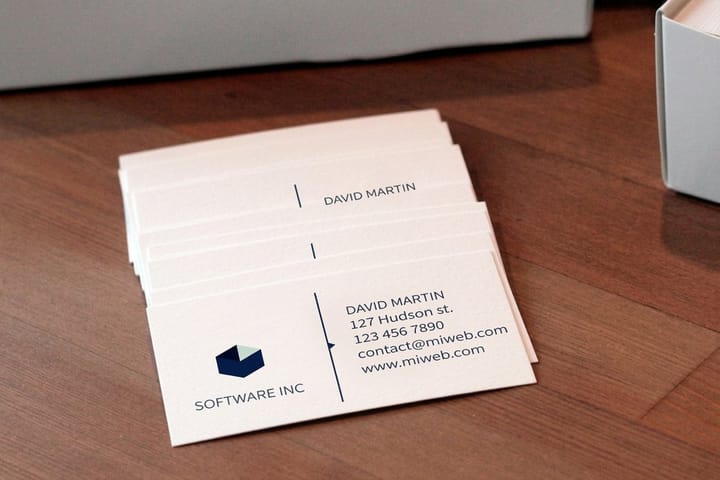
The shortest piece of advertising copy you will ever write is the line under your name on a standard business card, and most people waste it on a job title. A title says what you are called. A promise line says what happens to the person holding the card. "Same-week emergency plumbing, seven days" does more work in a wallet than "Director" ever will.
The back of the card is free space that most cards leave blank. Put the one thing a customer would need to remember there: your service area, a short guarantee, a QR code to a booking page, or a five-item list of what you actually do. It costs nothing extra on a double-sided card and it turns a contact detail into an argument.
The trade-off is restraint. A card crammed with eight services in 6pt type reads like a shrunken flyer, and it gets thrown out like one. Keep one promise, one name, one way to reply, and let the design carry the rest. If you want the tactics that make cards get used rather than filed, our business card marketing tips cover the ones that reliably produce calls, and you can start any of these layouts from a design template instead of a blank artboard.
Specs and pricing
The two you will reprint most: postcards and flyers
Postcards test the line and flyers carry the argument, so between them they account for most reorders on a copy-led campaign. Here are the live stock, size and price ladders for both.


| Quantity | Price Per Unit | Total |
|---|---|---|
| 50 | 33.0¢ | $16.48 |
| 100 | 24.2¢ | $24.16 |
| 200 | 15.9¢ | $31.86 |
| 300 | 12.8¢ | $38.45 |
| 400 | 11.3¢ | $45.04 |
| 500 | 10.3¢ | $51.62 |
| 600 | 9.89¢ | $59.31 |
| 700 | 9.57¢ | $67.00 |
| Quantity | Price Per Unit | Total |
|---|---|---|
| 50 | 79.1¢ | $39.54 |
| 100 | 57.1¢ | $57.11 |
| 200 | 37.3¢ | $74.69 |
| 300 | 28.6¢ | $85.68 |
| 400 | 24.4¢ | $97.76 |
| 500 | 21.8¢ | $108.75 |
| 600 | 18.7¢ | $112.03 |
| 700 | 16.5¢ | $115.33 |
Wally explains the word budget
Distance decides how many words you get
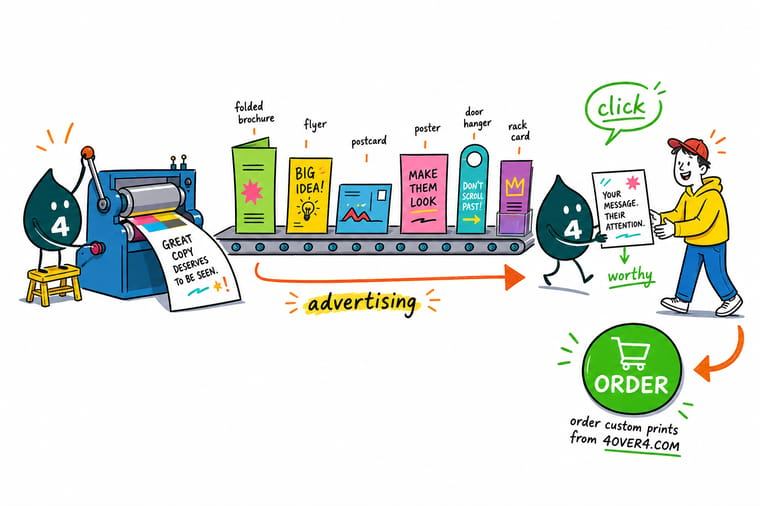
Wally walks backwards away from a poster until the paragraph turns into grey texture, then steps up to a brochure and reads the whole panel. Same campaign, same promise, completely different word counts. Write the five-word poster version first, because it is the hardest one, then let the flyer, the postcard and the door hanger stretch it. If the promise will not survive being cut to five words, the promise is not finished yet.
Shop all marketing materials →See it in use
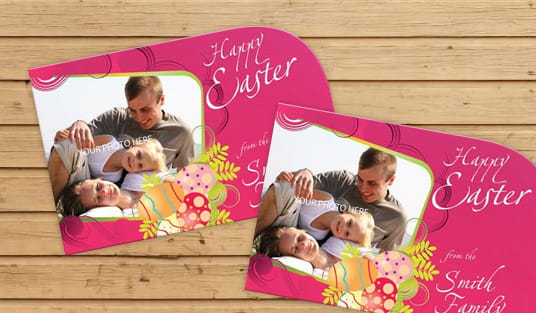
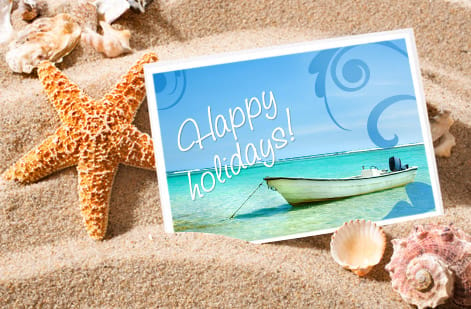
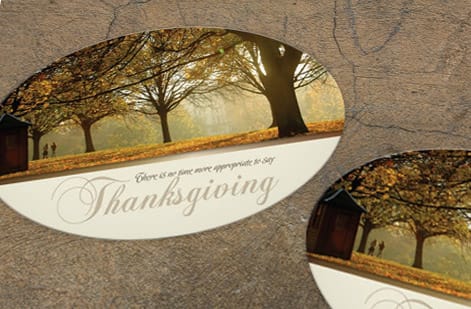
Postcard designs from customer orders
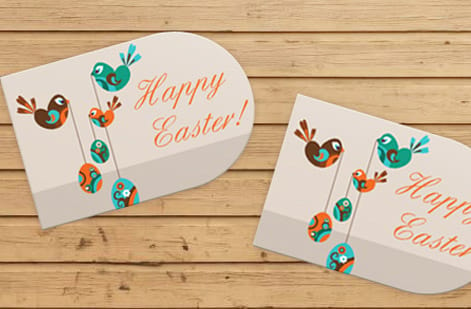
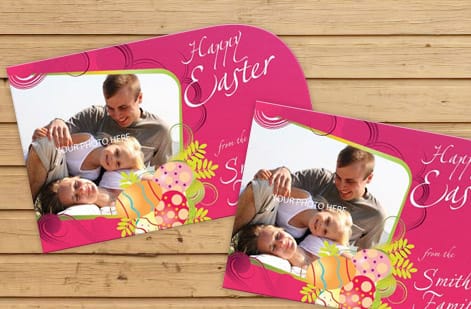

Explore more
Where to go next
By the numbers
Printing that matches the copy to the distance
Common Questions
Common questions about advertising copy in print
How long should a headline be on a printed ad?
It depends entirely on how far away the reader is standing. A poster read at 20 feet needs two-inch capitals, which leaves room for about five words. A postcard read at arm’s length can carry five to eight. A brochure cover, which someone is already holding, can run to a full short sentence. Decide the viewing distance first and the word count follows from it, rather than writing a headline and then discovering it does not fit.
What is the difference between print copy and web copy?
A web reader can scroll back, click a link or search for the answer to an objection you did not handle. A print reader can do none of that. Everything the reader needs has to be on the page, in the order the questions occur to them, which is why print copy carries its proof closer to its promise and states the next step explicitly instead of relying on a button.
Should the offer go on the front or the back?
The promise goes on the front and the mechanics of the offer go on the back. On a postcard that means the headline and the reason to believe it face up, with the code, the deadline and the response line on the address side. On a business card it means the name and the promise line on the front and the service list or QR code on the back. Splitting them this way means the front never has to compete with itself.
What is the cheapest way to test two versions of an ad?
Postcards. They start at $16.48 at 4OVER4.COM, they print fast, and a mailing list splits cleanly in half, so you can run headline A against headline B on the same audience in the same week and count the difference in replies. Change one thing between the versions, not three, or you will not know which change did the work.
Do I need a different headline for every format?
You need one core promise and different lengths of it. Write the five-word poster version first because it is the hardest, then expand it for the flyer and the postcard rather than writing each piece from scratch. Campaigns lose their pull when the poster, the flyer and the door hanger each argue a slightly different point and the reader never hears the same thing twice.
What is the most common copywriting mistake on printed advertising?
Two offers on one piece. A reader given a choice between a free consultation and 20 percent off will usually take neither, because deciding is work and putting the piece down is not. The second most common is writing to a blank rectangle instead of the real printable area, so a headline ends up under a brochure fold, behind a door hanger die-cut or inside a postcard mail panel.
How many words fit on a brochure panel?
Roughly 60 to 120 words per panel before it starts to read as dense, depending on the fold and the type size. The more useful rule is one idea per panel. If a sentence has to break across a fold, the reader has to move the paper in the middle of a thought, and that is where people put brochures down.
Get Started
Write it once, print it six ways
Pick the format that matches your reading distance, set your stock and quantity, and watch the price update live as you build the order at 4OVER4.COM.
Legal Disclaimer
Gold Standard guarantees apply to all standard orders placed through 4over4.com. Price match requires verifiable proof of a competitor's published price for an equivalent product with matching specifications and turnaround time. Satisfaction guarantee covers manufacturing defects and print quality issues. Contact support with order number and documentation. On-time delivery rate based on tracked orders 1999 to 2026. Individual results may vary based on shipping carrier performance.
