
What Is a Trifold Brochure and How the Three Panel Fold Works


Three panels, two folds, six printable sides. This is the plain English answer to what a trifold is, how the roll fold works, what each panel measures, and how to set artwork up so the fold lands exactly where you drew it.
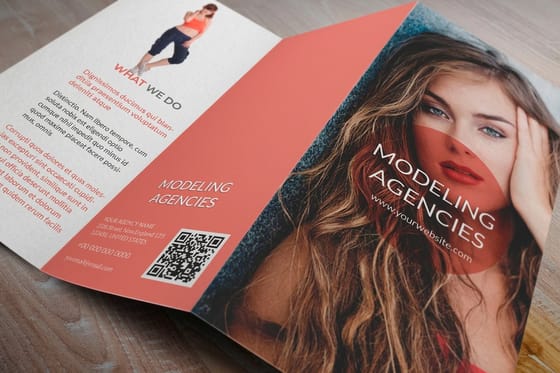
A trifold brochure is a single sheet of paper divided into three vertical panels and folded twice, so the panels nest inside one another. Printers call the mechanic a roll fold or a letter fold. Because both faces of the sheet are printed, a trifold gives you six design surfaces: a front cover, a back panel, an inside flap and a three panel inside spread. The standard letter size version starts as an 8.5 by 11 inch sheet and folds down to 3.67 by 8.5 inches.

Start here
The tri fold in one paragraph
Take one sheet of paper, divide it into three vertical panels, roll the right panel in and fold the left panel over it. That is a trifold. Two creases turn a flat sheet into a piece with a cover, a back, a flap and a wide inside spread, six printable surfaces in total. It fits standard racks and envelopes, it costs a fraction of a stitched booklet, and it paces information in three natural beats. The only real craft is respecting the fold: the tuck in panel has to be slightly narrower, and live text has to stay clear of every crease.
What a trifold brochure actually is
A trifold brochure is one flat sheet of paper divided into three vertical panels and folded twice so the panels wrap around each other. Nothing is stitched, stapled or bound. The whole format is a single piece of stock plus two creases, which is exactly why it stays the cheapest way to hand somebody a story with a beginning, a middle and an end.
Print shops rarely call it a trifold on the production floor. There it is a roll fold or a letter fold, named after the way you fold a letter to fit an envelope: the right third rolls in, then the left third folds over the top of it. Two folds, three panels, one finished piece that slides into a rack, a folder or a number 10 envelope without any trimming.
The word trifold describes the panel count, not the page count. Because the sheet prints on both faces, you get six surfaces to plan. Designers who treat those six as six separate flyers end up with a brochure that reads like a stack of unrelated notes. Designers who treat them as a sequence get a piece that unfolds like a short story. If you want the fold family in full, the guide to how to fold a brochure walks through every option next to the trifold.
How a tri fold brochure folds into three panels and six sides
Lay the sheet down in landscape. Two vertical creases split it into left, middle and right thirds. Roll the right third inward so it sits on top of the middle. Then bring the left third over the whole stack. The panel that folded in first is now hidden between the other two, and the panel that folded last is facing you as the cover.
That mechanic decides which surface plays which role. On the outside face of the sheet, reading left to right, you have the panel that tucks inside, then the back panel, then the front cover. On the inside face you have the flap a reader meets first when they lift the cover, followed by the two panels of the main spread. Six surfaces, three per side, each with a job.
The sequence matters more than the geometry. A reader sees the cover, opens one flap and reads a partial view, then opens the second flap and gets the full spread. Good trifolds reward each of those three moments with something new. Weak ones repeat the headline three times and waste two thirds of the paper. The elements of brochure design covers how to pace that reveal panel by panel.
Trifold vs bifold vs gatefold vs Z fold
A bifold is a single fold down the middle: two panels per side, four surfaces total, and a finished piece that is half the flat sheet. It reads like a small book and suits long copy, photography and anything you want to feel like a program or a report. Fewer surfaces means fewer decisions, but also less room to build a narrative.
A Z fold uses the same three panels as a trifold but folds them in opposite directions so the sheet zigzags instead of nesting. Nothing tucks inside anything, so all three panels stay identical in width, and the piece opens in one pull to reveal a full banner style spread. Choose it when the inside is one big image or one continuous timeline.
A gate fold folds both outer panels inward until they meet at the center like a pair of doors. It is the most theatrical of the group and the most expensive to fold accurately, which is why it usually shows up on invitations and premium product launches rather than rack brochures.
The trifold wins on economics and distribution. It fits every standard rack, mails without an envelope when you seal it, and gives you six surfaces on one sheet. Compare the full matrix in standard brochure sizes and folds before you commit a print run to a format.
Standard trifold sizes and panel dimensions

Trifold sizes are quoted two ways: the flat size the press runs and the finished size the reader holds. Four combinations cover almost every job.
- 8.5 by 11 in flat, 3.67 by 8.5 in finished. The default. Fits every literature rack, every standard envelope and most coat pockets.
- 8.5 by 14 in flat, 4.67 by 8.5 in finished. Legal stock with wider panels, the usual pick for menus, price lists and anything with tables.
- 9 by 12 in flat, 4 by 9 in finished. A taller, more premium proportion that still slips into a presentation folder pocket.
- 11 by 17 in flat, 5.67 by 11 in finished. Tabloid stock for trade shows, real estate sheets and anything that needs full width photography inside.
Panel width is where trifolds trip people up. On a letter size roll fold the two outer panels sit at about 3.6875 inches while the tuck in panel is cut closer to 3.625 inches. That sixteenth of an inch is not a rounding error, it is clearance. Give all three panels identical widths and the inner panel jams against the fold, bows the cover and produces a spine that will not lie flat in a rack.
If you would rather not do the arithmetic, start from a preset. The free trifold brochure template guide has the panel math already applied for each flat size.
How to set up artwork for the fold

Build the file as two spreads, not six pages. One document page carries the three outside panels and a second carries the three inside panels, both at the full flat size. Add guides at each fold position so every element is placed against the crease it will actually live beside.
The single most common mistake is laying the outside panels out in reading order. On the outside face the front cover sits on the right third and the back panel in the middle, because the fold reverses their positions once the sheet is closed. Design the cover in the wrong third and you get a beautifully printed brochure with the contact block on the front. Drop your content into a tri fold brochure template and that ordering is handled for you.
Four numbers keep a trifold out of trouble: an eighth of an inch of bleed on all four outer edges, an eighth of an inch of safety margin inside the trim, a quarter inch of clearance from every fold line for live text, and no background break exactly on a crease unless you want the misregistration to show. Export a single flattened PDF per side with fonts embedded and images at 300 dpi at final size.
Where a trifold brochure earns its keep

Trifolds are the workhorse of any situation where a person will hold your material for sixty seconds and then decide. Hotel and visitor racks, clinic waiting rooms, trade show tables, real estate open houses, university open days, gym membership desks, restaurant takeout counters and nonprofit donation drives all run on the same format for the same reason: it stands up on its own and it explains itself.
The format also suits any story with three natural beats. Problem, approach, proof. Services, process, pricing. Before, during, after. When your content already splits into thirds, the fold does half the information design for you and the reader never has to work out where to look next.
It is the wrong choice for two jobs. If you have a single message and a single call to action, a flat flyer says it faster and costs less. If you have more than about six hundred words of real content, you want a stitched booklet rather than a trifold with six inch type. For more angles on making the format work harder, see 10 brochure ideas you have not thought of yet.
Design and bleed tips for trifold panels
Treat the cover as a poster, not a page. One image, one headline, one reason to open it. Everything else you are tempted to put there belongs inside. The cover has roughly two seconds to earn the fold being opened, so a phone number and an address on the front is two seconds spent on information nobody needed yet.
Inside, keep body copy between 9 and 11 point and leave generous space at the fold. Type that crosses a crease gets cracked by the scoring wheel and becomes hard to read, especially on coated stock. Images can cross a fold if the subject does not: put the horizon or the background across the crease and keep the face, the logo or the product on one panel.
Paper weight changes the design. Text weights around 100 lb fold crisply straight off the press and feel like a rack brochure. Cover weights feel expensive but need scoring before folding, or the coating cracks along the crease in a white line. Ask for scoring on anything heavier than a text weight sheet, and get a proof before a long run.
Finally, plan the back panel before you fill it. If the piece will be mailed, that panel needs a clear address area and no varnish where the ink jet will print. If it will be racked, only the top third of the cover is visible, so put the hook there.
How to order trifold brochures

Ordering runs in five steps. Pick the flat size, pick the stock and coating, choose the fold, set the quantity, then upload two print ready spreads. The configurator prices the job live as you change each choice, so you can watch what a heavier stock or a shorter turnaround actually adds before you commit.
Order proofs on any run over a few hundred pieces, and order them on the real stock rather than a house sheet. A fold behaves differently on 100 lb text than it does on 14 pt cover, and the only way to know how your crease will sit is to hold it. If you are weighing suppliers on turnaround rather than price, the fast turnaround alternative to Staples brochure printing lays out how the production windows compare.
Build in time for preflight. Turnaround clocks start when files pass, not when the order is placed, and the two problems that stall folded jobs are missing bleed and artwork built as six separate pages instead of two spreads. Fix both before you upload and a trifold moves through production without a single email.
Wally explains the tri fold
Two creases, three panels, six chances to be read
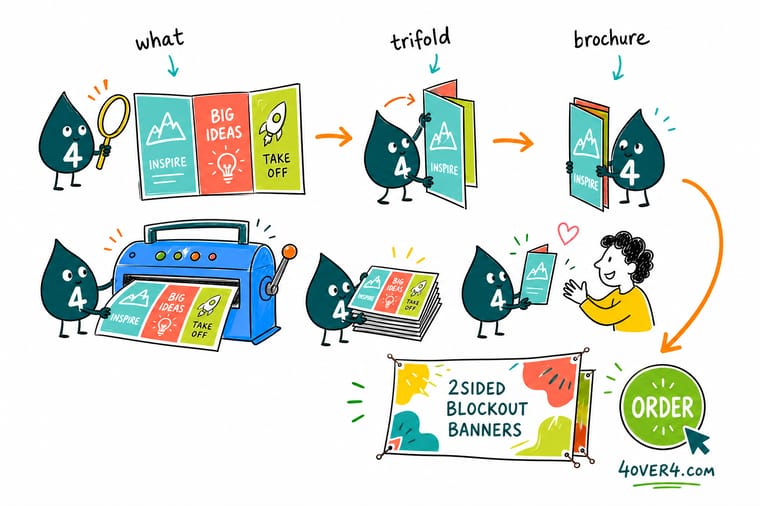
Wally thinks of a trifold as three small posters that have to agree with each other. The cover earns the open, the flap keeps the reader moving, and the full spread delivers the payoff. His rule of thumb: write the six panels on six index cards before you open any design software. If the story does not hold together on cards, no amount of paper weight will save it on press.
Print your folded piece →Fold diagram
Three panels per side, six printable surfaces
One flat sheet, two creases, and six places to put something worth reading. This diagram maps which panel becomes the cover, which one tucks inside, and where the inside spread lands.
Panel order on the outside face is not reading order. The front cover sits on the right third and the back panel in the middle, because the fold reverses their positions once the sheet is closed.
Specs and pricing
See how live specs and pricing work before you order
Every 4OVER4 product prices live by size, stock, quantity and turnaround, so you can watch what each choice adds before you commit. Here is a working example of the specs panel and the price table you will meet at checkout.

| Quantity | Price Per Unit | Total |
|---|---|---|
| 1 | $108.75 | $108.75 |
| 2 | $108.74 | $217.47 |
| 3 | $108.74 | $326.22 |
| 4 | $97.76 | $391.02 |
| 5 | $97.76 | $488.78 |
| 6 | $97.76 | $586.53 |
| 7 | $89.28 | $624.98 |
| 8 | $86.77 | $694.18 |
Print it
Popular products printed in house at 4OVER4


See it in use
Real customer work, printed in house





Explore more
Where to go next

By the numbers
Printing you can count on at 4OVER4.COM
Common Questions
Common questions about trifold brochures
What is a trifold brochure?
A trifold brochure is a single sheet of paper divided into three equal vertical panels and folded twice so the panels wrap around each other. Printers call the mechanic a roll fold or a letter fold because it is the same fold you use to put a letter into an envelope. Folding twice gives you six printable surfaces, a front cover, a back panel, an inside flap and a three panel inside spread that opens all at once.
How many panels and pages does a tri fold have?
Three panels per side and six panels in total. That is six separate design surfaces, not six pages, because the three inside panels are read together as one wide spread rather than one at a time. Most layouts use the front cover for the hook, the inside spread for the full story, the inside flap for supporting detail and the back panel for contact details, a map or a mailing area.
How do I choose the right trifold for my project?
Start with where the piece will live. Racks and counter displays want the letter size trifold at 3.67 by 8.5 inches finished. Menus, price lists and spec sheets usually want legal or 11 by 17 inch stock so the panels stay wide enough for tables. If the brochure will be mailed on its own, choose a heavier cover stock, leave one panel clear for the address block and check the fold seals against your postal requirements.
What does trifold brochure printing cost and how are prices set?
Price is driven by quantity, flat size, paper weight, whether you print one side or both, the coating you choose and how fast you need it. Cost per piece drops steeply with quantity because the press setup is spread across the run, so a thousand brochures rarely costs ten times what a hundred costs. Folding is a finishing step, so it is priced separately from the printing on most quotes.
What sizes, stocks and finishes can I order?
The common flat sizes are 8.5 by 11, 8.5 by 14, 9 by 12 and 11 by 17 inches, folding down to 3.67 by 8.5, 4.67 by 8.5, 4 by 9 and 5.67 by 11 inches. Text weights around 100 lb feel light and fold crisply, while cover weights feel substantial and usually need scoring first. Finishes range from uncoated for writability to gloss, matte and soft touch coatings for shelf presence.
How long does printing and shipping take?
Turnaround is quoted in business days and starts after your files pass preflight, not at the moment you place the order. Standard production for a folded piece typically runs a few business days because folding and scoring happen after the ink dries, and rush options shorten that window. Shipping time sits on top of production, so choose the ship method at checkout with your event date in mind.
Should the fold panels be exactly equal in width?
No. On a roll fold the panel that tucks in first must be slightly narrower, usually about a sixteenth of an inch, so it clears the fold instead of pushing against it and causing a bulge or a crooked spine. A Z fold is the exception, because its panels zigzag outward and never nest, so all three panels stay the same width.
Get Started
Ready to get your trifold on press?
Pick the flat size, choose the stock, upload two spreads and let the fold do the rest. 4OVER4 prints and finishes in house, so the crease lands where you drew it.
Legal Disclaimer
Gold Standard guarantees apply to all standard orders placed through 4over4.com. Price match requires verifiable proof of a competitor's published price for an equivalent product with matching specifications and turnaround time. Satisfaction guarantee covers manufacturing defects and print quality issues. Contact support with order number and documentation. On-time delivery rate based on tracked orders 1999 to 2026. Individual results may vary based on shipping carrier performance.
