
How to Design a Trifold Brochure That Folds and Reads Correctly


The panel order, the exact panel widths, the margins that keep type off a crease, and the content sequence a reader actually follows when they open one.
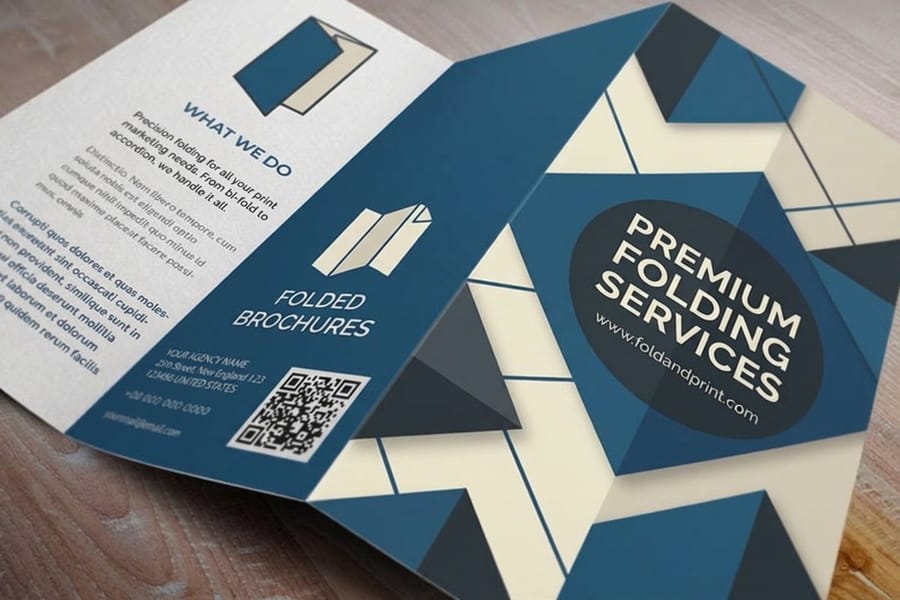
Lay a trifold out as one 8.5 by 11 inch sheet with three panels a side, and make the panel that folds in first 3 5/8 inches while the other two are 3 11/16 inches. The outside reads inside flap, back panel, front cover from left to right, and the inside is its mirror image. Keep live copy 1/4 inch off every fold and 1/8 inch inside the trim, add 1/8 inch of bleed, and put fold marks outside the artboard rather than on the artwork.
Quick answer
Two mirrored sides, and one panel that is 1/16 inch narrower
A trifold is a single sheet folded twice, so the panel order on the sheet is nothing like the reading order. On a letter sheet the outside runs inside flap, back panel, front cover from left to right, the inside is the mirror of that, and the panel that folds in first has to be trimmed 1/16 inch narrower so the piece closes flat. Live copy stays 1/4 inch off every fold and 1/8 inch inside the trim, with 1/8 inch of bleed beyond it. Get those three things right and the design work is ordinary layout.
The Six Panels and Which One Goes Where
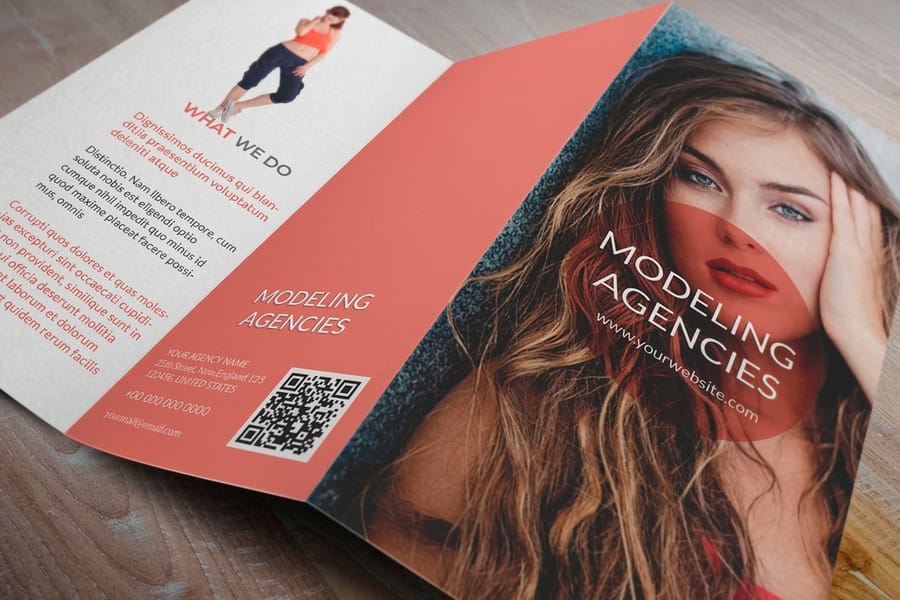
A trifold is one sheet with two parallel folds, which gives three panels on the outside and three on the inside. Six surfaces, not six pages, and they do not sit in reading order on the sheet.
Set up the outside first. Left to right it runs inside flap, back panel, front cover. Flip the sheet over and the order mirrors, so the inside runs inside left, inside middle, and then the reverse of that narrow flap on the far right. Nothing about that arrangement is intuitive, which is why designers who lay the cover on the left of page one end up with a brochure whose cover is in the middle.
| Panel | Side of sheet | Position | What belongs on it |
|---|---|---|---|
| Front cover | Outside | Right | One promise and one image. No paragraphs, no phone number. |
| Back panel | Outside | Middle | Logo, address, phone, hours. This is the mailing face if the piece is mailed. |
| Inside flap | Outside | Left, narrow | The panel a reader sees on the way in. A short hook, a testimonial, or a form. |
| Inside left | Inside | Left | The problem, in the reader's language, before you talk about yourself. |
| Inside middle | Inside | Middle | Your answer to it. This is the panel eyes settle on when the piece is fully open. |
| Flap reverse | Inside | Right, narrow | Proof and the next step. Pricing, a map, a call to action. |
Which two panels get folded depends on the fold you choose, and a trifold is not one thing. The roll fold described here is the common one, but a gate fold and an accordion fold reorder the panels entirely. Our guide to brochure fold types sets them side by side, and standard brochure sizes and folds gives the finished dimensions for each.
Panel Widths, Fold Lines and Safe Margins
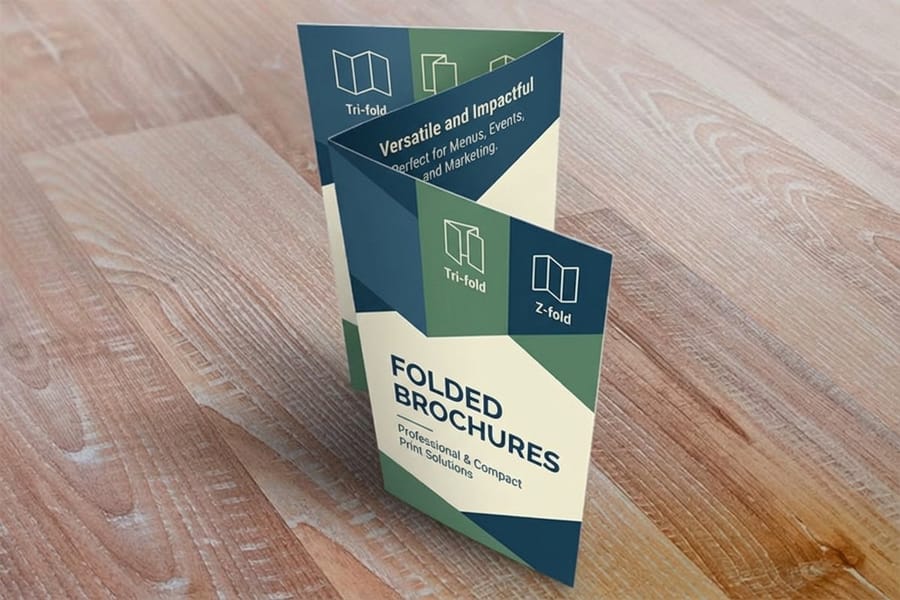
Divide 11 inches by three and you get 3.667 inches. Build the panels at that width and the brochure will not close properly, because the panel folding inside has to travel around the thickness of the two panels wrapping it.
The working split on a letter sheet is 3 5/8 inches for the tuck panel and 3 11/16 inches for the other two. Those add to exactly 11 inches, and the 1/16 inch of clearance is what lets the piece lie flat under a stack. On heavy cover stock the tuck panel is sometimes pulled back a full 1/8 inch instead. That is the whole trick, and it is the single measurement most homemade trifolds get wrong.
Margins stack on top of that. Extend any background that touches an edge 1/8 inch past the trim so the cut never exposes white paper. Pull live copy 1/8 inch inside the trim, and 1/4 inch away from each fold. Do the arithmetic on a middle panel and roughly 3 3/16 inches of usable width is left, which is narrow enough that a two column layout inside one panel almost never works.
Draw fold marks outside the artboard, never on the artwork. A fold line drawn as a visible rule prints as a visible rule. If you would rather not set the geometry up by hand, the correctly measured layouts in our blank template library already carry the panel splits and the fold marks, and the free trifold template guide walks through using one.
How Content Flows Across a Trifold
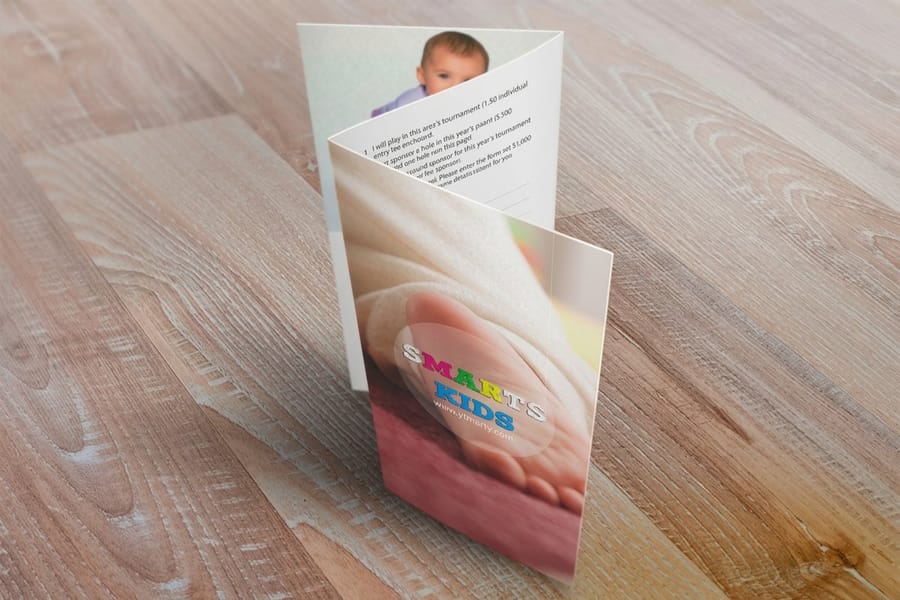
A reader meets a trifold in a fixed sequence, and copy that ignores the sequence reads like a folded flyer. Cover, then the flap on the way in, then the full inside spread, then the back.
Give the cover one job. A promise and an image, in type large enough to read from a rack two steps away. Anything you add beyond that competes with the one line you actually want read. The inside flap is the bridge: a sentence that earns the open, a short testimonial, or the question the brochure answers.
Treat the three inside panels as one canvas rather than three columns. A photograph or a band of color can run across the folds and hold the spread together, so long as nothing that has to be read sits on a crease. Headline on the middle panel, supporting copy either side, and the offer where a thumb naturally lands on the right. Keep paragraphs to three or four lines. A panel is a little over three inches wide, and long paragraphs turn into grey slabs at that measure.
The back panel is the practical one. Logo, address, phone, hours, and a QR code if you want the piece measurable. If the brochure will be mailed, that panel is the mailing face and the address block has to stay clear, which is a different layout from a rack piece. Direct mail brochures start at $238.73 with the mailing handled, and choosing fonts and sizes for a brochure covers the type sizes that survive a narrow panel.
Paper, Scoring and Getting the File Printed

Stock decides how the fold behaves. Text weight paper folds cleanly on its own and feels like a brochure should when it is handed over. Cover weight feels more substantial, holds a rack better, and will crack along the fold if it is not scored first.
Cracking is worth picturing before you commit to a dark inside spread. The outside of a fold stretches, the coating on top of it has no elasticity, and it splits into a fine white line down the middle of your color. Scoring crushes a channel into the sheet before folding so the paper bends along a controlled line instead of tearing. Ask for a score on anything at cover weight, and be extra careful with a solid dark panel that meets a fold.
Coating is the other decision. Gloss lifts photographs and resists fingerprints, matte reads better under fluorescent light and takes a pen, and the comparison in matte versus glossy brochures lands on which one suits which job. For the weight itself, the brochure paper guide lists what folds well.
When the file is ready, folded brochures start at $57.11 with the fold included, and flat standard brochures start at the same price if you would rather fold in house. If the piece is really a single panel that lives in a rack, rack cards at $42.84 do that job without any folding at all, and a piece with more than six panels of content belongs in booklets instead. The full range sits on the brochure printing page.
Wally explains the trifold
Three panels, and one of them is shorter on purpose
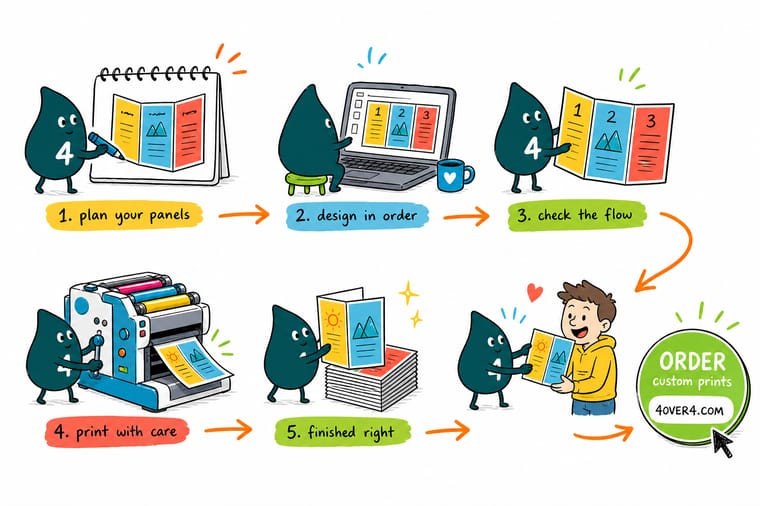
Wally divides the 11 inch width into 3 5/8, 3 11/16 and 3 11/16 instead of three equal thirds, because the short panel is the one that folds in and it needs room to clear the spine. He sets the outside as inside flap, back panel, front cover, then flips the sheet and lets the order mirror itself. Live text stays a quarter inch off every crease. Fold marks go outside the artboard, never on the artwork, or they print.
Print folded brochures →Specs and pricing
Brochure formats, sizes, and starting prices
Configure the format against your panel plan, with live sizes, stocks and starting prices from the 4OVER4.COM configurator.


Print it
Order the format your layout actually needs
Explore more
Where to go next


By the numbers
Brochure printing you can count on at 4OVER4
Common Questions
Your trifold setup questions, answered
What size is a trifold brochure when it is folded?
A letter size trifold starts as an 8.5 by 11 inch flat sheet and folds across the 11 inch width, so the finished piece is about 3.67 by 8.5 inches. That fits a standard number 10 envelope and a standard countertop brochure rack, which take up to 4 inches of width. The larger option is a legal size 8.5 by 14 inch sheet, which folds to roughly 4.67 by 8.5 inches and no longer fits a number 10 envelope.
Which panel is the front cover in a trifold template?
On the outside of the sheet, the front cover is the right hand panel. Reading left to right the outside runs inside flap, back panel, front cover. The inside of the sheet is the mirror image, so the narrow tuck panel that sat on the far left of the outside appears on the far right of the inside. Laying the outside out in reading order with the cover on the left is the single most common trifold mistake, and it prints a brochure whose cover is buried in the middle.
Why is one panel narrower than the other two?
Because it folds inside the other two and needs somewhere to go. Paper has thickness, so a panel that folds in against a closed spine at full width pushes outward and the brochure springs open or creases at the edge. Trimming that panel 1/16 inch, to 3 5/8 inches on a letter sheet, gives it clearance. On heavy stock some printers take 1/8 inch instead. The three widths still have to add up to the full 11 inches of the sheet.
Can text or a photo cross a fold line?
A photo or a background color can cross a fold and usually looks intentional. Text should not. A fold puts a physical ridge through the letterforms, and folding accuracy of about 1/32 inch means the ridge lands in a slightly different place on different copies. Keep headlines, body copy, phone numbers and logos at least 1/4 inch away from every fold. If a headline has to span the inside spread, break it so the gap falls between words rather than through one.
What bleed and margins does a trifold need?
Build the document at the flat trim size, 8.5 by 11 inches, then extend any background that touches an edge 1/8 inch past the trim on all four sides, giving an 8.75 by 11.25 inch artboard. Pull live content 1/8 inch inside the trim so nothing important is lost to cutting tolerance, and 1/4 inch away from each fold line. Add fold marks in the slug area rather than drawing lines on the artwork itself.
Do I need to score a brochure before folding it?
Text weight paper folds without scoring. Cover weight does not, and a coated cover stock is the worst case because the clay coating has no give. The fibers on the outside of the fold stretch, the coating splits, and a white crack runs down what should be a solid dark panel. Scoring crushes a channel first so the paper folds along a controlled line. On any brochure ordered at cover weight, confirm the job includes a score, not just a fold.
Get Started
Ready to print a trifold that closes flat?
Pick your size and stock, upload the flat sheet with the panels split correctly, and we fold, score where the paper needs it, and ship.
Legal Disclaimer
Gold Standard guarantees apply to all standard orders placed through 4over4.com. Price match requires verifiable proof of a competitor's published price for an equivalent product with matching specifications and turnaround time. Satisfaction guarantee covers manufacturing defects and print quality issues. Contact support with order number and documentation. On-time delivery rate based on tracked orders 1999 to 2026. Individual results may vary based on shipping carrier performance.
