
Trifold Brochure Paper Weights, Coatings and Panel Math


The stocks that suit a six panel piece, the coating that decides whether the fold cracks, and the panel widths that let a trifold close flat instead of springing open.
Most trifold brochures print on 100 lb gloss text, which is 148 gsm and folds cleanly without a scoring pass. Anything at cover weight, from 80 lb cover at 216 gsm upward, has to be scored first or the coating splits white along the crease. The panel widths matter just as much: on an 11 inch flat sheet, a roll fold runs 3.6875, 3.6875 and 3.625 inches, because the panel that folds inside has to be 1/16 inch shorter to close flat.
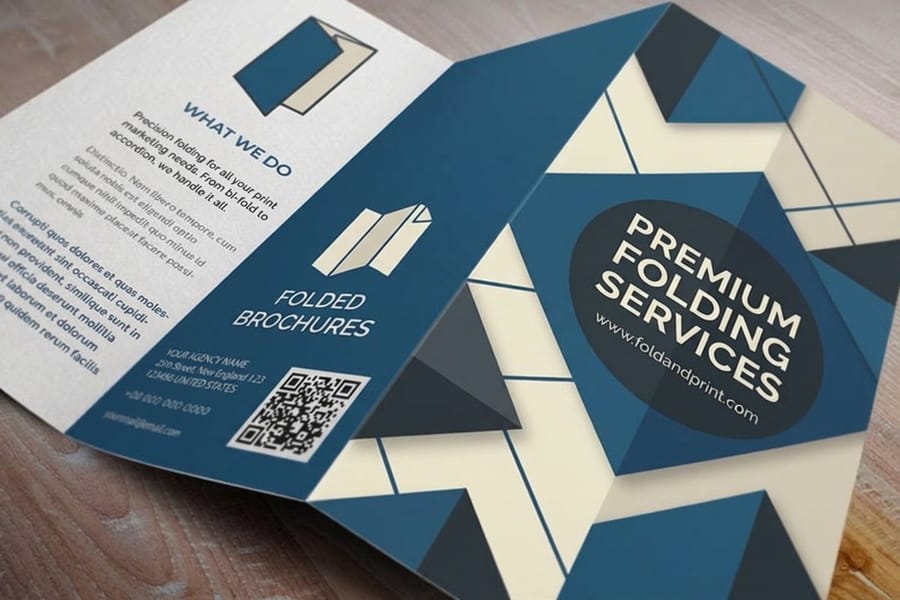
Quick answer
148 gsm text stock, and one panel cut 1/16 inch short
Pick the weight first, then the coating, then check the panel widths. 100 lb gloss text handles the majority of trifolds, 80 lb text is the mail run economy choice, and cover weight is for pieces that get handed over rather than posted. Gloss wins on photography, matte wins on body copy, uncoated wins whenever someone has to write on it. Then set the panels at 3.6875, 3.6875 and 3.625 inches, add 1/8 inch of bleed, and keep live copy 3/16 inch back from every fold.
What Trifold Brochure Paper Actually Is
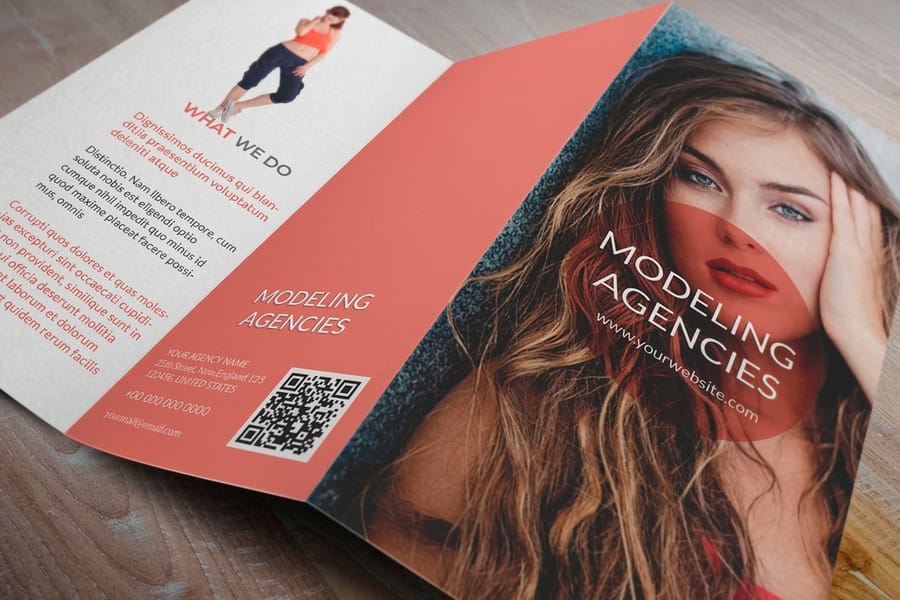
Brochure stock comes from two families, and mixing up the names is the single most common reason a job arrives feeling wrong. Text weight, also called book weight, is the paper a magazine page is made from. Cover weight is the thicker sheet a magazine cover is made from. The pound number is measured against a different sheet size in each family, so the numbers are not comparable.
That is why 100 lb text and 100 lb cover are nothing alike. 100 lb text is 148 gsm and folds in your hands. 100 lb cover is 270 gsm, close to double the thickness, and it needs a machine to fold it properly. If a quote says only 100 lb, ask which one before you approve it.
| Stock | Metric weight | How it folds | Where it fits a trifold |
|---|---|---|---|
| 80 lb gloss text | 118 gsm | Folds cold, no score needed. | Large mail runs and inserts that live inside an envelope. |
| 100 lb gloss text | 148 gsm | Folds cold, holds a sharp crease. | The default. Racks, counters, handouts, mailers. |
| 80 lb gloss cover | 216 gsm | Score first, or the coating splits. | Premium handouts that still need to be mailable. |
| 100 lb gloss cover | 270 gsm | Score first, folds like a card. | Trade show and real estate pieces that must feel solid. |
One more thing about text weight: it takes ink on both sides without ghosting, which matters on a trifold because six panels means both sides are printed. If you have ever held a brochure and seen the inside photo faintly through the cover, that is a sheet that was too light for the ink coverage. Our cardstock weights guide covers the point and pound systems side by side if you want the full conversion picture.
Coatings, and What Each One Does at the Fold
Coating changes two things at once: how the color looks, and how the sheet survives being bent. Most people only think about the first.
Gloss keeps ink sitting on the surface, so blacks go deep and photographs get their contrast. It is the right answer for an inside spread built on images. It is also the worst answer for a piece someone has to write on, and the most likely to reflect a ceiling light straight back into a reader's eyes.
Matte, sometimes called dull, is still a coated sheet with the same ink holdout, just without the shine. Three columns of body copy read noticeably easier on matte. Expect slightly less punch in the photos, which is a fair trade when the panels are mostly text. The matte versus glossy brochure comparison shows the same artwork on both if you want to see it before deciding, and 100 lb matte cover gets its own breakdown.
Uncoated absorbs ink into the fibers, so colors sit flatter and text edges soften a fraction. In exchange you get a sheet that takes pen ink, feels warmer in the hand, and cracks least of all at the fold. Anything with a form, a signature line or a write-in field should be uncoated.
Here is the part that decides the job. On coated cover stock, the coating and the ink film are more brittle than the paper fibers under them. Fold that sheet without scoring it first and the coating splits into a white hairline right along the crease, worst where a solid dark color crosses the fold. Scoring crushes a channel of fibers before the fold happens, so the sheet bends around the channel instead of tearing across it. Every cover weight fold we run gets scored. Text weight almost never needs it. Standard brochures start at $57.11, and the fold and score are part of the price rather than an extra line.
The Panel Math That Makes a Trifold Close Flat

A trifold is not one sheet divided by three. On a roll fold, one panel folds inside the other two, and a panel that has to sit inside two thicknesses of paper must be shorter or the closed piece bulges and springs open at the edge.
On an 11 inch flat sheet the working numbers are 3.6875, 3.6875 and 3.625 inches. The short panel folds in first and stops 1/16 inch back from the closed edge. That gap is not a defect. It is the clearance that lets the brochure lie flat in a stack.
| Flat size | Fold | Panel widths | Finished size |
|---|---|---|---|
| 8.5 x 11 in | Roll fold | 3.6875 / 3.6875 / 3.625 | 3.6875 x 8.5 in |
| 8.5 x 11 in | Z fold | 3.6667 / 3.6667 / 3.6667 | 3.6667 x 8.5 in |
| 8.5 x 14 in | Roll fold | 4.6875 / 4.6875 / 4.625 | 4.6875 x 8.5 in |
| 11 x 17 in | Roll fold | 5.6875 / 5.6875 / 5.625 | 5.6875 x 11 in |
The Z fold row is the exception worth remembering. A Z fold zigzags out and back, so nothing tucks inside anything and all three panels stay equal. Designers who learned the 3.625 rule on a roll fold sometimes apply it to a Z fold and end up with one narrow panel for no reason.
Two setup numbers finish the file. Add 1/8 inch of bleed on all four sides of the flat sheet so trim variance never leaves a white sliver at a panel edge. Then keep live text and logos at least 3/16 inch back from every fold line, because folding tolerance is looser than cutting tolerance and a headline sitting on the crease will look off center on some copies and fine on others. Bleed and trim explained walks through the measurements, and the blank template library has the panel splits already drawn so you do not have to build the guides yourself.
Panel order catches people too. On a roll fold the tuck panel is the one that ends up on the far right of the outside artwork and the far left of the inside artwork. Print a proof, fold it by hand, and check that the front cover is where you think it is before the run goes to press. The fold types guide maps the panel positions for each style.
Pick the Stock by Where the Brochure Ends Up

The use case decides the stock faster than any spec sheet. Four situations cover almost everything.
- In a wire rack. Text weight slumps and curls forward in an open rack, and a curled brochure looks abandoned. 100 lb cover stands straight, and it is worth the score and the extra paper cost when a rack is the whole distribution plan.
- In the mail as a self mailer. Text weight folds flat and keeps postage down. A folded self mailer has to be tabbed closed before it will run through postal equipment, so budget for tabs and leave the tab position clear of your artwork.
- Handed over at an event. Cover weight, every time. The piece is judged in the two seconds between one hand and another, and thickness is most of that judgment.
- Stuffed into an envelope or a folder. 80 lb text, folded, at the lowest cost per piece. Nobody evaluates the paper of an insert.
Cost sets the last boundary. Folded brochures start at $57.11 and cover the trifold, bifold and Z fold styles on both text and cover stocks. If the piece does not actually need a fold, standard flyers start at $39.54 and put the same information on one flat sheet. If six panels are not enough room, you have outgrown the format: standard booklets start at $240.55 and give you a bound piece with as many pages as the story needs. Our booklet versus brochure versus flyer comparison draws the line between the three, and the full brochure printing range lists every size and stock we run with live pricing.
Wally explains trifold paper
One panel shorter, and score it if it is cover weight
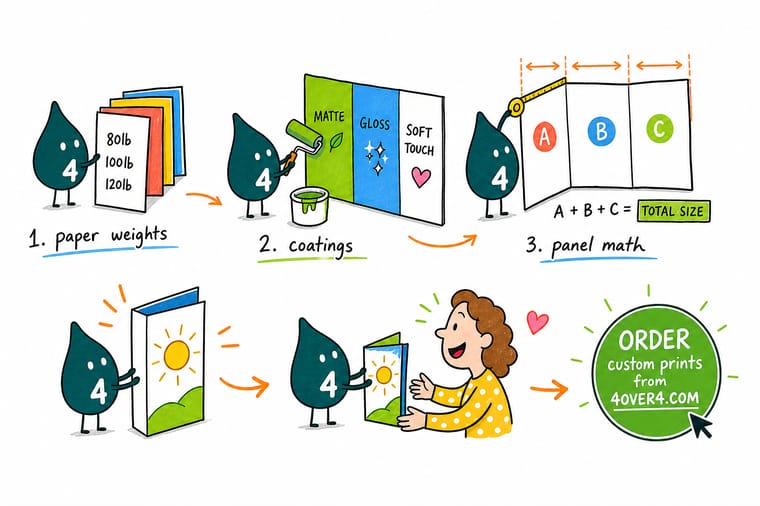
Wally lays the flat sheet on the bench and measures 3.6875, 3.6875 and 3.625 inches across 11 inches. The short panel folds in first, stopping a sixteenth of an inch back from the closed edge so the brochure lies flat instead of springing open. If the sheet is cover weight he scores it before folding, because coated cover cracks white along a cold crease. Text weight at 148 gsm he just folds.
Order folded brochures →Specs and pricing
Stocks, folds, sizes and starting prices
The live configuration options for each format, straight from the 4OVER4.COM configurator, so you can see which stocks and folds are available before you build the file.


Print it
Order a trifold that folds the way you drew it

Explore more
Where to go next


By the numbers
Brochure printing you can count on at 4OVER4
Common Questions
Your trifold paper questions, answered
What is the best paper weight for a trifold brochure?
100 lb gloss text, which is 148 gsm, handles the majority of trifold work. It is heavy enough that the panels do not curl in a rack, light enough that it folds crisply without a scoring pass, and it prints saturated color on both sides without show-through. Go up to 100 lb cover when the brochure is handed over at a counter or a trade show and needs to feel substantial. Go down to 80 lb gloss text when the piece is a mailer that lives inside an envelope and the run is large enough that the paper cost matters.
Can you print a trifold on cardstock?
Yes, but it has to be scored, and you should expect a heavier fold. 14pt and 16pt card measure roughly 0.014 and 0.016 inches thick, so the fold is a mechanical operation rather than a crease. A scored cover sheet gives a brochure that stands up on its own and survives a bag, which is why event and real estate pieces often use it. The trade off is bulk in the mail, a stiffer open, and a fold line that will show some coating stress no matter how carefully it is scored.
Why did my folded brochure crack along the fold?
Almost always because a coated cover sheet was folded without being scored first, and usually with a dark ink laid over the fold. The coating and the ink film are more brittle than the fibers underneath, so bending them past a certain radius splits them into a white hairline. Two fixes: score the sheet before folding, and where you can, avoid running a solid dark panel across the fold line. Uncoated stock and text weight rarely show it at all.
What is the standard trifold brochure size?
8.5 by 11 inches flat, folded down to 3.6875 by 8.5 inches. Legal size at 8.5 by 14 folds to 4.6875 by 8.5, and tabloid at 11 by 17 folds to 5.6875 by 11. The letter trifold is the one that fits a standard brochure rack and a number 10 envelope, which is why it stayed the default.
Should a trifold be gloss, matte or uncoated?
Match the coating to the panel that matters most. If the inside spread is photography, gloss gives the strongest contrast and the deepest blacks. If the inside spread is three columns of copy that someone reads under office lighting, matte removes the glare and reads better. Uncoated is the choice when a customer writes on the piece, since ink from a pen sits on a coated sheet instead of soaking in.
Do the three panels have to be different widths?
Only on a roll fold, where one panel folds inside the other two. That panel is cut about 1/16 inch narrower so the closed piece lies flat instead of bulging at the open edge. A Z fold, where the sheet zigzags in and out, has nothing tucking inside anything, so all three panels stay equal at 3.6667 inches on an 11 inch sheet.
Get Started
Ready to print a trifold that closes flat?
Choose your stock and coating, pick the fold, and we score the cover weights before they go through the folder so the crease stays clean.
Legal Disclaimer
Gold Standard guarantees apply to all standard orders placed through 4over4.com. Price match requires verifiable proof of a competitor's published price for an equivalent product with matching specifications and turnaround time. Satisfaction guarantee covers manufacturing defects and print quality issues. Contact support with order number and documentation. On-time delivery rate based on tracked orders 1999 to 2026. Individual results may vary based on shipping carrier performance.
