
Free Tri Fold Brochure Templates With Real Panel Dimensions


A tri-fold folds a single sheet into six panels, and the panels are not equal widths. Four-panel accordion and double parallel folds follow the same rules with different numbers. The tuck-in panel is about a sixteenth of an inch narrower, and that gap is what lets it fold flat.
A standard tri-fold folds an 8.5 by 11 sheet into three panels per side, six in total. On a roll fold the outer panels are about 3.69 in and the tuck-in panel about 3.62 in so it folds flat. Need a fourth panel: an 8.5 by 14 accordion is four equal 3.5 in panels, and an 11 by 17 double parallel runs about 4.28 in on the two outer panels and about 4.22 in on the two inner ones. Add 0.125 in bleed, keep text 0.25 in from folds, and export a press-ready PDF.
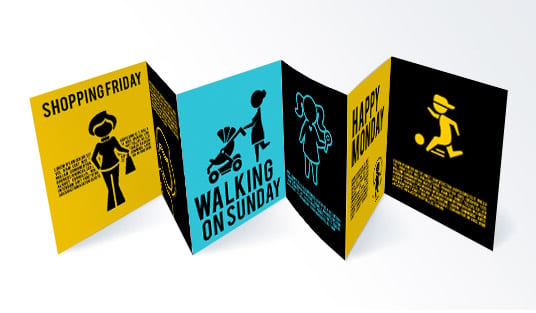
Start here
3.69, 3.69 and 3.62 inches
Three panels, six pages, unequal widths. A tri-fold folds an 8.5 by 11 sheet twice. On a roll fold the outer panels run about 3.69 in and the tuck-in panel about 3.62 in so it folds flat, while a Z fold keeps all three equal at about 3.67 in. Add 0.125 in bleed, hold text 0.25 in off the folds, and the diagram below maps the panels.
Why a tri-fold template saves the whole job

A tri-fold brochure looks simple, three panels folded from a single sheet, but the folds hide a detail that catches people out. The three panels are not equal widths. When a sheet rolls inward, the panel that tucks inside has to be a little narrower so it folds flat instead of buckling against the others. Miss that and your carefully centered art creeps across a crease.
That is exactly why starting from a template matters. A correct brochure template already has the panel widths, the fold lines, the bleed, and the safe margins set, so you design inside the guides and never fight the fold math. The result folds cleanly and prints predictably.
This guide covers the tri-fold and Z-fold layouts, the four-panel accordion and double parallel folds, the exact panel widths, and how to set up a file that folds where it should. When you are ready, order the finished piece as folded brochures, or browse the full brochure printing range to see stocks and finishes.
4 panel brochures, accordion and double parallel folds

Three panels are the default, but not every job fits them. A four-panel brochure gives you eight faces off one sheet and two ways to fold it. An accordion zig-zags so every panel opens flat and stands on its own, the way a Z fold does with three. A double parallel folds the sheet in half and then in half again in the same direction, so it opens like a small booklet with a wrap-around cover.
8.5 by 14 accordion. Split the 14 in length into four equal panels of 3.5 in each. The creases fall at 3.5 in, 7 in, and 10.5 in, and they alternate valley, mountain, valley. Nothing tucks inside anything else, so no panel needs the narrowing allowance a roll fold demands, which is the one place a four-panel is easier than a tri-fold. Closed, panel 1 is the cover and panel 4 is the back; opened, panels 2 and 3 are the first spread the reader sees.
11 by 17 double parallel. Fold the 17 in width in half at 8.5 in, then fold that doubled sheet in half again at 4.25 in with the crease running the same way. The two panels that end up wrapped on the outside have to be slightly wider than the two trapped inside, so set the outer pair at about 4.28 in and the inner pair at about 4.22 in. Skip that and the inside panels push against the spine and the piece springs open instead of lying flat. It is the same logic that makes a letter roll fold 3.69 in on the outside and 3.62 in on the tuck-in panel, applied twice.
The rest of the setup does not change: 0.125 in bleed on all four sides, text and logos held 0.25 in off every crease and the trim, CMYK at 300 DPI, fonts outlined or embedded, and one flattened press-ready PDF with the fold positions marked. A four-panel on 8.5 by 11 is possible, but the panels come out at 2.75 in, too narrow for comfortable body copy, so move up to 8.5 by 14 or 11 by 17 when you need the fourth panel.
Still weighing how many panels the content needs? The free brochure templates guide lays the folds out side by side. When the layout is settled, order the run as folded brochures and pick the fold style with the size and stock, compare stocks, quantities, and live pricing on brochure printing, or start from travel brochures if the piece is a destination or tour guide, since it folds on the same panel math.
How the six panels and reading order work
Fold an 8.5 by 11 sheet twice and you get three panels on the front and three on the back, six panels in total. They are read in a specific sequence as the piece opens, and designing in that order is what makes a brochure flow. On a roll fold the front cover faces out, the back panel wraps around, and the flap that tucks inside carries the first content a reader sees when they open it.
The inside spread, the three panels revealed when the brochure is fully open, is your main real estate, so put the heart of your message there. Treat each panel almost like its own small page: give it a headline, keep a clear safe margin, and hold logos and key text back from the fold lines so nothing important lands in a crease.
Getting the order right on paper before you design saves rework. Sketch which panel is the cover, which tucks in, and what the reader sees first, second, and third, then lay out the content to match that journey.
The exact panel widths for a clean fold
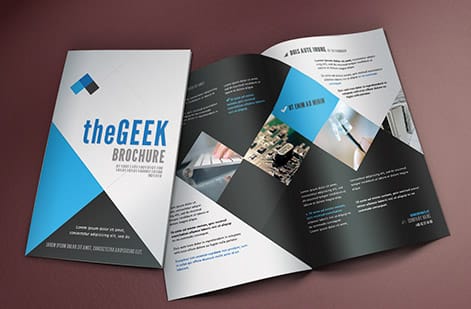
One number matters most. On a standard 8.5 by 11 roll fold, the two outer panels are about 3.69 inches wide and the inside tuck-in panel is about 3.62 inches. That small difference gives the narrow panel room to fold flat inside the others without pushing against the spine. Make all three equal and the tucked panel bows or wrinkles at the fold.
A Z fold plays by a different rule. Because the sheet zig-zags and no panel tucks inside another, all three panels are equal at about 3.67 inches. The choice between the two comes down to how you want the brochure to open: a roll fold reveals content in sequence for a guided read, while a Z fold opens like an accordion so each panel can stand on its own.
Legal and tabloid sheets scale these same proportions to their larger widths. Rather than calculate them by hand, start from a template sized to your sheet and fold, and the widths are already correct. Our companion guide on bleed and trim covers the edge setup that pairs with the fold layout.
Setting up the file so it folds and prints right
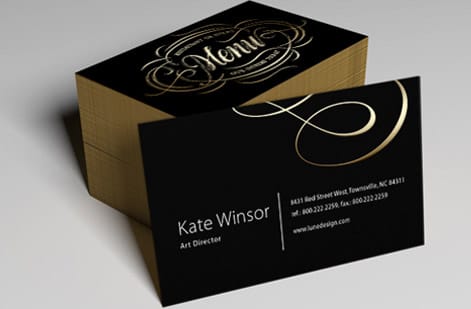
With the panel widths set, the rest of the file follows standard print prep. Extend the document 0.125 in past every edge for bleed so any art that runs to an edge survives the trim, and keep a 0.25 in safe margin from both the outside trim and the fold lines. That double margin is the tri-fold specific rule: text needs to stay clear of the creases as well as the blade.
Set the color mode to CMYK so your screen preview reflects the ink, place every image at 300 DPI at its final size so nothing prints soft, and outline or embed the fonts so your typefaces travel inside the file. These are the same fundamentals behind any press-ready piece, applied to a folded layout.
When the design is done, flatten it and export a single press-ready PDF with bleed and crop marks included. If you would rather not build the file yourself, our online design tool lays out the panels with the fold guides already in place, and our free file check confirms the folds before the brochure goes to press.
Choosing stock, finish, and what it costs
The last decisions are stock and finish, and they shape how the brochure feels. A heavier cover stock holds a crisp fold and feels substantial for a premium company or product brochure, while a lighter gloss text keeps a giveaway handout economical and easy to carry in volume. A gloss or soft-touch coating adds polish, and an uncoated sheet keeps things simple and writable.
Cost follows the familiar levers: quantity, size, stock, finish, and fold. Quantity is the biggest, so the per-piece price drops as the run grows. You set each option in the configurator and the total updates live, so you can compare a heavier stock or a larger run before you commit.
From there it is picking the product and the specs. Use the live specs and pricing panel below to see exact sizes, stocks, and finishes for folded brochures, or explore standard brochures and travel brochures for other formats.
Wally folds it before he designs it
The tuck-in panel is the narrow one
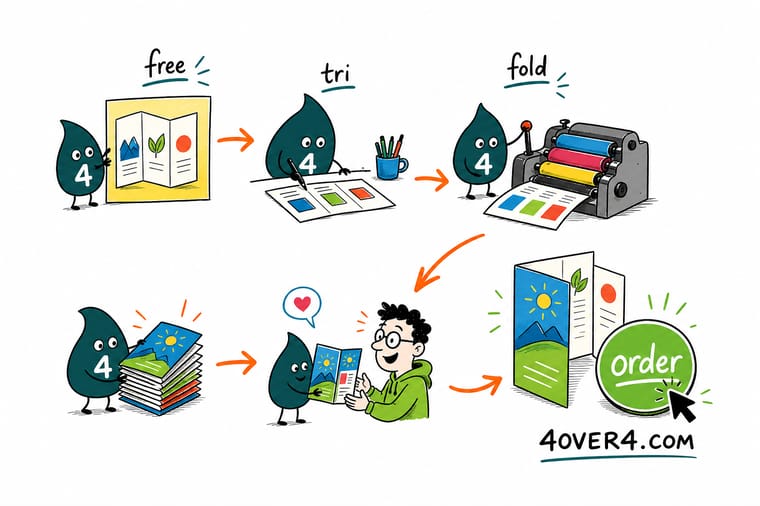
Wally starts a tri-fold by folding the sheet, not by drawing on it. Outer panels about 3.69 inches, the panel that tucks inside about 3.62, art past the bleed, and text held back from the creases. Start from a template with those widths set, export a press-ready PDF, and 4OVER4 folds and prints it clean.
Order your tri-fold brochure →Quick reference
Tri-fold sizes, folds, and setup at a glance
Match your sheet size and fold, then use these bleed and margin rules and the brochure folds and prints exactly as designed.
| Sheet or setting | Fold or target | Why it matters |
|---|---|---|
| 8.5 by 11 in (letter) | Roll fold, 3 panels | The standard tri-fold. Outer panels about 3.69 in, the tuck-in panel about 3.62 in so it folds flat without buckling. |
| 8.5 by 14 in (legal) | Roll or Z fold | A longer sheet for more content per panel, folded into three taller panels with the same tuck-in allowance. |
| 11 by 17 in (tabloid) | Large tri-fold | A big-format brochure for catalogs and detailed guides, folded to three wide panels. |
| 8.5 by 14 in, 4 panels | Accordion fold | Four equal panels at 3.5 in each, with creases at 3.5 in, 7 in, and 10.5 in. An accordion alternates direction so no panel tucks inside another and none needs a narrowing allowance. |
| 11 by 17 in, 4 panels | Double parallel fold | Folded in half at 8.5 in, then in half again the same way. The two outer wrap panels run about 4.28 in and the two inner panels about 4.22 in so the closed piece lies flat instead of bowing at the spine. |
| 8.5 by 11 in, 4 panels | Accordion fold, tight | Four 2.75 in panels off the 11 in length. It folds, but 2.75 in leaves almost no line length for body copy, so step up to 8.5 by 14 when the content needs a fourth panel. |
| Bleed | 0.125 in all sides | Art that runs to any edge must extend past the trim so folds and cuts never leave a white sliver. |
| Safe margin | 0.25 in from folds and trim | Keeps text and logos clear of the creases and the blade so nothing important gets folded through or cut off. |
Step by step
Set up a tri-fold brochure in 6 steps
- Pick the sheet size and fold style Start with an 8.5 by 11 letter sheet for a standard tri-fold, then choose a roll fold for a classic reveal or a Z fold for an accordion open. The fold style sets the panel widths. If the content needs a fourth panel, move to 8.5 by 14 for an accordion or 11 by 17 for a double parallel.
- Set the panel widths correctly For a letter roll fold, make the two outer panels about 3.69 in and the inside tuck-in panel about 3.62 in. For a Z fold, all three panels are equal at about 3.67 in. For a four-panel accordion on 8.5 by 14, all four panels are equal at 3.5 in, and for an 11 by 17 double parallel the two outer panels run about 4.28 in with the two inner panels about 4.22 in.
- Add bleed and place fold guides Extend the document 0.125 in past every edge for bleed, then drop vertical guides on the two fold lines so you can see exactly where each panel begins and ends. A four-panel layout takes three guides instead of two.
- Design panel by panel in reading order Lay out the front cover, the inside spread, and the back in the order a reader opens them. Keep headlines and logos inside each panel safe margin, well clear of the folds.
- Work in CMYK at full resolution Set the color mode to CMYK, place images at 300 DPI at final size, and outline or embed every font so the brochure prints exactly as designed.
- Export a press-ready PDF and order Flatten the artwork and export a single PDF with bleed included, then upload it, let our free file check confirm the folds, and place the order.
Specs and pricing
Folded brochure specs and live pricing
Once your template is set, size, stock and finish are what is left. Folded brochures run 50 for $57.11, which is $1.14 each.

| Quantity | Price Per Unit | Total |
|---|---|---|
| 50 | $1.14 | $57.11 |
| 100 | 82.4¢ | $82.38 |
| 200 | 53.3¢ | $106.55 |
| 300 | 41.0¢ | $123.02 |
| 400 | 34.9¢ | $139.49 |
| 500 | 31.2¢ | $155.97 |
| 600 | 26.7¢ | $160.36 |
| 700 | 23.5¢ | $164.75 |
Order it
Print your tri-fold brochure

See it in use
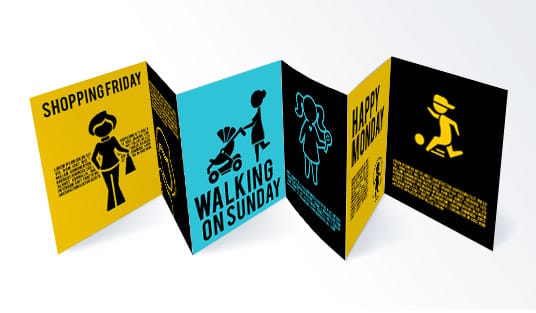
Tri fold brochures customers printed




Explore more
Where to go next



By the numbers
Stocks that fold cleanly into three panels
Common Questions
Common questions about tri-fold brochure templates
How wide is each panel on a 4 panel brochure?
It depends on the fold. On an 8.5 by 14 accordion the four panels are equal at 3.5 in each, with creases at 3.5 in, 7 in, and 10.5 in that alternate valley, mountain, valley, so nothing tucks inside anything else and no panel gets narrowed. On an 11 by 17 double parallel the sheet folds in half at 8.5 in and then in half again in the same direction, so the two outer wrap panels run about 4.28 in and the two inner panels about 4.22 in, which is what lets the closed piece lie flat instead of bowing at the spine. A four-panel on an 8.5 by 11 sheet works out to 2.75 in per panel, too narrow for comfortable body copy, so step up to legal or tabloid when you need the fourth panel. Everything else matches the tri-fold: 0.125 in bleed, text and logos held 0.25 in off every crease and the trim, CMYK at 300 DPI, and one press-ready PDF.
What is a tri fold brochure template?
A tri-fold brochure template is a pre-set layout for a sheet that folds twice into three panels per side, six panels in total. The template already has the correct panel widths, the two fold lines, the bleed, and the safe margins marked, so you design inside the guides instead of measuring from scratch. Because a tri-fold does not use three equal panels, a good template accounts for the tuck-in panel being slightly narrower on a roll fold, which is exactly the detail that trips up a hand-built file. Starting from a template means the folds land where they should and the brochure prints and folds cleanly.
Roll fold or accordion, which panel tucks in?
Match the template to the sheet size and the fold you want. An 8.5 by 11 letter sheet is the standard and works for most brochures, while 8.5 by 14 legal gives more room per panel and 11 by 17 makes a large-format piece. Then decide between a roll fold, where panels wrap inward and reveal in sequence, and a Z fold, where the sheet zig-zags into an accordion with equal panels. Roll folds suit a guided story from cover to inside spread, while Z folds suit content where each panel stands on its own. Pick the template that already has your size and fold, and the panel math is handled for you.
What does a tri fold brochure cost and how are prices set?
Folded brochure price is set by quantity, size, paper stock, finish, and fold style. Quantity is the biggest lever, so the per-piece price drops as the run grows, and a standard letter size on a standard text or gloss stock is the most economical base. Heavier cover stocks, larger sheets, and premium finishes like a soft-touch or gloss coating add to the total. You set each option in the configurator and the price updates live as you adjust it, so you can see exactly how a heavier stock or a bigger run changes the number before you order.
What sizes, stocks, and finishes are available for tri fold brochures?
Standard tri-fold sizes are 8.5 by 11, 8.5 by 14, and 11 by 17, folded into three panels, with both roll fold and Z fold options. Stocks range from text weights around 100 lb up through heavier cover stocks that hold a crisp fold, and finishes include uncoated, gloss, matte, and premium coatings. The right combination depends on the use: a giveaway handout does well on a lighter gloss text, while a premium company brochure benefits from a heavier stock and a soft finish. The product page lists every size, stock, and finish with its live price.
How long does a tri fold brochure take to print and ship?
Folded brochures print on a standard schedule, with most orders moving into production the same or next business day once the artwork passes the free file check, and folding adds only a small amount of finishing time. Larger sizes, heavier stocks, and premium finishes can extend that slightly. The exact production and shipping estimate appears in the configurator as you build the order, so you always see the timeline before checkout. For an event or launch date, order with a little lead time so the folded and finished pieces arrive comfortably early.
What is the difference between a roll fold and a Z fold?
Both fold a flat sheet into three panels, but they behave differently. A roll fold, sometimes called a C fold, wraps the panels inward so one tucks inside the other, which means the inside panel must be slightly narrower to fold flat. It reveals content in sequence as you open it, which suits a guided story from cover to inside. A Z fold zig-zags the sheet so the panels alternate direction and open like an accordion, and because no panel tucks inside another, all three panels are equal width. Z folds suit content where each panel stands alone, such as a map or a step-by-step.
How wide should each tri fold panel be?
For a standard 8.5 by 11 letter roll fold, make the two outer panels about 3.69 inches wide and the inside tuck-in panel about 3.62 inches, a small difference that lets the narrow panel fold flat inside the others without buckling. For a Z fold on the same sheet, all three panels are equal at about 3.67 inches because none tucks inside another. Legal and tabloid sheets scale these proportions to their larger width. A correct template already has these widths and the fold lines set, which is why starting from one saves you the panel math and prevents folds that crush your content.
Get Started
Order 50 travel brochures on 100# Gloss Text
Start from a correct template, then order folded brochures at 4OVER4.COM on the size, stock, and finish your job needs. Travel brochures run on the same three text stocks at $1.14 each.
Legal Disclaimer
Gold Standard guarantees apply to all standard orders placed through 4over4.com. Price match requires verifiable proof of a competitor's published price for an equivalent product with matching specifications and turnaround time. Satisfaction guarantee covers manufacturing defects and print quality issues. Contact support with order number and documentation. On-time delivery rate based on tracked orders 1999 to 2026. Individual results may vary based on shipping carrier performance.
