
How to Design a Roll Fold Brochure That Folds Right the First Time


The four panel roll fold trips up more layouts than any other fold, and it is always the same two things: panel widths and panel order. Here are both, with the numbers that add up to the sheet.
A roll fold brochure is a sheet creased two or more times in the same direction so each panel rolls inside the one before it, and the panels cannot be equal or the piece will not close flat. On text stock, set the two outer panels at the flat width plus 1/4 inch divided by four, take 1/16 inch off the panel that nests once, and 1/8 inch off the innermost panel. Then design to the reveal order, because the innermost panel is the last face anyone sees.
Quick answer
Stepped panels, and a reading order you design against
A roll fold rolls the same way at every crease, so each nested panel has to be cut shorter to clear the paper wrapping it. Two outer panels at (flat width + 1/4 inch) divided by four, minus 1/16 inch for the panel that nests once, minus another 1/8 inch for the innermost. Double the allowances on 100lb cover. Bleed 0.125 inch on the flat sheet, keep live type 0.25 inch off every crease, and remember the reader unrolls the piece one panel at a time, so the offer belongs on the first reveal and the fine print on the innermost panel.
What a Roll Fold Brochure Actually Is
Take a strip of paper and roll it up like a carpet. Now flatten the roll. That is a roll fold: every crease turns the same direction, and each panel wraps around the ones already folded. Printers also call it a barrel fold.
The version most people mean is the four panel roll fold. Three parallel creases, four panels down each side of the sheet, eight printable faces in total. It is popular for a reason: it holds twice the content of a letter fold, still fits a rack or a standard number 10 envelope when folded, and unrolls in a controlled sequence rather than flopping open all at once.
The letter fold you know from a trifold brochure is the same mechanism with one fewer crease. That matters because everything true about panel widths on a trifold is true here, only doubled. If you have ever wondered why the trifold template has one narrow panel, this page is the long version of that answer.
One thing a roll fold is not: it is not an accordion. The accordion fold alternates direction at every crease, so nothing nests inside anything and every panel is exactly the same width. Confusing the two is how a file gets built with four equal panels and comes back from the folder bowed at one edge.
Roll Fold Against the Other Folds You Could Use
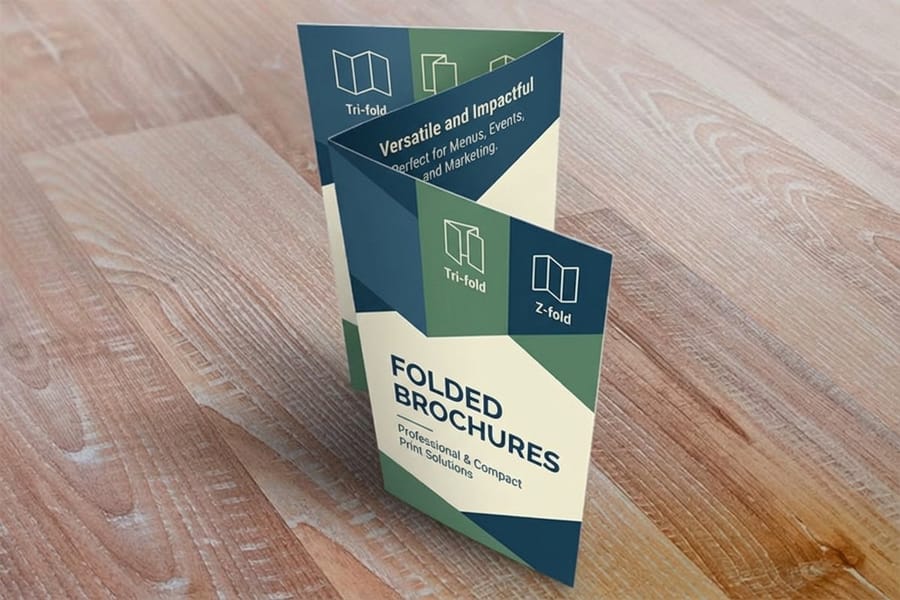
Choosing the fold before you design saves a rebuild later, because panel count and panel width both change the layout grid. These are the folds you will actually be picking between on a single flat sheet.
| Fold | Creases | Panels per side | Panel widths | Best at |
|---|---|---|---|---|
| Half fold | 1 | 2 | Equal | Menus, programs, anything read as a two page spread. |
| Letter fold | 2 | 3 | One panel 1/16 in narrower | Racks, envelopes, the default brochure. |
| Z fold | 2 | 3 | Equal | Long timelines and comparison strips that read across. |
| Roll fold | 3 | 4 | Stepped, each nested panel shorter | A controlled reveal with more content than a letter fold. |
| Accordion | 3 or more | 4 or more | Equal | Maps and panel by panel sequences you want open at once. |
| Gate fold | 2 | 3 plus a double centre | Two flaps meet at the middle | A big reveal behind two doors, usually invitations. |
Read the panel width column first, because it decides how much rework you are signing up for. Equal panel folds let you build one grid and repeat it. The roll fold does not, and the letter fold only half does. If a client changes their mind from accordion to roll fold after the layout is done, every panel edge moves.
Our print folding options guide covers the same folds applied to cards and inserts, and the fold types guide is the one to send a client who is still deciding. When you have picked, the flat sizes live on brochure printing.
Panel Order and How the Content Unrolls
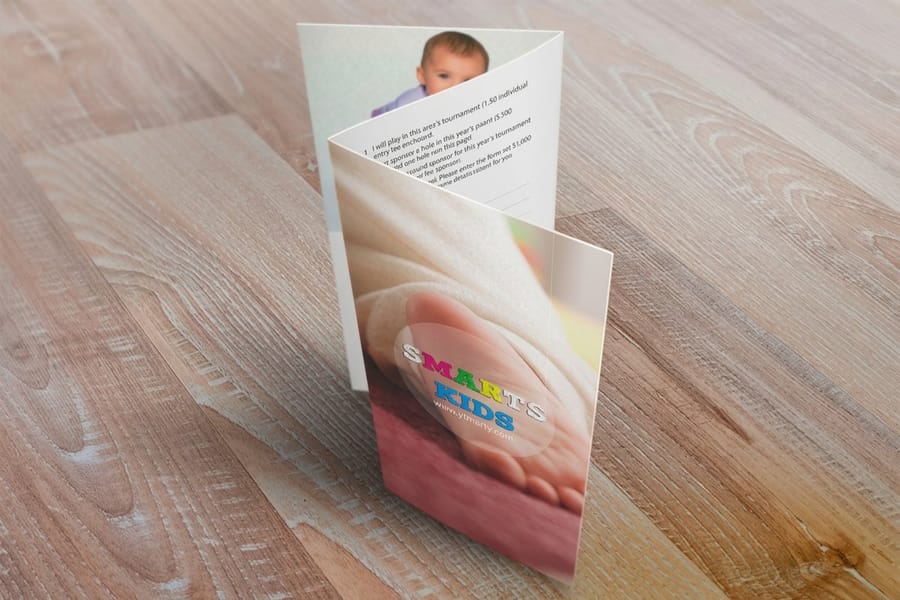
A roll fold does not open. It unrolls, one panel at a time, in a fixed order, and that order is the whole reason to use this fold instead of an accordion. Design against the sequence and the piece works. Ignore it and you have eight faces of paper in no particular order.
The sequence a reader goes through:
- The front cover. One panel. It has to earn the first unroll and nothing else.
- The first reveal. The cover swings open and two panel faces appear together. This is the best real estate in the piece after the cover, and it is where the offer belongs.
- The second reveal. Three faces. Supporting detail, proof, specifics.
- The full spread. All four panels flat. This is the only moment the innermost panel is visible at all.
Two rules follow directly. The innermost panel is the last thing anyone sees and plenty of readers never get there, so it takes the material you would be happy to lose: fine print, a secondary list, a map. Never the call to action on its own. And the back panel, the outward facing face when the piece is closed, carries the contact block, because that is what someone stares at while the brochure sits on a desk.
The trap that costs reprints is the flat file layout. Which end of the sheet the narrow panel sits on depends on which way the folder rolls the job, and you cannot tell by looking at a PDF. Label every panel in your file with its reading position, download the correct fold layout from our blank template library instead of drawing your own guides, and print the flat file at 100 percent and fold it by hand before you upload. That hand fold catches wrong panel order in about a minute, and nothing else catches it before the folder runs.
Panel Widths, Creep, Margins and Bleed
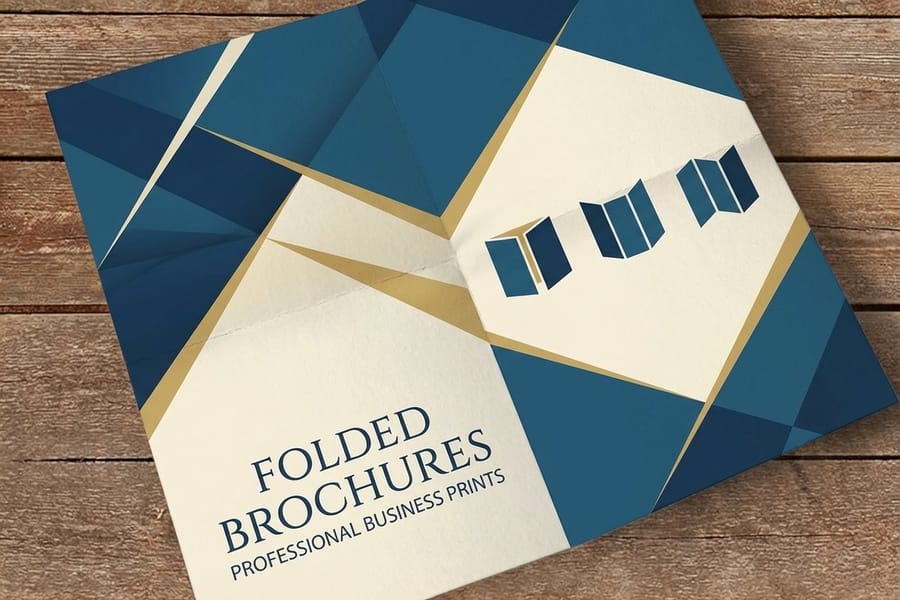
This is the section people come here for, so here are the numbers. Paper has thickness. A panel nested one layer inside has to clear that thickness at the fold, and a panel nested two layers in has to clear twice as much. Cut four equal quarters and the innermost panel runs past the fold edge, buckles, and the brochure will not close flat. That push out is creep, and on a roll fold you do not fix it in the bindery, you fix it in the panel width table.
The working formula on text and book stock: the two outer panels are the flat width plus 1/4 inch, divided by four. The panel that nests once loses 1/16 inch. The innermost panel loses another 1/8 inch. Every row below adds back to the flat sheet exactly.
| Flat sheet | Outer panel | Outer panel | Nests once | Innermost |
|---|---|---|---|---|
| 8.5 x 14 in | 3.5625 | 3.5625 | 3.5 | 3.375 |
| 11 x 17 in | 4.3125 | 4.3125 | 4.25 | 4.125 |
| 11 x 25.5 in | 6.4375 | 6.4375 | 6.375 | 6.25 |
Those allowances are sized for text weight paper. Move to 100lb cover and the sheet is roughly twice as thick, so double them: 1/8 inch off the panel that nests once, 1/4 inch off the innermost, and the outer panels become the flat width plus 1/2 inch divided by four. Check the stock before you commit the grid, because brochure paper choice changes the numbers.
Bleed and margins work on the flat sheet, not on individual panels. Extend artwork 0.125 inch past every outside edge of the full flat file, and keep live type at least 0.25 inch inside every trim edge. Then add the rule that only applies to folded work: keep type 0.25 inch clear of every crease as well. Folders track to roughly 1/32 inch, and a heading that sits on a fold reads as a defect no matter how accurate the machine was that day. Background images and colour fields can cross a crease freely. Text and logos should not. Our bleed and trim guide covers the flat sheet side of this in full.
What to Put on Each Panel
A roll fold gives you eight faces, which is enough rope to write a bad brochure. The panels are narrow, so the design problem is not filling them, it is resisting the urge to.
The cover gets one idea. On a 4.25 inch panel that means a short line of type, a mark, and one image, at a size that reads from arm's length in a rack where only the top third of the panel shows above the lip.
The first reveal is where the offer goes. Two faces open together, which lets you run a single headline across both, and this is the one place a spanning image genuinely helps because the crease between them is the fold the reader just made.
The middle panels take proof: specifications, a short comparison, a price list, testimonials. Keep each panel to one topic. A narrow panel with three subjects on it reads as clutter, and a reader who is holding the piece half unrolled cannot scan across panels the way they can on a flat page.
The innermost panel takes the material you can afford to have skipped. Terms, a detailed map, a full product index.
The back panel takes the contact block and, if the piece will be mailed, the address area.
Typography carries more weight here than on a flat sheet. Body copy under about 9 point on a narrow column gets hard to read at the angle people hold a half open brochure, and a 4 inch panel only holds around 35 characters per line at 10 point, so long words and justified text both fight you. Set ragged right, hyphenation off. If you want the same content in a format that does not fight narrow columns, a flat flyer at $39.54 is worth pricing before you commit to the fold.
Printing Your Roll Fold Brochure

Ordering is the short part if the file is right. Folded brochures and standard brochures both start at $57.11 and both carry Folding, Number of Panels and Scoring as configurator options, so the fold is part of the print order rather than something you arrange afterwards.
Pick the flat size first, because it fixes your panel width. The brochure flat sizes are 5.5 x 8.5, 8.5 x 11, 8.5 x 14, 11 x 17 and 11 x 25.5 inches. For a four panel roll fold, 8.5 x 14 lands at about a 3.5 inch panel, 11 x 17 at about 4.25 inches, and 11 x 25.5 at about 6.375 inches. The 11 x 17 sheet is the one most jobs want: the finished panel fits a standard rack and a number 10 envelope, and the width still holds a readable column.
Add scoring if you are on cover weight or running heavy solid ink across a crease. It is the single option that most often gets skipped and most often causes the reprint, because a cracked white line down a dark folded edge is visible from across a room. Finish choice matters too: high gloss UV looks excellent flat and is the least forgiving surface at a fold, so on a heavy stock with UV, score without arguing about it.
Send the flat file as a single spread per side, artwork at full size, fonts outlined, 0.125 inch bleed all round, and a note stating the fold. If the piece has to hold more than eight faces, stop folding and look at booklets from $240.55, which start at 8 pages and stay flat instead of getting thicker at one edge. The specs and live pricing for every option sit below.
Wally explains the roll fold
Four panels, four widths, one direction
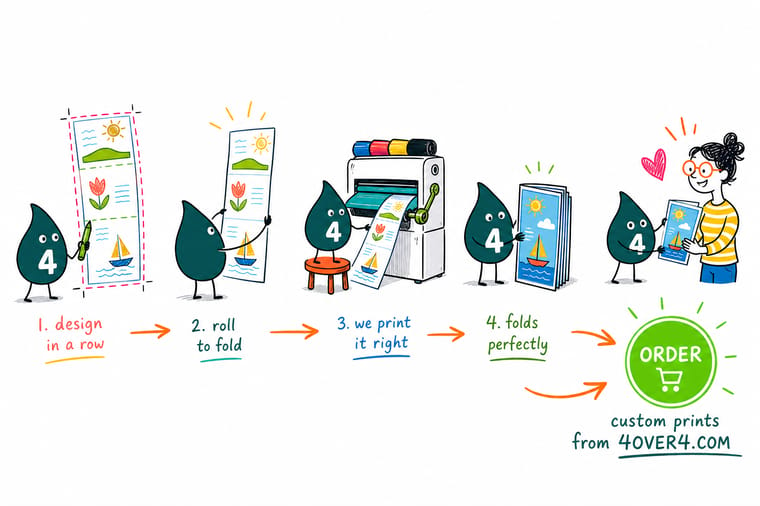
Wally rolls the sheet up like a carpet, same turn at every crease. The panel going inside has paper wrapped around it, so he trims it 1/16 of an inch. The one going in behind that gets another 1/8 off. Now it closes flat. Then he checks the order: cover first, offer on the panel that appears when the cover swings open, contact details on the back, and the boring detail on the innermost panel because that is the face nobody reaches. Cut four equal panels instead and the middle bows out every time.
Order folded brochures →Specs and pricing
Flat sizes, folding, scoring and starting prices
Compare the brochure formats side by side, with live configuration choices and starting prices straight from the 4OVER4.COM configurator.


Print it
Order a brochure that closes flat

Explore more
Where to go next



By the numbers
Brochure printing you can count on at 4OVER4
Common Questions
Your roll fold questions, answered
What is a roll fold brochure?
A roll fold brochure is a sheet creased two or more times in the same direction, so each panel wraps around the one before it like rolling a carpet. The most common version is the four panel roll fold: three parallel creases, four panels per side, eight printable faces. It is also called a barrel fold, and a standard letter fold brochure is technically the smallest member of the family, with one panel tucking inside instead of two.
Why are roll fold panels different widths?
Because paper takes up space. The panel that nests one layer in has to clear the thickness of the panel wrapping it, and the innermost panel has to clear two. If you cut four equal quarters, the innermost panel runs past the fold edge, the piece will not close flat, and the crease bows outward. On text stock, set the two outer panels at (flat width + 1/4 inch) divided by 4, take 1/16 inch off the panel that nests once, and 1/8 inch off the innermost one. On 100lb cover, double both allowances.
What size sheet do I need for a roll fold brochure?
Pick the flat size first and divide. At 4OVER4.COM the brochure flat sizes are 5.5 x 8.5, 8.5 x 11, 8.5 x 14, 11 x 17 and 11 x 25.5 inches. An 8.5 x 14 sheet gives four panels of roughly 3.5 inches, 11 x 17 gives roughly 4.25 inches, and 11 x 25.5 gives roughly 6.375 inches, which is close to a full rack card width per panel. Anything below about 3.25 inches of finished panel width gets cramped once you allow margins.
How many panels can a roll fold have?
Four is the practical ceiling on ordinary text stock. Every extra roll adds another thickness at the spine edge and another width reduction, so a five or six panel roll gets bulky at one edge and closes badly. If you need more surface than four panels, an accordion fold holds its shape better at the same panel count, and past about eight panels a saddle stitched booklet is a cleaner answer than any fold.
Do I need scoring on a roll fold brochure?
On text weight stock, no. On cover weight, or on any stock carrying heavy solid ink across a crease, yes. Folding cracks the coating and the fibers on the outside of the bend, and a dark panel edge shows a white line where it cracked. Scoring crushes the fibers first so the sheet bends instead of splitting. It is a listed configurator option on our brochures, and it costs far less than reprinting 2,500 pieces with cracked spines.
Can I mail a roll fold brochure without an envelope?
You can, but it becomes a folded self mailer and USPS applies its own rules to those, covering which edge the fold sits on and how the open edge is tabbed shut. Get the layout checked against the current Domestic Mail Manual before you commit to a long run, because a self mailer that fails the folded piece rules is either surcharged or returned. If the mailing is the point of the job, a flat piece in an envelope or a postcard format is the lower risk route.
How do I proof a roll fold before printing?
Print the flat file at 100 percent on your office printer, tape sheets together if it spans more than one page, then cut and fold it by hand. Two things show up immediately that never show up on screen: type sitting too close to a crease, and panels landing in the wrong reading order because the fold runs the other way. Do that before you order, and order a proof option on the job itself for anything above a few thousand pieces.
Get Started
Ready to print a roll fold that closes flat?
Pick your flat size, set the panel widths, add scoring on cover stock, and we fold and ship it. Send the flat file and a note stating the fold.
Legal Disclaimer
Gold Standard guarantees apply to all standard orders placed through 4over4.com. Price match requires verifiable proof of a competitor's published price for an equivalent product with matching specifications and turnaround time. Satisfaction guarantee covers manufacturing defects and print quality issues. Contact support with order number and documentation. On-time delivery rate based on tracked orders 1999 to 2026. Individual results may vary based on shipping carrier performance.
