
Gold Foil Postcards and Every Other Foil Finish, Explained


Foil postcards carry a stamped metal film instead of a shiny ink. Here is how the foil gets there, how gold, silver and holographic differ in the hand, and what the foil layer in your file has to look like.
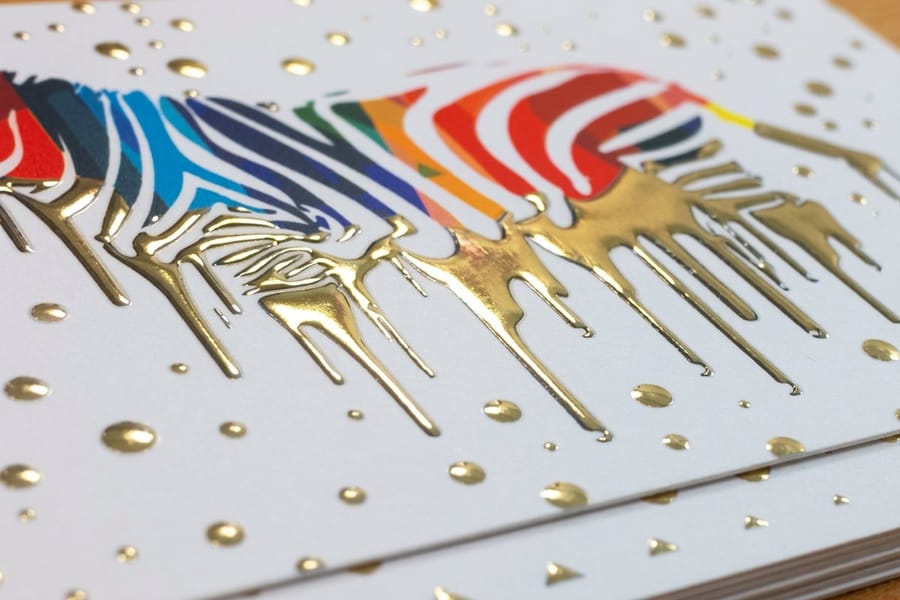
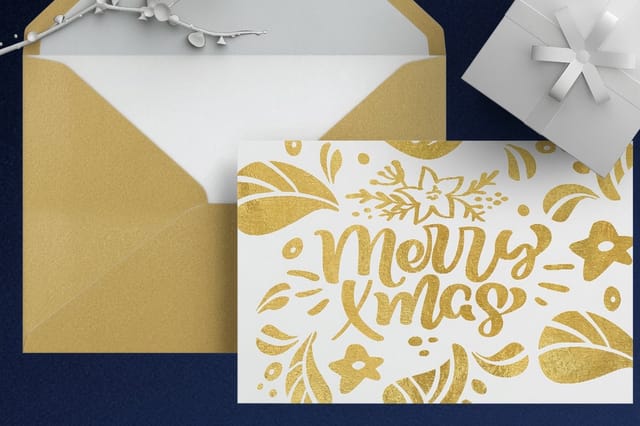
A foil postcard is a printed card with a metallic film bonded onto part of the design, transferred by a heated die after printing rather than laid down as ink. The foil lives on its own layer in your file, prints solid with no tints or gradients, and is the reason gold, silver and holographic finishes mirror light in a way metallic ink never does. Nothing prints, writes or coats over it, and a raised foil card sits above the USPS postcard thickness limit, so it mails at the letter price.
Quick answer
A stamped metal film, on its own layer, applied last
Foil postcards get their shine from a metallized film that a heated die transfers onto the card, not from ink. The metal goes down after printing and after any coating, so whatever finish you order ends up underneath it. In the file, the foil lives on a separate layer built as solid 100 percent K vector shapes, because a die has one shape and cannot render a tint or a gradient. Gold reads warm and wants a dark field, silver reads cool and disappears on plain white, and holographic shifts color as the card tilts. The practical limits are the ones nobody mentions up front: nothing prints on top of foil, a pen will not write on it, and a raised foil card is thicker than the USPS postcard ceiling.
What a Foil Postcard Is, and How the Metal Gets on the Sheet
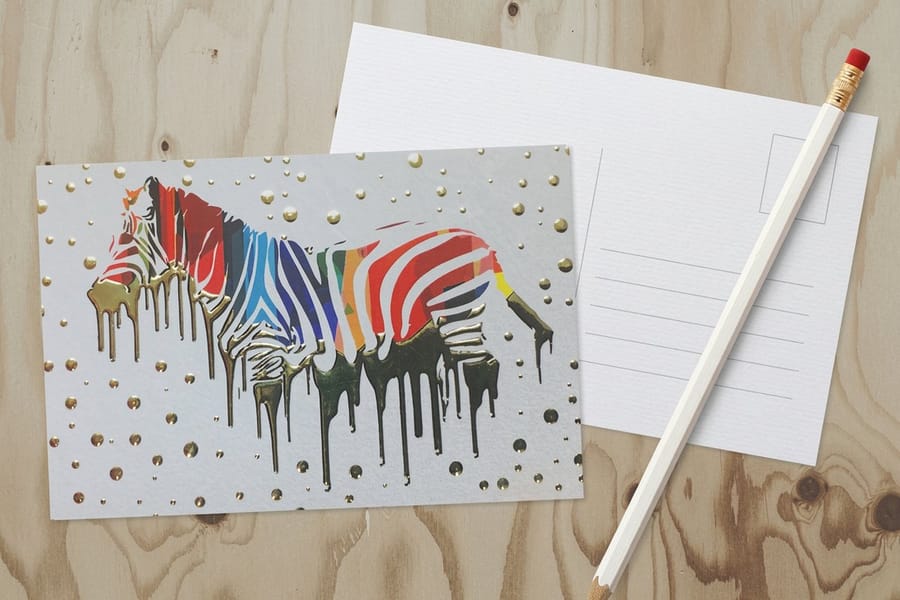
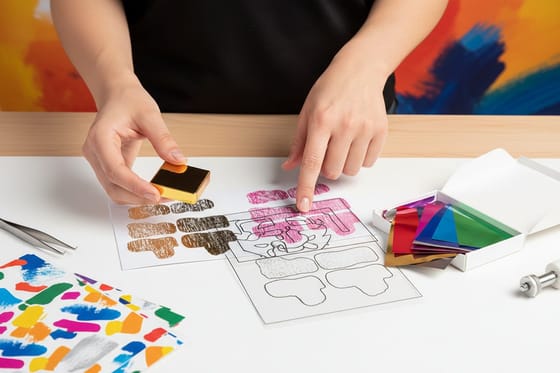
A foil postcard is a printed card with a thin metallic film bonded onto part of the design. The film is not ink, and it is not printed. It comes on a roll: a polyester carrier, a release coating, a metallized or pigmented layer, and a heat-activated adhesive on the underside.
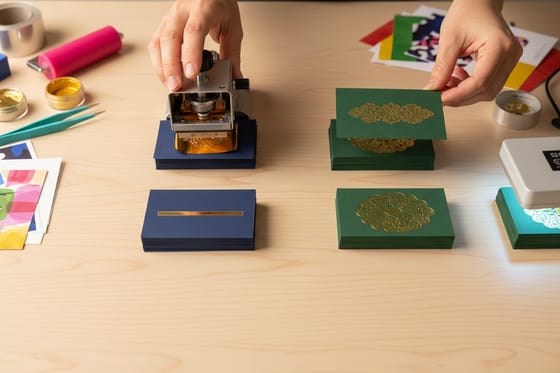
On a stamping press, a magnesium or copper die is cut to the exact shape of your foil artwork. The die heats up, the roll feeds between the die and the card, and the press closes. Where the die touches, heat and pressure fire the adhesive and split the metal off its carrier onto the paper. Everywhere else the foil stays put and winds onto the take-up reel. Pull a spent roll off the machine and you can read the whole job back in negative, which is the clearest picture of what stamping actually does.
Raised foil adds one step before the metal. A clear polymer base is laid down first in the shape of the artwork, then the foil goes over it, so the design stands off the surface and you feel it before you look at it. Raised foil postcards are built that way. Metallic foil postcards are flat foil, level with the card. The difference is covered in detail in our comparison of foil stamping against raised foil.
Three consequences follow from the fact that foil is a film rather than an ink, and every rule further down this page traces back to them. Nothing prints on top of foil. Nothing writes on it. Nothing coats over it without dulling it.
Gold, Silver and Holographic, and What Each One Does to a Design

Foil is a mirror, not a color. It reads by reflection, which means it needs a light source and an angle to do anything at all. Under flat overhead lighting, or in a phone photo taken straight down, silver can look grey and holographic can look like a smudge. Tilted in a hand, both come alive. Design for the hand, not for the scan.
| Foil | How it reads | Backgrounds it sits well on | The catch |
|---|---|---|---|
| Gold | Warm brass with a deep glow. The default for formal and premium work. | Navy, black, deep green, burgundy, cream. | On a warm cream or tan background the contrast drops and the shapes go soft. Give it a dark or saturated field. |
| Silver | Cool, neutral, closest to a true mirror. | Black, charcoal, mid blue, and any heavy solid ink coverage. | On plain white stock it can read as grey, because the paper is nearly as bright as the metal. |
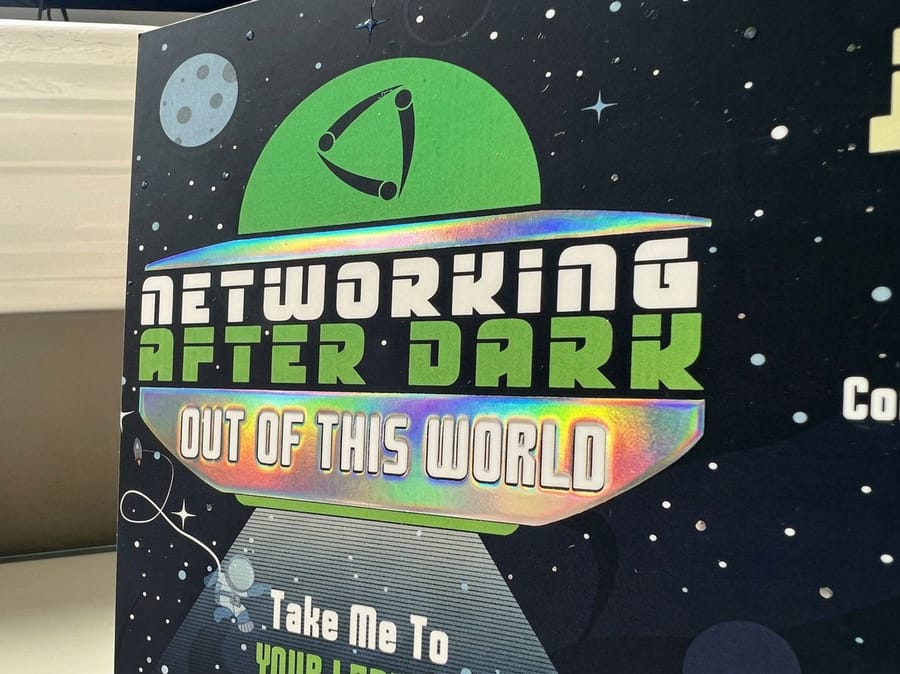
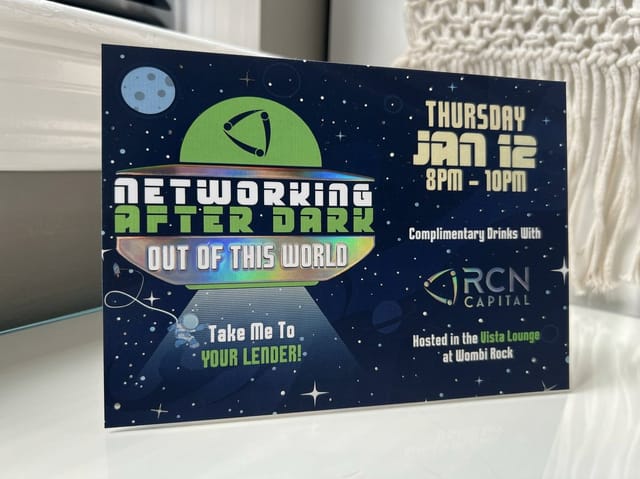
| Holographic | A diffraction pattern that splits light, so the color shifts as the card moves. | Black and dark solids, which give the rainbow something to sit against. | It photographs unpredictably. A piece destined for a product shot or a scanned catalog is the wrong place for it. |
| Raised versions of any of the three | The same metal, standing off the surface so you feel the shape. | Soft-touch and matte laminated stocks, where the velvet base makes the metal look twice as bright. | The added height pushes a mailer past the postcard thickness ceiling. Budget for letter postage. |
Metallic ink is the other way to get a shiny card, and it behaves nothing like foil. Ink loaded with metal flakes can be screened, tinted and printed over a photograph, but it stays the same at every angle and never mirrors. Our breakdown of gold foil against metallic gold ink puts the two side by side, and the holographic foil stamping guide covers the diffraction foils in more depth.
Stocks and Coatings That Actually Hold Foil
Smoothness matters more than whether the stock is coated. The die has to bring the foil into contact with the paper across the whole shape at once. On a smooth 14pt or 16pt card that contact is complete and the edges come out crisp. On linen, felt or a heavy laid texture, the die reaches the peaks and skips the valleys, and the foil comes back pitted with pinholes that show badly on any solid area.
Weight is the easier decision. 14pt takes foil without trouble. 16pt is the postcard default here and holds the stamping pressure without curling, which matters more on a raised job because the polymer base adds its own tension to the sheet.
The coating order is the part that surprises people. Foil is applied after printing and after any coating or lamination, never before. Whatever finish you order sits under the foil, not over it. That is exactly why raised foil pairs so often with a soft-touch laminate: the velvet matte base kills reflection everywhere except the metal, so the foil reads brighter than it would on gloss. Asking for a gloss coating over the top to protect the foil is not protection, it is a dimmer.
If you want a tactile card without the metal, raised spot UV postcards give you the same standing-proud effect in clear gloss instead, and dual raised postcards run both raised foil and raised spot UV on one card. Compare the whole family in the raised foil printing collection.
Building the Foil Layer in Your Print File
Foil is on or off. There is no 40 percent foil, no gradient foil and no soft drop shadow in foil, because the die is a physical piece of metal cut to one shape. Anything sitting on the foil layer becomes solid metal at full strength, so a designer who tints that layer to 40 percent gets 100 percent foil back and a surprised look on the proof.
- Put the foil artwork on its own layer, named Foil, in a vector file.
- Fill every foil shape 100 percent K solid. No tints, no gradients, no transparency, no drop shadows, no live raster effects.
- Keep strokes at half a point or heavier and type at 6 point or larger. Hairline rules and fine serifs either break up or fill in.
- Leave a visible gap between adjacent foil shapes. Two heavy shapes a hair apart can bridge and flood the space between them.
- Hold the foil an eighth of an inch inside the trim line. Foil running off the edge can lift at the guillotine.
- Leave the background artwork running underneath the foil rather than knocking it out. If the stamp shifts a fraction, you see background color instead of a white sliver.
- Supply a press-ready PDF with the foil layer as a separate marked page, same size and same position as the artwork.
- Keep foil out of the address block and out of the barcode clear zone. Reflective surfaces defeat mail scanners.
Our foil file setup guide walks the same steps through Illustrator and InDesign, and the blank template library gives you a correctly sized postcard layout with the bleed and safe zone already drawn. If Canva is your tool, the metallic foil postcard walkthrough in Canva covers what that editor can and cannot export cleanly.
When a Foil Postcard Earns Its Cost, and When It Does Not
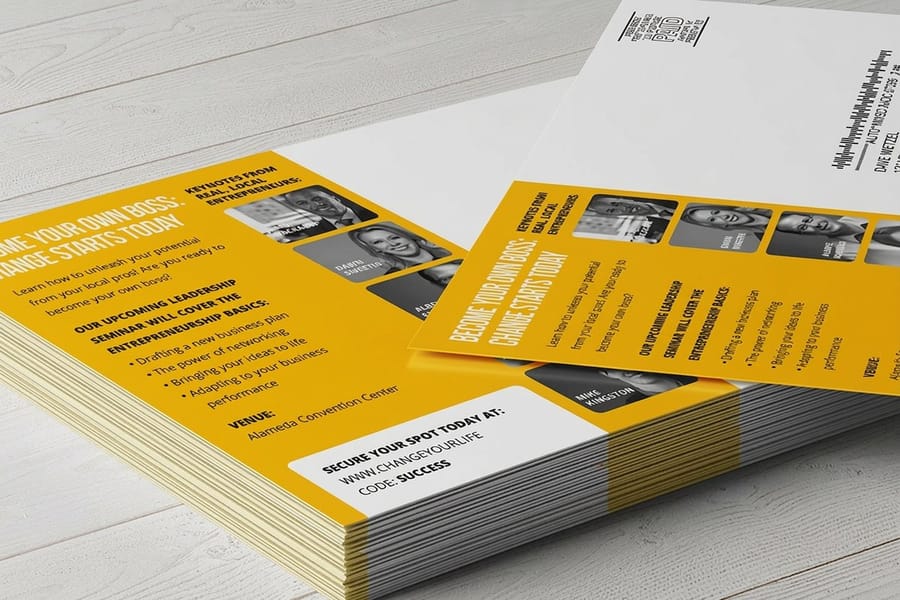
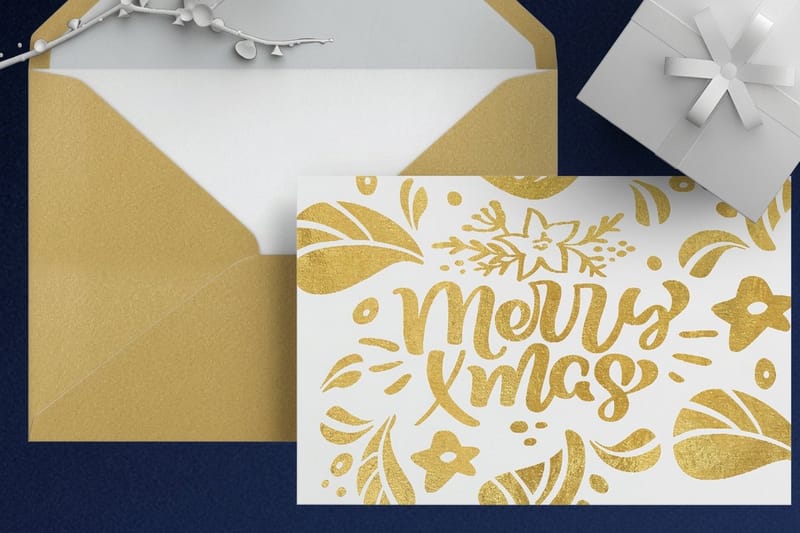
Foil pays where the card gets handled. Real estate is the clearest case: a just-sold card lands in a stack of near-identical mail, and the one that flashes when it tips is the one that gets picked up rather than swept into the recycling. Event invitations, gallery and restaurant openings, save-the-dates, holiday cards and anything that ends up on a fridge or a desk all work for the same reason. The recipient holds the piece, turns it, and often keeps it.
It does not pay on high-volume prospecting mail priced to the cent per piece, and it does not pay on anything a recipient has to write on, because a pen skips on metal. It also does not pay when the piece will only ever be seen as a flat image, since a mirror photographed head on is just a grey patch.
The mail rules are where budgets get broken late. USPS charges the postcard rate only for pieces between 3.5 by 5 inches and 4.25 by 6 inches, and between 0.007 and 0.016 inch thick. A 16pt card is right at that 0.016 inch ceiling, and a raised foil layer sits above it, so a raised or oversized foil card is priced as a letter. Uneven thickness can also push a piece out of the machinable stream and add a surcharge on top. Two practical moves: keep the foil entirely off the address side, and confirm the postage on the finished piece before you commit the design. If postage is the risk you care about most, direct mail postcards start at $89.68 with the mailing handled for you, and our five steps to send direct mail postcards covers the sequence. For the layout side, the anatomy of a postcard shows the zones the post office needs left alone.
Price, Turnaround and How to Order at 4OVER4.COM
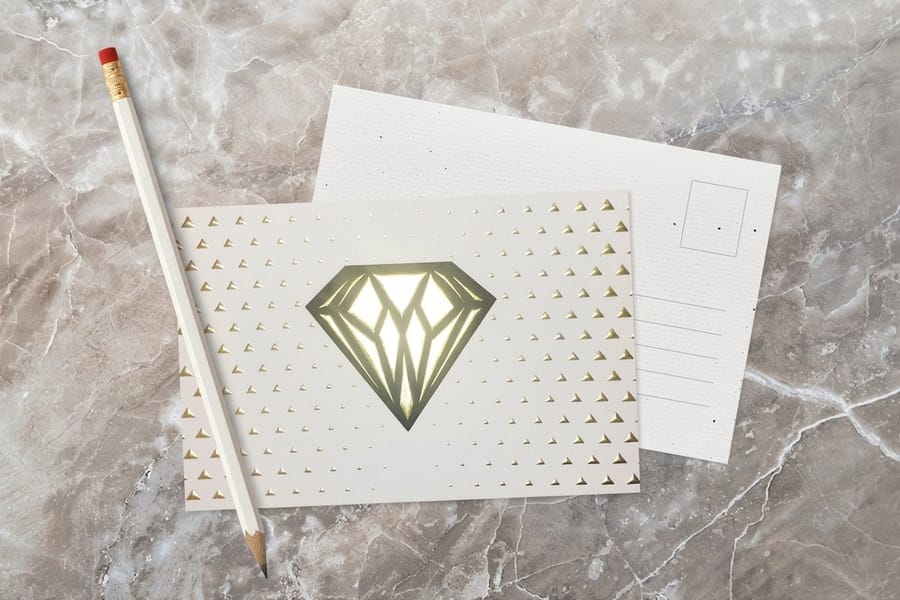
Catalog starting prices, straight from the configurator: raised foil postcards from $299.00, raised holographic postcards from $299.00, metallic foil postcards from $421.91. A standard postcard starts at $16.48, which tells you plainly that the finish is the cost, not the card.
One number catches people out. Here the raised foil postcard starts below the flat metallic foil postcard, which is the opposite of what most people expect. The two run different processes at different starting sizes and quantities, so price both at the quantity you actually need instead of assuming raised is the premium. The live configurations, production options and current prices for all three sit in the panels further down this page.
Turnaround follows the same logic as the price. Foil is a separate pass after printing, so a foil postcard takes longer than a flat one, and a raised foil job takes longer again because the polymer base has to cure before the metal goes down. Build that into the deadline rather than discovering it at proof stage.
- Pick the finish: raised foil, metallic foil, or raised holographic.
- Set size, stock and quantity, then read the live price and production time on that product page.
- Upload the artwork PDF plus the foil layer as a separate marked page.
- Check the proof at the foil shapes first. That is where thin strokes and tight gaps get flagged.
- If the card is mailing, confirm size and thickness against the postcard rate before you approve.
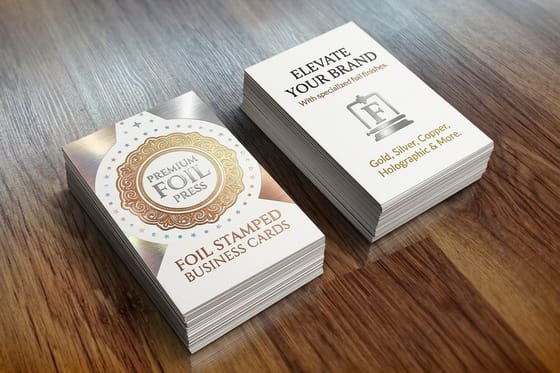
Browse the wider range in postcard printing, or see every product that carries a metal finish in the foil printing collection. For business cards rather than mailers, raised foil business cards use the same build at $86.78.
Wally explains foil postcards
A heated die, a roll of metal, and one extra layer in your file
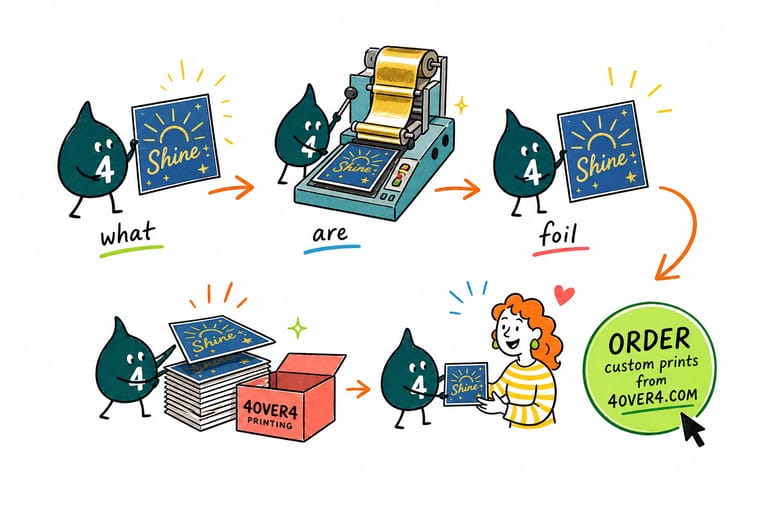
Wally prints the postcard first, then feeds a roll of metallized film between the card and a heated die cut to the shape of the artwork. Press, and the metal splits off the roll onto the paper exactly where the die touched. Pull the spent roll away and the whole job reads back in negative. Two things to remember: the foil goes on last, so nothing prints or coats over it, and the foil layer in your file must be solid black vector shapes, because a die has one shape and cannot do a gradient.
Order raised foil postcards →Specs and pricing
Foil postcard options, sizes and starting prices
Compare the three foil finishes side by side, with live configuration choices and starting prices straight from the 4OVER4.COM configurator.


Print it
Order a postcard that flashes when it tips
Explore more
Where to go next

By the numbers
Foil printing you can count on at 4OVER4
Common Questions
Your foil postcard questions, answered
What are foil postcards?
Foil postcards are printed cards with a thin metallic film bonded onto part of the design. The foil arrives on a roll as a polyester carrier holding a release layer, a metallized or pigmented layer and a heat-activated adhesive. A die cut to the shape of your foil artwork is heated and pressed through that roll onto the card, so the metal transfers only where the die touches. Because the shine comes from a mirror-bright film rather than pigment, it reflects light in a way no metallic ink reproduces.
What is the difference between gold foil and metallic gold ink?
Gold foil is a metal film stamped onto the sheet, so it behaves like a mirror and flashes when the card tilts. Metallic gold ink is ordinary ink loaded with metal flakes, so it looks like a warm, slightly sparkly yellow that stays the same at every angle. Ink can be screened, tinted and printed over photographs, which foil cannot. Foil looks far more expensive in the hand and costs more to produce. Our comparison of gold foil against metallic gold ink covers where each one is the right call.
Can you mail a foil postcard?
Yes, but check the size and thickness before you design it. USPS charges the postcard rate only for pieces between 3.5 by 5 inches and 4.25 by 6 inches, and between 0.007 and 0.016 inch thick. A 16pt card measures about 0.016 inch on its own, and a raised foil layer adds height above that, so raised and oversized foil cards get priced as letters instead of cards. Uneven thickness can also make a piece nonmachinable, which adds a surcharge. Keep foil off the address side and quote the finished piece before you print.
Can I print or write on top of the foil?
No. Foil is opaque and non-porous, so ink sits on the surface instead of soaking in. An inkjet addressing head lays a smeared address on foil, a laser toner will not key to it reliably, and a ballpoint pen skips across it. If recipients need to write on the card, or if the piece is addressed in-line, keep those areas free of foil and leave plain stock there.
Do foil postcards need a special print file?
They need one extra layer. Build the artwork as normal CMYK, then add a separate layer named Foil containing only the shapes that will be metal, drawn as solid 100 percent K vector art with no tints, gradients, transparency or drop shadows. Keep strokes at half a point or heavier, type at 6 point or larger, and hold the foil an eighth of an inch inside the trim line. Leave the background artwork running underneath the foil rather than knocking it out, so a small registration shift shows background color instead of a white sliver.
Is raised foil more expensive than flat foil?
Not automatically, and at 4OVER4.COM it is the other way round at the starting configuration. Raised foil postcards start at $299.00 and raised holographic postcards start at $299.00, while metallic foil postcards start at $421.91. The two use different processes and different starting sizes and quantities, so the honest answer is to price both at the quantity you actually need rather than assuming the raised version costs more.
Get Started
Ready to put real metal on a postcard?
Pick gold, silver or holographic, flat or raised, upload your foil layer, and we stamp cards that catch the light the moment they tip.
Legal Disclaimer
Gold Standard guarantees apply to all standard orders placed through 4over4.com. Price match requires verifiable proof of a competitor's published price for an equivalent product with matching specifications and turnaround time. Satisfaction guarantee covers manufacturing defects and print quality issues. Contact support with order number and documentation. On-time delivery rate based on tracked orders 1999 to 2026. Individual results may vary based on shipping carrier performance.
