
Gold Foil vs Metallic Gold Ink and When to Use Each


Gold foil and metallic gold ink both make gold, but they look, feel and cost differently. Foil is stamped film on a separate layer, ink is printed flat with the rest of the job.
Gold foil is stamped metallic film; metallic gold ink is printed shimmering ink. Foil is mirror-bright, raised, and best for logos and accents, and it needs its own spot layer. Metallic ink is a softer satin shimmer that lays flat, covers large areas and photos, and costs less. Choose foil to dazzle a small element, ink for broad coverage, or combine both.
Start here
One is raised, one is flat
Gold foil is stamped film; metallic gold ink is printed ink. Foil is mirror-bright and raised, which suits a logo or accent that has to catch light, and it needs its own spot layer. Metallic ink is a softer, flatter shimmer that covers large areas and photos and costs less. Reach for foil to spotlight a small element, ink for broad coverage, or combine both for a premium piece from 4OVER4.COM. The map below shows the difference side by side.
Two ways to print gold, and why the choice matters
Say gold and most people picture one thing, but print offers two very different roads to it, and they are easy to confuse. One is gold foil, a metallic film stamped onto the paper. The other is metallic gold ink, a shimmering ink printed like any other color. They both make gold, yet they look, feel, and cost so differently that picking the wrong one can leave a design flat or a budget blown.
This guide lays the two side by side so the choice is obvious for your piece. You will see what each technique actually is, where each one shines, how the design files differ, and when the smartest move is to use both together. By the end, choosing gold foil or metallic ink stops being a guess and becomes a deliberate decision tied to the effect you want.
What gold foil is, and why it dazzles
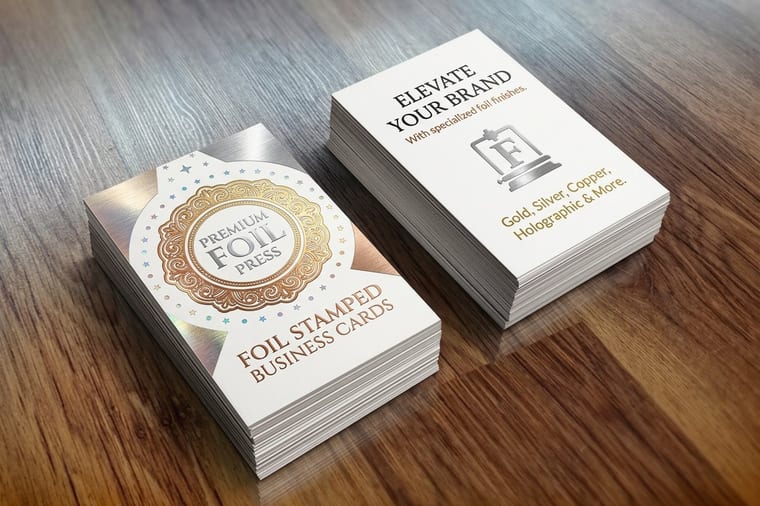
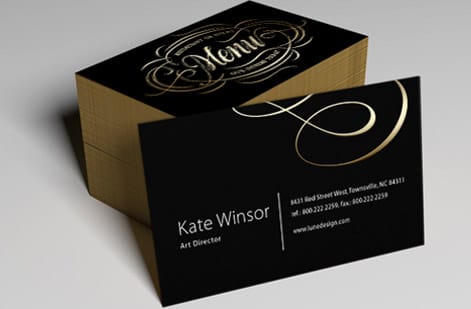
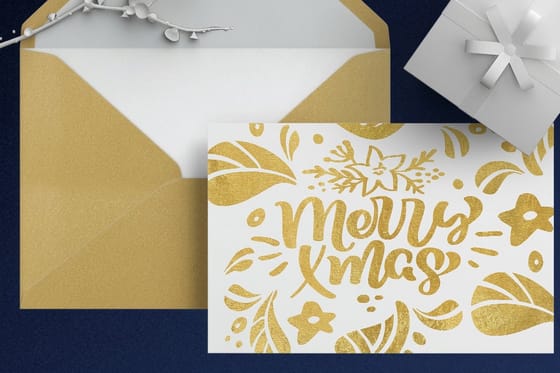
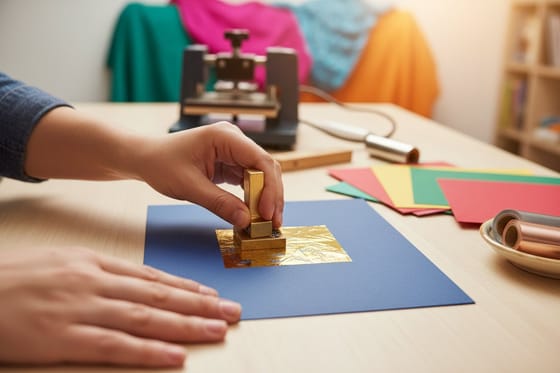
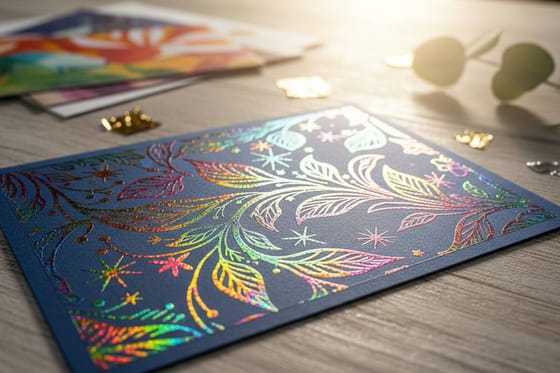
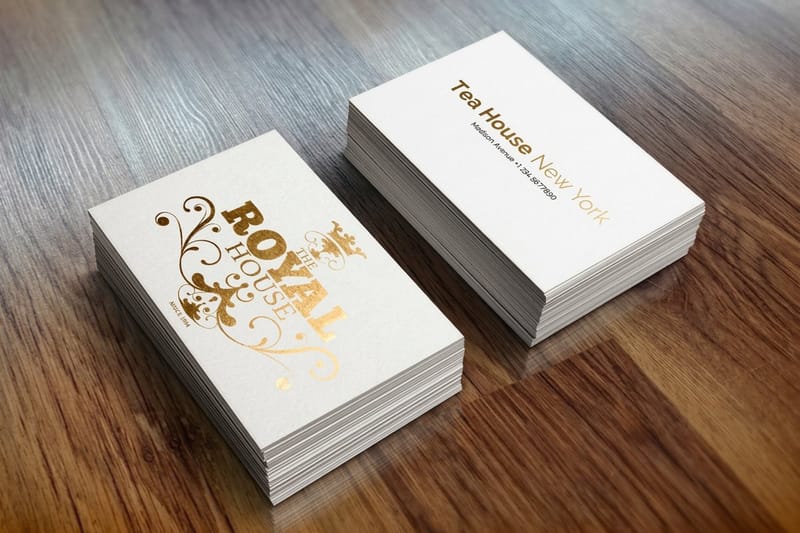
Gold foil is a physical layer of metallic film. In foil stamping, a heated metal die presses a thin sheet of gold foil onto the paper, bonding it exactly where the die shape is. The result is unmistakable: a mirror-bright, reflective gold that catches light like polished metal, with a slightly raised, tactile edge you can feel with a fingertip. That brightness and texture are why foil reads as the more luxurious finish.
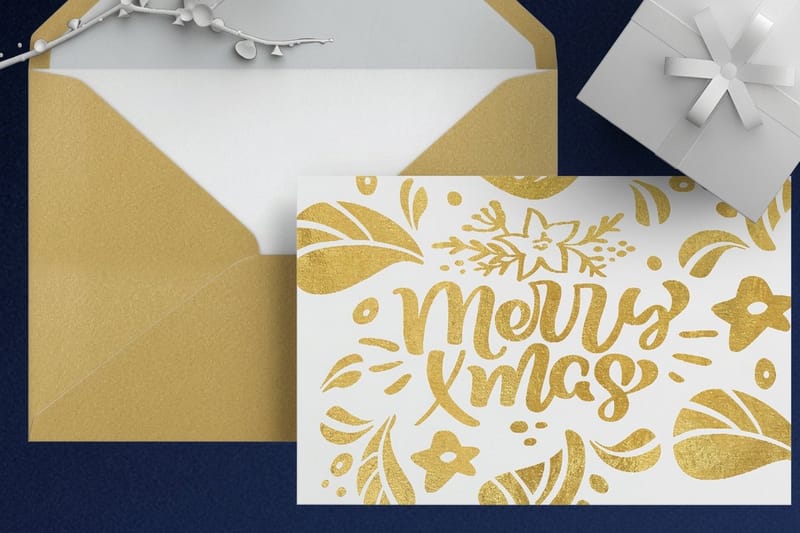
Because it is stamped from a die, foil is applied to specific elements rather than whole sheets, which is what a logo, a monogram, a border or a single headline needs. It looks its richest on heavier stocks and premium products, which is exactly why foil-stamped business cards feel so substantial. If you would rather not build the artwork, our online design tool helps, and our foil stamping service adds the finish to a range of products. Learn the mechanics in our guide on what foil stamping is.
What metallic gold ink is, and where it wins

Gold ink printing is gold printed as ink. Metallic pigment is carried in the ink itself and laid down on press alongside your other colors, with no die, no heat and no film, so the gold lies flat on the sheet and costs less than stamping.
Does it really look metallic? Yes, but it is a softer metal: brushed or satin gold that lifts under raking light, not the polished mirror foil gives you. Is it cheaper than gold foil? Almost always, because it prints closer to a standard color and skips the separate die and pass. Can you print gold ink on dark paper? It can be printed on dark stock, and gold reads brighter against black, navy or deep green than against white, though metallic ink is only semi-opaque, so keep the gold to solid shapes and heavier type rather than hairlines on a dark sheet, and choose foil when the gold has to punch off a very dark or uncoated stock.
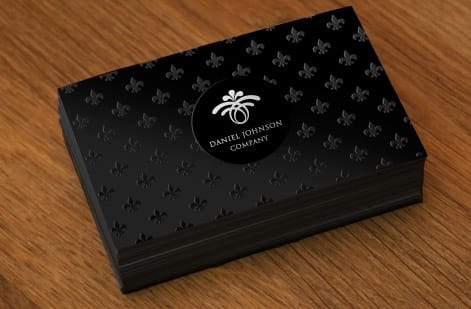
Metallic gold ink takes the opposite approach: instead of stamping metal onto the sheet, it prints a shimmering ink that contains fine metallic particles, laid down like any other color. The effect is a soft satin shimmer rather than a mirror shine, and crucially it lays flat, flush with the surface, with no raised edge.
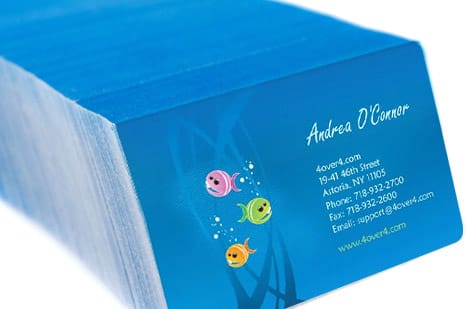
That flatness is a feature. Because it prints like a color, metallic gold ink can cover large areas, fill backgrounds, print inside or alongside photographs, and blend with other inks, all things foil cannot do affordably. It also works across a wider range of products, from metallic business cards to metallic postcards and metallic flyers. When you want gold to be broad and integrated rather than a single dazzling accent, ink is the tool. Explore the full range in the metallic printing collection.
Side by side: where each one wins
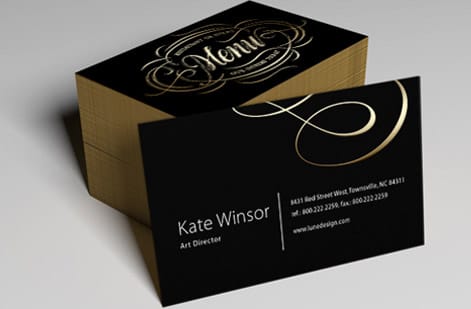
Put them next to each other and the trade-offs are clear. Gold foil wins on pure impact: it is brighter, reflective, raised, and unmistakably premium, which makes it ideal for the one element you want to shine, a logo on a business card, foil on an invitation, an accent on a hangtag. Its limits are coverage and cost: it suits small, crisp shapes and carries a premium price.
Metallic gold ink wins on flexibility and value: it covers large areas, works inside photos, blends with color, prints across more products, and generally costs less. Its shimmer is softer and it lacks the raised feel, so it trades a little drama for a lot of range. The rule of thumb: reach for foil when a small element must dazzle, and for metallic ink when gold has to cover ground or keep to a budget. The comparison table below sums up every difference at a glance.
How to design files for foil and for ink
The two finishes ask for different file setups. Gold foil needs its own spot layer, a separate art layer, usually a solid spot color, that contains only the elements to be foiled and tells the die precisely where the metal goes. Keep foil art clean and avoid extremely fine lines or tiny type, since very thin details can fill in or break under the heated die. Everything not foiled stays on your normal CMYK artwork.
Metallic gold ink is set up much like a standard color: you place it in your design where you want the shimmer, and the press handles the rest. The one thing both share is that neither reproduces truly on a monitor, so a screen preview will not show the real brightness or texture. Always judge the result on a printed sample. Our step-by-step guide on setting up design files for foil and the deeper reference on hot foil stamping types and finishes cover the details.
Combining both, and what gold costs

Foil and metallic ink are not rivals you must pick between; the most luxurious pieces often use both. A common premium move is to lay metallic ink across a broad area for overall shimmer, then stamp a foil logo or accent on top as the focal point that truly dazzles. When a product supports it, that combination gives you both breadth and drama in one piece.
On cost, both are upgrades on the base print. Foil generally costs more because of the separate die and pass, while metallic ink is usually the more economical route since it prints closer to a standard color. As always, larger runs lower the per-piece price, and the configurator prices every option live so you can see exactly what foil, metallic ink, or a combination adds before you commit. Use the specs and pricing panel below to compare, or order a proof so the brightness and texture are proven on real stock first.
Gold on a budget
If the gold look matters more than the method, there are three honest ways to spend less on it. First, print metallic gold ink instead of stamping foil: the ink runs with your other colors, so you skip the die and the second pass that make foil the pricier upgrade. Second, keep foil but shrink it: stamp the logo, a monogram or a thin rule only and let the rest of the piece print in regular ink, because foil is charged for the die and the area it covers, not for the whole sheet. Third, put the gold on a dark stock: gold reads far brighter against black, navy or deep green than against white, so a small amount of metal does the work of a large one. Then push the quantity up, since the per-piece price on both techniques falls as the run grows and the configurator will show you the difference before you commit.
Gold ink printing services and products
Everything in this section prints with metallic gold ink in the same pass as your other colors, so there is no die and no second press run to pay for. Start with metallic business cards when the gold has to cover the whole card, sit behind type or run through a photograph, and metallic postcards for mailers, invitations and save-the-dates that need shimmer across a large area. Letterheads, stationery sets, packaging inserts and belly bands take the same metallic ink, so the gold on the card can be matched on the paperwork that ships beside it.
When the gold has to mirror rather than shimmer, cross over to stamping: foil-stamped business cards for the raised, reflective logo, and our foil stamping service to add that finish to other products. Artwork differs by route. Metallic ink is built like any other color job, as flat solid vector shapes, while foil needs its own 100 percent black shape on a separate layer so the die can be cut from it. If you are not sending print-ready files, the online design tool will set either one up, and our guide on what foil stamping is covers the die side in detail.
There is no fixed gold price list here. Every product page prices the gold live in the configurator by quantity, size, stock and turnaround, so the starting price you see is the price for the job you actually configured. Set the real quantity before you compare metallic ink against foil, because the per-piece price on both drops as the run grows, and order a proof when the exact brightness of the gold has to be signed off on your stock before the full run prints.
Wally weighs foil against metallic ink
Same gold, two very different finishes
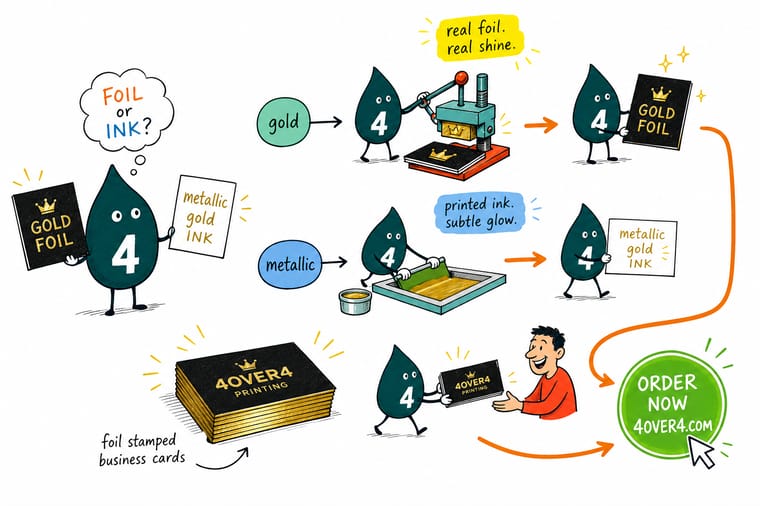
Wally treats gold as a decision, not a default. When one small element must dazzle, a logo, a monogram, a border, he reaches for foil, that mirror-bright raised film stamped by a heated die. When the gold has to cover ground, sit inside a photo, or keep to a budget, he prints metallic ink for its soft, flat shimmer. And for the truly premium piece, he uses both, and 4OVER4 makes it shine.
Order your gold prints →Quick reference
Gold foil vs metallic gold ink, at a glance
The same gold, two very different finishes. This side-by-side comparison shows how they differ on look, feel, coverage, file setup, and cost.
| Attribute | Gold foil | Metallic gold ink |
|---|---|---|
| What it is | Stamped metallic film | Printed shimmering ink |
| Look | Mirror-bright, reflective | Soft satin shimmer |
| Feel | Slightly raised, tactile | Flush with the surface |
| Coverage | Best for logos and accents | Handles large areas and photos |
| File setup | Needs its own spot layer | Set up like a standard color |
| Relative cost | Higher, premium finish | Lower, budget-friendly shine |
Step by step
Choose and design your gold finish in 7 steps
- Decide the effect you want Ask whether the gold needs to dazzle and stop people, or simply add a warm shimmer across the piece. Maximum sparkle and a luxury signal point to foil; broad, subtle metallic coverage points to ink.
- Map where the gold goes Foil shines on small, crisp elements: a logo, a monogram, a border, a headline. Metallic ink is the choice when the gold has to fill a large area, sit inside a photo, or blend with other colors.
- Match it to the product and stock Foil looks its richest on heavier stocks and premium pieces like business cards and invitations. Metallic ink works across a wider range, including postcards, flyers, and larger-format prints.
- Build the right file for foil For foil, create a separate spot layer, usually a solid spot color, that marks exactly where the metal is applied. Keep foil elements clean and not too fine, since very thin lines can fill in under the die.
- Build the file for metallic ink Metallic ink is set up much like a standard color, so you place it where you want it in your artwork. Remember the shimmer reads differently than a flat color on screen, so judge it on a printed sample.
- Consider combining both They are not mutually exclusive. A common premium move is metallic ink for broad coverage plus a foil logo on top for a focal point. Confirm the product supports the combination before you design it.
- Proof, then order Because both finishes look different in hand than on a monitor, order a proof or sample to judge brightness, texture, and color on the real stock, then place the run.
Specs and pricing
Foil-stamped card specs and live pricing
Once you have chosen your gold finish, size, stock and quantity are what is left. Foil stamped cards run 500 for $222.13, which is $0.44 each.

| Quantity | Price Per Unit | Total |
|---|---|---|
| 500 | 44.4¢ | $222.13 |
| 1,000 | 26.9¢ | $269.14 |
| 2,500 | 20.2¢ | $504.19 |
| 5,000 | 19.7¢ | $986.04 |
| 10,000 | 16.4¢ | $1,644.19 |
| 15,000 | 14.4¢ | $2,161.30 |
| 20,000 | 13.5¢ | $2,701.94 |
| 25,000 | 13.0¢ | $3,242.54 |
Order it
Print your gold, foil or metallic ink

See it in use
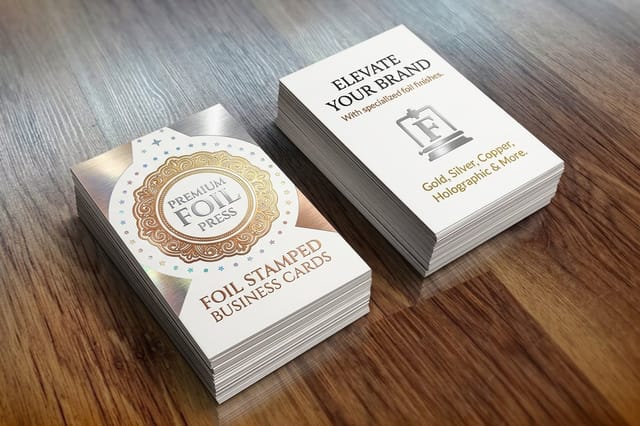
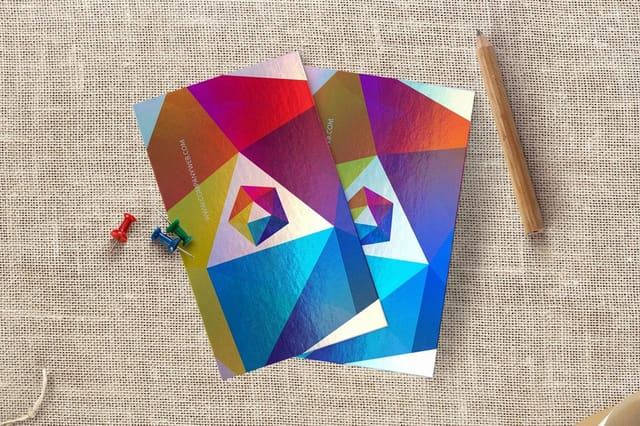
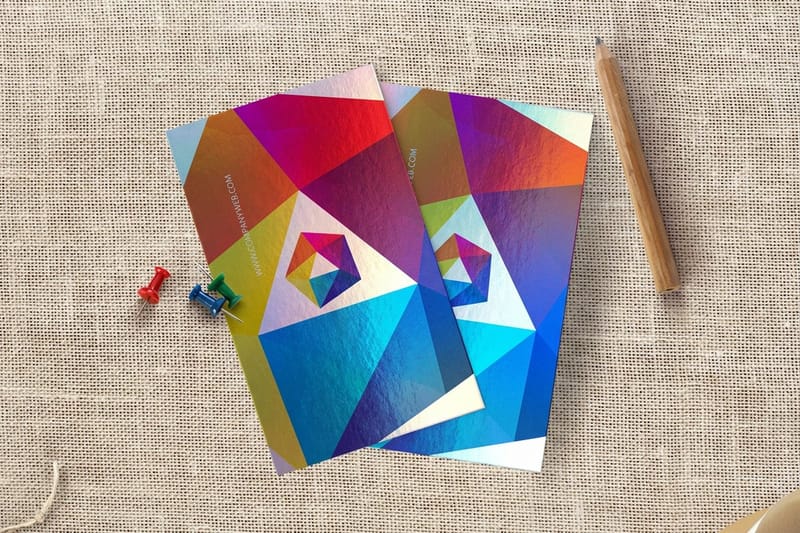
Foil and metallic cards off our press

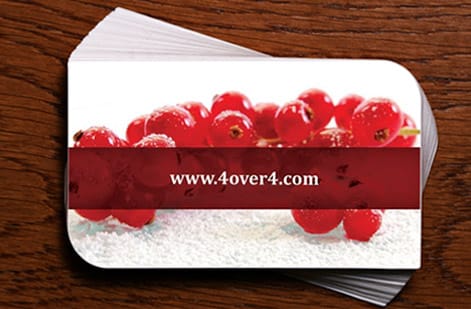
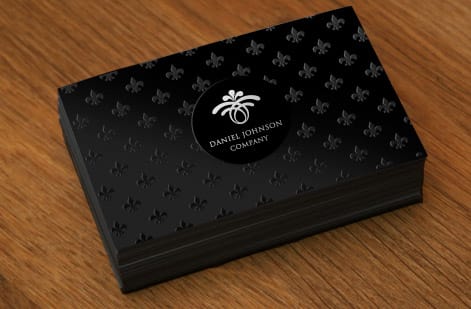
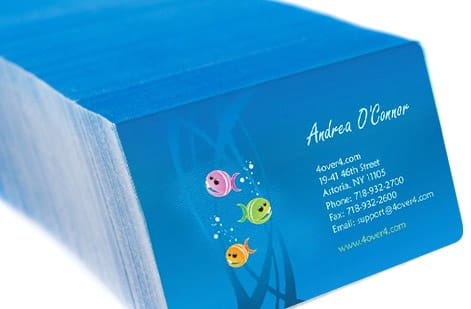
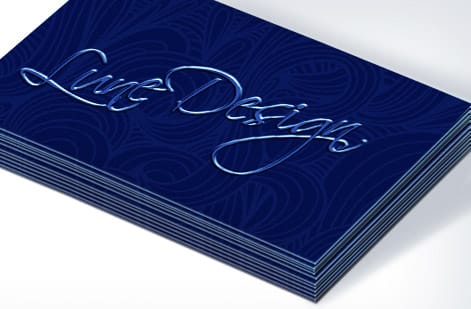
Explore more
Where to go next
By the numbers
Stocks that take foil and metallic ink
Common Questions
Common questions about gold foil and metallic ink
What is gold image printing?
Gold image printing is any method of putting a metallic gold element onto a printed piece, and it comes in two main forms: gold foil stamping and metallic gold ink. Foil stamping presses a thin sheet of metallic film onto the paper with a heated die, leaving a bright, reflective, slightly raised gold mark. Metallic gold ink is a shimmering ink printed like any other color, giving a softer satin shine that lies flat on the surface. Both create a gold effect, but they look, feel, and cost differently, so choosing between them, or combining them, depends on whether you want a dazzling accent or broad, budget-friendly metallic coverage.
How do I choose between gold foil and metallic gold ink?
Choose by the effect, the coverage, and the budget. Gold foil is the pick when a logo, monogram, border, or headline needs to be as bright and reflective as possible and to feel raised under a finger; it reads as the more luxurious option and shines on premium pieces like business cards and invitations. Metallic gold ink is the pick when the gold has to cover a large area, print inside a photo, blend with other colors, or keep costs down, and it works across a wider range of products. If you want both a focal accent and broad shimmer, many premium pieces combine metallic ink with a foil logo on top.
What does gold foil or metallic ink printing cost and how are prices set?
Gold effects are priced as an upgrade on top of the base print, and the two methods sit at different points. Foil stamping generally costs more because it uses a separate die and an extra pass, so its price reflects the premium finish, and it scales with quantity, size, and how much foil coverage the design has. Metallic gold ink is usually the more economical route, since it prints more like a standard color and can cover large areas without a big jump. As with all printing, larger runs lower the per-piece cost, and the configurator prices each option live so you can see exactly what adding foil or metallic ink does to the total.
What sizes, stocks and finishes work with gold foil and metallic ink?
Gold foil is at its best on heavier stocks and premium products such as business cards, greeting cards, invitations, hangtags, and postcards, where the stock supports the raised, reflective finish. Metallic gold ink is more flexible, printing across business cards, postcards, flyers, rack cards, and larger formats, and it pairs well with both coated and uncoated stocks. Foil is typically applied to specific elements rather than full sheets, while metallic ink can cover broad areas. The live product pages show which sizes, stocks, and finishes each foil or metallic product supports, so you can match the effect to the right item.
How long does gold foil or metallic ink printing take?
Turnaround depends on the product, the finish, and the quantity. Metallic gold ink usually prints on a timeline close to standard color work, while foil stamping can add production time because it involves a separate die and pass. Larger runs and combined finishes, such as metallic ink plus a foil accent, can extend the schedule further. The live estimate on each product page shows the current print and ship window for your exact specs, so if a deadline is tight, choosing metallic ink or a standard foil product is usually the faster path than a heavily customized combination.
How do I set up a design file for gold foil?
Gold foil needs its own dedicated art layer that tells the press exactly where the metal is stamped. The standard approach is to create a separate spot color layer, often set to a distinct spot swatch, containing only the elements that will be foiled, and to keep that art clean and not too fine, since very thin lines or tiny text can fill in or break under the heated die. Everything that is not foiled stays on your normal CMYK artwork. Metallic gold ink, by contrast, is set up much like any other color in your design. Our guide on setting up design files for foil walks through the layer setup step by step.
Get Started
Order 500 metallic business cards at $0.25 each
Choose gold foil for dazzling accents or metallic ink for broad shimmer at 4OVER4.COM, set every option, and watch the price update live before you order your premium prints.
Legal Disclaimer
Gold Standard guarantees apply to all standard orders placed through 4over4.com. Price match requires verifiable proof of a competitor's published price for an equivalent product with matching specifications and turnaround time. Satisfaction guarantee covers manufacturing defects and print quality issues. Contact support with order number and documentation. On-time delivery rate based on tracked orders 1999 to 2026. Individual results may vary based on shipping carrier performance.
