
How Holographic Foil Catches Light and What Artwork It Needs


Holographic foil is a stamped film with a diffraction pattern pressed into it. The pattern is what makes the color, the foil layer is built as a separate spot, and past a point the effect works against your own type.
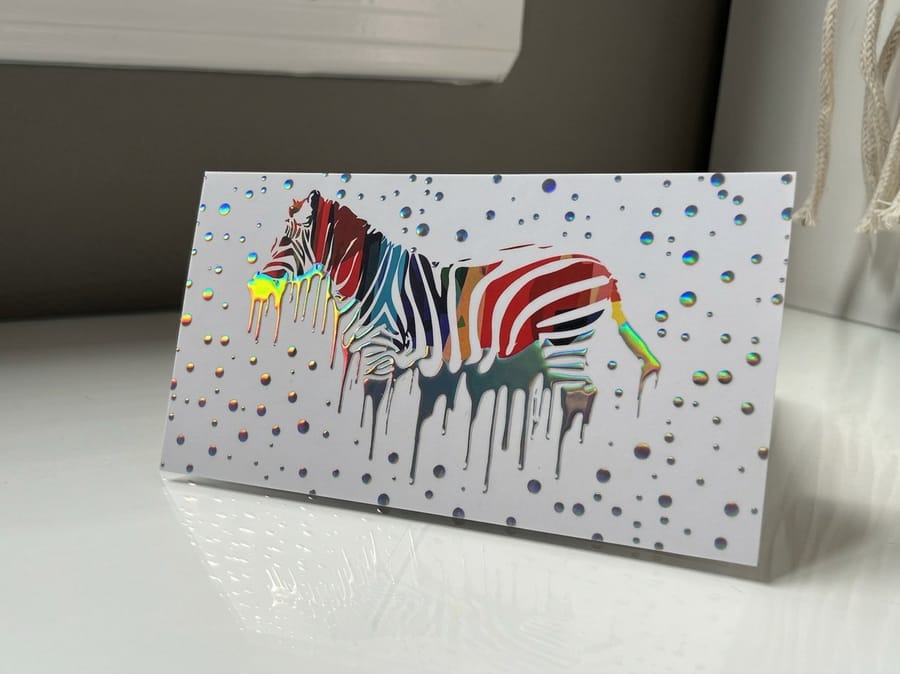
Holographic foil is a metallized film with a microscopic groove pattern embossed under its surface, stamped onto the sheet by a heated die. Those grooves split reflected light so each wavelength leaves at its own angle, which is why the color shifts as the piece turns and why the same card looks gray under flat, diffuse light. Build the foil as vector art on its own layer in a 100 percent spot swatch, keep strokes at half a point or heavier, and save it for marks and borders rather than small text.
Quick answer
A grating under the metal, not a rainbow ink
Holographic foil makes color by splitting light, not by carrying pigment. A groove pattern embossed into the film sends each wavelength off at a different angle, so the piece changes color as it moves and flattens to silver gray when the light is diffuse. The stamping itself is ordinary hot foil work: a heated die presses the film onto the sheet in one pass, after all the ink is down. What changes is the design brief. The effect owns whatever shape it fills, so it belongs on a mark, a border or a panel, with the reading matter printed flat beside it.
What Actually Produces the Rainbow
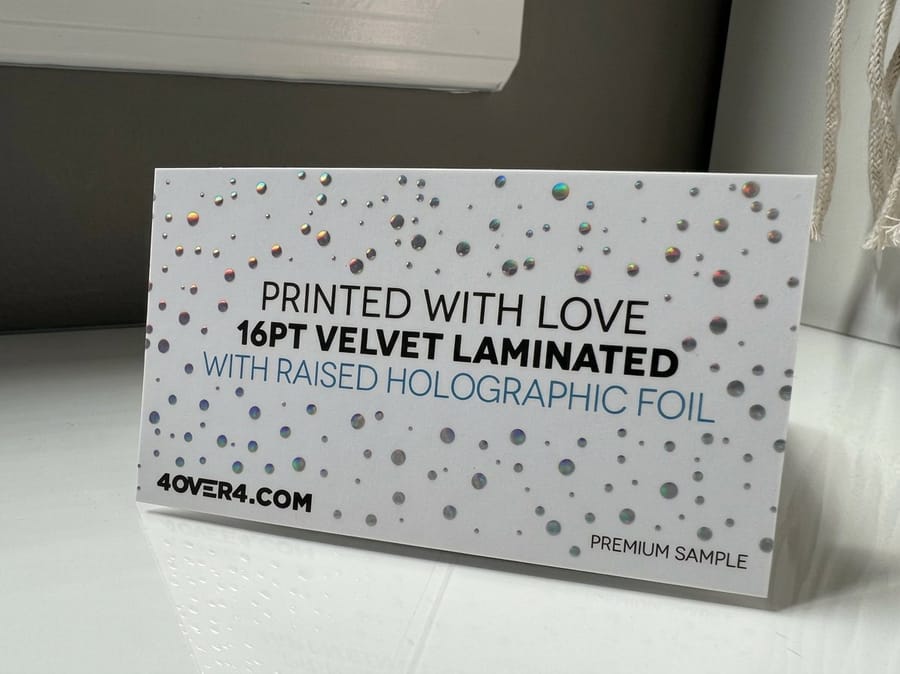
Holographic foil starts life as a polyester carrier film. Before the metal layer goes on, a microscopic groove pattern is embossed into the lacquer, at a pitch fine enough that the grooves are spaced on the same order as the wavelength of visible light. Then the film is metallized and coated with a heat activated adhesive.
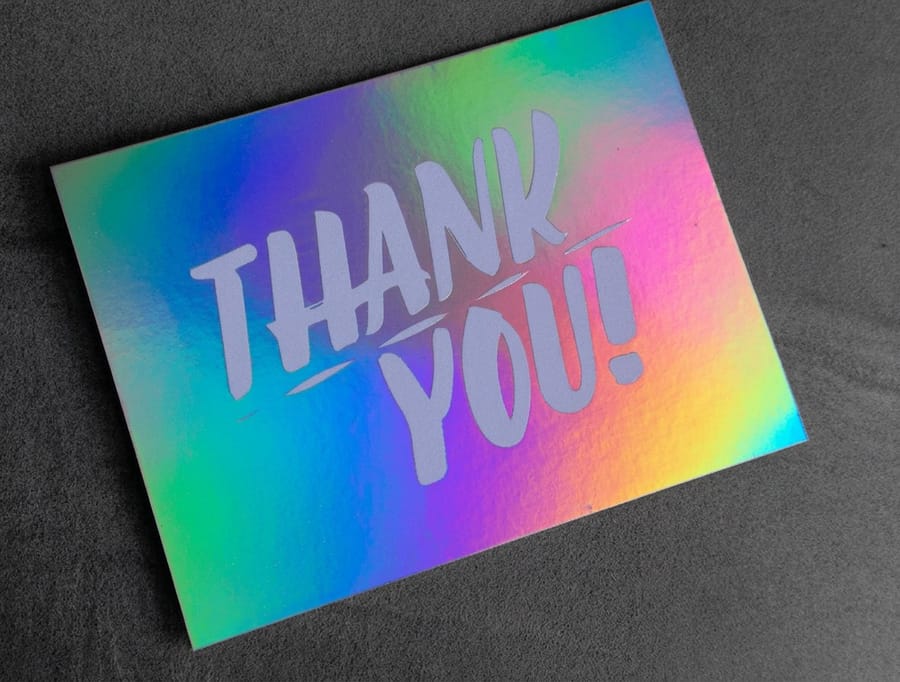
That groove pattern is a diffraction grating. When white light hits it, each wavelength leaves at its own angle instead of bouncing off together, so red points one way and blue points another. Tilt the card by a few degrees and a different wavelength lands in your eye. Plain metallic foil has a smooth mirror surface, so it reflects everything at one angle and stays silver or gold no matter how you hold it.
Two consequences follow, and both catch designers out. The effect needs a directional light source to exist at all: a lamp, a window, a phone flash. Put the same card under an overcast sky or a ceiling of diffused office panels and the spectrum washes out into gray silver. And the pattern is manufactured into the foil roll, which means you choose from what the foil makers offer, such as a broad rainbow, a fine sparkle, a sequin dot or a linear pillar pattern. You do not design the pattern yourself the way you design the shape it fills.
| Foil family | Surface | What it does in the hand | Holds a brand color |
|---|---|---|---|
| Holographic | Embossed diffraction grating under the metal layer. | Colors fan and shift as the piece turns. Needs a hard light. | No. It is a spectrum, not a color. |
| Metallic | Smooth mirror finish, gold, silver, copper and similar. | Bright and steady from every angle. | Within the metal family only. |
| Pigment | Opaque colored film with no metal in it. | Flat and solid, like very dense ink. | Yes, matched to a foil chart. |
| Raised foil | Foil sitting on a raised resin layer. | You feel the shape before you read it. | Follows whichever foil sits on top. |
If you want the mechanics of the stamping itself rather than the film, our guide to what foil stamping is covers the die, the heat and the pressure, and foil stamping versus raised foil explains when the tactile version is worth the extra step.
Building the Foil Layer in Your File
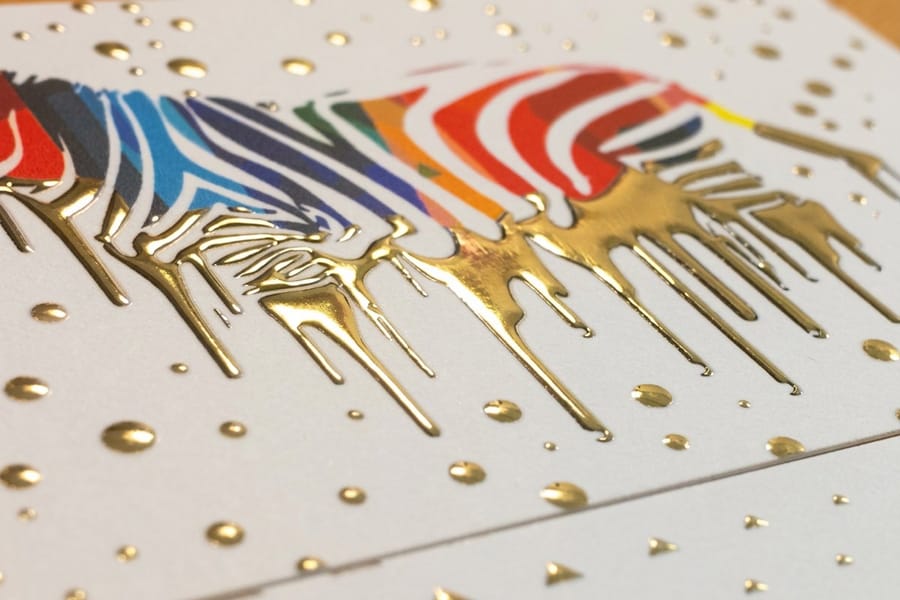
Foil is binary. Either the die presses foil onto that spot or it does not, and there is no such thing as a 40 percent holographic. Everything about the file setup follows from that one fact.
- One dedicated layer, one spot swatch. Put every foil element on its own layer and fill it with a named spot color called Foil, at 100 percent. Never a CMYK build, never a tint.
- Vector only. Outlines and live shapes. A placed raster of a logo will be traced by someone at some point, and it will not be traced the way you would have done it.
- No effects inside the foil layer. Gradients, transparency, drop shadows, feathering and blend modes all describe partial coverage, which the process cannot make.
- Set the spot to overprint off so it knocks out of the artwork underneath instead of quietly disappearing into it in the separation.
- Half a point minimum on strokes, roughly 6 point on type. Below that, thin lines flare or drop out under the heated die.
- Give it room. Keep foil elements around an eighth of an inch inside the trim, and leave visible space between two heavy foil shapes so the die does not pull them together into one blob.
Register is the other thing to design around. Foil is a separate pass from the ink, so two passes never land on top of each other with hairline precision. If a foil rule is meant to sit beside a printed panel, build a deliberate gap rather than a shared edge, and never try to trap a thin foil outline around printed type. Because ink will not stick to the metallized surface, foil is always applied last and nothing prints over it, so knock the ink out wherever foil is going.
Send the file as a print ready PDF with fonts outlined, the foil layer clearly named, and a flattened preview showing where the foil is meant to land. Our bifold brochure setup guide shows the same layer and bleed discipline applied to a folded piece, and the backdrop banner setup guide covers scaling artwork up when the same mark has to work large.
Where Holographic Foil Helps and Where It Swallows Your Type
The rainbow is loud, and loud competes with reading. That is the trade you are making, and it decides where the foil should go long before it decides how much of it you buy.
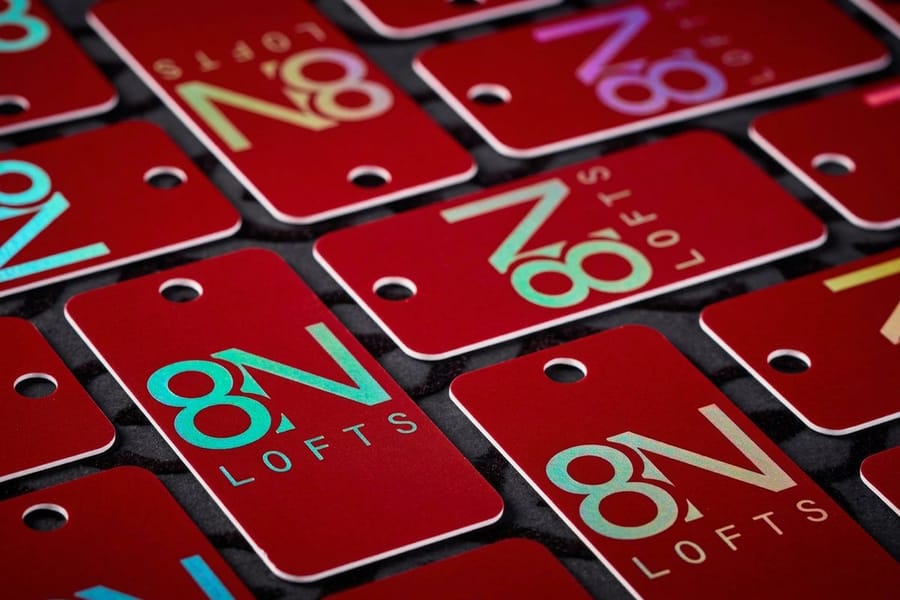
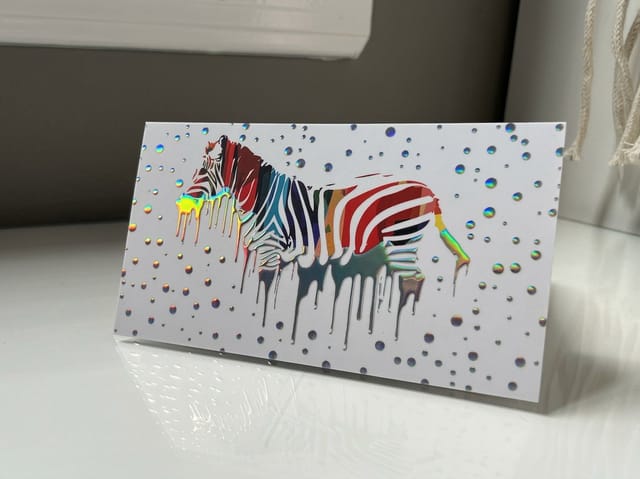
Holographic works best as a shape you look at rather than text you read. A logo mark, a monogram, a border, a pattern block, a die number on a hangtag. It works hardest against a dark, matte ground, because a black soft touch surface gives the diffracted colors somewhere to sit. Put the same foil on a white gloss stock and half the effect gets lost in the surrounding brightness.
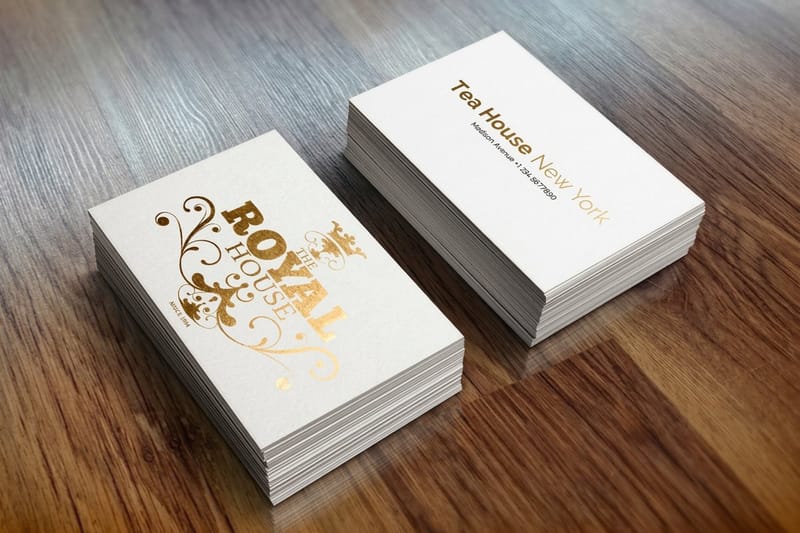
It fails on small type, on long text, and on anything with fine internal detail. A set of contact details in holographic foil looks impressive in a proof photograph and turns into work at a networking table, where the colors shift every time the card moves. The reliable pattern is to foil the mark and print the details flat, so the piece has one showpiece and the reading stays easy. Raised holographic business cards take this further by lifting the foil on a raised layer, which adds a texture edge you feel before the light does anything.
Two more limits worth planning around. Holographic photographs badly, since a camera captures one angle and the effect lives in movement, so build extra time into any product shoot. And it will not carry a corporate color, which means an identity built on one exact shade should use a pigment foil for the logo and keep the holographic for a secondary element. Everything we stamp with a rainbow film sits in the holographic foil stamping collection if you want to see the range in one place. If you are weighing a stamped foil against an adhesive film, how holographic stickers are made covers the sticker route, where the same diffraction film becomes the face stock instead of a stamp.
What It Costs and Which Piece to Put It On
On a traditional trade foil job the cost sits in three places: the die that has to be made for your artwork, the setup for each pass, and the foil itself. That is why a second foil color roughly doubles the finishing cost, since it needs a second die and a second run through the press. It is also why enlarging a single foil area is cheap while scattering foil into four separate corners is not.
Our holographic products are priced as finished products, so the finish is already in the number and you can compare them directly.
| Product | Starts at | Why the holographic suits it | Watch for |
|---|---|---|---|
| Raised holographic business cards | $86.78 | Handed over and turned in the hand, which is exactly the motion the effect needs. | Keep contact details in flat ink, not in foil. |
| Raised foil business cards | $86.78 | Same raised build with a steady metallic instead of a shifting spectrum. | Choose this when the logo must stay one color. |
| Holographic hangtags | $186.73 | Moves constantly on the rail, so the color shift reads from across the store. | String hole placement needs clearance from the foil area. |
| Holographic postcards | $220.20 | A full surface effect that survives being seen at arm length in a stack of mail. | Address and message areas must stay flat and legible. |
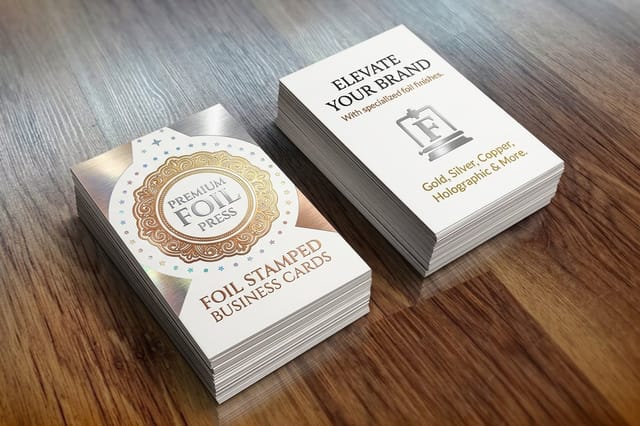
Anything that gets turned over, hung, or pulled out of a pocket earns the effect. Anything read straight on under flat office light does not, and the money is better spent on stock weight or a soft touch laminate. For the wider range of foil options across stationery and packaging, the foil printing collection and the foil stamping collection list every product that carries a foil pass, and the hot foil stamping guide covers the finishes we can put on them.
Wally explains holographic foil
Tilt it and the color moves, because the surface is grooved
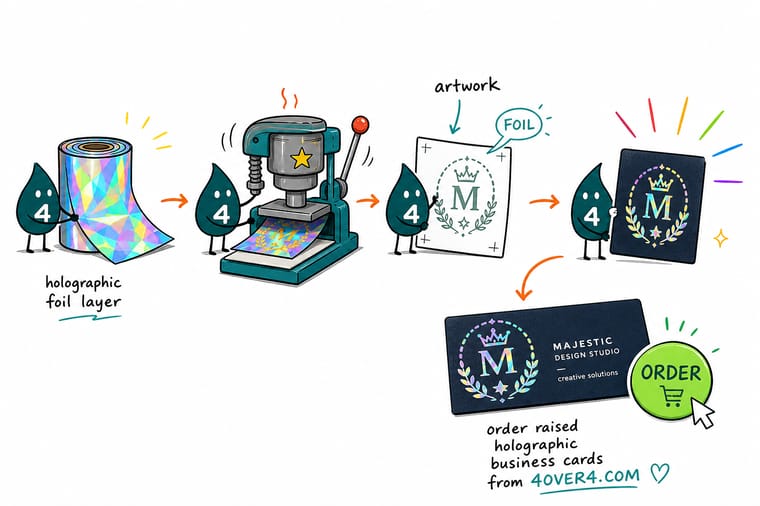
Wally holds the card under one lamp and turns it. The grooves pressed into the foil send red one way and blue another, so the mark changes color as it moves. Hold it still under a flat ceiling light and it goes back to looking like silver. That is the whole trick, and it tells you what to foil: a logo, a border, a panel. Give Wally a phone number in 6 point holographic and even he has to tilt the card to read it, so keep the small print in flat ink.
Order raised holographic business cards →Specs and pricing
Holographic products, sizes, and starting prices
Holographic hangtags start at 100 for $186.73 and postcards at 100 for $220.20, both running 10 business days.


Print it
Order a finish that changes as it moves

Explore more
Where to go next
By the numbers
The foil department behind a holographic run
Common Questions
Your holographic foil questions, answered
Is holographic foil the same thing as a hologram?
Not in the way most people mean. A true hologram stores a three dimensional image you can look around. Holographic foil carries a repeating diffraction pattern pressed into the film, which splits reflected light into its component colors. There is no hidden image and no depth, just a surface that sends different wavelengths off at different angles. The security holograms on banknotes are a separate, custom made product with its own origination cost, and they are not what you get when you order a rainbow foil stamp.
Can holographic foil match our brand color?
No, and this is the honest reason to walk away from it on some jobs. The whole point of the grating is that the color changes with the angle you hold the piece at, so the same stamped logo reads green at one tilt and magenta at another. If a brand guideline says the mark must appear in one specific corporate color, use a pigment foil or a metallic foil in that family instead. A common compromise is holographic on a background panel or a border, with the logo itself in a solid foil or in ink.
What line weight and type size survive a holographic foil stamp?
Keep strokes at half a point or heavier and type at roughly 6 point and up, and pick a face with open counters. The practical failure is not the stamping, it is the reading. Thin serifs and tight counters fill in or flare slightly under the heated die, and the shifting spectrum then breaks up whatever is left. Anything the customer has to read at arm length, such as an address block or a phone number, belongs in flat ink rather than in holographic foil.
Can you print ink on top of holographic foil?
Ink will not adhere to the metallized polyester, so foil is always the last thing applied and nothing overprints it. That changes the build order in your file. If a logo needs both foil and a printed element, either butt them against each other with a small deliberate gap or knock the ink out where the foil sits, rather than assuming a hairline register between two separate passes.
Does holographic foil work on uncoated or textured stock?
It works best on smooth coated stock or over a laminate, and it gets patchy on heavy texture. The die presses foil onto the sheet, so it lands on the peaks of a linen or felt finish and skips the valleys, which reads as pinholing across a large solid. On a textured stock, keep the foil area small and bold. On soft touch laminate the foil sits perfectly and the matte surface gives the rainbow the dark ground it needs to look strong.
Why does my holographic card look gray in photos?
A camera freezes one angle, and one angle only shows one narrow slice of the spectrum, often none. The effect lives in movement. Shoot it with a single hard light rather than a softbox, tilt the piece while you shoot, and take several frames, because the version that looks brilliant in your hand rarely survives one flat lit photograph. Plan for this before you build a product listing around a holographic finish.
How much more does a holographic finish cost than a plain one?
At 4OVER4.COM the finish is priced into the product rather than quoted as a separate die and setup charge, so you can read the difference straight off the catalog. Raised holographic business cards start at $86.78, the same starting point as raised foil business cards at $86.78, while holographic hangtags start at $186.73 and holographic postcards at $220.20. What still adds cost on any trade foil job is a second foil color, because that means a second die and a second pass through the press.
Get Started
100 raised holographic cards cost $86.78, or 87 cents each
Pick your stock, set the foil layer as one clean spot color, and we stamp a holographic finish that fans into a spectrum every time the piece turns.
Legal Disclaimer
Gold Standard guarantees apply to all standard orders placed through 4over4.com. Price match requires verifiable proof of a competitor's published price for an equivalent product with matching specifications and turnaround time. Satisfaction guarantee covers manufacturing defects and print quality issues. Contact support with order number and documentation. On-time delivery rate based on tracked orders 1999 to 2026. Individual results may vary based on shipping carrier performance.
