
Foil Stamping Vs Raised Foil


Two ways to put metallic shine on a business card, and they are not the same. One presses the foil flat into the stock for a quiet mirror finish. The other builds it up so you can feel it and it catches the light. Here is how they differ on look, feel, process, and price, so you print the right one.
Choose foil stamping for a flat, formal mirror shine. Choose raised foil for a tactile finish that lifts off the card. Foil stamping uses a heated metal die to press foil flush with the stock, runs on premium paper, and starts around $222.13, which makes it the classic, heritage choice. Raised foil builds metallic foil over a raised base so you can feel it, needs no die, and starts around $86.78, which makes it the affordable, modern choice. Both print sharp on premium stock at 4OVER4.COM.
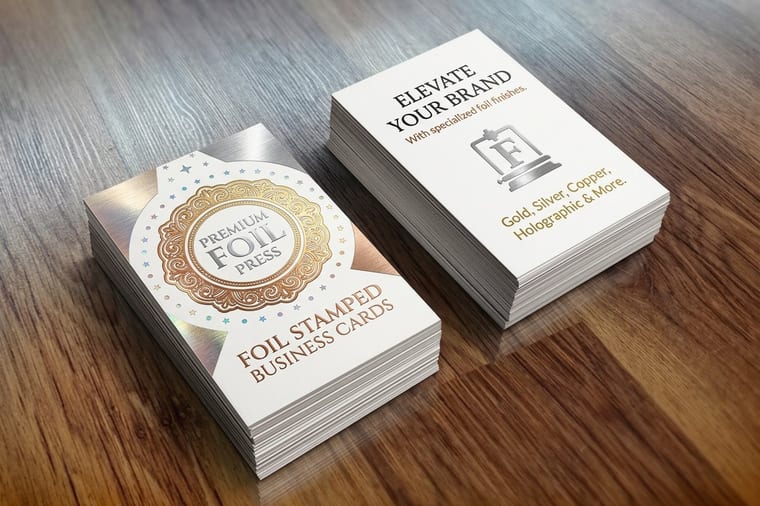
Head to head
Foil stamping vs raised foil at a glance
The fastest way to choose is to read down the column that matches your brand. If you want a flat, formal mirror shine, your answer is on the left. If you want a raised finish people can feel, it is on the right. Starting prices are live from the 4OVER4.COM configurator.
| Foil stampingflat & flush | Raised foilraised & tactile | |
|---|---|---|
| Best for | Timeless, formal brands that want quiet luxury | Modern, creative brands that want a tactile wow |
| The finish | Metallic foil pressed flush into the card | Metallic foil raised above the card surface |
| How it feels | Smooth and level, mirror-flat to the touch | Raised ridges you can feel with a thumb |
| The process | Traditional hot-foil die stamping | Digital raised foil over a spot-UV base |
| Custom die | A metal die is cut for your artwork | No die needed, straight to press |
| Stock | Heavy premium stocks, suede and silk options | 16pt gloss or matte with foil on top |
| The shine | Classic mirror shine, quiet and even | Dimensional sparkle that catches the light |
| Starts at | $222.13 | $86.78 |
| Order online | Customize foil stamped | Customize raised foil |
Foil stamping needs a custom die and runs on premium stock. Raised foil is a digital finish with no die. The choice is about the feel you want and the brand you are, not just the price.
Our picks
Three ways to print this at 4OVER4
The tactile raised finish, the flat classic stamp, and the card that layers both. Each one is live with real specs and pricing.
The anatomy: flush foil vs foil that sits proud
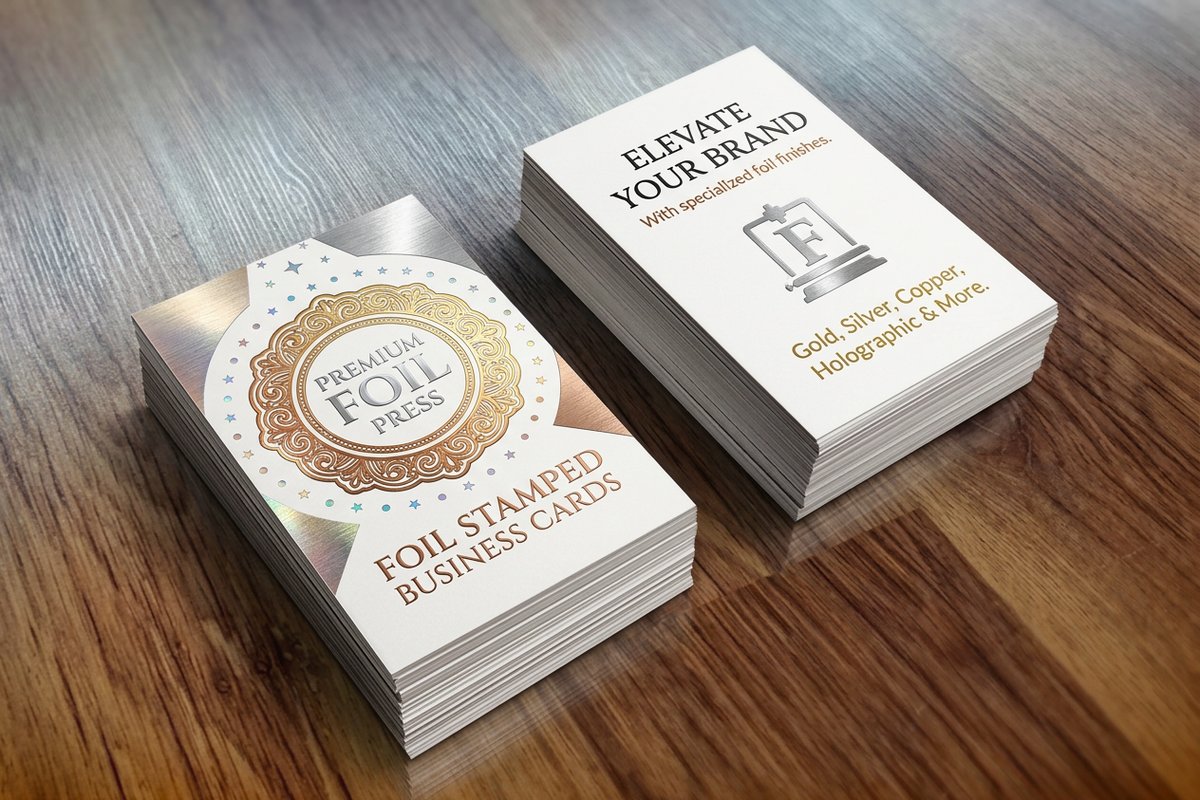
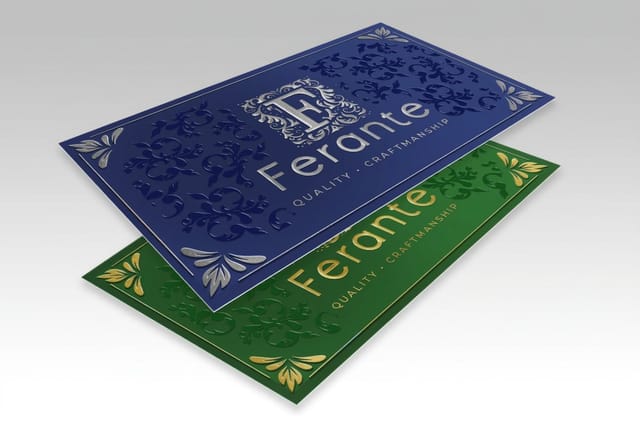
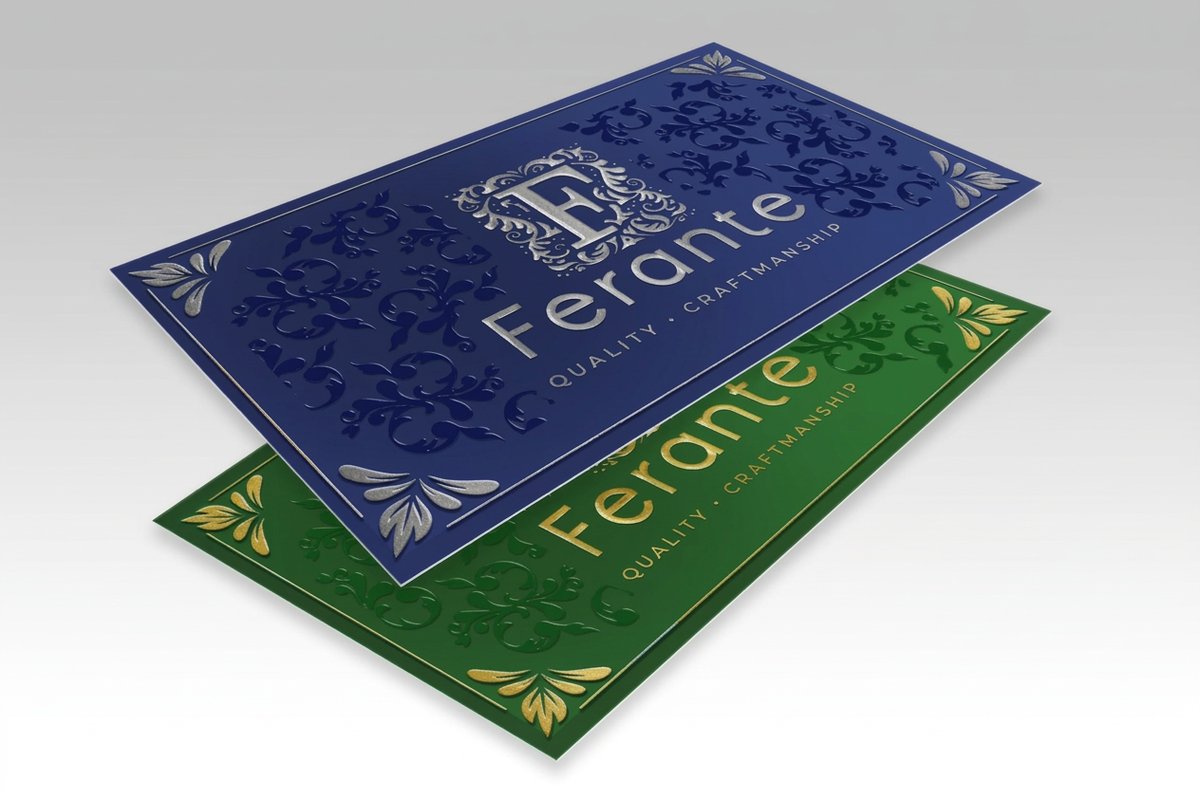
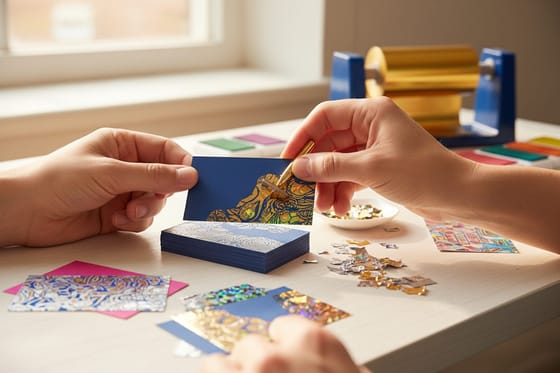
Both finishes use the same raw material, a thin metallic foil, but they put it on the card in opposite ways. Foil stamping is the traditional method. A metal die is heated, the foil is pressed onto the stock, and the metal bonds flush with the surface. The result is a mirror-flat shine that reads as sleek and formal, with nothing rising above the card.
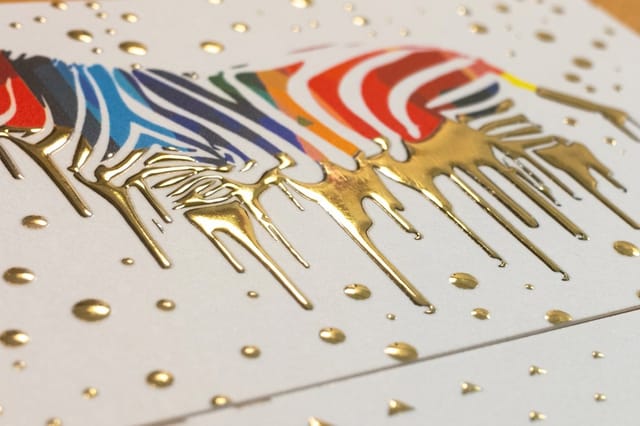
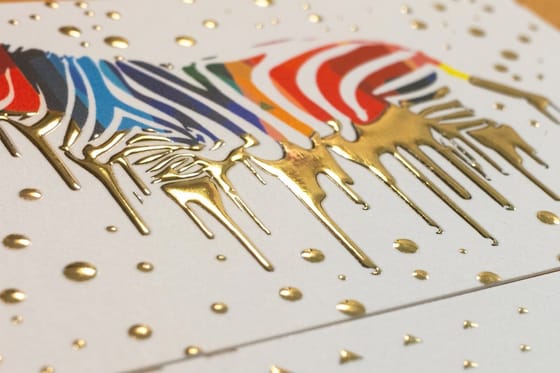
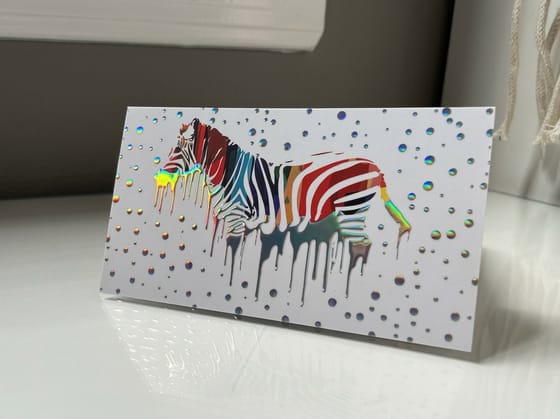
Raised foil flips the geometry. First a clear base is printed and cured so the design stands up off the stock, then the foil is laid over that raised shape. Now the metallic areas physically rise above the card, so they catch the light from more angles and, more importantly, you can feel them under a fingertip. Same sparkle, a completely different surface.
If the vocabulary of dies, bases, and coatings is new, keep our printing terms glossary open in another tab. And for the wider picture of how metallic treatments behave on a card, the guide on what a foil accent is walks through where each one shines.
Look and feel: quiet mirror shine vs dimensional sparkle
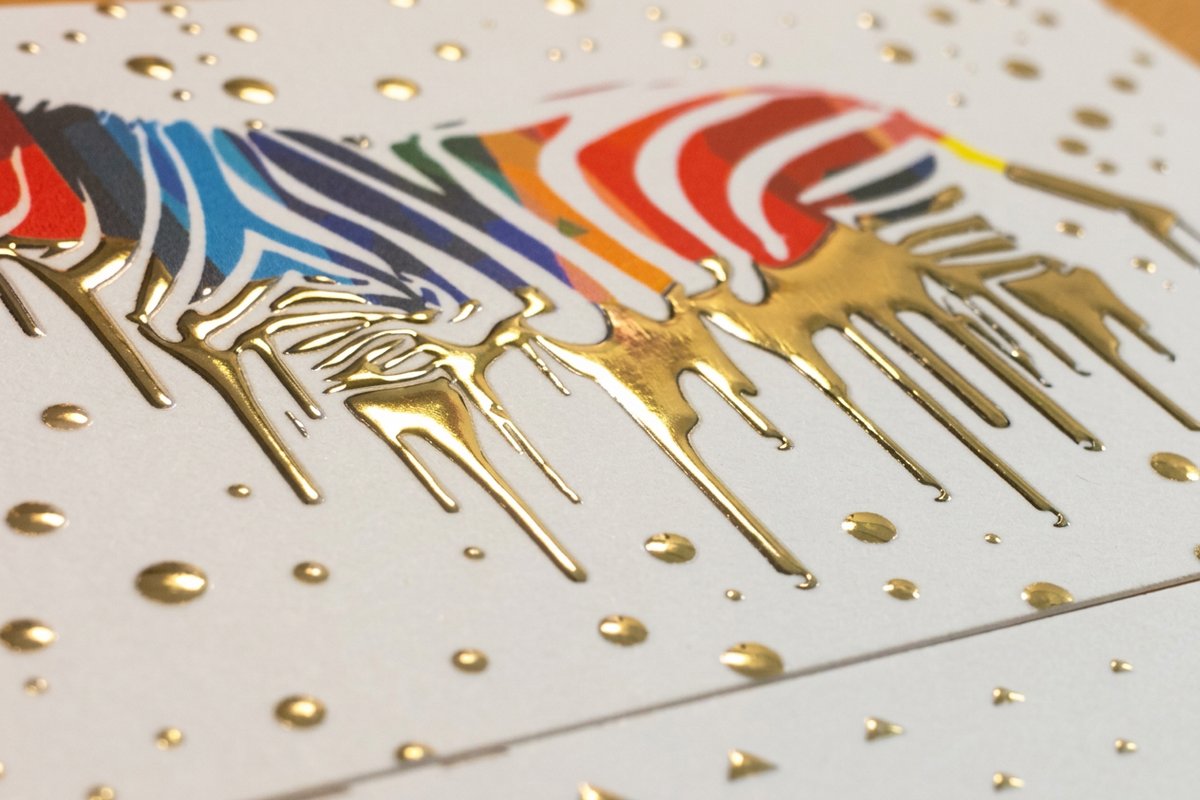
Set the two side by side and the eye sees them differently before the hand does. Foil stamping delivers an even, mirror-flat shine that stays calm and controlled, the kind of restraint that reads as expensive. Raised foil delivers movement. Because the metal rises, light glances across it and the design almost flickers as the card tilts, which is why it stops a scan the moment someone picks it up.
Then there is touch, and touch is where raised foil wins outright. Run a thumb across it and you feel the design. Do the same on a stamped card and it is glass-smooth. That tactile beat is a real part of the impression, so if you want the card to be remembered by feel as well as by sight, raised foil is built for it.
Foil accents vs embossed gloss, or spot UV
A foil accent is real metallic leaf, so it mirrors the room and reads as gold, silver, or copper whatever colour sits under it. Embossed gloss, which we print as raised spot UV business cards, is a clear resin ridge with no metal in it, so it glints only at an angle and lets the ink below show through unchanged. Metal reads more premium on dark or uncoated stock and on formal work, so pick foil stamped business cards for a flush mirror mark or raised foil business cards for metal you can feel. Clear raised gloss reads more premium when the artwork is already colourful and you want texture without touching the palette.
Whichever direction you lean, the design path is the same. Lay out your card in our online designer, start from a ready-made layout in the design templates library, and order free paper samples so you can feel a stamped card and a raised card in hand before you commit a full run.
Cost and process: a custom die vs straight to press
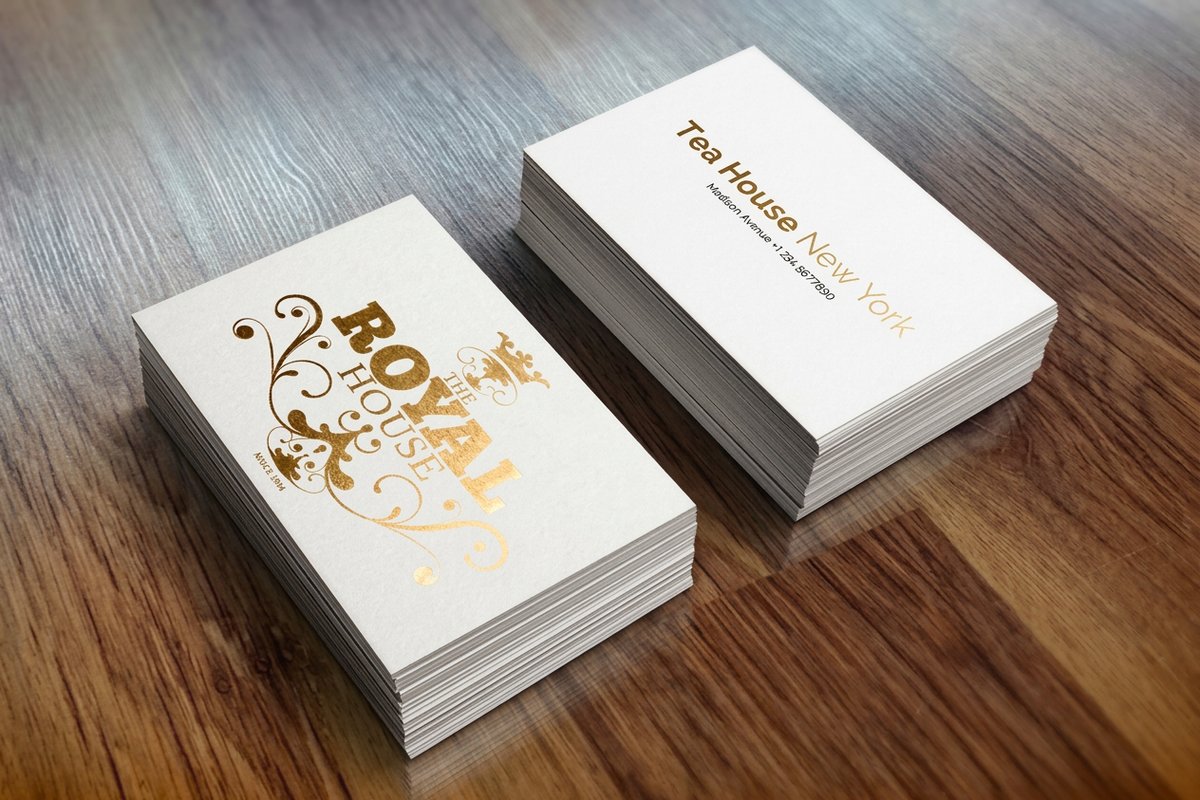
The price gap is not markup, it is method. Raised foil starts around $86.78 because it is a digital finish that needs no tooling. Your print-ready file goes to press as is, which keeps short runs quick and affordable and makes it easy to test a bold card without a big commitment.
Foil stamping starts around $222.13, and the reason sits in the setup. A metal die is cut to match your artwork, and the finish runs on heavier premium stock, sometimes suede or silk. You are paying for tooling and materials that produce that flush, old-world shine, which is fair when the object is meant to feel like a keepsake.
Step by step, the stamped job goes: artwork is separated into the foil-only shape, a metal die is cut to that shape, the die is heated, foil and card meet under pressure so the metal transfers and the stock compresses slightly, then the sheets are trimmed to size. Raised foil skips the first three steps: the file prints, a clear raised base is laid down where the metal belongs, the foil bonds to that base on press, and the sheet is trimmed. That is the whole reason one job carries a tooling line and the other does not.
Both numbers are live, not estimates. Set quantity, size, and stock in the configurators below and watch the price move. Thickness matters here too, since a foil card feels its best on a substantial stock, so the 14pt vs 16pt guide is worth a look before you lock the spec.
When foil stamping is the right call
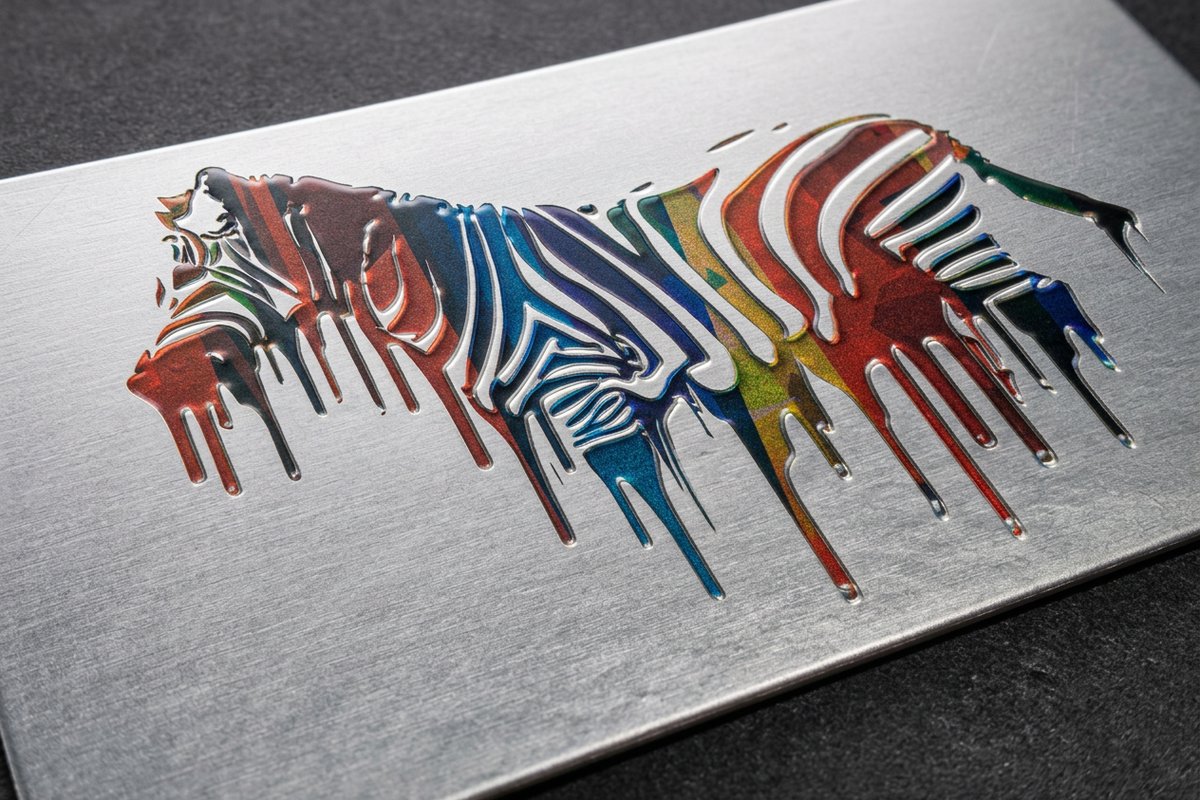
Reach for foil stamping when the brand trades on heritage, formality, or understated quality. The flush, mirror-flat foil is the finish people associate with law firms, luxury labels, private clients, and anyone whose card should whisper rather than shout. It pairs beautifully with embossing and letterpress, and it looks its best on the heaviest stocks.
It is also the pick when consistency and craft matter more than speed. A die cut for your logo reproduces the same crisp edge on every card in the run, which is exactly what a legacy brand wants. If your foil is a single refined mark, a monogram, a crest, a wordmark, the flat stamp lets it read as quietly confident.
Want to see the family it belongs to? Explore foil stamped cards alongside metallic foil and silk aluminum foil, or browse the full foil stamping collection to compare stocks and coverage in one place.
When raised foil is the right call
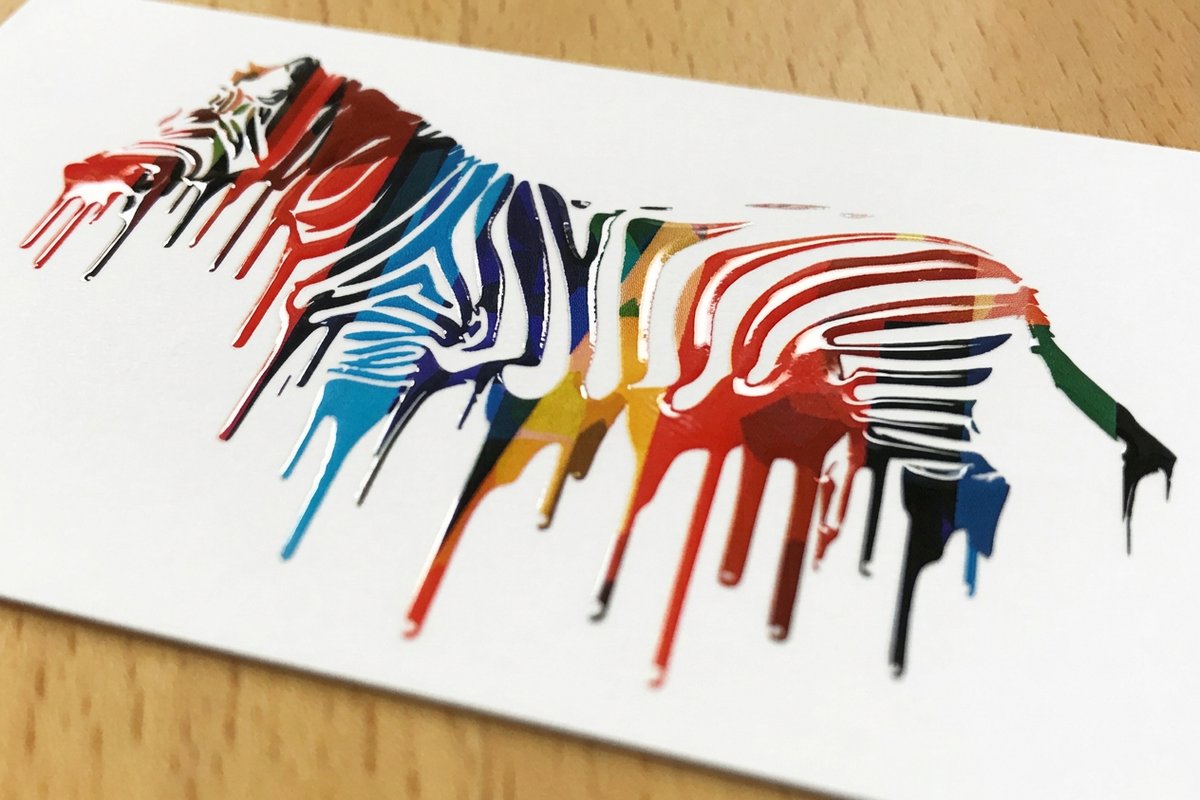
Reach for raised foil when the brand is modern, creative, or wants to feel new the instant the card leaves your hand. The dimensional finish and the tactile lift signal energy, and because the foil rises off the stock it photographs with real sparkle for social and portfolio shots. Studios, salons, photographers, and founders who want to be memorable gravitate here.
It is also the practical pick when budget and turnaround matter. With no die to cut, raised foil is the affordable way into metallic shine, which makes it easy to print a bold small batch, test a design, and reprint without setup costs stacking up. That flexibility is a genuine advantage for a growing brand.
Raised foil also has close cousins worth a look. Raised spot UV adds tactile gloss without the metallic, raised holographic pushes the shine into rainbow territory, and fat foil turns the metal up to full coverage for maximum impact.
Weighing the metal against the clear gloss, the short version is this: raised foil business cards give you reflection plus texture in one pass, raised spot UV business cards give you the same lift with no metal so your brand colours print exactly as drawn, and foil stamped business cards give you the mirror with no ridge at all. If two of those are still tied on screen, order them as free paper samples and let your thumb settle it.
How to choose in one minute
Reach for foil stamping when the brand is formal or heritage, you want a quiet mirror shine, and the card should feel smooth, restrained, and timeless. A single refined mark on a heavy stock is exactly its strength. Start with foil stamped cards.
Reach for raised foil when the brand is modern or creative, you want texture people can feel, and you value an affordable, die-free run you can reprint on a whim. Bold, dimensional, and made to be noticed. Start with raised foil cards.
Reach for both when one finish is not enough. Dual Raised layers raised foil with a raised gloss accent on the same card, so you get metallic shine and a second tactile highlight in one print. It is the honest compromise for anyone who keeps going back and forth.
Wally weighs the two foils
Same shine, two different surfaces, and both are right
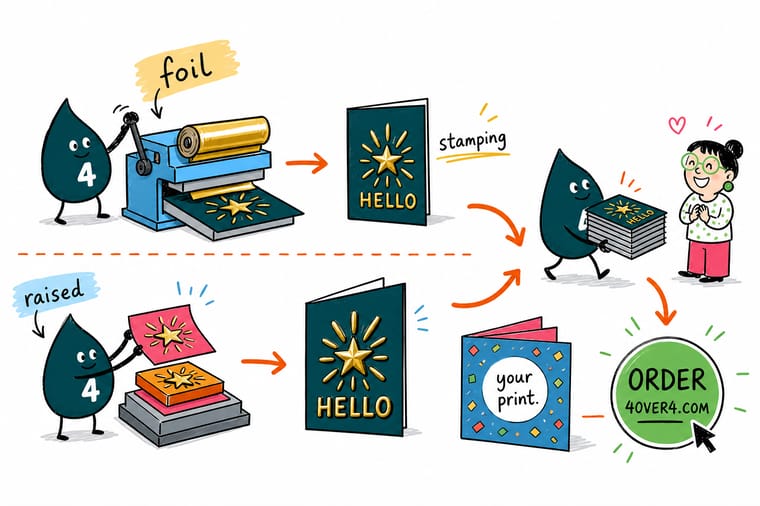
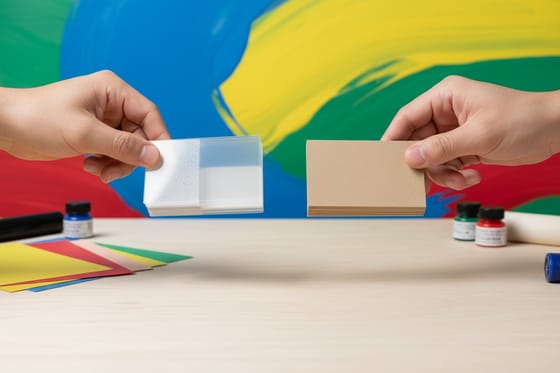
Wally holds a foil stamped card in one hand and a raised foil card in the other. The stamped card is glass-smooth, a quiet mirror shine that reads formal and timeless. The raised card lifts off the stock, so his thumb can feel every metallic line and the light dances as it tilts. Want understated luxury on premium paper? Go stamped. Want texture and sparkle people notice by feel? Go raised. Either way, 4OVER4 prints it sharp on the stock you choose.
Start with raised foil →
The trade-offs
What each finish gives you, and what it asks in return
No finish is free of compromise. Weigh the upside against the trade-off for the card you actually want to hand over.
Foil stamping
Where foil stamping wins
- Mirror-flat, flush foil with a classic luxury shine
- Reads formal, heritage, and understated
- Runs on heavy premium stocks, suede and silk options
- Pairs beautifully with embossing and letterpress
- A crisp die reproduces the same edge on every card
Where it falls short
- Higher entry price, starting around $222.13
- A custom die adds cost and a little lead time
- The finish is smooth, so there is no texture to feel
- More than you need for a quick, budget-first run
Raised foil
Where raised foil wins
- Foil sits raised, so you feel it and it catches light
- Affordable entry at $86.78 with no die required
- Digital process, so short runs and reprints are easy
- Dimensional sparkle that stops a scan
- Modern, bold, and made for creative brands
Where it falls short
- The raised texture reads modern, not old-world formal
- Fewer ultra-premium stock pairings than hot foil
- Heavy raised coverage can feel busy if overused
- Less of the quiet, mirror-flat elegance of a stamp
Live options
Compare real foil business card options
Pulled straight from the catalog, side by side, so you can see how price, stock, and turnaround shift across the foil family at 4OVER4.COM.
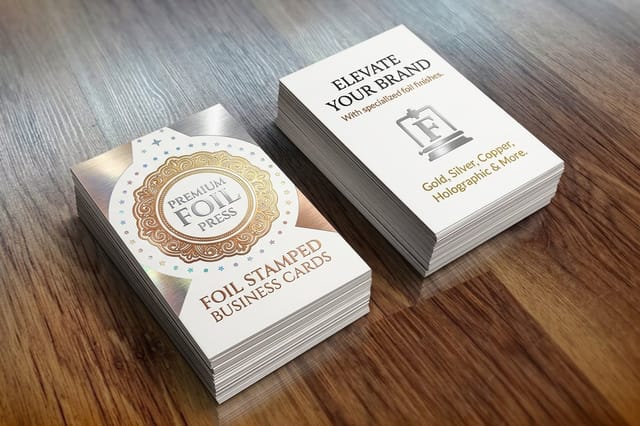 Foil Stamped Business Cards | 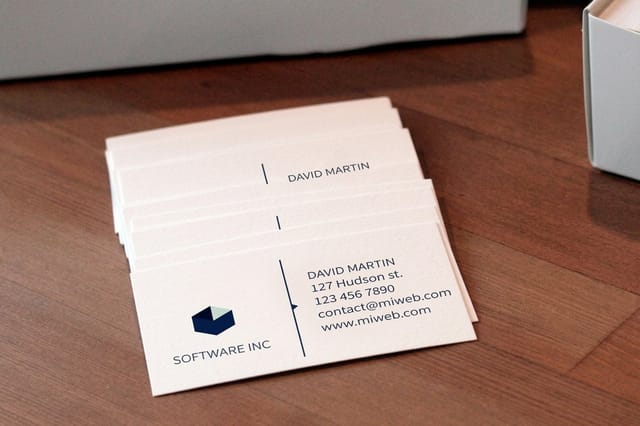 Standard Business Cards | 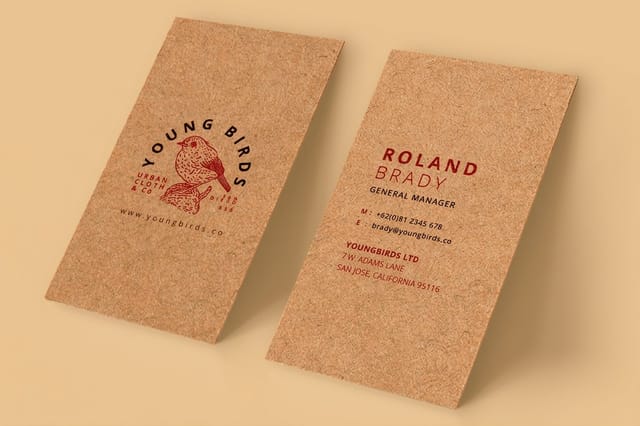 Kraft Business Cards | 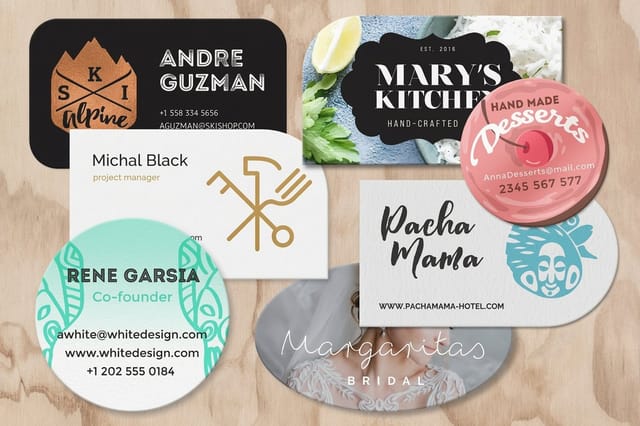 Die-Cut Business Cards | 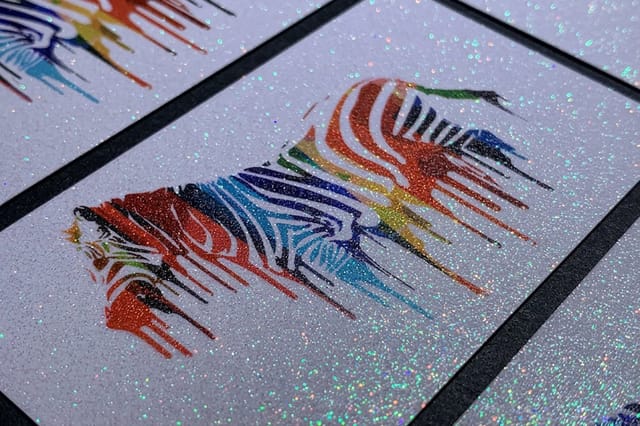 Diamond Glitter Business Cards |  Premium Prestige Business Cards | |
|---|---|---|---|---|---|---|
| Min price | $222.13 | $17.57 | $24.75 | $26.37 | $31.84 | $36.62 |
| Paper / stock | 16 Point Silk Laminated | 14pt Gloss Cover | 18pt Kraft Uncoated Cover (100% PCW) | 14pt Gloss Cover | 17pt Diamond Glitter (Front Only) | 32pt UltraWhite Uncoated Cover |
| Finish | - | Standard Finish | - | Standard Finish | - | Standard Finish |
| Size | 2" x 3.5" | 2" x 3.5" | 2" x 3.5" | 2" x 3.5" Rounded Corners | 2" x 3.5" | 2" x 3.5" |
| Default qty | 500 | 100 | 100 | 100 | 50 | 50 |
| Turnaround | 7 business days | 3 business days | 5 business days | 3 business days | 5 business days | 5 business days |
| Rating | ||||||
| View & customize | View & customize | View & customize | View & customize | View & customize | View & customize |
Specs and pricing
Live specs and pricing, side by side
When you have narrowed the choice, it comes down to size, stock, and quantity. Here are the live specs and price-per-unit for foil stamped and raised foil business cards.
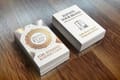
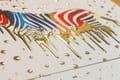
| Quantity | Price Per Unit | Total |
|---|---|---|
| 500 | 44.4¢ | $222.13 |
| 1,000 | 26.9¢ | $269.14 |
| 2,500 | 20.2¢ | $504.19 |
| 5,000 | 19.7¢ | $986.04 |
| 10,000 | 16.4¢ | $1,644.19 |
| 15,000 | 14.4¢ | $2,161.30 |
| 20,000 | 13.5¢ | $2,701.94 |
| 25,000 | 13.0¢ | $3,242.54 |
| Quantity | Price Per Unit | Total |
|---|---|---|
| 100 | 86.8¢ | $86.78 |
| 250 | 47.9¢ | $119.73 |
| 500 | 37.1¢ | $185.63 |
| 1,000 | 36.1¢ | $361.37 |
See it in use
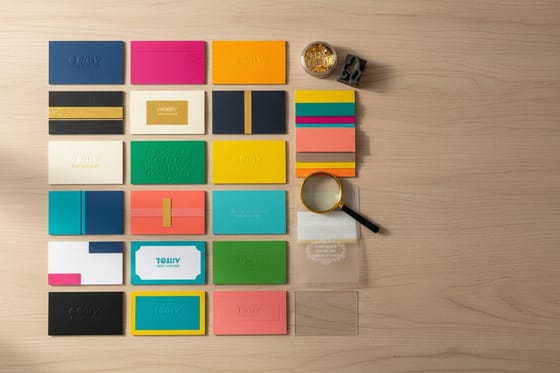
Real foil business cards, printed in-house


The verdict
So which should you print?
There is no single winner, because they are not really competing. Score each one on the turf it was built for and the choice makes itself: foil stamping owns quiet, formal luxury, raised foil owns tactile, modern impact. Below is how each rates for its own job.
Foil stamping, for timeless luxury
The right call when the brand is formal or heritage, you want a flush mirror shine, and the card should feel smooth, restrained, and expensive. Classic, and hard to beat on premium stock.
Raised foil, for modern impact
The right call when the brand is creative, you want texture people can feel, and you value an affordable, die-free run. Dimensional, bold, and made to be remembered by hand as much as by eye.
Cannot pick just one? Print a Dual Raised card: it layers raised foil with a raised gloss accent on a single card, the honest compromise between flat elegance and tactile shine.

Explore more
Where to go next

By the numbers
Print either finish with a shop you can count on
Common Questions
Common questions about foil stamping and raised foil
What is the difference between foil stamping and raised foil?
Foil stamping uses a heated metal die to press metallic foil flush into the card, so the finish is smooth and level with the surface, like a mirror set into the stock. Raised foil builds the foil up over a clear raised base, so it sits above the card and you can feel it with your finger. Both use real metallic foil and both shine, but foil stamping is flat and classic while raised foil is dimensional and tactile.
What is the difference between foil accents and embossed gloss?
A foil accent is real metallic foil, so it mirrors the light and reads as gold, silver, or copper no matter what colour is printed underneath. Embossed gloss, which we print as raised spot UV, is a clear raised resin with no metal in it, so it catches the light only at an angle and lets the ink below show through unchanged. Both sit above the surface and both can be felt with a thumb, so the choice is about shine, not about texture. Use foil when the metal is meant to be the statement, and use embossed gloss when the artwork is already colourful and you only want to add feel without changing the palette. Foil stamping is the third route, metallic and flush, with no lift at all.
Is raised foil cheaper than foil stamping?
Yes. At 4OVER4.COM raised foil business cards start around $86.78, while foil stamped business cards start around $222.13. The gap comes down to process. Raised foil is a digital finish that goes straight to press with no tooling, so short runs stay affordable. Foil stamping requires a custom metal die cut for your artwork and runs on heavier premium stock, which adds cost. Both prices update live in the configurator as you set quantity, size, and stock.
Which one looks more premium?
They read premium in different ways. Foil stamping gives a quiet, mirror-flat luxury that feels formal and traditional, which is why law firms, luxury labels, and legacy brands lean on it. Raised foil gives a bold, dimensional sparkle that feels current and confident, which suits creative studios, salons, and modern brands. Neither is more premium than the other. Match the finish to the personality of the brand rather than to a price tier.
Can you feel the difference between the two?
Absolutely, and it is the fastest way to tell them apart in hand. Run a thumb across a foil stamped card and it stays perfectly smooth, because the foil is pressed level with the stock. Do the same on a raised foil card and you feel the design lift off the surface, because the foil is built up over a raised base. If texture matters to the impression you want to leave, raised foil is the one you notice with your eyes closed.
Do I need a custom die for either finish?
Only for foil stamping. The traditional hot-foil process uses a metal die that is cut to match your logo or design, which is part of why it costs more and takes a little longer to set up. Raised foil skips the die entirely. It is a digital process, so your print-ready file goes to press as is and short runs are quick and economical. If you want metallic shine without tooling, raised foil is the simpler path.
Can I combine foil stamping and raised foil on one card?
You do not have to blend the two processes to get a layered look. Dual Raised business cards, starting around $149.00, stack raised metallic foil with a raised gloss accent on a single card, so you get the shine of foil plus a second tactile highlight. It is the go-to when you want more than one finish working together and cannot pick a single treatment. For pure single-finish elegance, though, stay with one of the two.
Which finish is better for a modern brand versus a traditional one?
Reach for raised foil when the brand is modern, creative, or wants to feel new. The dimensional finish and the tactile lift signal energy and confidence, and it photographs with real sparkle. Reach for foil stamping when the brand is formal, established, or trades on heritage. The flush, mirror-flat foil reads as restrained and timeless, the look people associate with quality that has been earned. Both are printed sharp and on premium stock at 4OVER4.COM.
Get Started
Ready to print the right one?
Bring your design to 4OVER4.COM and print foil stamped, raised foil, or a Dual Raised card on the size, stock, and quantity that fits the brand. Adjust every option and watch your price update live.
Legal Disclaimer
Gold Standard guarantees apply to all standard orders placed through 4over4.com. Price match requires verifiable proof of a competitor's published price for an equivalent product with matching specifications and turnaround time. Satisfaction guarantee covers manufacturing defects and print quality issues. Contact support with order number and documentation. On-time delivery rate based on tracked orders 1999 to 2026. Individual results may vary based on shipping carrier performance.
