
How to Choose a Digital Printing Company for Short Runs and Fast Turnarounds


Digital presses skip plates, so they win on small quantities, tight deadlines and jobs where every piece is different. Here is the crossover point, the questions worth asking, and the limits nobody volunteers.
Choose a digital printing company when your run is short, your deadline is tight, or every piece needs different data on it, and judge one on four things: a hard price you can see before uploading, turnaround counted from proof approval, stocks named by weight and finish rather than adjectives, and a printed color policy. The one question that decides everything else is quantity. Below roughly 1,000 to 2,500 pieces digital is cheaper and faster; above that band, ask for an offset quote too, and be wary of any shop that has only one answer.

Quick answer
Quantity picks the process, then you pick the printer
A digital press has no plates and no makeready, so a run of 100 costs close to what a run of 100 should cost, and the job can be on press as soon as the file passes preflight. That advantage shrinks as the quantity climbs, and somewhere between about 1,000 and 2,500 pieces offset takes the lead on price. Settle your quantity, sheet size and stock first. Then compare printers on the price you can see, the turnaround they will commit to in writing, and whether they can move you to offset when your run outgrows the press.
Digital vs Offset, and Where the Cost Crosses Over
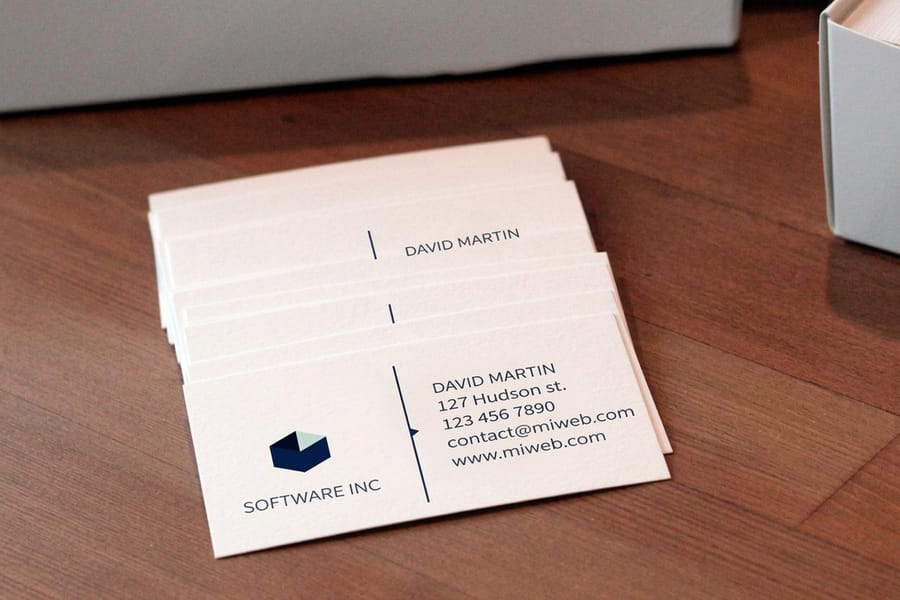
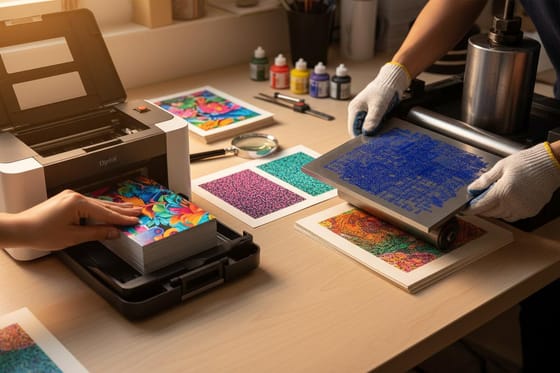
Every quote you get from a digital printing company is shaped by one fact: nothing has to be made before printing starts. Offset needs a plate for each color and a stack of makeready sheets to bring the press up to color, and you pay for all of it whether you order 500 or 50,000. Digital images the sheet from the file, so the cost of piece number one is close to the cost of piece number five hundred.
That is also why digital stops winning. Its per-unit price barely falls as the run grows, while offset spreads its setup thinner with every thousand. The three processes below cover almost everything a commercial printer will quote you.
| Process | Setup before the first good sheet | Sweet spot | Variable data | Spot and metallic inks |
|---|---|---|---|---|
| Production toner | None. The file is ripped, imposed and printed. | 1 to roughly 2,500 pieces, and anything urgent. | Yes, every sheet can differ. | Simulated in CMYK. Some presses add a white or clear station. |
| Production inkjet | None, but stock often needs a primer or an inkjet-treated sheet. | Medium runs of books, manuals and personalized mail. | Yes, and at higher speeds than toner. | Simulated in CMYK. |
| Offset lithography | A plate per color plus makeready waste, charged to the job. | Thousands and up, especially on large sheets. | No, unless a separate imprint pass is added. | Real mixed inks, including metallics and fluorescents. |
Read the setup column first, because it decides the rest. If you are ordering 250 postcards for a weekend event, paying for four plates is absurd. If you are ordering 25,000 of the same postcard, paying digital rates on all 25,000 is equally absurd. The full mechanics of the offset side are in our guide to offset printing and offset lithography, and the head-to-head sits in digital printing vs offset printing.
The Jobs Digital Printing Is Built For
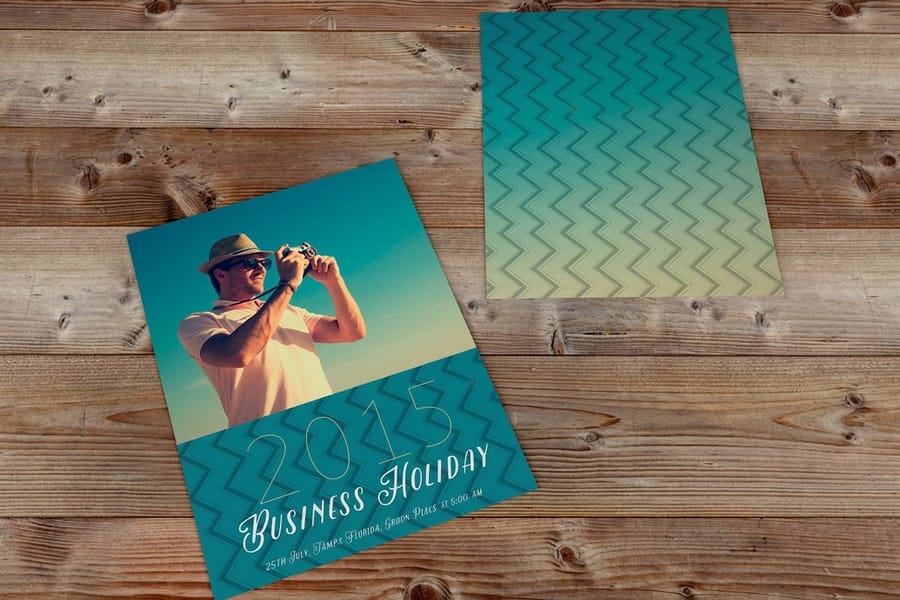
Four job types belong on a digital press, and recognizing yours saves an email thread with a sales rep.
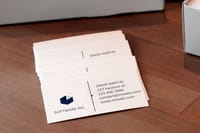
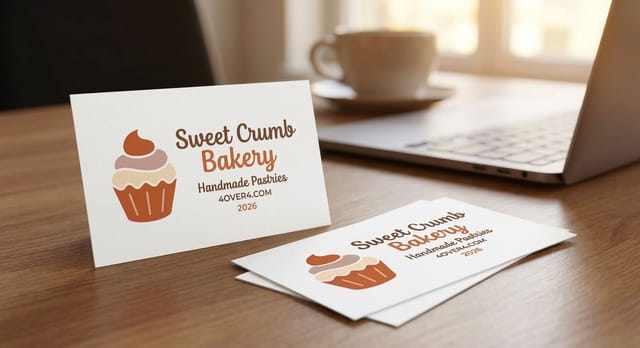
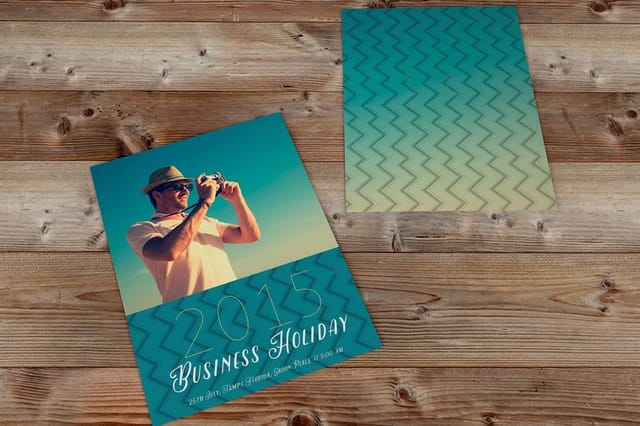
- Short runs. A box of cards, 250 postcards for a trade show, 100 flyers for a class. Standard business cards start at $17.57 and standard postcards at $16.48, which is the price level that only exists because no plates were cut.
- Deadlines measured in days. Digital removes plate making from the schedule entirely, which is what makes same day business cards possible at $17.57 when the file is correct.
- Variable data. Names, promo codes, ticket numbers, per-location addresses. One design, a spreadsheet, and every sheet different.
- Testing before you commit. Print 250 standard flyers at $39.54, see what the response looks like, then reorder or rewrite. Nobody tests an offer at 20,000 copies.
The one place to check yourself is page-count work. Standard brochures start at $57.11 and standard booklets at $240.55, and once a booklet run gets long the plate cost stops mattering; our guide on digital vs offset for booklets walks through where that flips.
What to Check Before You Send Anyone a File

Most bad print experiences are not printing failures. They are quoting failures, spec failures and turnaround misunderstandings, and all three are visible before you upload anything.
- A price you can see without talking to anyone. If the quantity, stock and turnaround are configurable and the total updates as you change them, you can compare printers honestly. Our guide on getting an instant online printing quote covers what to compare beyond the headline number.
- Turnaround counted from proof approval. Not from checkout. Ask what the daily file cutoff is, and what happens to the clock if your file needs a fix.
- Stocks named with numbers. 14pt or 16pt cardstock, 100lb gloss cover, 80lb text. A printer who says premium paper and stops has told you nothing you can compare.
- Published file specs. Bleed, safety margin, resolution and color mode should be written down, not explained on request. Start from our blank template library and the checklist in creating commercial print ready files.
- A stated color policy. Ask what tolerance they hold on brand color and whether a hard proof is available for the job. The conversion side is covered in choosing the best color profile for printing.
- A reprint policy in writing. What counts as their error, what counts as yours, and how long you have to report it.
- Offset available when you outgrow digital. A digital-only shop will quote you digital for 25,000 postcards, because that is all it has.
If you are still deciding between a website and a counter you can walk into, local print shop vs online printing lays out the real trade, and how to choose a print shop covers the vetting questions that apply to both.
Where Digital Costs You More Than It Saves
A printer who only sells you the upside is not being straight with you. Four limits are worth knowing before the job is on press.
Long runs. Past the crossover band you are paying a short-run rate on every single piece. On 25,000 postcards that difference is not a rounding error, it is the whole print budget.
Sheet size. Most production digital presses top out around 13 by 19 inches, some a little longer for banner-format sheets. Anything larger is a different machine, which is why a wall poster at $108.75 comes off large-format equipment rather than the same press as your cards.
Difficult stocks and finishes. Heavy cotton, deep-textured and some uncoated sheets are where toner sheen and adhesion show up. Raised, foiled and embossed effects are separate passes regardless of how the base is printed, which is covered in print finishing techniques.
Reorders weeks apart. Two digital runs on different days can sit slightly apart in color, because calibration, toner batch and stock lot all move. If a set has to match perfectly, order the full quantity at once instead of splitting it. When you do need to reorder, mention the original job number so the printer can pull the same settings.
None of this makes digital the wrong choice. It makes the quantity, the sheet size and the stock the three questions to settle before you compare prices at all. The rest of the ordering flow, from upload to delivery, is in how online printing works.
Wally sizes up the job
Count the pieces before you compare the prices
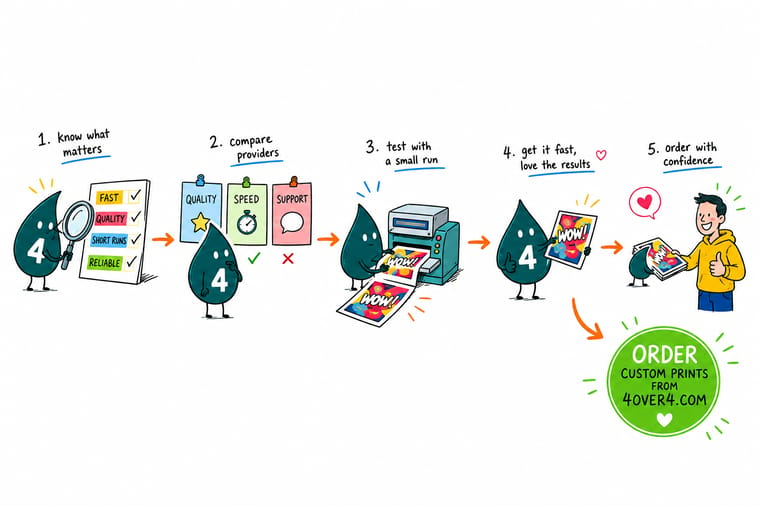
Wally asks one question first: how many are you printing? Under a thousand or two, digital wins, because there is no plate to cut and no makeready to pay for, and the job goes on press as soon as the file checks out. Past that band the plates pay for themselves and offset takes over. He also checks the sheet size and the stock, because a 24 inch poster and a heavy cotton card were never going on the same press as your business cards.
Order same day business cards →Specs and pricing
Short-run favorites, sizes and starting prices
The three products people order digitally most often, with live configuration options and starting prices straight from the 4OVER4.COM configurator.


Print it
Put a short run on press today

Explore more
Where to go next

By the numbers
Digital printing you can plan a deadline around
Common Questions
Your digital printing questions, answered
What actually makes a company a digital printing company?
Production digital presses, not office copiers. The dividing line is the equipment: a production toner or liquid-electrophotography press, or a production inkjet, running on a calibrated color workflow with a rip that handles PDF/X files, bleed and imposition. A shop running a desktop laser printer can print your file, but it cannot hold color across a run, cannot imposition-gang your job onto a large sheet, and usually cannot trim to bleed. Ask what press the job runs on and what the largest sheet it takes is. A company that will not answer that question is reselling your job to someone who can.
How many pieces before offset becomes cheaper than digital?
Usually somewhere between 1,000 and 2,500 pieces, and it depends on the job more than on the printer. Offset front-loads its cost into plates and makeready, so that fixed amount spreads thinner as the run grows. Digital has almost no setup, so its per-piece price barely moves with volume. Heavy ink coverage, larger sheets and more colors all pull the crossover down; small, light-coverage pieces push it up. The practical move is to ask for both a digital and an offset price at your real quantity rather than guessing which side you are on.
Can a digital press match my exact Pantone brand color?
It gets close, and close is usually enough, but it is not a mix. Digital builds a spot color out of CMYK, so a Pantone with a fluorescent or metallic component, or a heavily saturated orange or blue, is the kind that drifts most visibly. Two things help: supply the file in CMYK with the conversion done deliberately rather than letting the rip guess, and order the whole quantity in one run so every piece comes off the same calibration. Our guide to the best color profile for printing covers the conversion side.
What is variable data printing and do I actually need it?
Variable data means each printed piece carries different content, pulled from a spreadsheet, while the rest of the design stays fixed. Personalized names on postcards, unique promo codes, numbered tickets, and per-store addresses on the same flyer are the common uses. You need it when the whole point of the mailing is that the recipient sees something specific to them; you do not need it for a generic offer that every recipient gets. If your list is under a few hundred and the variable part is only the address, a mailing house label may be cheaper than variable printing.
Is digital printing lower quality than offset?
On a coated stock at normal viewing distance, most people cannot tell them apart, and that has been true for years. Where offset still pulls ahead is large solid areas of a single color, which lay down more evenly, real spot and metallic inks, very large sheet sizes, and specialty uncoated or heavily textured stocks where toner adhesion and sheen become visible. Where digital pulls ahead is short runs, next-day work, and any job where every sheet is different.
How fast can a digital printing company really turn a job around?
Fast enough that the file, not the press, is normally the bottleneck. Because there are no plates to make, a digital job can go on press as soon as it is preflighted and imposed, which is what makes Same Day Business Cards possible at $17.57 when the file is correct and submitted before the posted cutoff. A file with missing bleed, RGB images or unembedded fonts loses that head start immediately, so build the file to spec first. Turnaround is also quoted from proof approval, not from the moment you pay, and confusing the two is the most common reason a rush job arrives late.
Get Started
Order 50 flyers from $39.54 and see the short run price
Set your quantity, stock and turnaround, watch the price update as you go, and upload a file that is already built to spec.
Legal Disclaimer
Gold Standard guarantees apply to all standard orders placed through 4over4.com. Price match requires verifiable proof of a competitor's published price for an equivalent product with matching specifications and turnaround time. Satisfaction guarantee covers manufacturing defects and print quality issues. Contact support with order number and documentation. On-time delivery rate based on tracked orders 1999 to 2026. Individual results may vary based on shipping carrier performance.
