
High-Converting Landing Page Frameworks and When Each One Works


Four running orders, the five page slots they all fill, and the proof block that three of them quietly leave out. Plus how to pick one from the traffic source rather than from taste.
A landing page framework is a fixed running order for the blocks on the page: what the visitor sees first, what carries them down, and what asks for the action. The four that still earn their keep are PAS (Problem, Agitate, Solution), AIDA (Attention, Interest, Desire, Action), BAB (Before, After, Bridge) and the 4 Ps (Promise, Picture, Proof, Push). Choose between them by how much the visitor already knows: PAS for cold traffic, AIDA for browsers, BAB for switchers, the 4 Ps for someone who arrived ready to ask a price.
Quick answer
Same five slots, four opinions about what goes in slot two
Every framework fills the same skeleton: above the fold, opening block, the turn, proof, and the close. PAS opens on the problem, AIDA opens on attention, BAB opens on life as it is now, and the 4 Ps open on the promise. Only the 4 Ps treats proof as a stage, so on the other three you insert an evidence block yourself between the turn and the ask. Pick by traffic temperature, then spend your remaining effort on the offer and the message match rather than on the acronym.
The Five Slots Every Framework Is Rearranging
Strip the acronyms away and every landing page framework is filling the same five slots in the same order. Learn the slots and the frameworks stop being competing philosophies and start being four opinions about slot two.
Slot one is above the fold. One headline, one supporting line, one image and one button. The headline has a single job: confirm to the visitor that they are in the right place. If it does not repeat the promise that brought them, nothing further down gets read.
Slot two is the opening block. This is where the frameworks disagree. PAS names the problem, AIDA grabs attention, BAB describes life as it is now, the 4 Ps state the promise. All four are answering the same question: why should this person keep reading.
Slot three is the turn. Something changes here. The solution appears, the desire is built, the bridge is crossed. This is also the slot where most pages get vague, because it is easier to write "our proven process" than to explain what actually happens in week one.
Slot four is proof, and it is the one that gets left out. Three of the four frameworks never mention it. Reviews with a full name, a photograph of the real work, a client list, a guarantee, a sample you can hold. Without it, slot three is a claim.
Slot five is the close. The same action as the button above the fold, worded the same way, with the objection that stops most people handled right next to it. Repeating the ask is not padding. Visitors who scrolled the whole page should not have to scroll back up.
Layout does the same work visually. Our guide to hierarchy in graphic design covers how size, weight and spacing tell the eye which of these five blocks matters most.
PAS, AIDA, BAB and the 4 Ps, Side by Side
Four frameworks, four different bets about the reader. The column that decides your choice is the last one.
| Framework | Running order | Use it when | Where it breaks |
|---|---|---|---|
| PAS | Problem, Agitate, Solution | The visitor feels something is wrong but has not named it. Cold ads, cold mail, cold search. | Agitation overdone reads as manipulation, and an audience that already knows the problem finds it patronizing. |
| AIDA | Attention, Interest, Desire, Action | Browsing traffic that needs pulling forward one step at a time, and longer pages with several blocks. | It says nothing about what to put in each stage, so it turns into a filing system rather than an argument. |
| BAB | Before, After, Bridge | The visitor already has a solution and you want them to switch. Competitor comparisons and upgrades. | The After has to be specific and honest. Vague future-state copy makes the whole page feel like a brochure. |
| 4 Ps | Promise, Picture, Proof, Push | Warm traffic that arrived ready to ask for a price. Quote requests, bookings, sample orders. | Push without a real reason to act now becomes a fake deadline, and visitors recognize those quickly. |
Notice that only the 4 Ps names proof as a stage. That is the single most useful thing this comparison shows: on PAS, AIDA and BAB you have to insert an evidence block yourself, usually between the turn and the close. Skip it and the page argues with itself.
The frameworks also stack. A long service page can run PAS across the whole document and use BAB inside one section to handle the "we already have somebody" objection. Nothing forces you to pick one for the entire page.
Pick the Framework by How Cold the Traffic Is
Traffic temperature decides the framework more reliably than industry does. A dentist and a software company selling to the same awareness level need the same running order.
Cold traffic has never heard of you and has not defined the problem. PAS earns its keep here because the first block does the defining. Give the page more room than feels comfortable, and expect a low conversion rate that still pays if the offer is right.
Warm traffic knows the category and is comparing options. BAB and AIDA both work, and this is where a comparison table, a spec list and named clients matter more than another paragraph of persuasion.
Hot traffic already decided and wants a price or a date. The 4 Ps get out of the way fast. Anything above the form that is not the promise, the picture or the proof is slowing down someone who was ready to convert.
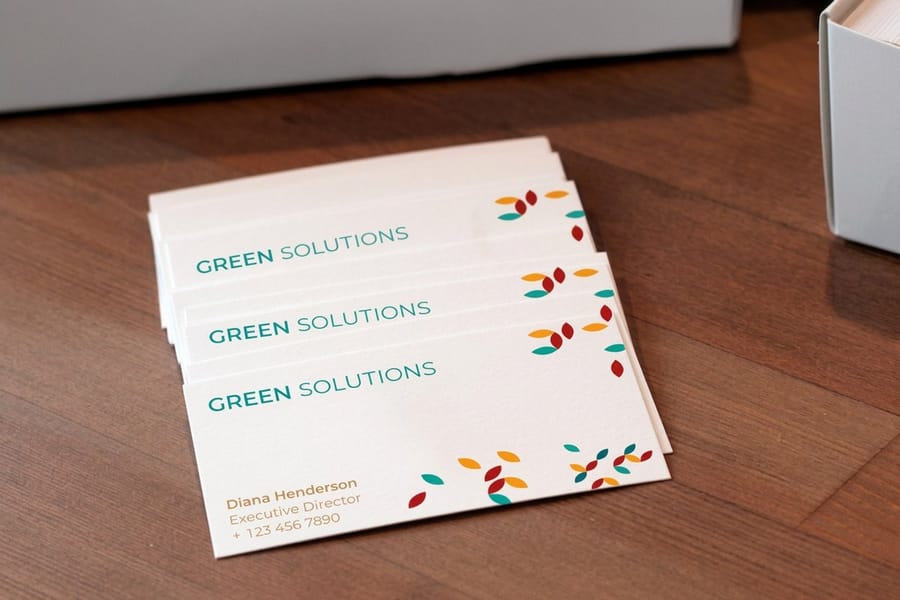
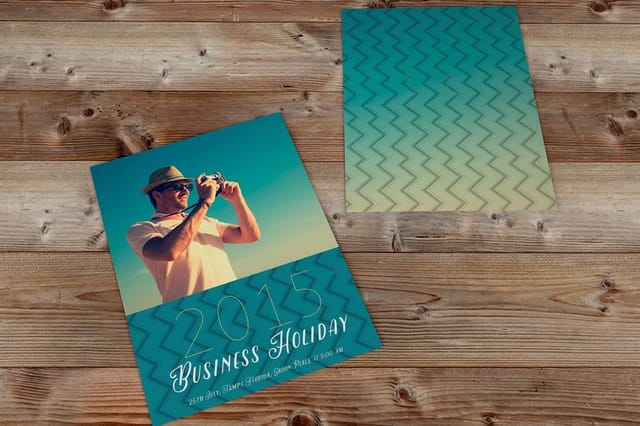
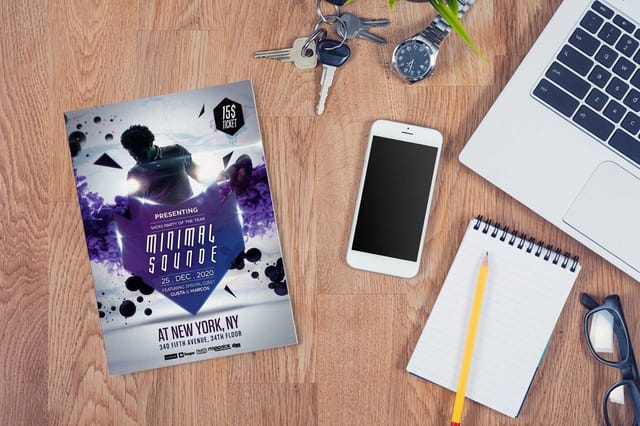
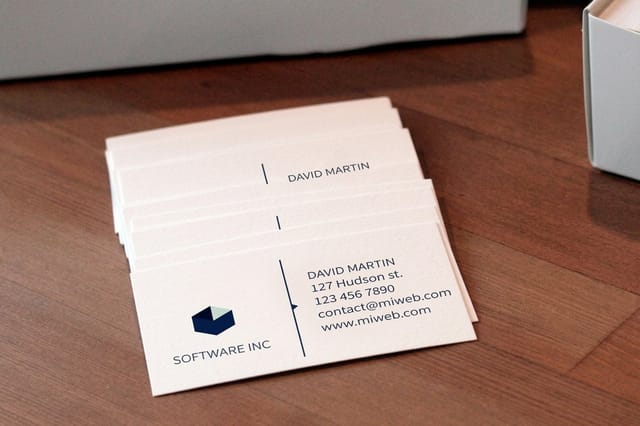
Print is one of the few channels that lets you choose the temperature before anyone lands on the page. A mailed standard postcard from $16.48 puts your offer in the hands of a list you selected, so the traffic arrives pre-qualified and a shorter 4 Ps page usually outperforms a long PAS page. Standard flyers from $39.54 handed out at an event do the same job for people who just spoke to you. A standard business card from $17.57 with a short vanity URL on the back is the cheapest landing page driver there is, and it keeps working months after the conversation.
Two rules make offline traffic actually convert. First, the printed headline and the page headline say the same thing, word for word. Our postcard design guide covers the ten elements that carry that promise across the mailing panel. Second, give a scannable route and a typeable route: a QR code for phones and a short URL for anyone who does not scan. The QR code setup walkthrough shows how to build one that survives at print size. Give each print run its own landing URL and you can tell which mailing produced which lead without touching analytics.
The Parts That Move Conversion More Than the Framework
Rewriting a page from AIDA into PAS is the smallest lever on this list. These are the bigger ones, in the order worth attacking them.
- The offer. "Contact us" is not an offer. A free roof inspection, a printed sample pack, a fixed-price audit, a 15 minute call with a named person: these change the number more than any structural edit. If the page is failing, suspect the offer first.
- Message match. The words on the ad, the mailer or the email have to appear in the headline. Visitors check for that match in about the time it takes to blink, and a mismatch bounces them before they read anything.
- Form length. Ask only for what someone will use before the first conversation. Fields you do not act on are pure friction.
- A single action. Count the asks on your page. A form plus a phone number plus a chat bubble plus a newsletter box is four, and each one dilutes the others.
- Load speed and the mobile fold. Most print-driven and ad-driven traffic is on a phone. If the headline and the button are not visible without scrolling, slot one is not doing its job.
- Proof that can be checked. A named reviewer, a photograph of the real job, a client logo you can verify. Anonymous praise reads as invented, because most of it is.
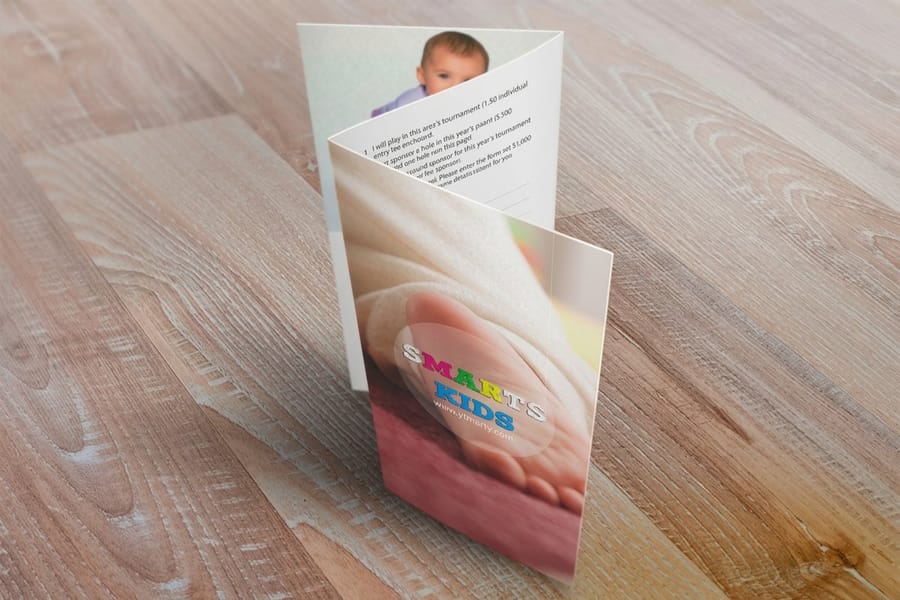
Clarity in the words themselves sits underneath all of it. Brand messaging for small business covers how to fix the value proposition once rather than rewriting it on every page. And when a page has to be handed over in person, a standard brochure from $57.11 carries the same five slots in a form the prospect keeps on a desk.
Testing a Framework Without Fooling Yourself
Here is the uncomfortable part. Most small business landing pages do not get enough traffic for a clean split test, and calling a winner early is how teams end up confidently wrong.
If a page gets a few hundred visits a month, a split test comparing two button colors will never separate signal from noise. What you can do is test large differences and accept slower, rougher answers. Swap the whole framework, swap the offer, swap the headline promise. A change big enough to move the number is a change big enough to see without a statistics degree.
Run one change at a time and give it a fixed window rather than stopping the moment one version pulls ahead. Two weeks with the same traffic mix beats four days that happened to include a holiday.
Measure the outcome you are paid for, not the one that is easiest to count. Form fills are a proxy. A shorter form always lifts form fills and sometimes lowers booked jobs, and you only see that if you track the lead through to the sale. The same discipline applies offline: put a distinct URL or code on each print run and the direct mail campaign guide shows how to structure the drop so the result means something.
Keep the wider plan in view while you do it, because a page is one step in a sequence that starts with the list and the channel. Our small business marketing plan guide sets that sequence, and the postcards printing range covers the sizes and stocks most campaigns test first.
Wally explains landing page frameworks
Same five slots, and one of them is usually empty
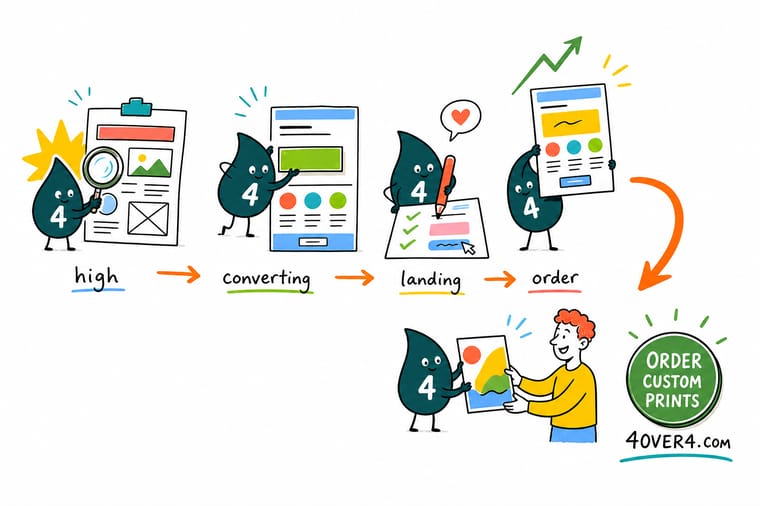
Wally lays the page out in five slots: the fold, the opening, the turn, the proof, the close. PAS, AIDA and BAB tell him what to put in the first three and in the last one, then go quiet on slot four. So he fills it himself with named reviews, a photo of the real job and a guarantee. Then he prints the postcard that sends people there with the exact same headline, because a mailer that promises one thing and a page that promises another wastes the whole drop.
Order postcards for your campaign →Specs and pricing
The print formats that feed a landing page
Sizes, stocks and starting prices straight from the 4OVER4.COM configurator, for the three formats most campaigns use to drive traffic to a single URL.


Print it
Send pre-qualified traffic to the page
Explore more
Where to go next

By the numbers
Campaign print that backs a landing page, by the numbers
Common Questions
Your landing page questions, answered
Which landing page framework converts best?
None of them wins on its own, because they solve different starting points. PAS works when the visitor has a problem they have not put into words yet, which is why it suits cold traffic. AIDA works when someone is browsing and needs to be pulled forward one step at a time. BAB works when the visitor already has a solution and you are asking them to switch. The 4 Ps work when someone arrived ready to buy and just needs the promise, a picture of the result, evidence and a reason to act now. Pick by traffic source and awareness level, not by which acronym reads best.
How long should a landing page be?
Long enough to answer every objection that stands between the visitor and the action, and not one block longer. A free download for warm email traffic can be a headline, three lines and a form. A $6,000 service sold to cold traffic needs the problem, the method, the proof, the pricing logic and the objections, which usually runs several screens. Write out the questions a salesperson gets asked on the phone, answer each one in a block, then delete anything left over. Word count targets are the wrong tool.
Should a landing page have a navigation bar?
Remove it when the traffic is paid, mailed or scanned from print, because those visitors arrived for one thing and every nav link is a way out of the funnel. Keep a logo that links home so the page does not feel like a trap. Pages that also need to rank in organic search are a different case: they sit inside the site, they benefit from internal links, and stripping the navigation cuts them off from the rest of your content.
Can I use the same framework on a printed piece and the landing page?
Use the same first two stages, not the whole thing. A postcard has room for one promise, one image and one instruction, so it carries slot one and slot two of the framework and hands the rest to the page. The critical part is that the printed headline and the page headline say the same thing in the same words. A postcard offering a free roof inspection that lands on a page headlined "Quality roofing services" throws away everything the mailing cost.
How many fields should the form have?
Only the fields somebody will actually use before the first conversation. Name, email and one qualifying question is enough for most services, because phone number, company size and budget can be asked once a human is on the call. Every extra field is a request the visitor has to justify before they trust you. The exception is a business that is drowning in unqualified leads, where adding a budget question on purpose reduces volume and raises quality.
What is the difference between a landing page and a homepage?
A homepage serves everyone who arrives without a specific reason, so it has to route visitors: services, about, pricing, contact. A landing page serves one campaign, one audience and one action, and everything that does not serve that action comes off. That is why sending ad or direct mail traffic to a homepage almost always underperforms a page built for the campaign, even when the homepage is the better looking page.
Get Started
Drive traffic with 50 postcards from $16.48
Print the postcard, flyer or card that carries the same headline as the page, add a QR code and a short URL, and you can tell exactly which drop produced which lead.
Legal Disclaimer
Gold Standard guarantees apply to all standard orders placed through 4over4.com. Price match requires verifiable proof of a competitor's published price for an equivalent product with matching specifications and turnaround time. Satisfaction guarantee covers manufacturing defects and print quality issues. Contact support with order number and documentation. On-time delivery rate based on tracked orders 1999 to 2026. Individual results may vary based on shipping carrier performance.
