
Flier or Flyer, Which Spelling to Use and When a Poster Beats Both


Two questions, one page. Which spelling to put on the order, and whether the job in front of you is really a flyer at all.
Flier and flyer both mean a printed handbill, and flyer is the spelling to use. Dictionaries lead with flyer, British English settled on it long ago, and print catalogs sell flyers, while flier now survives mainly in American news style and in the sense of a person who flies. A poster is a different product, not a bigger flyer: it is read from six feet or more, so it needs larger type, fewer words, and only about 150 dpi at full size, where a flyer read at arm's length needs 300 dpi.

Quick answer
Spell it flyer, then decide whether it should be a poster
Flyer is the spelling to order with, and flier is a correct but shrinking variant. The format question matters far more than the spelling one. A flyer is read at arm's length by a single person and carries detail, dates and a call to action. A poster is read from across a room by everyone who walks past, so it carries one message in type large enough to survive the distance. The sheet where the two overlap is 11 by 17.
Flier or Flyer, and Which One Belongs on a Print Order
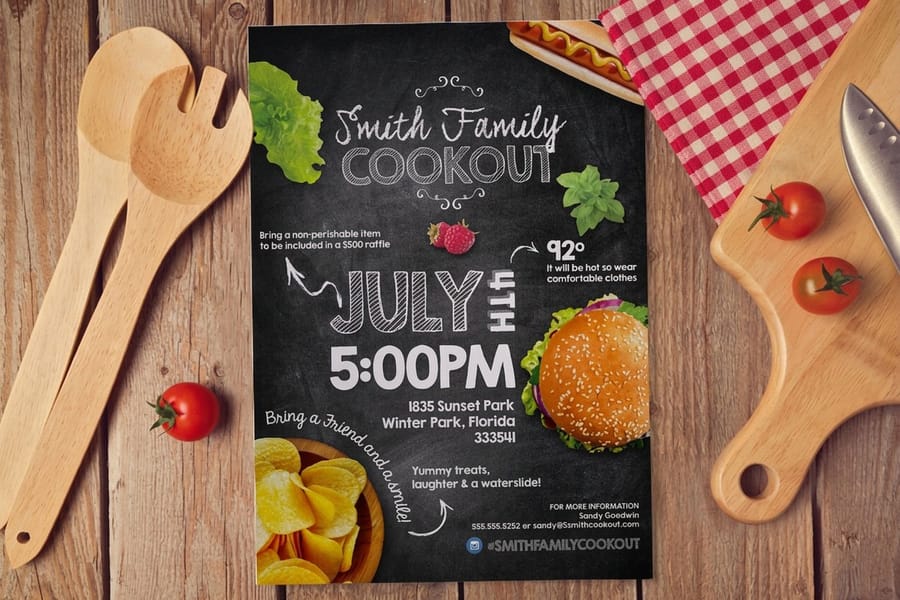
Write flyer. It is the main entry in Merriam-Webster, it is what British English settled on, and it is the word every print supplier uses on its product pages, quotes and invoices. Flier is listed as a variant rather than an error, so nothing breaks if you use it, but you will be the only one in the email chain spelling it that way.
The reason both spellings survive is that they split along different lines at different times. Flier was the American preference and flyer the British one, and American news style still keeps that separation alive: reporters are told to use flier for a handbill and reserve flyer for proper names, the sort of thing you see in the Western Flyer. Outside journalism the distinction quietly collapsed, dictionaries reordered their entries, and flyer took over commercial use.
Flier does still do useful work in two places. One is aviation, where a flier is a person who flies. The other is the idiom take a flier, meaning to make a bet you probably should not. Neither has anything to do with a sheet of paper, which is exactly why the printed sense drifted to flyer and stayed there.
Practical rule for a print order: match the supplier. Our catalog sells standard flyers, our size references are written as flyer sizes, and searching a shop for fliers can return nothing at all on stricter site searches. Keep flier for a style guide that demands it, and keep flyer for anything you are actually buying.
Flyer vs Poster, and Why Reading Distance Decides Everything

A flyer is put into someone's hand. A poster is put on a wall and left there. Once you fix that, the rest of the spec writes itself, because a piece read at 18 inches and a piece read at 12 feet are solving different problems with the same ink.
Sign shops use a rough guide of one inch of cap height for every ten feet of viewing distance on anything meant to be read quickly. A headline that works across a lobby needs letters around two inches tall, and an 8.5 by 11 sheet cannot carry two-inch letters and still say anything else. That is the whole distinction, expressed in millimetres of type rather than in marketing terms.
| Format | Read from | Usual trim sizes | What it is good at | Starting price |
|---|---|---|---|---|
| Flyer | About 18 to 24 inches, in the hand | 4x6, 5.5x8.5, 6x9, 8.5x11 | Detail, offers, dates, a tear-off or QR code, distribution in volume. | $39.54 |
| Poster | 6 to 20 feet, on a wall | 11x17, 12x18, 18x24, 24x36 | One message that stops a passer-by, working in the same spot for weeks. | $108.75 |
| Postcard | In the hand, out of a mailbox | 4x6, 5x7, 6x9 | Mailing to a list, because it needs no envelope and carries postage rates. | $16.48 |
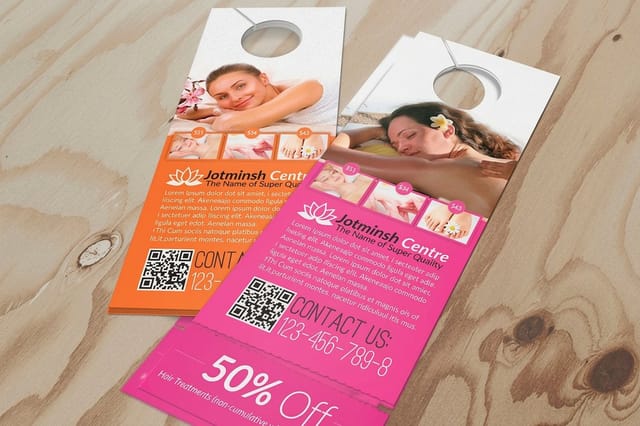
| Door hanger | In the hand, off a doorknob | 4.25x11 and similar tall trims | Neighborhood routes where nobody is home to hand a flyer to. | $290.41 |
Look at the second column before the fifth. A standard poster costs more per piece than a flyer but is read by everyone who walks past it, while a flyer is one reader per sheet. The right comparison is cost per reader, not cost per piece, and it flips depending on whether your audience comes to you or you have to go to them. The trade-off is covered from the other direction in our postcards versus flyers comparison.
Which One to Print for the Job in Front of You
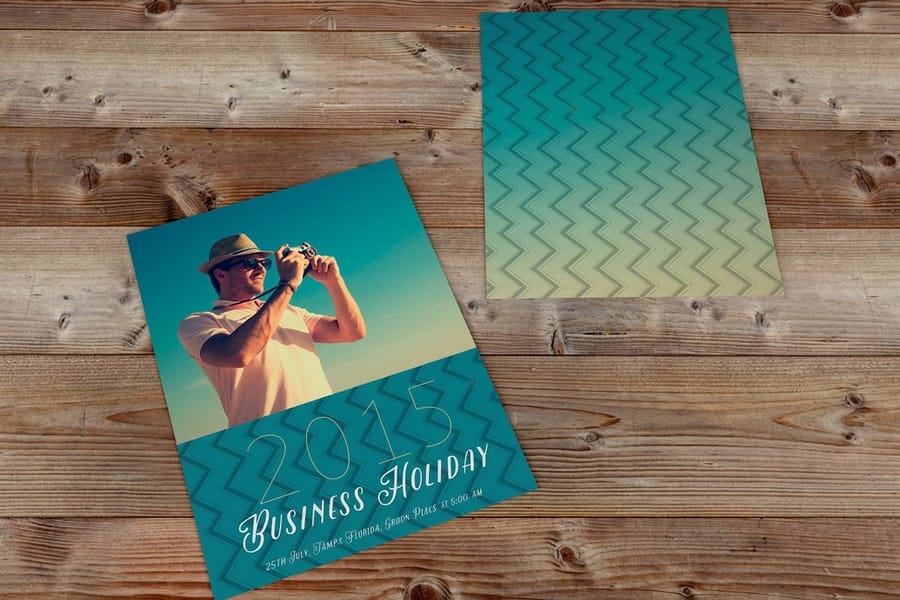
Ask one question: does the audience come past a fixed spot, or do you have to reach them where they are? A cafe with foot traffic already has an audience walking by the window, so a poster does the work. A contractor covering four streets has no fixed spot, so flyers and door hangers are the only formats that travel.
- Event with a date and a ticket link. Both, and in that order. One 18x24 poster in each venue that will take it, then flyers for the people who ask about it at the door.
- Menu, price list, or anything with more than 30 words. Flyer. Nobody reads a price list from across a room, and squeezing one onto a poster produces type too small to read at poster distance and too far away to read at flyer distance.
- Grand opening or a sale with one message. Poster in the window, because the message is short enough to survive being read in two seconds.
- Mailing a list of addresses. Neither. Use postcards, which need no envelope and are built around mailing rates.
- Something that has to fold out into panels. Neither. That is a brochure, and the choice between the three formats is worked through in our booklet, brochure and flyer guide.
When a campaign genuinely needs both, print the poster art first and cut the flyer down from it rather than the other way round. A design built for six feet away already has a strong headline and a simple hierarchy, and adding detail to it is easier than pulling detail out of a crowded handout.
Setting Up Files So Neither One Prints Soft

The most common file problem on both formats is resolution, and it works in opposite directions. A flyer is inspected at reading distance, so raster artwork needs to hit 300 dpi at final size. A poster is read from several feet, so 150 dpi at full size holds together, which is why a photo that would look soft on a business card can carry a 24x36 sheet without complaint.
The trap is scaling. A 300 dpi image built for an 8.5 by 11 flyer drops to roughly 106 dpi if you blow it up to 24 by 36, and that is below what even a wall poster forgives up close. Start large-format work from the largest source file you have rather than from the flyer file you already exported.
Everything else is standard print setup: build to trim size, extend the artwork 0.125 inches past every edge for bleed, keep type at least 0.125 inches inside the trim, supply CMYK, and outline or embed the fonts. Stock choice separates the two formats as well, with flyers usually running on a text or light cover weight so a stack stays easy to carry, and posters going heavier so they hang flat. Our flyer paper weight guide works through the options, and correctly sized starting files for both live in the blank template library. If the whole ordering process is new, how online printing works covers file handoff to delivery.
Wally settles the flier and flyer argument
One spelling to order with, two very different sheets
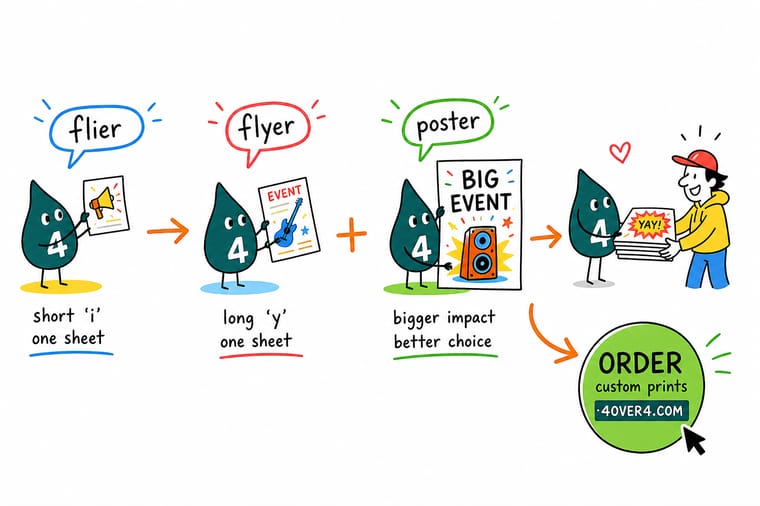
Wally checks the dictionary, shrugs, and writes flyer, because that is what the order form says and what every printer stocks. Then he does the part that actually matters. He holds the sheet at arm's length: if you can read it there, it is a flyer, so give it detail and 300 dpi artwork. He pins the same design on the wall and walks back six feet: if the headline still lands, it is a poster, so cut the words, grow the type, and 150 dpi at full size is plenty. When he cannot decide, he prints 11 by 17 and tries it both ways.
Print standard flyers →Specs and pricing
Flyers, posters and postcards side by side
Sizes, stocks and starting prices pulled live from the 4OVER4.COM configurator, so you can compare the three formats before you commit to one.



Print it
Order the format the job actually needs


Explore more
Where to go next



By the numbers
Flyer and poster printing you can count on at 4OVER4
Common Questions
Flier, flyer and poster questions, answered
Is it flier or flyer?
Both are real English words and both mean a printed handbill, but flyer is the spelling to use. Merriam-Webster gives flyer as the main entry and lists flier as a variant, British usage settled on flyer a long time ago, and the print trade lists the product as flyers on every catalog and order form. Flier is not wrong, and nobody will misunderstand you, but it now reads as either a house style choice or a typo.
Is flier American and flyer British?
That is the old rule and it no longer holds. Flier was once the American preference and flyer the British one, which is why American style guides still carry an entry telling reporters to write flier for a handbill and save flyer for proper names such as the Western Flyer. Outside newsrooms, American writers and American printers moved to flyer, so today the split is more journalism versus everything else than the United States versus the United Kingdom.
What is the difference between a flyer and a poster?
A flyer is handed over, mailed, or left on a counter, and it gets read at about arm's length by one person at a time. A poster is fixed to a wall or a window and gets read from six feet or more by everyone who passes it. That difference in reading distance is what changes the size, the stock weight, the smallest usable type, and the image resolution you need to supply. The artwork rarely transfers cleanly from one to the other.
What size is a standard flyer, and what size is a standard poster?
Flyers cluster at 8.5 by 11 inches, 5.5 by 8.5 inches, 6 by 9 inches, and 4 by 6 inches. Posters cluster at 11 by 17, 12 by 18, 18 by 24, and 24 by 36 inches. The 11 by 17 sheet belongs to both lists, which is why it is the usual compromise when a campaign needs a handout and a wall piece with one design. Our size guides for flyers and posters list the full set with the trim and bleed measurements.
Can I use the same artwork for a flyer and a poster?
Only if you rebuild the type. Scaling an 8.5 by 11 flyer up to 24 by 36 makes the headline large enough but leaves body copy nobody stops to read, and scaling a poster down to flyer size shrinks its headline to something that no longer earns the space it takes. Photographs usually survive the trip up, since a poster viewed from several feet holds together at 150 dpi at full size while a flyer wants 300 dpi. Type is what has to be redrawn.
Is a leaflet the same thing as a flyer?
In the United States they are treated as the same product, a single unfolded sheet. In the United Kingdom leaflet is the everyday word and it often implies a fold, which in American ordering would make it a brochure instead. If a supplier quotes you for leaflets, confirm whether the price includes folding before you compare it against a flat flyer price.
Which one gets thrown away faster?
Flyers, by a wide margin, because a flyer is a single reader with a single decision and most of those decisions are no. That is the honest trade-off of the format, and it is why flyers are priced and printed in quantity. A poster keeps working in the same spot for weeks, which is why one poster in the right window often beats several hundred flyers pushed at people walking past it.
Get Started
Ready to print the one that fits?
Pick a size, a stock and a quantity, upload the artwork, and we print flyers that hold up in the hand and posters that read from across the room.
Legal Disclaimer
Gold Standard guarantees apply to all standard orders placed through 4over4.com. Price match requires verifiable proof of a competitor's published price for an equivalent product with matching specifications and turnaround time. Satisfaction guarantee covers manufacturing defects and print quality issues. Contact support with order number and documentation. On-time delivery rate based on tracked orders 1999 to 2026. Individual results may vary based on shipping carrier performance.
