
8 Durable Trade-Show Booth Prints That Survive Show After Show
A booth that lasts is a booth built from aluminum frames, fabric graphics, and a case that takes the freight hit for you. These are the eight pieces we would order, in the order most exhibitors buy them, priced live.
Durability at a trade show is an aluminum frame instead of plastic and a fabric graphic instead of vinyl. Dye-sublimated polyester folds, rolls, and washes without holding a crease, so the panel that looked sharp at show one still looks sharp at show twelve. Then buy the case, because most booth damage happens in freight rather than on the floor.

The picks
The 8 picks, numbered and priced live
Start at whichever number matches the booth you actually have. A 6 ft table at a regional show needs picks 3, 5, and 8. A 10 x 10 island needs the wall first. Every price below is the live starting price from the configurator and drops as quantity climbs.
- 1
Retractable Fabric Banner Stands From $159.85
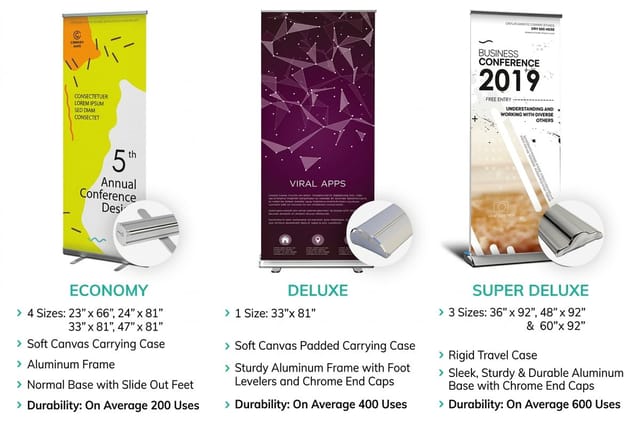
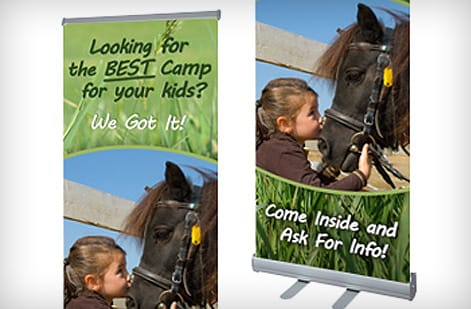
The one piece that gets set up and torn down more than anything else in the booth. A fabric graphic re-rolls into the cassette hundreds of times without holding a crease, which is exactly where a vinyl roll-up starts to look tired.
- 2
SEG Displays From $229.00
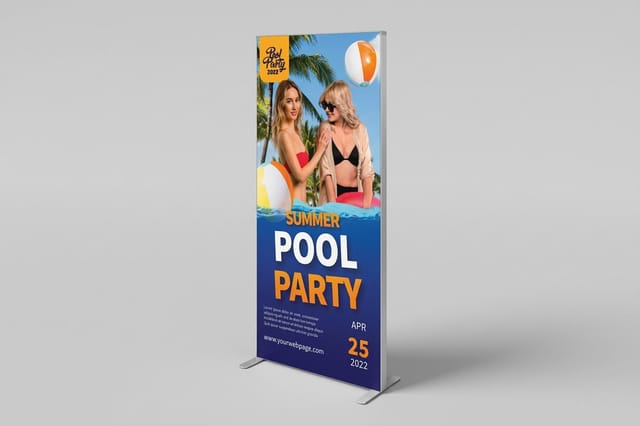
An aluminum extrusion frame with a silicone-edge fabric panel that zips into the groove. Next year you reprint the fabric and keep the frame, so the expensive half of the display never gets thrown away.
- 3
Fabric Table Covers From $225.00
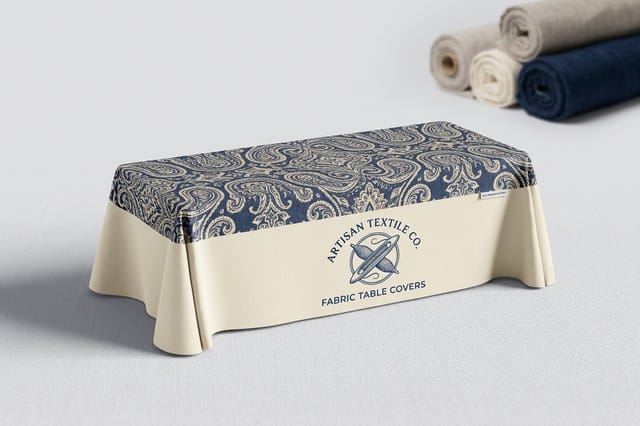
Machine washable polyester that comes out of the bag creased and hangs flat within the hour. Vinyl and plastic covers crack white along the fold line after a few shows and there is no fixing that.
- 4
Trade Show Booth Kits From $2599.00
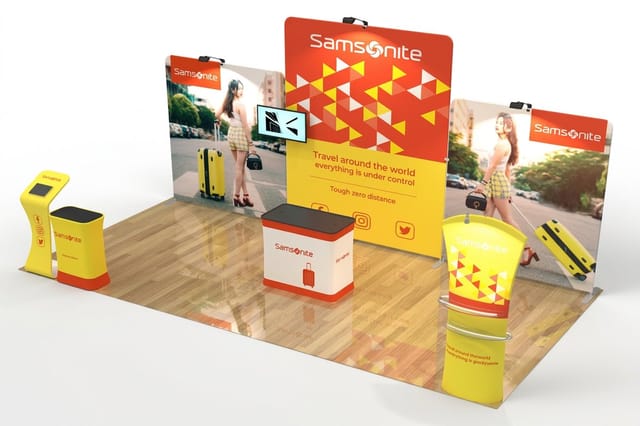
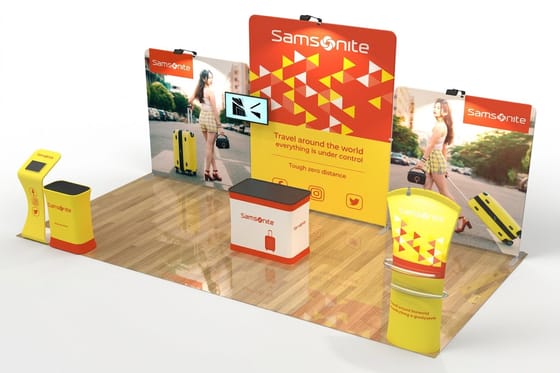
The whole 10 x 10 back wall as one system: frame, fabric graphic, and the shipping case it lives in. Buying the wall as a kit is what stops you assembling a booth out of five vendors that do not line up.
- 5
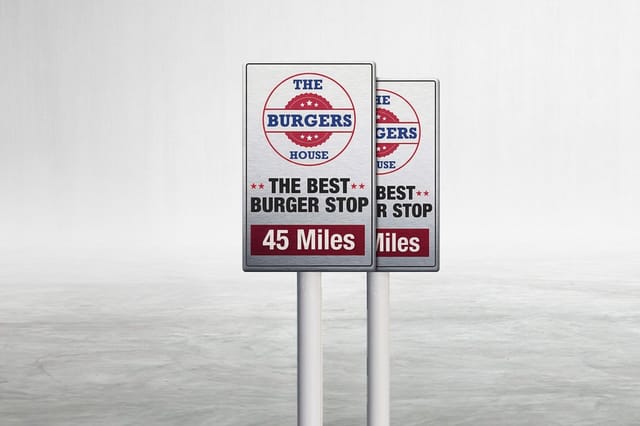
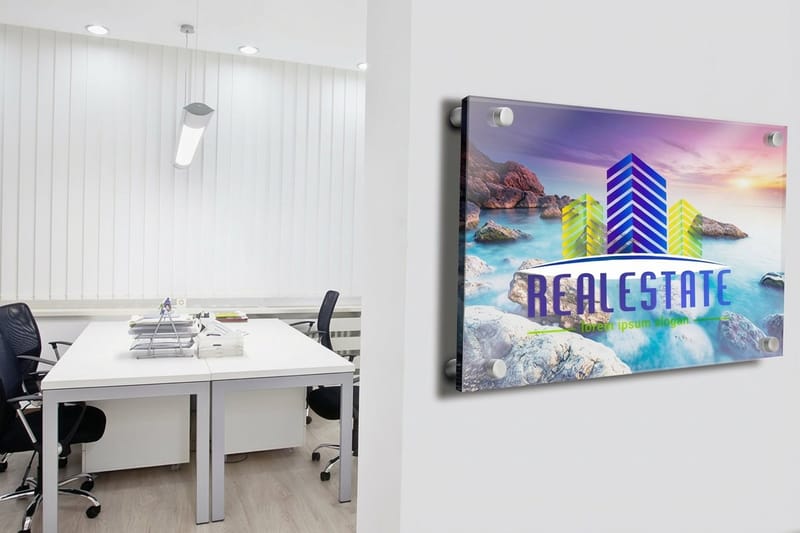
Aluminum Signs From $36.00
For pricing boards, spec plates, and directional signs that ride in a crate. Aluminum comes out the far end straight. Foam core arrives with a dented corner and a crushed edge on about the second trip.
- 6
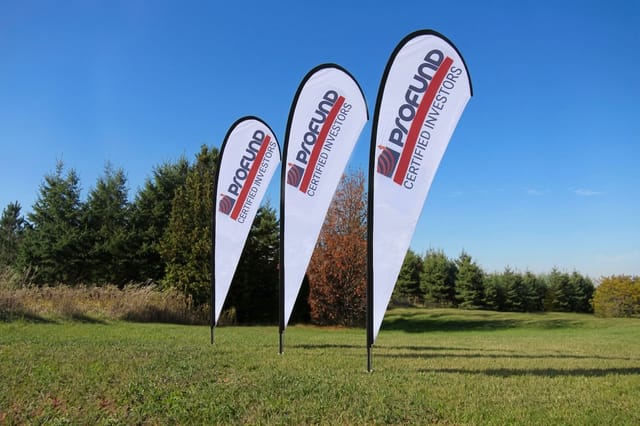
Teardrop Flags From $108.75
The fabric is tensioned around a curved pole, so a teardrop keeps its shape instead of flapping. Less flap means less abrasion at the pole sleeve, which is where flags usually tear first.
- 7
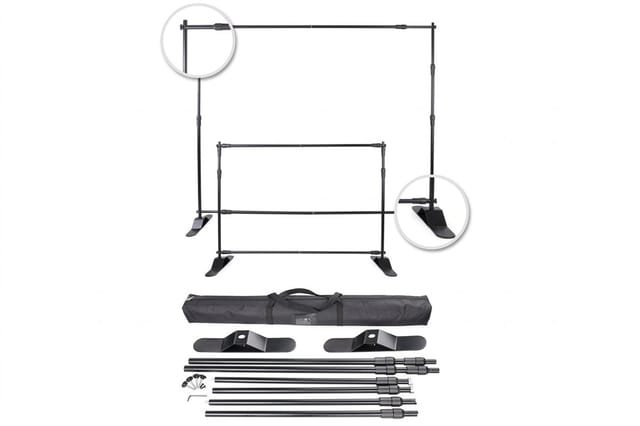
Step-and-Repeat Banner Stands From $192.22
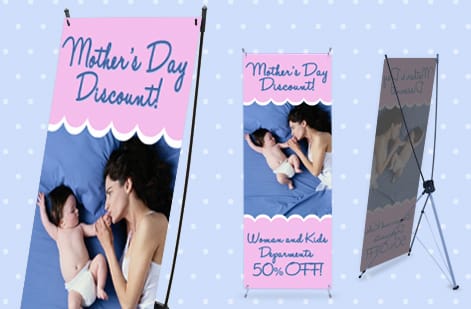
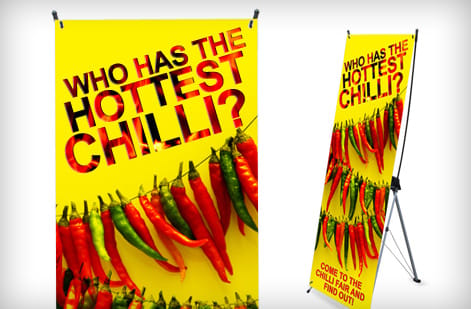
A telescopic frame that adjusts to several widths, so one stand carries this year’s logo wall and next year’s. Buy the frame once and treat the printed backdrop as the consumable.
- 8
Table Top Displays From $49.41
A counter-height retractable that fits in a carry-on, which matters when the booth is a 6 ft table at a regional show. The cheapest piece in the pack and the one most likely to get borrowed by sales.
Shop the pack
All eight products, ready to configure
Each card opens the live configurator, where the price moves with size, material, quantity, and turnaround. Build any piece from scratch in the free online designer or start from a design template and drop your logo in.

What fails first
Material, packing, and the part that gives out
Every booth piece has a predictable failure mode, and it is almost never the printing. Knowing which part goes first tells you what to pack a spare of and what to inspect before the truck leaves.
| Piece | Material | How it packs | What gives out first |
|---|---|---|---|
| Retractable fabric stand | Polyester fabric on an aluminum cassette | Padded soft case, roughly 36 in long | The spring cassette loses tension long before the print fades |
| SEG display | Aluminum extrusion, silicone-edge fabric | Fabric folds into a bag, frame breaks down to poles | The silicone bead pulls out of the seam if the panel is yanked instead of eased |
| Fabric table cover | Dye-sublimated polyester | Folds flat into a tote | Staining, not wear. Coffee and red wine set into polyester |
| Aluminum sign | Rigid aluminum panel | Flat in a crate with corner protection | Edge dings from loose packing, never delamination |
| Teardrop flag | Knitted polyester on a fiberglass pole | Pole sections plus a sleeve bag | Abrasion at the pole sleeve and a bent top section |
1. Retractable fabric banner stands: the piece that gets handled most
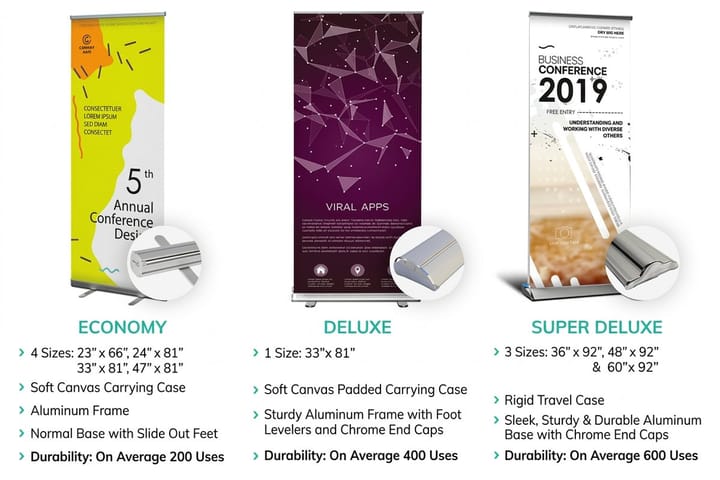
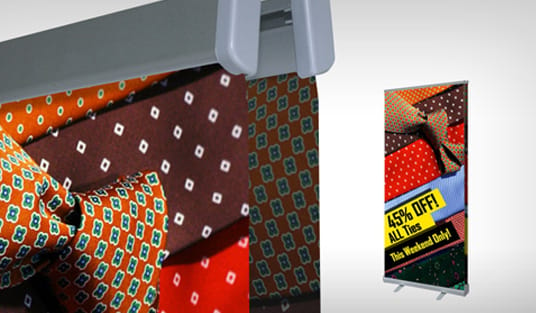
Count the number of times a booth graphic gets rolled up and pulled back out over a season and the retractable stand wins by a wide margin. That is why the graphic material matters more here than anywhere else in the booth. Retractable fabric banner stands use a dye-sublimated polyester panel instead of a vinyl one, and polyester goes back into the cassette without taking a set.
A standard vinyl roll-up is the cheaper buy, and for one show it is the right buy. Over a year of monthly events the difference shows up as a soft vertical wave near the top of the graphic where the roll started, plus a hard line across the panel if it ever got stored half-extended. Fabric does not do that. The trade-off is honest: fabric has a slight translucency, so a solid dark background will let a hint of the cassette and the pole read through under bright hall lighting. Design with that in mind or pick a mid-tone background.
The part that actually breaks is not the print. It is the spring cassette. A tired spring will not hold the panel at full height and the graphic sags an inch or two by the afternoon of day two. Store the stand upright, never leave it extended overnight, and lower the panel by hand instead of letting it snap. Our walkthrough on setting up a retractable banner stand covers the sequence, and if you are still deciding between mechanisms, retractable versus X-frame stands lays out where each one wins.
2. SEG displays: the frame you keep, the graphic you replace

SEG stands for silicone edge graphic. A thin silicone bead is stitched around the border of a fabric panel and that bead presses into a groove milled along an aluminum extrusion, which pulls the print drum-tight with no visible hardware. SEG displays are the format that makes a booth look built rather than assembled.
The durability argument is a money argument. The aluminum frame is the expensive half and it does not wear out. When the messaging changes, you order fabric only and the frame stays in the crate. A company that rebrands or reprices every year ends up replacing the cheap half of the display instead of the whole thing, and after three cycles that is the difference between the two approaches.
Two limits worth knowing before you order. First, SEG frames are not universal. Groove width and bead thickness vary by system, so a panel cut for one manufacturer's extrusion often will not seat in another's, and you should order the replacement graphic from whoever supplied the frame. Second, the bead is sewn on, and yanking a corner to get the panel out instead of easing it along the seam is what pops the stitching. Start at a corner, work down one side, take your time.
If you want to see how a tensioned fabric wall reads on the floor next to a conventional pop-up, our piece on curved tension fabric displays is a useful comparison, and pop-up display frames covers the hardware side.
3. Fabric table covers: the only booth piece you can wash
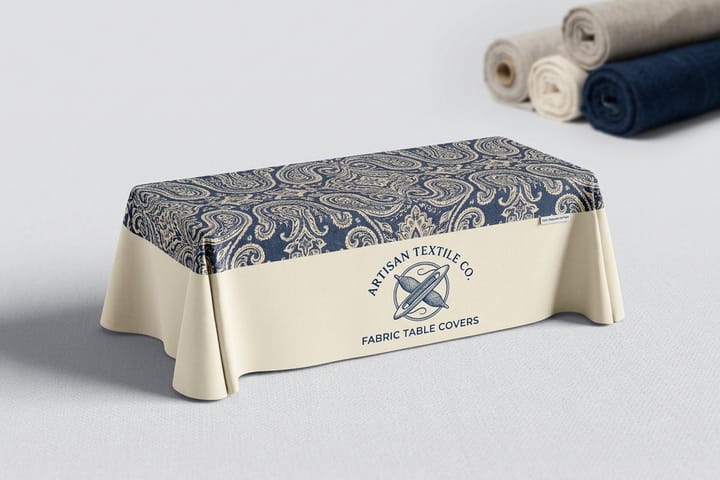
Every booth has a table and every table gets a coffee spilled on it. Fabric table covers print by dye sublimation, which puts the ink into the polyester fiber rather than on top of it. That is why the color survives a wash cycle and why a fabric cover is the one piece in the pack you can genuinely clean and put back into service.
Compare that with a vinyl or plastic cover. Vinyl looks fine folded once. Fold it the same way ten times and the fold line goes white and eventually splits, because the plasticizer migrates out along the crease. Polyester has no crease memory to speak of. It comes out of the tote looking rumpled, and within an hour of hanging on a table the wrinkles have dropped out on their own. A shot of steam speeds that up if you have a morning setup.
The honest limit is staining. Dye sublimation makes the print permanent, not the surface stain-proof, so red wine and coffee will set if you leave them. Rinse a spill in cold water the same day. On sizing, a 6 ft table and an 8 ft table are not interchangeable and the drop length changes whether the cover reads as tailored or as a bedsheet. Our table cover sizing guide has the measurements, and polyester versus stretch versus vinyl compares the three fabrics side by side.
4. Trade show booth kits: buy the wall as one system
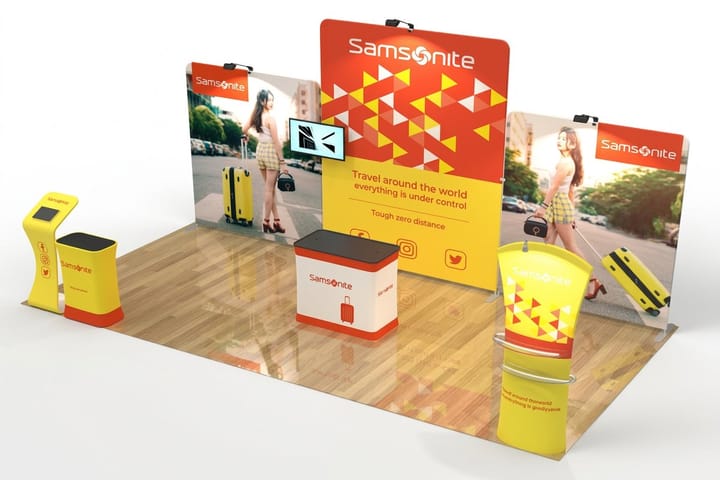
A trade show booth kit is the 10 x 10 back wall bought as a single system: the frame, the printed fabric, and the case that carries both. It is the most expensive line on this page and it is also the one that saves the most grief, because everything in it fits everything else in it.
The alternative is what most first-time exhibitors do, which is buy a frame from one supplier, a graphic from another, and lights from a third. It nearly works. The graphic is an inch short on one side, the light clamps do not fit the extrusion profile, and the whole thing ships in three boxes that arrive on two different days. Read through the first-time exhibitor checklist before you go that route.
Check the case before you check anything else. A kit that ships in a cardboard box is a kit that arrives with a bent pole, and freight handling at a convention center is not gentle. A molded case with wheels doubles as a counter under a fitted cover once you are on the floor, which is why so many booths put one behind the table. Then budget for drayage: the hall charges by weight to move your crate from the dock to the space, and a heavy case is a real per-show cost. Our trade show signage and display guide walks the full booth layout, and if the calendar has already run out, next day trade show displays covers what is still possible.
5. Aluminum signs: rigid panels that survive the crate
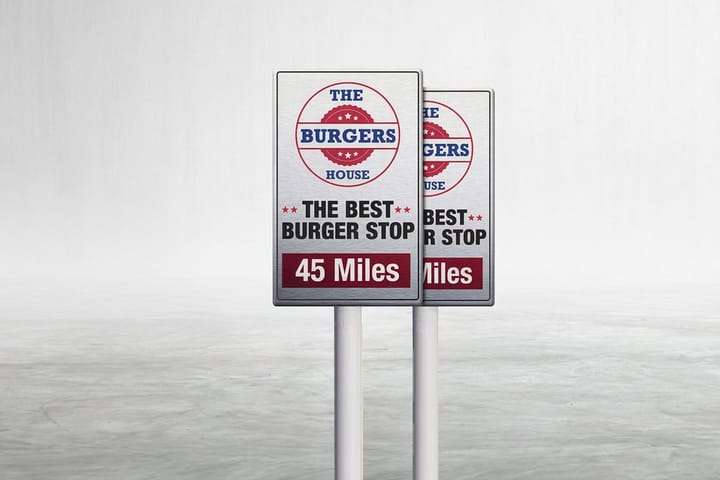
Somewhere in every booth there is a rigid sign: a price board, a spec panel, a "demo starts at 2pm" plate on an easel. Print those on aluminum signs rather than foam core and they stop being a per-show consumable. Aluminum does not dent at the corner when a crate shifts, it does not absorb humidity, and it does not delaminate at the edge the way a foam sandwich board does after a couple of trips.
Foam core is lighter and cheaper, and for a one-off it makes sense. The failure is predictable: a crushed corner on the second show, a soft edge on the third, and by the fourth it looks like something that got left in a garage. If the sign carries a price or a spec that stays true across shows, aluminum is the cheaper piece of paper over eighteen months.
Two trade-offs. Aluminum is heavier, and weight is money at a convention center, so keep the rigid pieces small and let the fabric do the large-format work. And you cannot pin aluminum to a fabric wall the way you can pin a lightweight board, so plan the mounting: an easel, a sign stand, or standoffs into a hard panel. For the wider set of booth signs and where each one sits, see booth signs for vendor and trade show booths.
6. Teardrop flags: the flag shape that stops flapping
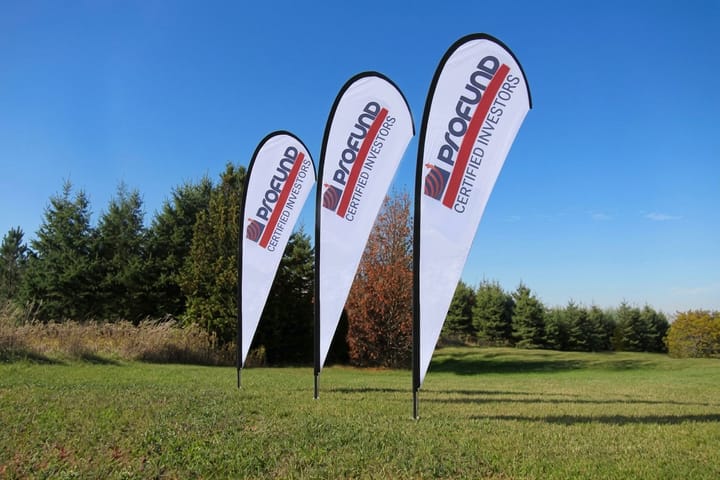
Outdoor shows, expo entrances, and the sidewalk outside a regional venue all call for a flag, and the shape you pick decides how long it lasts. On a teardrop flag the fabric is tensioned along a curved pole on both the leading and trailing edge, so it holds a taut aerofoil shape instead of whipping. A feather flag has a free trailing edge that snaps in the wind.
That snapping is what destroys flags. Every whip cycle drags the sleeve against the pole, and after enough hours the stitching at the sleeve gives out and the tear runs. A teardrop moves less, so it abrades less. It also reads better in a light breeze, because a taut shape keeps the logo legible while a flapping one turns the artwork into a blur for half of every second.
The catch is indoor rules. Plenty of exhibitor kits cap anything within the booth footprint at 8 ft in the front half of the space, and a flag on a full pole clears that easily, so read the show regulations before you ship one. Outdoors, weight the base properly. A cross base alone is not enough on an exposed forecourt. If you are comparing shapes, our guide on choosing trade show banners covers where flags fit against banners and stands.
7. Step-and-repeat banner stands: one frame, many backdrops

A logo wall earns its keep at any show where people take photos, and the frame that holds it should long outlast the print. Step-and-repeat banner stands use telescopic uprights and a crossbar, so a single frame adjusts across a range of widths and heights. Order a new backdrop when the sponsor list changes and keep the aluminum.
The weak point in every telescopic stand is the joint. Overtighten a twist lock and the collar cracks; undertighten it and the upright creeps down under the weight of a wet-hung backdrop by mid-afternoon. Snug is the right setting, and a spare collar in the case costs almost nothing. Hang the graphic with the bungees supplied rather than tying it off with cord, which pulls the grommets oval.
For the print itself, the pattern spacing decides whether a phone camera picks up a whole logo or three partial ones. There is a full breakdown of the layout maths in our custom backdrops and step-and-repeat guide, and you can start from a ready layout in our design templates rather than setting the repeat by eye.
8. Table top displays: the small piece that travels the most

Not every event gets you a 10 x 10. Regional shows, association meetings, and partner days hand you a 6 ft table and a chair, and that is the whole booth. A table top display is a counter-height retractable that stands on the table, packs down to about the length of a briefcase, and fits in a carry-on so nobody has to check a bag.
Because it travels the most, it takes the most knocks, and the base is what to look at. A stamped base with a screw-in foot will loosen over a season of setups. Snug the foot before every show. The rest of the durability story is the same as the full-size stand: a fabric panel re-rolls without a crease, a vinyl one eventually shows the roll.
Size honestly limits what it can say. A tabletop graphic reads from about six feet, not twenty, so it holds a logo and one line, not a feature list. Put the detail on paper the visitor takes with them and let the display do the job of saying who you are. There is more on matching the display to the space in how to choose a tabletop display, and portable counters and podiums covers what to put underneath it.
Specs and pricing
The two pieces every booth reorders: stands and covers
Banner stands and table covers get bought first and replaced most, so here are the live specs and price ladders for both straight from the configurator.


| Quantity | Price Per Unit | Total |
|---|---|---|
| 1 | $159.85 | $159.85 |
| Quantity | Price Per Unit | Total |
|---|---|---|
| 1 | $229.00 | $229.00 |
| 2 | $224.50 | $449.00 |
| 3 | $223.00 | $669.00 |
| 4 | $219.75 | $879.00 |
| 5 | $219.80 | $1,099.00 |
| 6 | $216.50 | $1,299.00 |
| 7 | $216.43 | $1,515.00 |
| 8 | $216.13 | $1,729.00 |
Wally explains what actually wears out
Frames age in years, graphics age in folds
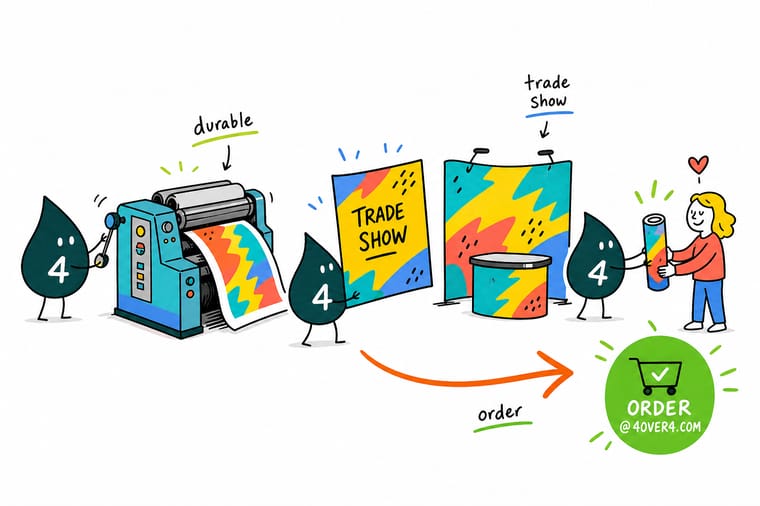
Wally packs the case the way a veteran exhibitor does. Aluminum poles and the SEG frame go in first because they will still be here in five years. The fabric goes on top folded, not rolled, because polyester does not care and vinyl does. The spares bag rides in the lid, because the part that ends a setup is a lost base bolt, never the back wall. Print the fabric at 4OVER4 whenever the message changes and keep the hardware.
Shop trade show printing →See it in use
Banner stand graphics built for a booth


Explore more
Where to go next

By the numbers
Printing built to survive the next ten shows
Common Questions
Common questions about durable booth printing
What makes a trade show display actually durable?
Three things, in this order: an aluminum frame instead of a plastic one, a dye-sublimated fabric graphic instead of a vinyl one, and a hard or padded case instead of a cardboard box. The frame decides how many shows the hardware survives, the fabric decides whether the print still looks new after being folded fifty times, and the case decides how much of that survives freight. Most booth damage happens between the dock and the hall, not on the show floor.
Is a fabric banner stand worth the extra money over vinyl?
If you exhibit more than about three times a year, yes. Retractable fabric banner stands start at $159.85 against $139 for a standard retractable, so the premium is roughly twenty dollars, and fabric goes back into the cassette without holding a crease. For a single show, the vinyl stand is the sensible buy. The one thing to design around is that fabric is slightly translucent, so a solid dark background can let the cassette read through under bright hall lights.
What does SEG mean on a display?
SEG is silicone edge graphic. A silicone bead is sewn around the edge of a fabric panel and presses into a groove machined into an aluminum extrusion, which tensions the print flat with no visible hardware. The practical benefit is that the graphic is replaceable: when the message changes you reprint the fabric and keep the frame. Frames are not interchangeable between manufacturers, so order replacement panels from whoever supplied the extrusion.
How much does a durable trade show booth setup cost?
It depends on how much of the wall you buy at once, and every price updates live in the configurator as you change size, material, and quantity. At 4OVER4.COM, table top displays start at $49.41, aluminum signs at $36, teardrop flags at $108.75, retractable fabric banner stands at $159.85, step-and-repeat banner stands at $192.22, SEG displays at $229, fabric table covers at $225, and a full trade show booth kit at $2,599. A common first build is a fabric stand, a table cover, and a tabletop display.
Can I reuse a booth graphic if my branding changes?
That depends entirely on whether the system separates the frame from the print. With SEG displays and step-and-repeat stands you keep the aluminum and reorder the fabric, which is usually a small fraction of the original outlay. With a one-piece display, a rebrand means replacing the hardware too. If a logo refresh is anywhere on the horizon, pay the premium for the replaceable-graphic format now.
How do I get wrinkles out of a fabric table cover at the show?
Most of the time you do not have to. Hang it on the table when you arrive and polyester drops its own creases within an hour. If setup is tight, a handheld steamer held a few inches off the fabric clears it in a couple of minutes. Do not press a hot iron directly onto a dye-sublimated cover, and keep the steamer moving so you never hold heat in one spot.
Should booth signs be aluminum or foam core?
Aluminum for anything that comes back show after show, foam core for anything printed for one event. Aluminum survives crate handling without a crushed corner and does not soften in humidity, which is what turns a foam board edge fuzzy by its third trip. The trade-off is weight, and convention halls charge drayage by weight, so keep the rigid pieces small and let the fabric wall carry the large-format work.
What spare parts should live in the booth case?
The small ones, because those are what go missing. A spare foot and base bolt for each banner stand, a spare twist-lock collar for a telescopic frame, a handful of bungees, gaffer tape, zip ties, and a multi-tool. Nobody loses a back wall on the way to a show. They lose the ten-dollar part that holds it up, and no exhibitor hall has a hardware store in it.
Get Started
Build a booth that comes back next year
Print the eight-piece durable booth pack at 4OVER4.COM. Pick sizes, materials, and finishes, and watch every price update live as you build the order.
Legal Disclaimer
Gold Standard guarantees apply to all standard orders placed through 4over4.com. Price match requires verifiable proof of a competitor's published price for an equivalent product with matching specifications and turnaround time. Satisfaction guarantee covers manufacturing defects and print quality issues. Contact support with order number and documentation. On-time delivery rate based on tracked orders 1999 to 2026. Individual results may vary based on shipping carrier performance.
