
How to Store and Transport Vinyl Banners Without Damage


Roll it, keep it dry, keep it between 50F and 80F. Here is the storage and transport routine that gets a second and third season out of a banner, and the handling that quietly ruins one.
Roll a vinyl banner printed side out on a core of at least 3 inches, and never fold it. Folding splits the PVC skin on 13 oz scrim vinyl and leaves a white crease that does not come out. Clean it with mild soap, dry both sides completely, then store the roll flat on a shelf between roughly 50F and 80F, away from sun and damp. Move it in the tube it shipped in, laid flat with nothing stacked on top.
Quick answer
One shallow curve beats one sharp line
A rolled banner shares the bend across the whole panel. A folded banner puts the entire bend into a single line, and the PVC coating on the outside of that line splits. That is the whole reason for every rule below. Roll printed side out on a 3 inch core or wider, dry the panel and the hems before the roll goes away, keep it off concrete and out of the sun, and store it somewhere that stays between roughly 50F and 80F all year.
Most Banner Damage Happens in the Closet, Not on the Wall
A 13 oz banner survives a season of wind and rain and then gets ruined in six weeks on a shelf. That is the pattern, and it is worth knowing which failures do the ruining, because each one has a different cause.
Creases. The one you cannot undo. Scrim vinyl is woven polyester mesh laminated between PVC layers. Fold it and the mesh survives while the PVC skin on the outside of the crease splits, and the split scatters light as a white line.
Blocking. Heat makes the surface slightly tacky. Rolled layers press together, and when you unroll them months later a patch of ink stays behind on the layer above it. This is what an attic does to a banner over a summer.
Mildew at the hem. The panel is waterproof. The hem tape, the stitching and the grommet washers are not, and any moisture rolled up with the banner ends up there.
Abrasion. A banner tossed in a truck bed drags across grit. A brass grommet on the layer above works like sandpaper on the panel below when the roll shifts. Both leave scratch haze across solid color that photographs badly.
Every one of those is a handling problem rather than a material problem, which is the good news. Our guide to scrim vinyl covers what the material is made of, and the fixes below follow from it.
Moving a Banner Without Putting a Mark in It
Keep the banner rolled from the moment it comes off the wall until it goes back up. Almost every transport problem starts with someone folding a wet banner into a car boot because they were in a hurry to leave the venue.
The tube the banner shipped in is the right container, so keep it. If that is gone, a 3 inch cardboard postal tube costs a few dollars and protects both ends of the roll. Slide the roll in, cap it, write the banner name on the cap in marker. For a large 4 by 10 foot panel, roll it around a length of 3 inch PVC pipe instead, which holds the roll open and lets you carry it on one shoulder.
Three habits handle the rest. Lay the roll flat in the vehicle rather than standing it in a footwell where it gets kicked. Never put a toolbox, a case of water or a folding table on top of a rolled banner, because point pressure through a roll makes a ring mark. On arrival, unroll onto a table or a clean tarp, not onto asphalt, since grit picked up at setup is what abrades the panel on the way home.
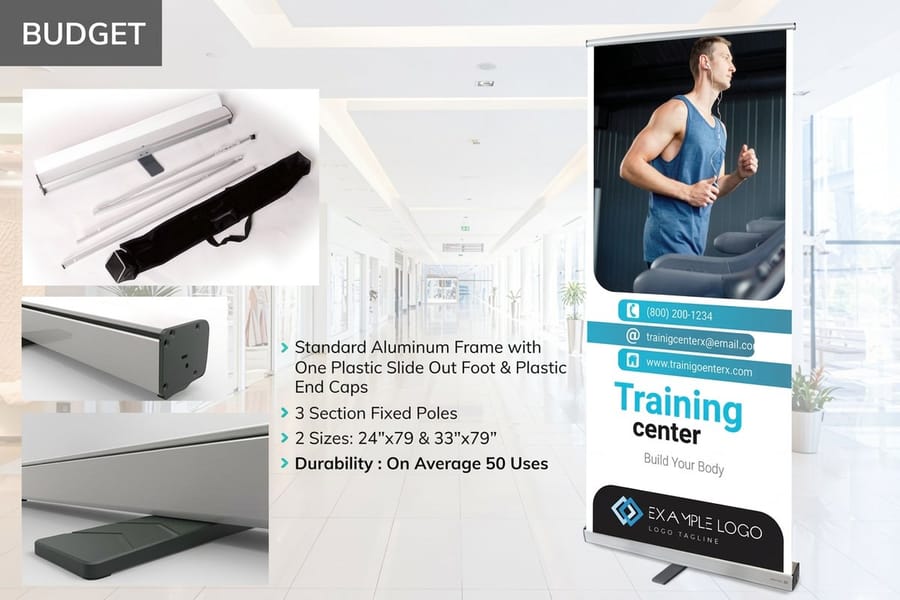
Banner stands travel differently. A retractable graphic is already rolled inside its cassette, so it needs a padded bag and an upright position more than anything else. If you are new to them, the retractable stand setup guide walks through deploying and retracting one without twisting the graphic, and retractable banner stands start at $139 with the case included.
Roll or Fold, and the One Material That Forgives a Fold

Roll every vinyl banner, printed side out, on a core of 3 inches or wider. That is the whole rule for scrim, mesh and blockout. Fabric is the exception, and it is the only one.
| Material | Roll or fold | Minimum core | What to watch |
|---|---|---|---|
| 13 oz scrim vinyl | Roll only, printed side out. | 3 in | A fold leaves a permanent white crease. Interleave paper if double sided. |
| 15 to 18 oz blockout | Roll only. Stiffer, so it fights a tight roll. | 4 in | The gray blocking core between the two faces creases harder than single-ply vinyl. |
| Mesh vinyl | Roll. It feels foldable and it is not. | 3 in | The coated strands take a set at a crease and the pattern shows against sky. |
| Polyester fabric | Fold or roll. Both are fine. | Any | Wrinkles release with a steamer or a low iron behind a cloth. Machine washable. |
| Retractable graphic | Leave it in the cassette. | Built in | Store the whole stand upright and retracted, never deployed for months. |
The fabric row is why fabric banners at $57.20 are worth a look for anything that travels to a different city every month. They pack into a suitcase, they come out of it with wrinkles that steam away, and there is no tube to lose. The trade-off is honest: fabric is softer in the wind, less opaque, and it does not hold a hard edge in solid color the way vinyl banners at $79 do. For a fence line or a building face, vinyl still wins.
If a banner already arrived folded, hang it for 24 to 48 hours before you decide anything is wrong. Most fold lines in fresh vinyl relax on their own, and warmth speeds that up. A hair dryer on low, held a foot away and kept moving while you stretch the panel by hand, takes out most of what is left. Heat held in one place puckers the panel, and a pucker is worse than the crease you were chasing.
Temperature and Humidity Limits Worth Respecting
Store banners between roughly 50F and 80F, out of direct sun, somewhere that never gets damp. Both ends of that range fail in a specific way, and knowing which one you are dealing with tells you what to do about it.
Cold. PVC stiffens as the plasticiser cools. A banner that has been below freezing overnight is a different material from the one you rolled up in October, and unrolling it cold can craze the ink along the bend. The fix costs nothing: bring the roll indoors and leave it a couple of hours before you open it. Do the same in reverse on an install day in January and hang the banner before it has time to chill on site.
Heat. Above roughly 110F the surface softens and rolled layers block. Attics, closed vehicles in summer and metal storage sheds all clear that easily. If a roll has been sitting somewhere hot, unroll it in the shade and go slowly, separating layers by hand rather than pulling the roll open.
Damp. The panel does not care about humidity. The hem does. Any water rolled inside the banner sits against the hem tape and the stitching for months, and mildew starts there before it reaches the print. Concrete floors are the other trap, since a tube laid on a garage slab wicks moisture up through the cardboard. Put it on a shelf.
Store the roll flat on a shelf or hang it from a hook through one grommet. Standing a heavy roll on end for a season lets the bottom edge take the weight and deform. The same thinking applies to the products in the vinyl banner range, whatever size you ordered.
Cleaning a Banner Before It Goes Into Storage
Wash it, dry both sides fully, then roll. Rolling a dirty banner sets the dirt into the surface for the whole storage period, and rolling a damp one starts the mildew clock.
The method is mild dish soap in lukewarm water with a soft sponge or a microfibre cloth. Wipe along the panel rather than in circles. Rinse with clean water, because dried soap film attracts dust and shows as a bloom on dark color. Then hang it until both faces are dry to the touch, which usually takes an hour or two indoors and longer in the hems.
What to keep away from it: acetone, paint thinner, bleach, alcohol wipes, scouring pads and a pressure washer held close. Solvents attack the ink and the coating together. A pressure washer at short range drives water straight into the hem and can lift print off the panel in a strip. If a stain resists soap, a diluted vinegar wipe handles mildew spots and a little more soap and a little more patience handles road grease. Neither problem is solved by a stronger chemical.
Check the hardware while the banner is down. Rust rings around a grommet mean water sat there, and a grommet with a torn hem behind it will fail on the next install. Our grommet placement guide covers replacing one and spacing them so the next install pulls evenly. Give the panel edges a look too, since a small tear caught now takes a patch of tape and a large one takes a reprint.
Getting a Second and Third Season Out of the Same Banner

Reuse is a design decision made months before storage. A banner with a date on it prints once. A banner with the message and no date comes back out every year, which is why seasonal street programs order artwork that carries the theme and not the year.
Keep a rotation honest with three habits. Label every roll on the outside with the message and the size, so nobody unrolls four banners looking for one. Store the mounting kit in the tube with the banner: the bungee cords, the zip ties, the pole pockets, whichever it uses. Photograph the banner hanging on the last day of the run, and you will know next season exactly how it looked and where it went.
Swap zip ties for ball bungees on anything that sees wind. A zip tie holds a grommet rigid, and a rigid grommet in a gust tears through the hem instead of flexing with it. Bungees give and the banner survives. The banner hanging guide runs through the mounting options in more detail.
Know when to stop reusing one. Chalky, faded color means UV has broken down the surface and no cleaning brings it back. Hems separating along a long run means the stitching has gone and the next wind takes the panel. At that point the honest answer is a reprint from the same file, and the whole banner printing collection holds the original sizes, along with pole banners at $97.76 and mesh banners at $75 for sites where wind is the recurring problem. If you are choosing between formats for a new run, vinyl vs fabric vs polyester lays out how each one ages, and banner stands cover the indoor half of most rotations.
Wally explains banner storage
Roll it wide, dry it first, keep it off the concrete
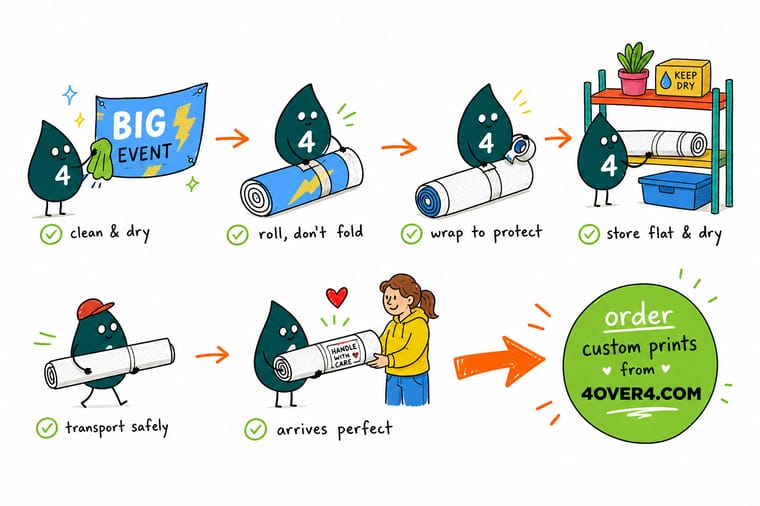
Wally wipes the banner down with soapy water, dries both faces and the hems, then rolls it printed side out around a 3 inch tube. He caps the tube, writes the message on the cap, and lays it flat on a shelf. The folded banner next to him has a white line straight down the middle, and no amount of hanging is going to take that out. Cold makes vinyl brittle and heat makes it stick to itself, so the shelf is indoors, not in the garage in August.
Order vinyl banners →Specs and pricing
Banner materials, sizes, and starting prices
Compare the materials side by side, with live configuration choices and starting prices straight from the 4OVER4.COM configurator.


Print it
Reprint a banner that has earned its retirement

Explore more
Where to go next


By the numbers
Banners rolled on a tube, never folded
Common Questions
Your banner care questions, answered
Should a vinyl banner be rolled printed side in or printed side out?
Printed side out. On any bend, the outer surface has to travel further than the inner surface, and rolling face out puts the printed skin on the larger radius where that stretch is spread thinner. Rolling face in compresses the ink layer and pushes it into itself, which is where crazing shows up first on solid dark coverage. Use a core of at least 3 inches, keep the roll loose rather than cinched, and slip a sheet of kraft paper or the shipping interleaf between the layers if the banner is double sided.
Can I fold a vinyl banner if I have no tube?
Not without leaving a mark. Scrim vinyl is a woven polyester mesh sandwiched between PVC layers. The mesh tolerates a fold, the PVC skin on the outside of the crease does not, and it opens into a fine white line that reads from across a room. With no tube, roll the banner loosely around itself and tie it with a strip of the shipping wrap. If you have nothing at all, roll it around a broom handle wrapped in paper before you fold it.
How do I get creases out of a banner that arrived folded?
Hang it and give it time first. Most fold creases in 13 oz vinyl relax within 24 to 48 hours hanging in a warm room, and full sun for an hour speeds it up because warm vinyl relaxes. If a line is still visible, run a hair dryer on low from about a foot away, moving constantly, and stretch the panel gently by hand as it warms. Never hold heat in one place and never use a heat gun on high setting. PVC deforms and puckers well before it looks scorched, and a puckered panel is worse than a crease.
What temperature and humidity should banners be stored at?
Ordinary indoor conditions, roughly 50F to 80F, out of direct sun, with no standing damp. The two failures are at the ends of that range. Below freezing, the plasticiser in the PVC stiffens and unrolling can crack ink on the bend. Above about 110F, which an attic or a parked car reaches easily in summer, the surface goes tacky and rolled layers block together, so separating them lifts print. A closet or a shelf in a conditioned room is enough. A garage is usually fine in temperate months and a bad idea in August.
How do you clean a vinyl banner without ruining the print?
Mild dish soap in lukewarm water, a soft sponge or microfibre cloth, a clean water rinse, then air dry both sides completely before rolling. Wipe with the print, not in circles. Keep away from solvents, acetone, bleach, abrasive pads and pressure washers held close, since all of them either attack the ink or force water into the hem where it stays. Mildew spots on the hem come off with a diluted vinegar wipe. Grease from a curb or a truck bed needs soap and patience rather than a stronger chemical.
How should a retractable banner stand be stored between shows?
Retracted, in its padded case, standing upright. The graphic lives rolled inside the cassette on a spring, which is the safest place for it, so retract it fully rather than leaving it deployed for months. Store the case upright and do not stack heavy crates on top, because a bent base is what makes a graphic lean or wander off center on the next setup. Retractable banner stands start at $139 at 4OVER4.COM and the hardware outlasts several graphic changes when the base stays true.
Get Started
Need a banner that comes back out next season?
Pick your material, hem and grommet spacing, and we print a banner built to be rolled, stored and hung again. Same file, same color, whenever you need the reprint.
Legal Disclaimer
Gold Standard guarantees apply to all standard orders placed through 4over4.com. Price match requires verifiable proof of a competitor's published price for an equivalent product with matching specifications and turnaround time. Satisfaction guarantee covers manufacturing defects and print quality issues. Contact support with order number and documentation. On-time delivery rate based on tracked orders 1999 to 2026. Individual results may vary based on shipping carrier performance.
