
What Are SEG Frames and How Silicone Edge Graphics Work


Tobias is our voice for cutting, binding and large format, built from the knowledge of our production team, with over 20 years in printing.
Silicone edge graphics turned large format display into something you can change in minutes. This guide covers the extrusion, the fabric, the groove that holds it all under tension, the depths that allow backlighting, and what the finished system really costs to own.
SEG stands for silicone edge graphic. A SEG frame is an extruded aluminum profile with a groove milled into its face. The graphic is a dye sublimated fabric panel with a silicone strip sewn around its perimeter, and that strip pushes into the groove to hold the print flat under even tension. The result is an edge to edge, borderless, glare free surface with no visible hardware, and a graphic you can pull out and replace by hand whenever the campaign changes.

Start here
How a silicone strip holds fabric flat
A SEG frame is an aluminum extrusion that grips a printed fabric panel by its silicone edge. The fabric is printed by dye sublimation, sewn with a silicone bead around all four sides, and pushed bead first into a groove machined into the frame face. Tension does the rest. Because the fastening is hidden inside the profile, the print runs to the outer edge with no border, no clips and no glare. Deeper profiles hold edge lit LEDs and a diffuser, which turns the same frame into a lightbox.
Why SEG frames took over large format display

Walk a trade show floor or a modern retail flagship and count the graphics that have no visible border. Almost all of them are SEG: 6oz fabric with a 10mm silicone keder sewn around its edge, pushed into a frame that we sell in 3, 10 and 20 ft widths, from $229.00 for the 3 ft SEG display. The format won because it solved the two things that always gave large printed panels away as printed panels: the hardware around the edge, and the glare across the middle. Remove both and a graphic starts reading as architecture.
SEG is short for silicone edge graphic, and the name describes the fastening method rather than the artwork. Once you understand how the fabric attaches, every other decision on the spec sheet gets easier: how deep the frame needs to be, whether it can be lit, how the panel ships, and what a graphic change actually costs you. This guide walks the whole system, then points you at the flex frame range when you are ready to size one.
What are SEG frames?
A SEG frame is an extruded aluminum profile with a narrow channel, usually called the kerf or groove, machined along the inside face of the frame. The graphic that goes into it is a polyester fabric panel, printed by dye sublimation, with a flexible silicone bead sewn around its full perimeter. Press the bead into the channel and it stays there under tension.
Nothing else holds the graphic. There are no clips, no eyelets, no double sided tape and no snap rails. Because the fastening lives inside the extrusion, the printed surface runs all the way to the outer lip of the frame, and the viewer sees image where every other display system would show a border. The extrusion itself becomes a thin dark or silver outline, which is why so many installers describe SEG as looking like a mounted screen rather than a sign.
The second half of the definition is just as important: the frame and the graphic are sold as separate lifecycles. The extrusion is a durable fixture that lives on the wall or in the crate for years. The fabric is the part that changes with the campaign. That split is what makes SEG cheaper over time than any rigid panel, and it is a very different economic model from the one behind traditional banners and rigid signs.
How the silicone edge locks the graphic flat

The silicone strip is a soft, springy extrusion in its own right, typically a few millimeters wide with a rounded profile. It is stitched to the fabric with a straight seam set back a consistent distance from the trim line, and that setback is what controls tension. Cut the panel slightly under the frame opening, and pushing the bead home stretches the fabric until the face is drum tight.
Installation is done with the flat of your finger or a plastic tuck tool. You seat the four corners first, then work the middle of each run, and the panel pulls itself into square as you go. Any ripple you see means the bead is not fully seated in that section, so you pop it out and re-tuck rather than fighting the fabric.
Removal is the same motion in reverse. Hook a corner, lift the bead out of the channel, and the whole panel comes away in one piece with no residue and no damage. The silicone recovers its shape, which is why a well handled graphic can go in and out of storage repeatedly without the edge losing its grip.
Frame profiles and depths, and how to pick one
Profile depth is the single spec that shapes everything else. Shallow profiles sit close to the wall and read almost like a canvas, which suits corridors, showrooms and anywhere the graphic should feel built in. Medium profiles add rigidity for wide unsupported spans and give you room for wall standoffs. Deep profiles create an internal cavity, and that cavity is what a lightbox needs.
Mounting method follows from there. Wall SEG uses cleats or brackets hidden behind the extrusion. Freestanding SEG uses feet, a weighted base or a rear brace so the panel resists a knock. Hanging SEG uses rigging points at the top rail and is common over booths and reception desks. Double sided frames carry two grooves, one per face, and take two fabrics printed with the same or different artwork.
Very large graphics are not one piece of aluminum. They are built from multiple extrusion sections joined with internal splices, then skinned with a single fabric or a small set of panels whose seams land on the frame members. This is how SEG scales to full walls without losing the unbroken face, and it is the reason wide formats stay shippable in flat boxes.
Backlit SEG lightboxes and how the light gets even
A backlit SEG display is the same frame with three things added: LED bars mounted inside the extrusion around the perimeter, a diffuser or light guide panel behind the graphic, and a power feed. The LEDs fire inward from the edges rather than straight at the viewer, and the diffuser spreads that light across the full face so no bulb outline shows through the fabric.
The fabric changes too. A backlit graphic is printed on a translucent weave and profiled for transmitted light, not reflected light, because color that looks correct on a wall will look washed out once light passes through it. That is a printing decision made before the file goes to press, which is why backlit artwork should be quoted as backlit from the start.
Lit displays earn their place where ambient light works against you: dim booths, evening retail, restaurant menu walls, airport concourses. Our SEG Backlit Displays start at $1,899.00 as a complete lit system, frame, lighting and printed face together, so the price you compare already includes the parts that make the graphic glow. Watch one lit up in the SEG backlit displays video.
The fabric graphic: dye sublimation, weight and finish
SEG graphics are printed by dye sublimation. Ink is deposited as a solid dye, then heat turns it to gas and drives it into the polyester fibers, where it sets as part of the material rather than sitting on top of it. The result does not crack when folded, does not peel at the edge, and holds color through repeated handling. If you want the broader context on how this sits next to offset and digital work, the primer on different types of printing lays out the processes side by side.
Weave choice follows the application. Blockout fabrics carry an opaque layer so a double sided frame does not show ghosting from the other face. Standard display fabrics are lighter and used for single sided wall work. Backlit fabrics are engineered for transmission and even light spread. All of them are matte by nature, which is the property that kills glare and makes SEG so much easier to photograph than laminated vinyl.
Handling is genuinely low maintenance. Panels fold into a small box, travel without a tube or a crate, and come out of storage with soft creases that relax under tension within a short time on the frame. When a graphic gets dusty it takes a gentle wash rather than a replacement, which is the same logic that keeps other fabric printed products such as custom printed ribbon looking sharp after handling.
Installing a SEG frame and swapping the graphic
Frame assembly is a bolt together job. Extrusion sections join at the corners with internal brackets and a hex key, and most crews build a mid size frame flat on the floor before lifting it into position. Once the frame is square and mounted, the graphic goes on last so it never takes the weight of the build.
The swap itself is the part that changes how marketing teams plan. Pulling one campaign and seating the next is a two person job on a large panel and a one person job on anything smaller, with no tools, no ladders full of hardware and no reprinting of the fixture. Retail and event teams run whole seasonal calendars this way, mailing fabric to each site in a padded envelope sized box.
That reusability is why SEG shows up so often in project driven marketing where the same footprint has to say something different every quarter. It is a pattern worth borrowing for any campaign heavy program, including the site and showroom signage covered in the construction company marketing guide.
SEG frames versus banners, rigid signs and A-frames
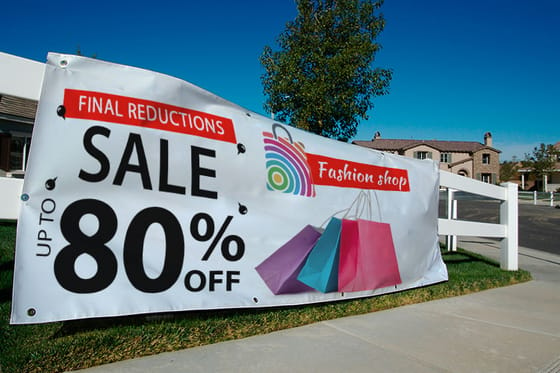
Against a hanging banner, SEG wins on finish and loses on price per square foot at the very first order. A banner ripples, shows its hems and needs grommets or a pole pocket. A SEG panel is flat, borderless and repeatable, and it starts paying that difference back the second time you change the artwork. The tradeoffs are laid out in more detail in the guide to banners versus signs.
Against rigid board, SEG wins on logistics. A large rigid panel needs a crate, corner protection and freight, and it is scrap the moment the message changes. Fabric folds into a box and posts anywhere. Rigid still wins where the graphic has to take physical abuse or live outdoors unprotected, and that is a real category, not a consolation prize.
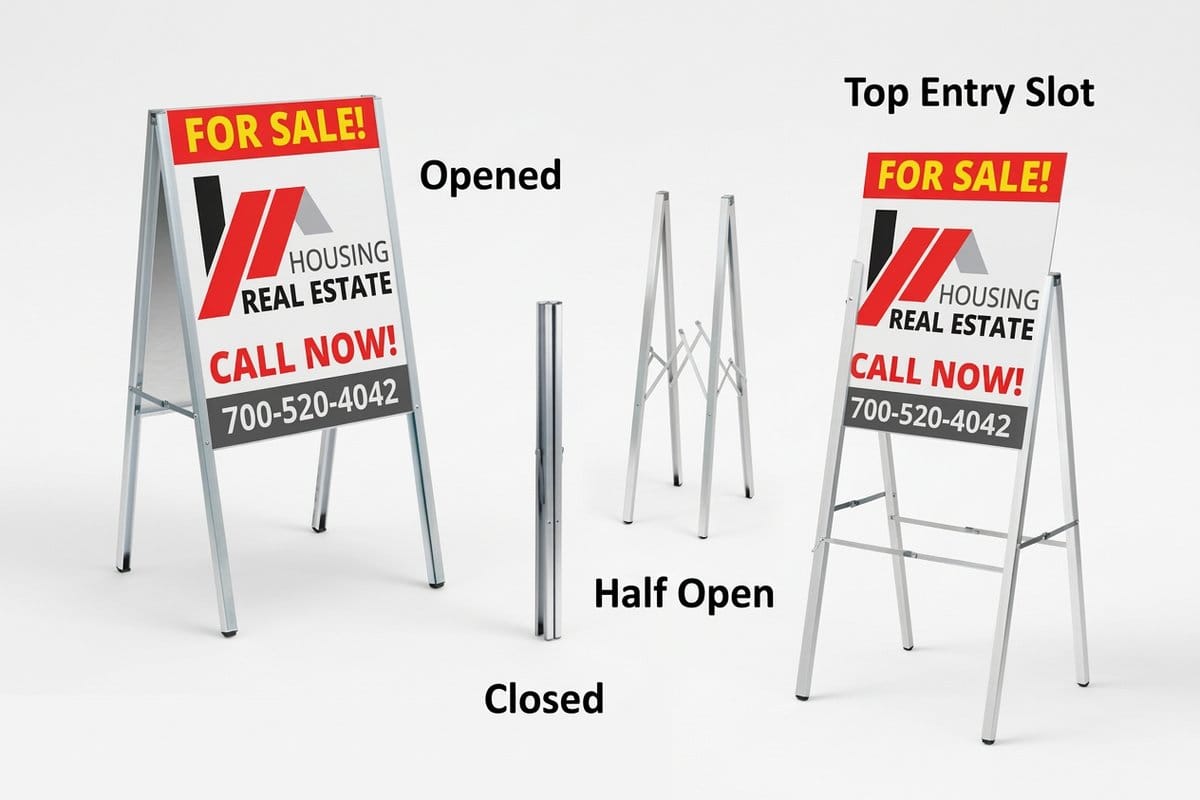
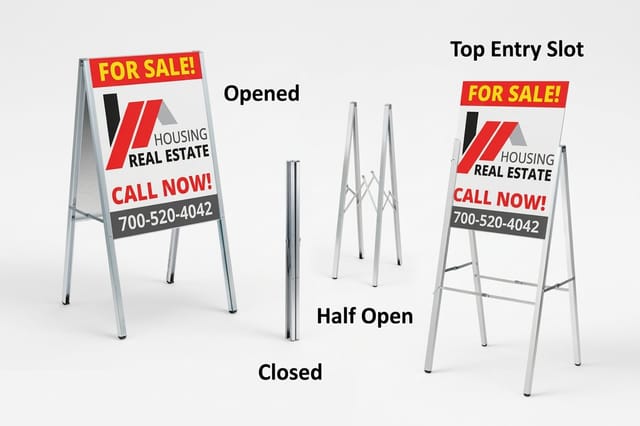
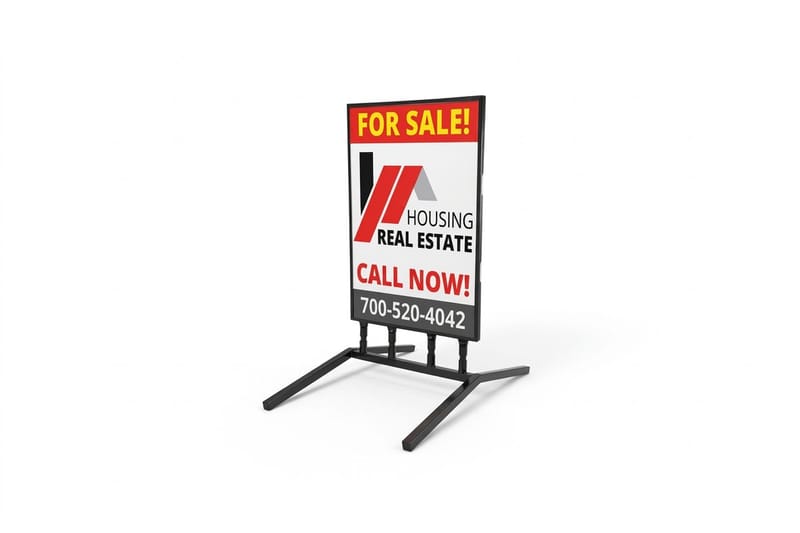
Sidewalk signage is a different job entirely. When you need something you can carry outside at open and bring in at close, a frame like Aluminum A-Frame Signs from $146.07 or the lighter Metal Rod A-Frames from $65.90 does that work for a fraction of a SEG budget. The honest answer is that most businesses run both: A-frames at street level, SEG inside where the finish is on show. You can see metal rod A-frames at work in their story.
What SEG frames cost and how the pricing is built
Four things set the number. Size, because both aluminum and printed fabric scale with area. Profile depth, because deeper extrusion uses more metal and more structure. Single or double sided, because a second face means a second groove, a second graphic and often an internal blockout layer. And lighting, because LEDs, diffusion and power are the most expensive components in the build.
Read the total across the life of the fixture rather than the first invoice. A complete lit system such as SEG Backlit Displays at $1,899.00 buys hardware you keep, and every campaign after that is fabric only. Compare that to reprinting a rigid panel each quarter and the crossover usually arrives faster than buyers expect. Configure your exact size on the product page, where live pricing shows the real cost of your build before you commit.
Wally explains SEG frames
The frame is the fixture, the fabric is the message
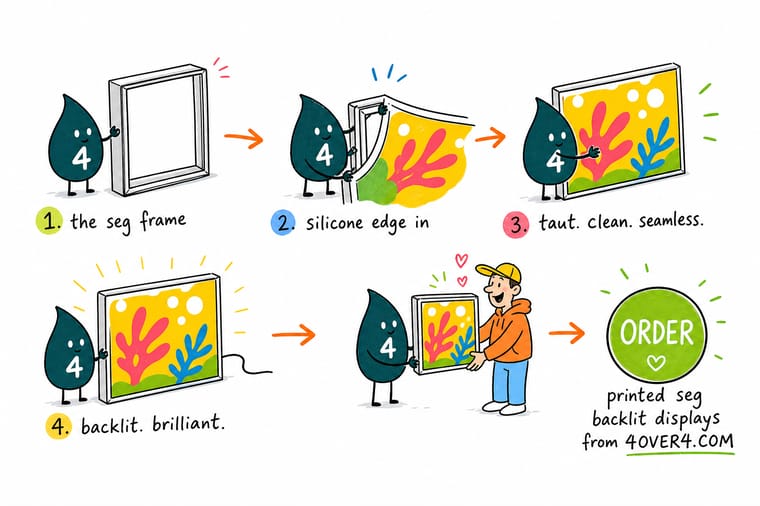
Wally thinks of a SEG display as a picture frame that never needs the picture. Buy the extrusion once, mount it, and then let the printed fabric carry every campaign after that. New season, new panel, same aluminum. Push the silicone bead into the groove, work the corners, and the graphic pulls tight with nothing showing around the edge.
Explore SEG displays →
Diagram
A SEG frame in cross section, part by part
Seven parts of the system, from the groove milled in the aluminum extrusion and the 10mm silicone edge sewn onto 6oz fabric, to the LED cavity that makes a backlit face glow evenly. Slim profiles sit on a wall and deeper ones carry the lighting, so keep this one open while you spec your size.
Parts one to four describe every SEG frame ever built. Parts five to seven are the choices that separate a slim wall panel from a lit trade show wall.
Specs and pricing
SEG backlit display specs and live pricing
Size, profile depth and lighting drive the number. The SEG backlit display comes as a 10 ft lit system from $1,899.00, printed single or double sided on 6oz fabric with a sewn in 10mm silicone keder. Set your build below and the price updates against the same production data our plant runs on.

| Quantity | Price Per Unit | Total |
|---|---|---|
| 1 | $1,899.00 | $1,899.00 |
| 2 | $1,899.00 | $3,798.00 |
| 3 | $1,876.33 | $5,629.00 |
| 4 | $1,877.25 | $7,509.00 |
| 5 | $1,869.80 | $9,349.00 |
| 6 | $1,849.83 | $11,099.00 |
| 7 | $1,849.00 | $12,943.00 |
| 8 | $1,837.25 | $14,698.00 |
Print it
Display hardware to pair with your graphics


Explore more
Where to go next



By the numbers
SEG displays in a 1,000+ product catalog
Common Questions
Common questions about SEG frames
What is a SEG frame?
A SEG frame is an extruded aluminum profile with a narrow groove milled into its face, built to hold a silicone edge graphic. The graphic is a dye sublimated polyester panel with a thin silicone strip stitched around its perimeter. That strip presses into the groove and holds the fabric under even tension, so the printed surface finishes flat, unbroken and free of visible fasteners on every side.
Where will the frame stand or hang?
Start with where it lives. Wall mounted graphics in a lobby or retail aisle usually want the slimmest profile you can get away with. Freestanding walls and trade show backdrops need a deeper profile with feet or a base for stability. If the graphic has to compete with overhead lighting or read after dark, choose a backlit profile deep enough for edge lit LEDs and a diffuser layer.
What does a SEG display cost and how is the price set?
Price is driven by the frame first and the fabric second. Square footage, profile depth, whether the unit is single or double sided, and whether it carries lighting all move the number. Our SEG Backlit Displays start at $1,899.00 for a complete lit system. Replacement fabric costs a fraction of that, which is why the cost per campaign keeps dropping the longer you own the frame.
What sizes and finishes are available for SEG frames?
SEG systems scale from small menu panels to full room dividing walls, because large graphics are simply built from multiple extrusion sections joined into one continuous face. Standard finishes are silver anodized and matte black, with custom powder coating available on larger runs. Fabrics are offered in blockout for opaque wall work and in translucent weights made for even light transmission behind a backlit face.
How long does a SEG display take to print and ship?
Production runs on two tracks that finish together. The fabric is printed, cut, sewn and inspected, while the extrusion is cut to size, mitered and packed with its hardware. Turnaround depends on the overall size, the number of sections and whether lighting is included, so the live configurator on the product page shows the real dates for your exact build before you pay.
Can I reuse a SEG frame with new artwork?
That is the whole point of the format. The extrusion is a fixture and the fabric is the consumable. When a promotion ends you pull the old panel out by hand, roll it up, and push the new one in. Nothing is glued, drilled or taped, so the frame survives dozens of graphic changes without any wear showing on the finished face.
How is a SEG graphic different from a printed vinyl banner?
A banner hangs from its edges and shows every ripple, hem and grommet. A SEG graphic is stretched by the frame itself, so the surface stays taut and the border disappears. Fabric also scatters light instead of bouncing it, which kills the hot spots that make a laminated vinyl panel hard to photograph under retail or booth lighting.
Get Started
SEG backlit displays cost $1,899.00, three business days
Size your SEG display, choose the depth and decide whether it needs light. We print the fabric, cut the extrusion and ship the whole system ready to assemble.
Legal Disclaimer
Gold Standard guarantees apply to all standard orders placed through 4over4.com. Price match requires verifiable proof of a competitor's published price for an equivalent product with matching specifications and turnaround time. Satisfaction guarantee covers manufacturing defects and print quality issues. Contact support with order number and documentation.
