
Winning Product Research, From Demand Signal to Proven Seller


A repeatable screen for product ideas: what demand looks like when it is real, the margin math that decides it, how to read competitors, and the cheap test that comes before inventory.
Product research is a screen with four gates in cost order: is the demand already there, does the unit margin survive every cost, is there a reason to buy from you, and can you ship the thing profitably. Run them in that order, because each gate costs more to answer than the one before it. Then buy the smallest test you can measure, set the pass mark before the results arrive, and only order inventory after a real offer got a real response.

Quick answer
Four gates, cheapest question first
Screen every product idea against demand, margin, differentiation and shippability, in that order. Demand costs an afternoon to check. Margin costs a spreadsheet. Differentiation costs a sample batch. Shippability costs real inventory, which is why it is the last gate you should ever reach on a bad idea. Most abandoned stock exists because someone answered gate four before gate one.
Where Real Demand Signals Come From
Demand research means watching what people already do with their money. Everything else is a story you tell yourself while the stock arrives.
Four sources are worth your afternoon, and they answer different questions:
- Search behaviour. People type what they want to buy. A steady search line over two years beats a vertical spike from last month, because the spike was harvested by whoever already had stock.
- Marketplace review velocity. Reviews carry dates. A listing with reviews arriving every week is a live market. A listing with three hundred reviews that all stop eighteen months ago is a market that moved on.
- Communities and forums. This is where you find the complaint that becomes your product difference. People describe what annoys them about the thing they already bought, in their own words, which is also your future ad copy.
- Suppliers and trade shows. Wholesalers know what reorders. Ask what moved last quarter rather than what is new, because new is what they need to clear.
The trade-off nobody mentions: the easier a signal is to read, the more people have already read it. Search volume tools are open to everyone, so a product that looks obviously good in a keyword tool usually has thin margins by the time you arrive. The signals that still pay are the awkward ones, like a recurring complaint in a niche forum or a supplier telling you which boring item reorders every month. Our guide to finding a niche goes deeper on narrowing the market before you widen the catalogue.
Test the Offer Before You Buy the Inventory
The gap between research and a purchase order is a test that costs money but not much money. You are buying one number: how many people act when the offer is real.
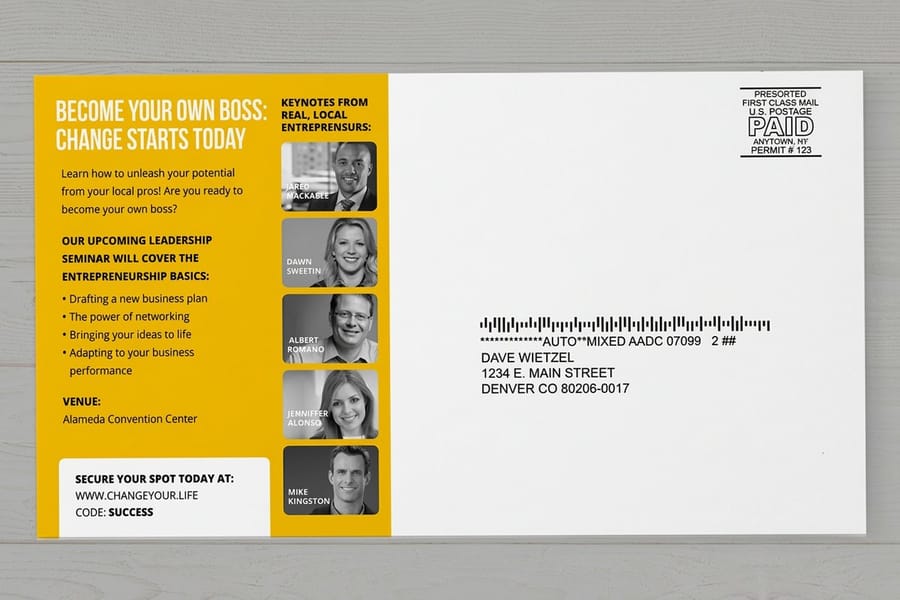
Online, that means a landing page and a small ad budget pointed at one audience. Offline, it means putting the offer into a hand. A mailed test is still the sharpest version, because a list can be targeted by geography, household type or business category, and the response arrives with a code you can count. Direct Mail Postcards start at $89.68 at 4OVER4.COM with the mailing included, and the five steps to send direct mail postcards covers the list and the drop. If you are testing at a market stall or an event instead, Standard Postcards start at $16.48 and do the same job across a table.
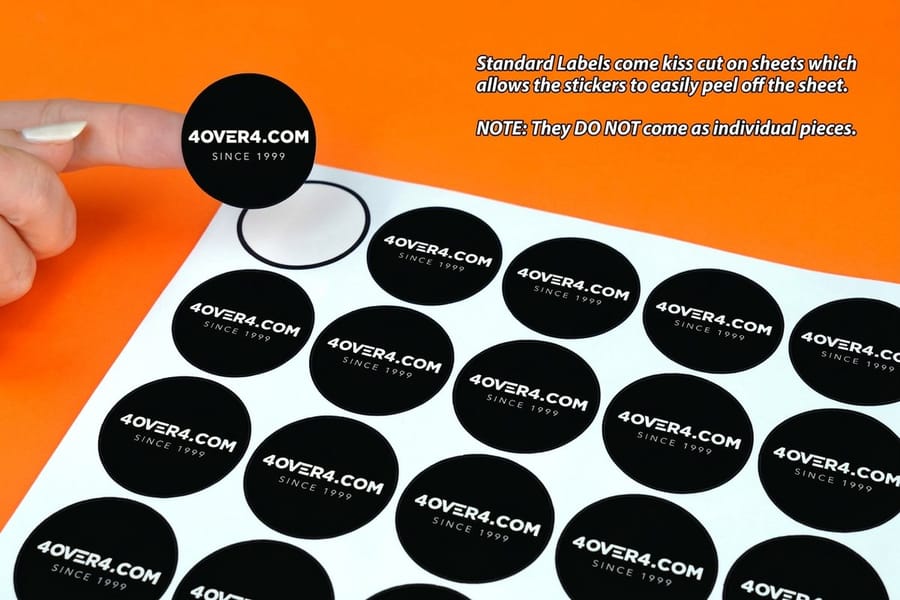
When the test involves a physical sample, the product needs to look like it belongs to a business. That is what short-run Standard Labels at $23.88 and Standard Hang Tags at $25.27 are for: enough branding to photograph the product honestly and ship a first batch, without committing to a pallet of printed cartons. Die-Cut Stickers start at $93.37 and are the usual choice for sealing a plain box in your own shape while you find out whether the idea holds.
Set the pass mark before you run the test, not after. Decide the response rate or the number of orders that would make you continue, write it down, and hold to it. Tests fail most often because the person running them moves the target once the result is in.
The Margin Math That Kills Most Ideas

Most failed products sold fine. They just did not leave anything behind after the costs finished arriving. Run the unit economics on paper before you fall in love with a category.
Start with the selling price, then subtract in this order: the landed cost of the product including freight and duty, payment processing, packaging and the label, outbound shipping to the customer, the ad spend it takes to win one order, and a return allowance based on what that category really does. The line people skip is customer acquisition, and it is the line that decides whether the business scales or bleeds.
The route you use to source the product changes every one of those numbers, so it is worth choosing deliberately rather than by habit.
| Sourcing route | Cash up front | Margin | Speed to test | Main risk |
|---|---|---|---|---|
| Dropship | Almost none. | Thinnest of the four. | Days. | No control over stock, quality or delivery time, and nothing stops the next seller listing the identical item. |
| Wholesale resale | A case or a pallet. | Set by the brand you resell. | Weeks. | You compete on price against everyone else carrying the same brand, including the brand itself. |
| Private label | A full production run plus artwork. | Wide, once volume arrives. | Months. | You own the inventory and the mistakes. A wrong colour or size split sits in a warehouse. |
| Made by you | Materials and your hours. | Widest per unit, smallest per hour. | Immediate. | It stops the day you stop. Scaling means hiring or moving to production anyway. |
Read the last column before the margin column. Dropshipping wins the speed test and loses the differentiation test, which is why so many stores selling identical items end up in a price race with no floor. Private label wins the margin argument only after you survive the cash it takes to get there. If a private-label run is where you are heading, choosing a packaging supplier deserves the same scrutiny as choosing the factory.
Reading the Competition, and Knowing When to Walk

Competition proves a market. Identical competition proves a trap. The useful question is not how many sellers there are, but how much daylight sits between them.
Open the first page of results for the product and look at what the sellers own. Do they have their own photography, or the supplier catalogue shots everyone else uses? Does the packaging carry a brand? Are recent reviews mentioning the seller, or only the object? Is anyone running paid ads on the term, and have they been running long enough to suggest the ads pay? A page of anonymous listings with catalogue photos means nobody has planted a flag. A page of distinct brands with their own audiences means the flag was planted years ago and you are late.
Walk away when three conditions land together: every seller offers the same item, the lowest price is already near the landed cost you were quoted, and none of the listings shows a customer group being served differently. There is no version of that market where a new entrant wins on effort. Move the idea sideways instead. The same research often points at a narrower audience, a bundle, or a service wrapped around the product, which is the move covered in building a store that sells and in starting a sticker business, where a commodity product is made specific by the niches it serves.
Once an idea clears all four gates, the work becomes execution: photography, listings, packaging and the print that carries your name into a customer's hands. The marketing materials collection gathers the pieces most first launches need, and hang tags, labels and postcards are usually the first three orders a new product line places.
Wally explains product research
Four gates, and the cheap one goes first
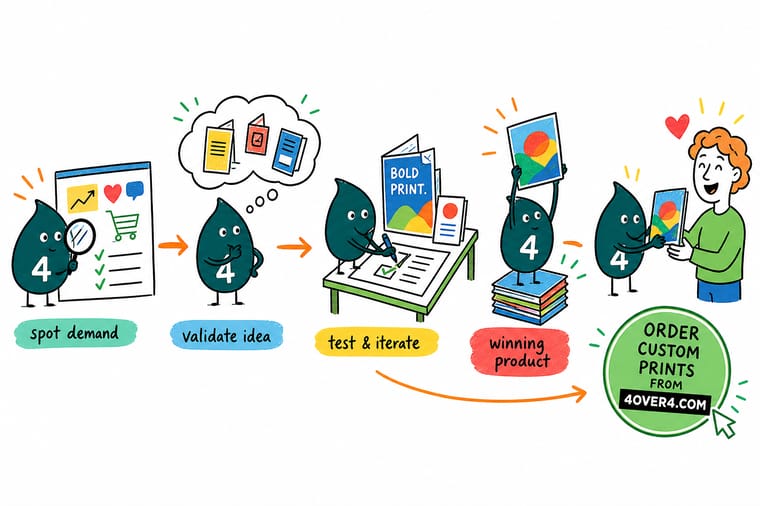
Wally checks whether anyone is already searching and buying, then works out what is left per unit after landed cost, fees, packaging, shipping and ads. Only then does he ask why a customer would choose him over the ten identical listings, and whether the thing survives a courier. When an idea clears all four, he prints a small run of labels and mails a test offer instead of ordering a pallet. The pass mark gets written down before the results arrive.
Order direct mail postcards →Specs and pricing
What a test run costs to print
The three pieces most product tests need, with live sizes, quantities and starting prices from the 4OVER4.COM configurator.



Print it
Print the test before you buy the stock


Explore more
Where to go next




By the numbers
The print partner behind a lot of first launches
Common Questions
Your product research questions, answered
What actually makes a product a winner?
Four things at once, and most ideas fail on the second or the fourth. There is existing demand you can observe rather than assume. There is enough margin left after landed cost, fees, packaging, shipping and customer acquisition to pay you for the work. There is a reason to buy it from you rather than the cheapest listing, whether that is a bundle, a brand, faster delivery or better support. And it can be shipped without breaking, without oversize fees, and without a return rate that eats the profit. A product that clears three of the four is a hobby with a receipt.
How do I tell real demand from a passing trend?
Look at the shape of the interest over a couple of years rather than the last few weeks. Steady seasonal peaks mean a real category. A single vertical spike with a long decline behind it means the money was made by whoever was in stock during the spike, and that was not you. Check whether people are still leaving reviews on established listings this month, whether there are questions being asked in forums and communities right now, and whether suppliers keep the item in stock year round. Trends are worth entering only when your lead time is short enough to arrive while the spike is still climbing.
How much margin do I need before a product is worth selling?
Enough that a single return, a bad ad week, or a supplier price rise does not put the order underwater. Work it per unit and include everything: the product cost landed at your door with duty and freight, payment processing, the box and label, outbound shipping, the share of ad spend it takes to get one order, and a realistic allowance for returns. Sellers who skip the ad-spend line are the ones who scale into a loss, because a product can look profitable in the spreadsheet and lose money on every paid order.
Is it worth entering a market that already has a lot of sellers?
Often yes, because competition is the clearest proof that people spend money there. The question is not how many sellers exist but how similar they are. If every listing shows the same generic packaging, the same photography and the same description, that is an opening. If the top sellers each have a distinct brand, real reviews and their own audience, you are competing against years of work, and you need either a genuine product difference or a customer group they ignore.
What is the cheapest way to test a product idea offline?
Put a real offer in front of real people and count who acts. A short mailed test is the classic version: Direct Mail Postcards start at $89.68 at 4OVER4.COM including the mailing, so a small drop to a tight list gives you a response rate rather than an opinion. At a market stall or a pop-up, Standard Flyers start at $39.54 and give you the same read for foot traffic. Track responses with a single dedicated URL or code so the number you get is the number you can trust.
Do I need branded packaging before I know the product sells?
No, and buying it early is a common way to lose money on an idea you then abandon. Order the smallest quantity of labels or tags that lets you photograph the product properly and ship a first batch that does not look anonymous. Once orders repeat, move to designed packaging and larger runs where the unit price drops. The sequence that works is plain box, printed label, then custom packaging, and each step waits for the previous one to pay for itself.
Get Started
Ready to test the idea instead of arguing about it?
Print a short run of labels, tags or a mailed offer, put it in front of the people you think will buy, and let the response rate decide what you order next.
Legal Disclaimer
Gold Standard guarantees apply to all standard orders placed through 4over4.com. Price match requires verifiable proof of a competitor's published price for an equivalent product with matching specifications and turnaround time. Satisfaction guarantee covers manufacturing defects and print quality issues. Contact support with order number and documentation. On-time delivery rate based on tracked orders 1999 to 2026. Individual results may vary based on shipping carrier performance.
