
The Telegram Monetization Playbook for Channel and Group Owners


Five ways a channel earns, what each one really requires, and the growth problem nobody warns you about before you start charging.
A Telegram channel makes money five ways: sponsored posts, Telegram's own ad revenue share, affiliate links, a paid private channel, and selling your own product. Which one fits is decided by a single trade-off, because revenue per member falls as the audience a route needs rises. Selling one thing to ten people pays this week. Selling ad slots needs thousands of readers who actually open the post, and that is measured in views, not in subscriber count.

Quick answer
Revenue per member falls as the audience a route needs rises
Pick the route your current size can carry, not the one you want to grow into. Your own product and your own time pay the most per member and need the fewest of them. A paid private channel pays a small amount every month and needs a real reason to renew. Affiliate links need trust and pay after the merchant's return window. Sponsored posts need the largest audience and pay the least per person, and they are priced on post views rather than subscriber count. Telegram's ad revenue share sits alongside all of it, paid in Toncoin, on Telegram's schedule.
The Five Ways Money Enters a Telegram Channel

Telegram pays nothing for posting. Every dollar arrives through one of five doors, and they behave so differently that treating them as a menu of equal options is the first mistake most channel owners make.
| Route | What it needs first | Who pays you | How fast the money lands |
|---|---|---|---|
| Sponsored posts | Steady post views in a niche somebody wants to reach. | The advertiser, per post. | Fastest of the five, often the same week. |
| Telegram ad revenue share | A public channel that meets Telegram's current eligibility rules. | Telegram, as a Toncoin balance you then have to move and convert. | Slow, on Telegram's own payout schedule. |
| Affiliate links | Trust, plus products your members were going to buy anyway. | The merchant, once the return window closes. | Weeks behind the click, and reversible if the buyer refunds. |
| Paid private channel | Something worth a recurring fee, and the appetite to keep answering. | Members, monthly. | Tiny at first, then compounding while churn stays low. |
| Your own product | A real product and a way to take payment. | The customer, at checkout. | Immediate, and the whole price is yours. |
Read the last column against the first. The routes that pay quickly are the routes that rent your audience to somebody else, and the routes that pay slowly are the ones that build something you keep. Sponsored posts hand a stranger the trust you spent a year earning. A paid channel earns less in month one and more in month twelve, assuming you are still posting in month twelve.
Two of those doors are worth a warning. Telegram's ad revenue share arrives as cryptocurrency, which is a currency conversion and a tax question before it is income. Affiliate money can be clawed back after you have already spent it. Neither is a reason to skip them, but neither belongs in a plan that assumes a fixed monthly figure. If you are folding a channel into a wider effort, the marketing strategy guides cover how the pieces sit together, and how to create a small business marketing plan gives you the frame to hang them on.
Nothing Recommends You, So the Join Is the Whole Job
Telegram has no feed, no explore tab, and no recommendation engine deciding who sees your post. Everyone who joined gets every post, in their chat list, in order. That is the platform's real gift and its real bill: you never fight an algorithm, and nothing ever brings you a stranger.
Search does not fill the gap either. It matches channel names and public handles rather than the content of your posts, so a channel with a clever name and nothing in it outranks the good one nobody can spell. Which leaves three sources of joins: another channel mentioning you, a link from a platform that does have discovery, and the physical world.
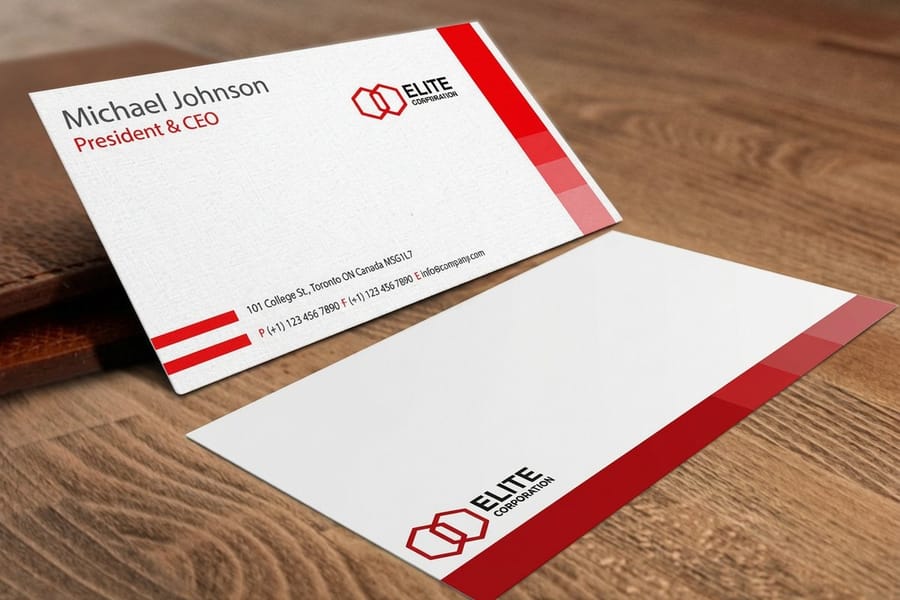
That third one gets dismissed as old fashioned, and it is the one with the least competition. A QR code on something a member already carries turns their laptop lid into a recruiting surface. Die-cut stickers start at $93.37 and get applied by the people who already like you, which is a filter no ad buy can match. Standard business cards start at $17.57 and are still the fastest way to turn a two minute conversation at an event into a scan, especially the layouts in our guide to QR code business card ideas that convert. For an event table or a shop counter, standard flyers at $39.54 carry the code plus the reason to scan it.
Two rules make the difference between a scanned code and a wasted print run. First, put the promise on the artwork, not the logo. Nobody scans a mark they do not recognize, but they will scan a line that names what they get. Second, generate a separate Telegram invite link for every printed surface. Telegram counts joins per named link, so the stickers, the cards and the flyers each report their own number, and you find out which one earned its cost instead of guessing. Our guide to business cards with social media icons covers the layout side of putting a handle on a card without cluttering it.
Pricing a Sponsored Post Without Guessing

Sponsored posts are the first real money for most channels, and they are also where owners quote the wrong number. Subscriber count is a vanity figure. Telegram prints a view counter under every post, so a buyer can see the truth in ten seconds.
Build the price from that counter. Take your last ten ordinary posts, drop the one that travelled unusually far, and average the rest. That average is the thing being sold. A channel with 6,000 members and 4,000 views is a better buy than one with 20,000 members and 2,000 views, because the second one is mostly people who joined during a giveaway and muted it that evening. Anyone buying seriously will ask for a screen recording of recent view counts rather than a screenshot, so expect it.
Then sell terms, not just a slot. A price per post should state how long the post sits at the top before you publish again, whether it stays pinned, whether a competing advertiser can appear the same day, and whether the post stays up permanently or comes down after a set period. Vague terms are how a cheap slot turns into an argument.
The part nobody mentions in the negotiation is churn. Every sponsored post costs you some members, and Telegram shows the subscriber change, so you can measure the cost instead of imagining it. Check the number two days after each paid post. If a category of advertiser reliably costs you members, that category needs to pay more or stop appearing. When you are pitching in person, a one page rate card printed as a flyer beats a PDF nobody opens, and the promotional materials guide covers what belongs on it.
Running a Paid Channel Without It Running You
The mechanics are simple enough. Make the channel private, put a bot in front of it, and let the bot take payment, issue a single-use invite link, track the start date, and remove the member when the subscription lapses. Telegram Stars covers digital payment inside the app. An outside processor covers cards, and gives you something the app never will, which is an email address attached to a paying customer.
The hard part is week seven. A paid channel is a recurring promise, and the month you go quiet is the month the cancellations arrive. Before you set a price, write down what you will post when the launch energy is gone. If the honest answer is that you would post the same thing publicly anyway, the subscription has no floor under it and members will notice within two billing cycles.
Leaks are the next question, and the honest answer is that you can slow them, not stop them. Restrict saving content blocks forwarding, copying and saving inside Telegram and disables screenshots on some clients. A second phone still defeats it. So put the value in things that copy badly: answers to a member's specific situation, timing, live sessions, and work you do rather than files you send. A channel that reposts findable information gets mirrored inside a week.
Which brings up the structural weakness of the whole platform. You own no contact data. No email, no address, no way to reach a member who drifts away, and no way to rebuild if the channel is restricted or you lose the account. Anything that captures a real inbox or a real address is worth more than another hundred subscribers. Take email at checkout. Take an address when you ship something physical, because standard postcards at $16.48 are the one channel nobody can switch off, and adding a QR code to a postcard pulls a lapsed member straight back into the channel. If you are thinking about selling physical goods rather than just promoting the channel, print on demand dropshipping explains how the fulfilment side works before you promise anyone a shipping date.
Wally explains the Telegram money map
Few members, high value each. Many members, pennies each.
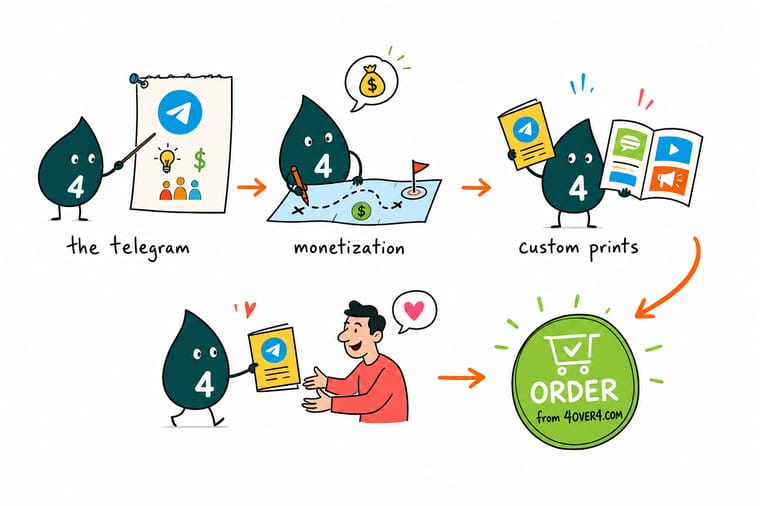
Wally runs two channels. The small one sells him one real thing to ten people and pays this month. The big one sells ad slots and pays on views, so the counter under the post is the price, not the subscriber number. Neither channel gets handed a single stranger by Telegram, because there is no feed to be recommended by. So Wally puts the QR code on a sticker, a card and a postcard, gives each surface its own invite link, and watches which one actually brings people in.
Order die-cut stickers with your QR code →Specs and pricing
The three printed surfaces that carry a channel QR code
Sizes, stock options and starting prices straight from the 4OVER4.COM configurator, for the pieces that turn an offline moment into a channel join.



Print it
Give every printed surface its own invite link



Explore more
Where to go next






By the numbers
Printing that backs a channel, from 4OVER4
Common Questions
Your Telegram monetization questions, answered
How many subscribers do you need before a Telegram channel makes money?
It depends entirely on the route. Selling your own product or your own time needs no particular size, because ten buyers at a real price beat ten thousand passive readers. Affiliate links start returning something once a few hundred engaged people trust your recommendations. Sponsored posts are the one route with a genuine floor, because advertisers buy views and will not open a conversation about a channel whose posts are seen by a few dozen people. Telegram's own ad revenue share also has eligibility rules for public channels, and those rules have changed more than once, so read the current terms in the app before you plan around them.
How do you actually set up a paid Telegram channel?
Make the channel private, then put a bot in front of it. The bot takes payment, issues a single-use invite link to that one buyer, records when the subscription started, and removes the member when it lapses. Telegram Stars handles digital payment inside the app; an outside payment processor handles cards and gives you a receipt trail and an email address. Whichever you use, a platform cut applies and the exact figure changes, so check it on the day you price the subscription rather than repeating a number from a blog post.
What is a fair price for a sponsored post?
Work from views, not members. Take the view count of your last ten normal posts, drop the one that went unusually wide, and average the rest. That average is what the buyer is purchasing. Then quote a flat price per post with the terms attached in writing: how long it sits at the top before the next post, whether it stays pinned, and whether a competing advertiser can appear the same day. Also watch your subscriber count in the two days after each paid post. Telegram shows the change, so you can see exactly what an ad slot costs you in departures and price the next one accordingly.
Can you stop people forwarding paid content for free?
You can slow it down, not stop it. Turning on Restrict saving content blocks forwarding, copying and saving inside Telegram, and it disables screenshots on some clients. A determined member still has a second phone and a camera. The practical defense is to make the value live in things that do not copy well: answers to specific questions, timing, live sessions, and anything tied to the buyer's own situation. A channel that only reposts information anybody can find will get copied within a week.
Is a channel or a group better for making money?
A channel is a broadcast, a group is a room. Channels give you clean view counts, quiet subscribers, and a post that everyone receives, which is what advertisers pay for and what a one-to-many paid feed needs. Groups create the conversation that makes people stay and pay, and they also create moderation work that never ends. Most channel owners who charge run both: the channel carries the posts, a small paid group carries the discussion, and the group is the part that justifies the monthly fee.
Does anything printed still help a channel that lives inside an app?
It helps at the one point Telegram is weakest, which is discovery. Nothing inside the app suggests your channel to a stranger, so the join has to come from somewhere else, and a QR code on a physical surface is somewhere else. Die-cut stickers start at $93.37 and get put on laptops and water bottles by people who already read you. Standard business cards start at $17.57 and turn a conversation at an event into a scan. Standard postcards start at $16.48 and reach a buyer whose address you have but whose inbox you do not. Put the promise on the artwork, not the logo, or the scan never happens.
Get Started
Turn an offline moment into a channel join
Put your QR code on a die-cut sticker, a business card or a postcard, give each one its own Telegram invite link, and find out which surface actually brings people in.
Legal Disclaimer
Gold Standard guarantees apply to all standard orders placed through 4over4.com. Price match requires verifiable proof of a competitor's published price for an equivalent product with matching specifications and turnaround time. Satisfaction guarantee covers manufacturing defects and print quality issues. Contact support with order number and documentation. On-time delivery rate based on tracked orders 1999 to 2026. Individual results may vary based on shipping carrier performance.
