
The Psychology of Selling and How Buyers Actually Decide


What the research on buying decisions actually says, which influence levers survive contact with a skeptical buyer, and how to tell a price objection from the risk objection hiding behind it.
People buy to stop a cost they are already paying, and the job of selling is to lower the perceived risk of changing until it drops below the cost of staying put. That happens at five gates in order: attention, relevance, trust, risk and timing. Every stalled deal is parked at one of them, and a discount only ever answers the fourth. Find the gate first, then use the tool that fits it.
Quick answer
Five gates, and only one of them is about money
A buyer is not deciding whether your product is good. They are deciding whether changing is safer than not changing. They work through five refusals to get there, and each one has a different answer: being noticed, being relevant, being believed, being safe to choose, and being worth doing now rather than next quarter. Testimonials fix the third and do nothing for the fourth. A guarantee fixes the fourth and does nothing for the fifth. Diagnose before you reach for a tactic.
Why Buyers Move, and Why It Is Rarely the Feature List
Nobody wakes up wanting a product. They wake up with a problem that has started to cost them something, and buying is one of several ways to make that cost stop. Doing nothing is always on the list, and doing nothing is free today.
This is why prospect theory, the work Daniel Kahneman and Amos Tversky built on how people weigh gains against losses, matters more to a salesperson than any closing script. A potential loss weighs heavier than an equivalent potential gain. So "you could grow bookings" is a weaker sentence than "the two hours a week you spend rebuilding this by hand are gone either way". The second one describes a cost that is already being paid.
The practical consequence is uncomfortable: your feature list is not an argument, it is evidence for an argument you have not made yet. Features earn their place after the buyer accepts that the problem is real, is theirs, and is worth money. Lead with them and you are asking a stranger to do the translation work for you.
There is a limit worth naming. Loss framing gets ugly fast. Push it and you are selling fear, which produces a signature but also produces a buyer who resents the transaction and does not renew. Describe the cost accurately, once, and let it sit. If the cost is not actually there, you have found a prospect who should not buy, and the cheapest possible outcome is finding that out in week one instead of month six.
The Six Levers of Influence, and Where Each One Backfires

Robert Cialdini catalogued six patterns that reliably shift human decisions. They are useful and they are also the most abused ideas in sales, because every one of them has a cheap imitation that works once.
| Lever | What it actually is | How it gets faked | What the fake costs you |
|---|---|---|---|
| Reciprocity | You gave something of real value before asking for anything. | A "free audit" that is a sales call with a template attached. | The next genuine offer you make reads as bait. |
| Social proof | People like this buyer, in this situation, already chose you. | Logos of companies that trialled once and left. | One check by the buyer and every other claim is suspect. |
| Authority | Demonstrated competence, ideally shown rather than stated. | Awards nobody has heard of and self-issued certifications. | Reads as insecurity, which is the opposite of authority. |
| Liking | Genuine common ground and being straightforward to deal with. | Mirroring drills and rapport scripts. | Buyers detect performance faster than they detect a bad product. |
| Commitment | Small agreements the buyer chose, which they then live up to. | Trick questions engineered to extract a yes. | The buyer feels handled and starts defending instead of deciding. |
| Scarcity | A limit that is real and checkable, like a date or a run size. | A countdown that restarts on reload. | Kills the credibility of every future deadline you set. |
Read the last column as the actual pricing of these tactics. The fake version does not fail politely by having no effect. It transfers the buyer into a mode where they audit everything, and an audited claim needs three times the evidence to land.
Scarcity is the one worth building properly, because print gives you an honest version of it for free. A dated offer on a mailer is a real deadline: the piece went out on a date, the code expires on a date, and the buyer can hold the evidence. Standard postcards start at $16.48, which makes a checkable deadline cheaper than a fabricated one.
What the Buyer Keeps Does the Selling After You Leave
The decision almost never happens in front of you. It happens later, in a conversation between the person you met and two or three people you did not, and your argument attends that meeting only if it was written down somewhere they can hold.
This is the least glamorous finding in selling and the most reliable. Whatever your contact remembers is what gets repeated, and memory of a conversation degrades within a day. Whatever you left behind gets read again. A single page beats a deck here, because a deck has to be opened, and a page on a desk is already open.
Three formats do almost all of this work, and they answer different gates:
- A one-page sales sheet for the internal argument. One problem, one solution, the proof, the price and the next step. Sales sheets start at $75.80 and are the piece your champion forwards when someone asks "what is this".
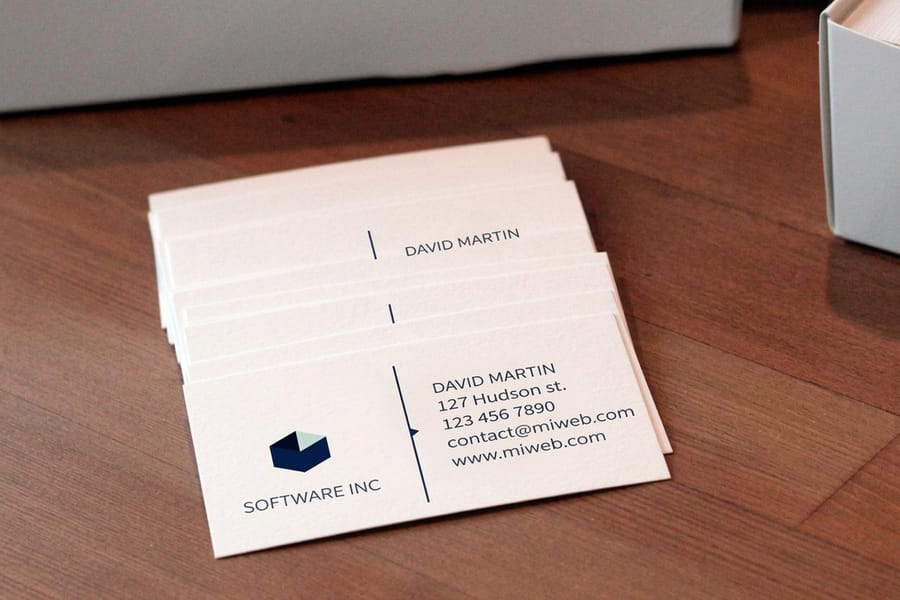
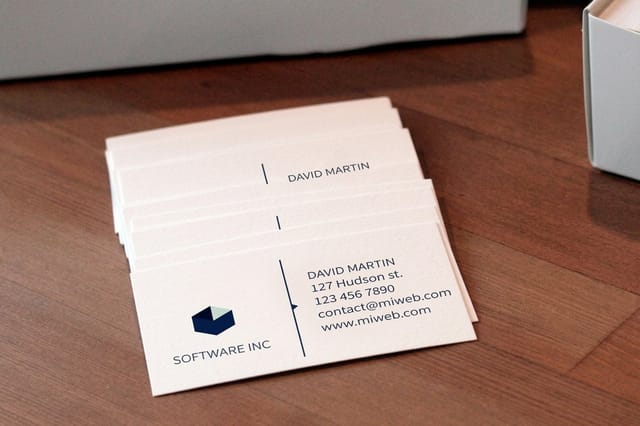
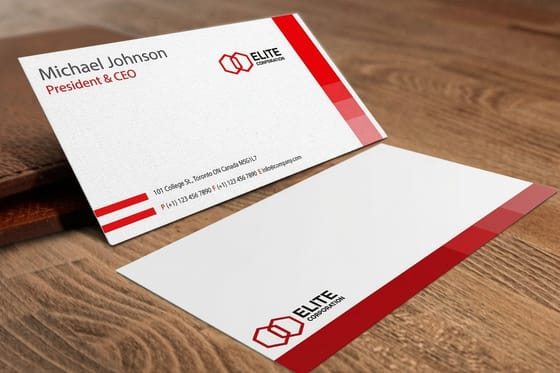
- A business card for the memory gate. Small, but it survives a pocket, a wallet and a drawer for months. Standard business cards start at $17.57, which is the lowest-cost persistence you can buy.
- A mailed follow-up for timing. Most deals die because the buyer was not ready when you called and nobody was present when they were. A printed postcard shows up on a desk without asking permission first.
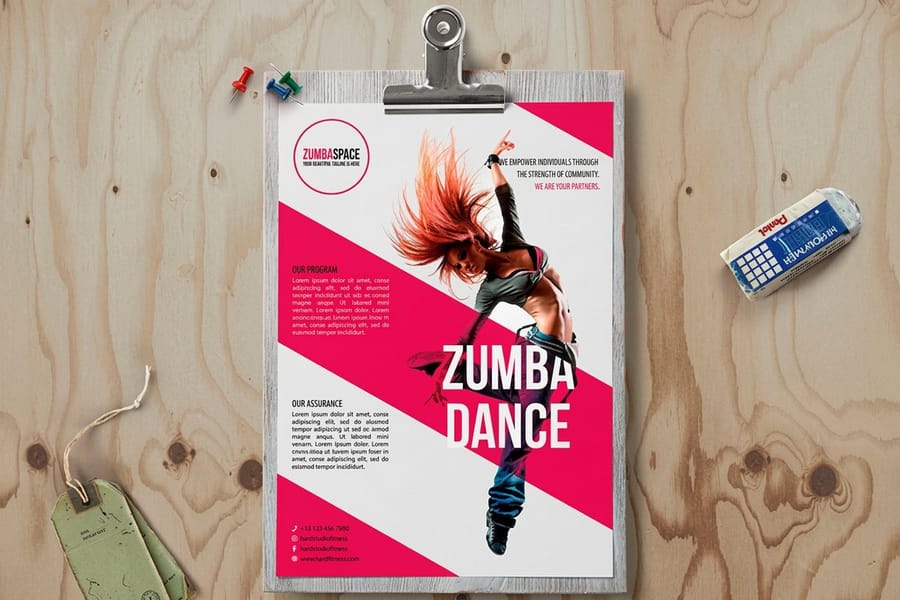
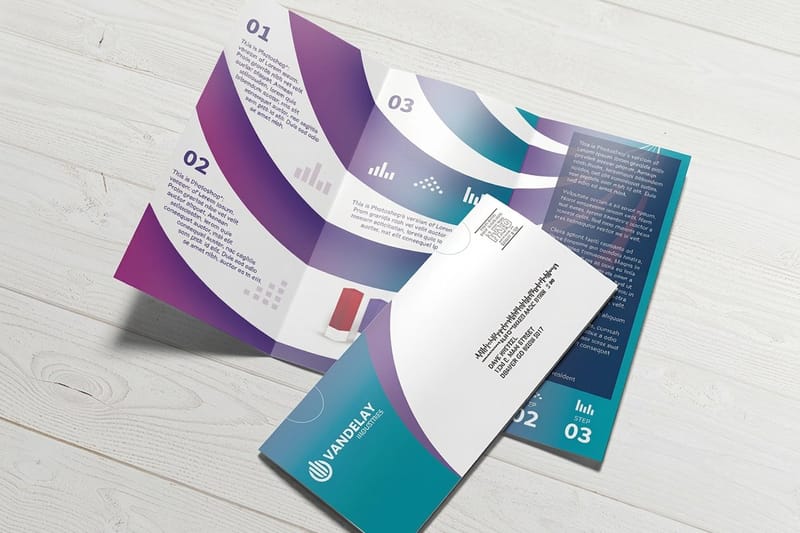
When the argument runs longer than a page, a folded piece carries it. That is the honest job of a brochure: not persuasion by itself, but the structured version of an answer someone has already asked for. Standard brochures start at $57.11, and they are worth printing only after you know which three questions the buyer actually asks, which you will not know until you have lost a few deals.
Two limits. Printed material cannot create interest that was never there, so mailing a beautiful sheet to a cold list is an expensive way to test a message. And the quality of the object is read as the quality of the company, which cuts both ways. Our guide to choosing paper for marketing materials covers the weights that signal care, and you can start from a correctly sized file in the blank template library.
Questions Do the Work, the Pitch Only Confirms It
A conclusion the buyer says out loud is one they will defend to their colleagues. The identical conclusion said by you is one they weigh against the fact that you get paid if they agree. That asymmetry is the whole reason good salespeople ask more than they tell.
The questions that move a deal are boring and specific. What are you doing about this now. How long has it been like that. What does an hour of that person's time cost you. What happens if this is still true in six months. Who else has to agree. None of these are clever. They exist to get the buyer to state the cost of the problem in their own numbers, because a figure they produced is a figure they trust.
Then stop talking. The instinct after a hard question is to soften it with a follow-up sentence, and that sentence hands the buyer an exit. Silence after a question feels twice as long to the person who asked it as it does to the person answering.
Here is the trade-off nobody puts in the sales manual: this approach is slower, and it disqualifies people. You will finish more first meetings with no deal because you found out in twelve minutes that the problem was not expensive enough to fix. That is the point. Pressure tactics convert a higher share of first meetings and a much lower share of second years, and if you sell anything with renewals or repeat orders, the first number is the one that flatters you and the second is the one that pays you. The same discipline applies to messaging at scale, which our guide to persuasive campaign messaging works through under the hardest possible deadline.
Framing the Price So the Number Stops Being the Decision
A price means nothing on its own. It only means something next to another number, and if you do not supply that number the buyer will supply one, usually the cheapest thing they can find that looks similar.
So supply it, honestly. The comparison that works is the cost of the problem, stated in the buyer's own figures from your earlier questions. Against six hours a month of someone's time, a subscription is small. Against a competitor's list price, the same subscription is a negotiation. You choose which conversation you are in by which number you put on the table first.
Order and structure matter too. Presenting three options rather than one changes the question from "yes or no" to "which one", and most buyers land in the middle, which is why the middle option should be the one you actually want to sell. That is a real effect and it has a limit: a decoy option that exists only to make the middle look good is obvious when the options are not genuinely useful, and a buyer who spots it stops believing the price list.
Two more things worth knowing. Round numbers read as estimates and precise numbers read as calculated, so $2,850 sounds worked out in a way $3,000 does not. And discounting to close teaches a buyer exactly one lesson, which is that your first price was fiction. If you have to move, trade rather than discount: a shorter term, a smaller scope, a faster payment schedule, a bigger print run. Volume pricing is a clean example of a trade, since the buyer earns the lower unit price by taking more, and every quantity break on our sales sheet printing and business card printing pages works that way rather than as a favour.
Wally explains why buyers hesitate
It is almost never the price, it is the risk behind the price
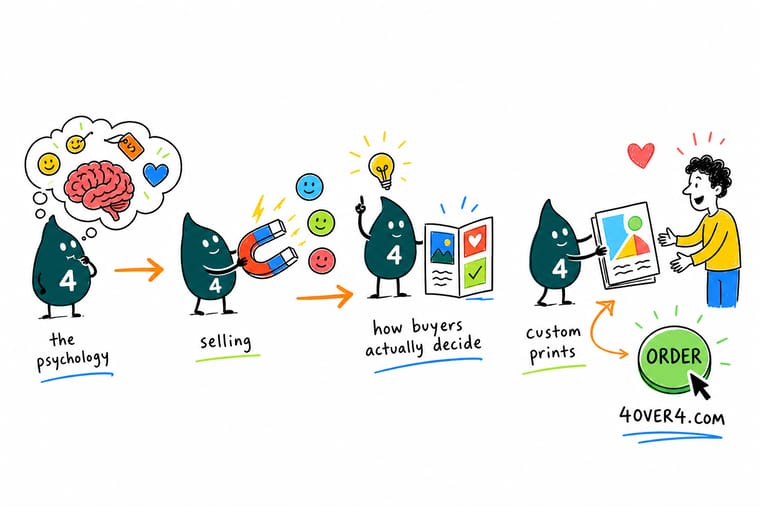
Wally watched a customer stall on an order for two weeks. The price had not changed. What changed was that Wally sent one sheet showing the paper, the run size and the guarantee, and the customer ordered the next morning. The number was never the problem. The buyer just could not explain the decision to their boss until somebody handed them something to explain it with.
Print a one-page sales sheet →Specs and pricing
The three pieces that keep selling for you
Sizes, stocks and starting prices for the leave-behind, the memory jogger and the follow-up, straight from the 4OVER4.COM configurator.


Print it
Put your argument somewhere the buyer can keep it

Explore more
Where to go next




By the numbers
The print partner behind the pieces you hand over
Common Questions
Your selling psychology questions, answered
What is the psychology of selling?
It is the study of how people actually decide to buy, which is mostly a process of reducing perceived risk rather than being convinced of value. A buyer already has a problem, already has an alternative (usually doing nothing), and already has a reason to distrust the person selling. The psychology of selling describes the order in which those obstacles get cleared: attention, relevance, trust, risk, then timing. Techniques matter far less than knowing which of those five is currently blocking the deal.
Does scarcity still work when buyers recognize the tactic?
Real scarcity works and manufactured scarcity now costs you. A deadline tied to something verifiable, such as a print run that closes on a date or a rate that changes when a contract renews, still moves people because the constraint is checkable. A countdown that resets when the page reloads teaches the buyer that your other claims are also decorative. The safest rule is to only state a limit you would honor if the buyer asked you to prove it.
How do you handle a price objection without discounting?
Find out whether it is a price objection at all. Most are risk objections wearing a price costume: the buyer is not saying the number is wrong, they are saying they cannot justify the number if it goes badly. Ask what they would need to see to feel confident, then answer that. A sample, a smaller first order, a written guarantee and a reference all reduce risk without touching the price, and none of them retrain the buyer to wait for a discount next time.
Is social proof more persuasive than a guarantee?
They work on different gates, so the useful question is which gate you are stuck at. Social proof answers trust, meaning "can you do this at all". A guarantee answers risk, meaning "what happens to me if you cannot". A buyer who believes you are competent but fears the downside is unmoved by another testimonial, and a buyer who doubts your competence reads a generous guarantee as desperation. Match the tool to the refusal.
How many follow-ups are reasonable before stopping?
Keep going as long as each contact carries something new and stop the moment it does not. A follow-up that adds a case, a relevant change in their market, or an answer to a question they raised is a service. A follow-up that says "just checking in" is a request for free attention, and three of those in a row will get you filtered. Spacing them out and switching channel, for example a mailed postcard after two emails, tends to work better than raising the frequency.
Does any of this apply when a committee is buying?
It applies more, because the person you are talking to has to sell your case again without you. Committee decisions punish nuance and reward whatever is written down, so the practical move is to hand your contact a short, self-contained argument they can forward or drop on a table. That is exactly what a one-page sales sheet is for. Sales sheets start at $75.80 at 4OVER4.COM, and a stack of them costs less than losing a deal because your champion paraphrased you badly.
Get Started
Give the buyer something to decide with
Print the one page your champion can forward, the card that survives a pocket for six months, and the postcard that lands the week they are finally ready.
Legal Disclaimer
Gold Standard guarantees apply to all standard orders placed through 4over4.com. Price match requires verifiable proof of a competitor's published price for an equivalent product with matching specifications and turnaround time. Satisfaction guarantee covers manufacturing defects and print quality issues. Contact support with order number and documentation. On-time delivery rate based on tracked orders 1999 to 2026. Individual results may vary based on shipping carrier performance.
