
Silver Stickers Explained, From Metallic Ink to Foil and Chrome


Three production routes share the word silver, and they do not look alike on a desk. Here is what each one does to light, what artwork it will accept, and where it costs you.
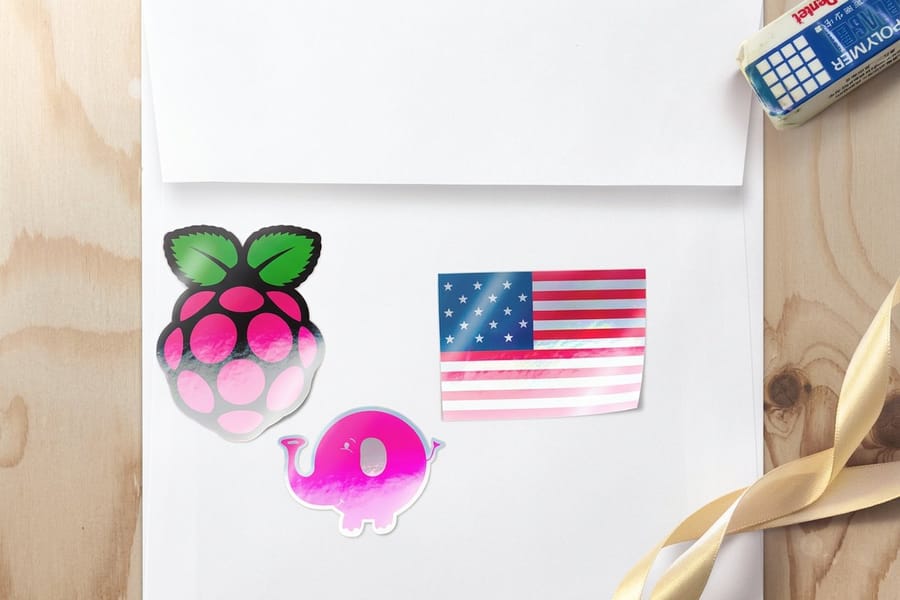
A silver sticker is made in one of three ways: silver metallic ink printed on press, a metallised face stock whose bare areas are the silver, or a metallised film stamped on by a heated die. Metallic ink scatters light into a soft sheen and prints any artwork including gradients. Mirror stock gives a brighter ground but tints every colour printed over it unless a white underbase goes down first. Stamped foil is the hardest shine and the strictest, because it only exists in the exact shape of the die.
Quick answer
Ink scatters it, stock reflects it, foil mirrors it
Pick the build by how the sticker will be lit and handled, not by which sample looks shiniest in a photo. Metallic ink is the flexible option and the only one that will hold a gradient or a photograph. Metallised stock gives you a bright silver ground for free in every area you leave empty, at the cost of tinting anything printed over it. Stamped foil is the strongest shine and the least forgiving, since it exists only in the die shape and nowhere else on the sheet.
How Silver Actually Gets Onto a Sticker
There are three production routes, and knowing which one you are buying explains almost every argument that happens later over proofs.
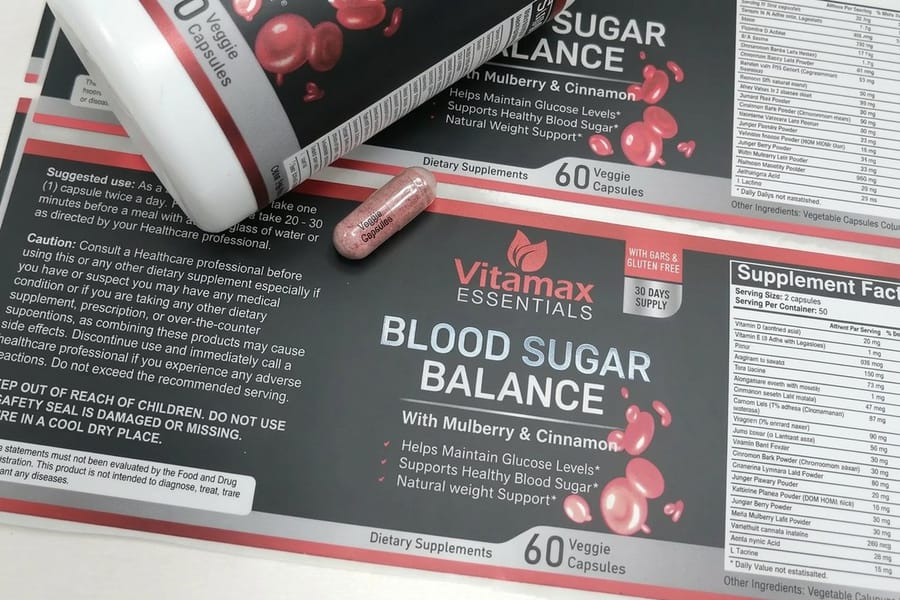
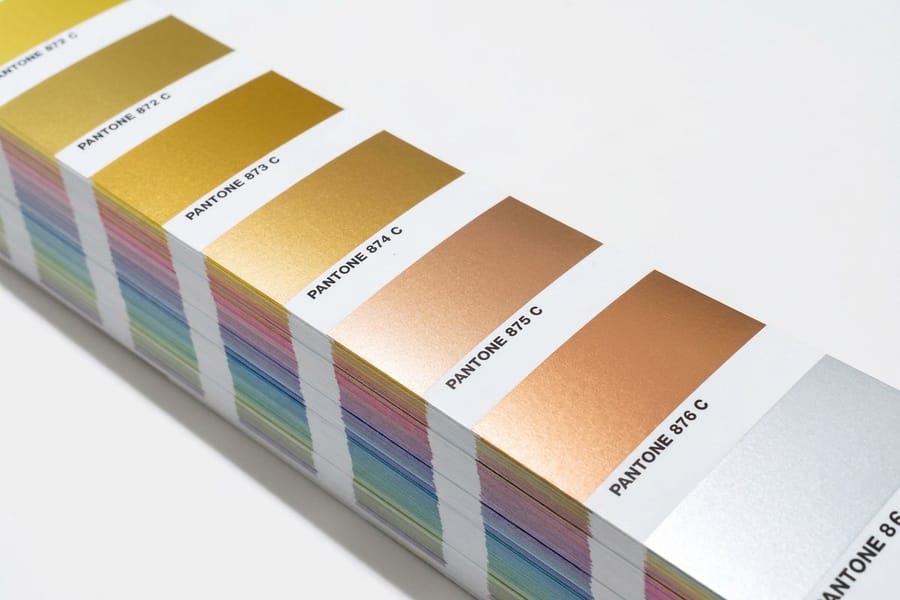
Silver metallic ink. The press carries a silver ink alongside the process colours. The pigment is flake, so it catches light and throws it back in every direction at once. Because it is ink, it prints exactly like ink: gradients, halftone tints, small type, thin rules, whatever your artwork holds. What you do not get is a mirror. Under office light metallic ink reads as a warm pewter sheen rather than a flash. Metallic Stickers start at $108.75 and are the route to pick when the design has detail in it.
Metallised face stock. Here the sticker material itself is silver, and the printing sits on top of it. Wherever you leave artwork empty, the bare stock shows and that is your silver. This gives a much brighter ground than ink can, and it is the cheapest way to make a large silver area look convincing, because nothing has to be laid down to create it. Metallic Labels use the same principle on a label roll.
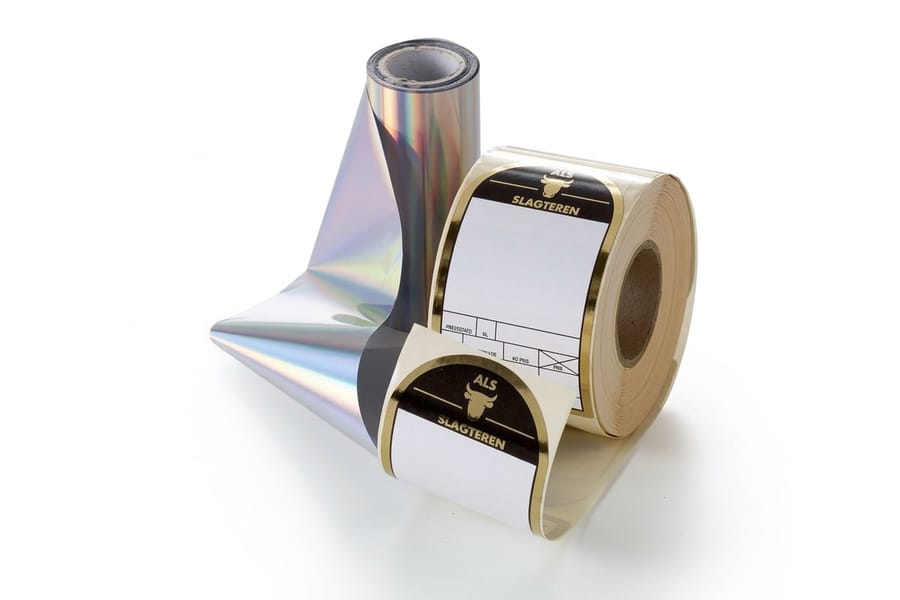
Foil stamping. A metal die is heated, pressed against a roll of metallised polyester film, and the film releases onto the sheet only where the die touches. The result is the hardest shine of the three, a true mirror, and it stops precisely at the die edge. It also means no tonal variation whatsoever, since foil is either there or it is not.
If you only remember one thing: ink scatters light, mirror stock reflects it, stamped foil reflects it hardest. The gold and silver foil printing guide walks through the stamping side in more depth.
Metallic, Foil, Chrome and Embossed Compared
The names get used loosely in briefs, so here is what each one buys you, what it refuses to do, and where it starts.
| Finish | How the shine is made | Artwork it accepts | Where it fails | Starts at |
|---|---|---|---|---|
| Metallic ink | Silver flake pigment printed on press. | Anything. Gradients, photos, fine type. | Never reads as a true mirror. | $108.75 |
| Metallic stock | The face material is already metallised. | Print anywhere, silver shows in the gaps. | Colours tint unless a white underbase is printed. | $108.75 |
| Stamped foil | Heated die transfers a metallised film. | Solid shapes, marks, rules, heavy type. | No tints, no gradients, no photographs. | $322.98 |
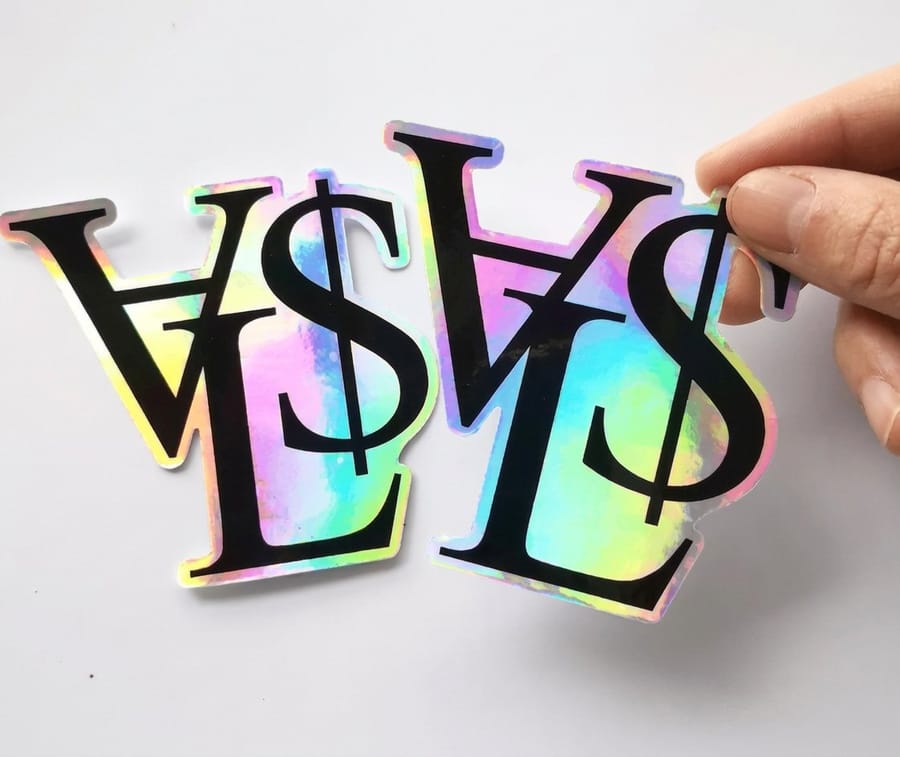
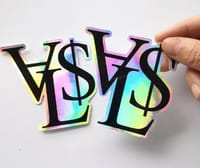
| Holographic chrome | A diffraction pattern under a chrome film. | Solid shapes and open areas. | Shifts to rainbow off-axis, so it is not a neutral silver. | $322.98 |
| Embossed foil | Foil plus a raised die impression. | Bold marks with room around them. | Fine detail collapses in the emboss. | $322.98 |
Read the fourth column before the fifth. Most of the regret in this category comes from ordering the brightest option and then discovering the design needed a gradient, or ordering holographic for a brand whose silver is supposed to stay neutral. If you want the rainbow shift without the moving-image effect people often confuse it with, holographic against lenticular pulls the two apart.
For contrast, ordinary Standard Stickers start at $23.88, which is the baseline any of these premiums gets measured against.
Where a Silver Sticker Earns the Premium
Silver pays for itself where the sticker is the last thing a person touches before deciding what they think of the product. Three jobs do that consistently.
Seals. A silver seal across a box flap or an envelope carries the visual grammar of something official and closed. It also does real work: the recipient can see whether it has been broken. A round metallic sticker at one to two inches is the standard size for this, and it is the single most common silver sticker we print.
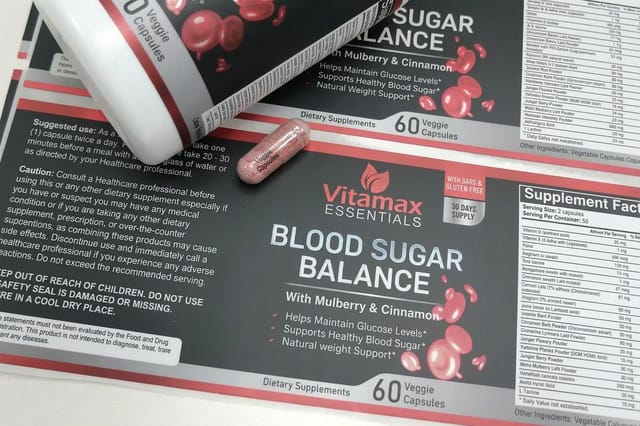
Packaging and product identity. On shelf, a metallic label competes with everything around it by reflecting the store lighting rather than absorbing it, which is why so many spirits, cosmetics and supplement brands sit on metallised stock. This is where the white underbase discipline matters most, because a brand colour that goes green over silver undoes the whole effect. Our label printing range carries the same metallic options in roll and sheet formats.
Certification and awards. A stamped foil seal on a certificate, a warranty card or a diploma folder is doing the same job a wax seal used to do.
Where silver does not earn its cost: high-volume mailers that get skimmed and binned, anything that gets written on by hand, and anything with a barcode or QR code that has to scan first time. On those, spend the money on a heavier stock or a laminate instead and keep the sticker matte. The barcode sticker guide covers the scanning constraints properly.
Artwork Rules That Keep Silver Looking Silver
Four setup habits prevent almost every silver sticker that comes back looking wrong.
- Build the foil as its own layer. Foil is a separate pass, so it needs a separate artwork layer using a 100 percent spot colour, named clearly, with nothing else on it. Do not send a grey gradient and expect us to guess which parts are meant to be metal.
- Decide the white underbase deliberately. On metallic stock, mark every area that needs an opaque white printed under it, and every area where you want the metal to show through and tint the ink. Both are valid, and the difference between them is a decision, not a default.
- Give foil edges room. Stamping has a registration tolerance, so a foil rule sitting tight against a printed rule will show any drift. A small gap between the foil and the printed elements around it costs nothing and hides the tolerance.
- Knock out anything functional. Barcodes, QR codes, batch numbers, and any field a person will write on all sit on an opaque white block with clear margin. Silver behind them is the reason a scanner beeps twice instead of once.
Beyond that, the usual sticker rules apply: artwork at full size, fonts outlined, and the die line drawn as its own path if the shape is custom. Start from a correctly sized layout in the blank template library, and if you are still choosing between paper, vinyl and metallised stocks, sticker materials explained makes the call easier. For the foil layer specifically, setting up design files for foil is the step-by-step.
Wally explains silver stickers
Same word, three very different builds
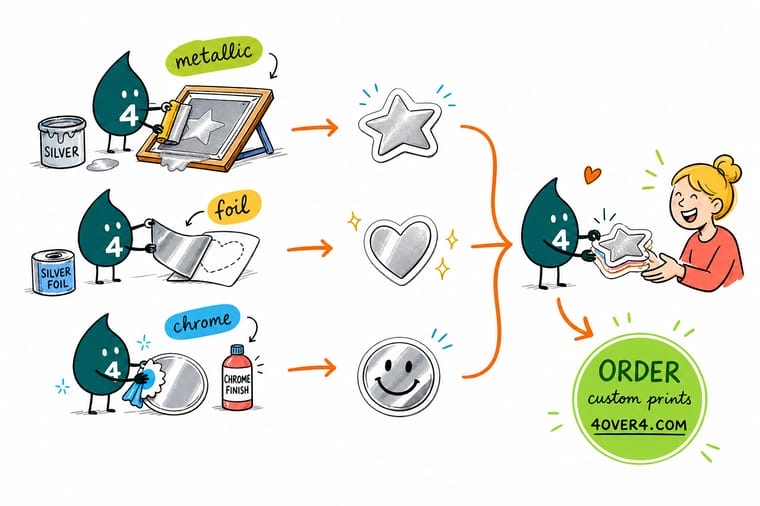
Wally holds three silver stickers under one lamp. The metallic ink one glows softly and keeps every bit of detail in the artwork. The one on mirror stock throws back a bright silver wherever he left the design empty, and tints the colours he printed straight over it. The foil-stamped one flashes hardest but only in the exact shape of the die, with no shading anywhere. Ask him for a gradient and he reaches for the ink. Ask him for a seal that has to look official across a room and he reaches for the foil.
Order metallic stickers →Specs and pricing
Sizes, materials and starting prices for each silver route
Configure metallic ink, stamped foil and holographic chrome side by side, with live options and starting prices straight from the 4OVER4.COM configurator.
Print it
Order the silver finish your artwork can actually carry

Explore more
Where to go next

By the numbers
Specialty sticker printing you can count on at 4OVER4
Common Questions
Your silver sticker questions, answered
What is a silver sticker made of?
It depends which of the three builds you order. Metallic ink stickers are ordinary face stock with a silver pigment ink printed on it, so the sheen comes from flakes suspended in the ink film. Metallic or mirror stickers use a face stock that is already metallised, and the silver you see is the bare stock showing between the printed areas. Foil stickers have a thin metallised polyester film stamped onto the surface by a heated die. All three are silver in a catalogue and clearly different in your hand.
Why does my colour look muddy on silver stock?
Because process inks are transparent and the silver underneath is showing through them. Ink on a metallic stock behaves like a stained glass window, not like paint. If a colour has to match a brand standard, ask for an opaque white underbase printed first in that area, then the colour on top of the white. Leave the white out only where you deliberately want the metal to tint the artwork, which is a genuinely nice effect on a red or a deep blue.
Which silver finish holds up outdoors?
A printed metallic vinyl sticker with a laminate over it survives outdoor use best, because the reflective layer is under the print and the laminate. Stamped foil sits on the very top surface with nothing above it, so it scuffs against a key ring or a shipping carton faster than a laminated print does. For a seal on a box that ships, that scuffing is rarely a problem. For a hard hat or a bumper, choose the laminated vinyl route.
Can I get silver from a desktop printer?
No. Home and office printers have no metallic channel, so the closest they can produce is a grey tint made from black and cyan, which reads flat and slightly blue under any real light. Metallic ink needs a press with a dedicated metallic unit, metallic face stock has to be die-cut on a converting line, and foil stamping needs heat, a die, and pressure. This is the honest reason a silver sticker gets ordered rather than made at a desk.
Do silver stickers cost much more than plain ones?
Yes, and the gap is worth seeing before you commit. Standard Stickers start at $23.88. Metallic Stickers start at $108.75 because of the metallic ink pass. Foil Stickers and Custom Holographic Stickers both start at $322.98 because they add a stamping or a specialty film converting step. The right way to read that is per piece across the run, since the specialty setup is spread over the quantity and the gap narrows sharply on larger orders.
Will a barcode or a QR code read on a silver sticker?
Not reliably on a reflective surface. Scanners work by measuring the contrast between dark bars and a light background, and a mirror throws the beam back at an angle instead of scattering it evenly, so the reader either fails or reads intermittently depending on how the light hits. The fix is simple: print an opaque white rectangle behind the code with a clear margin around it, then the black on white. The rest of the sticker keeps the silver.
Can silver foil and silver ink appear on the same sticker?
Yes, and it is a strong combination when it is deliberate. A common layout puts a stamped foil logo mark at the top for the hard mirror shine and prints the supporting type in metallic ink, so the mark clearly outranks everything around it. Keep a little breathing room between the two, because a stamped foil edge next to a printed silver edge makes any registration shift obvious. Embossed Stickers take that one step further by raising the foiled area off the surface.
Get Started
Ready to print something that catches the light?
Choose metallic ink for detail, metallised stock for a bright silver ground, or stamped foil for the hardest shine, then set your size, shape and quantity.
Legal Disclaimer
Gold Standard guarantees apply to all standard orders placed through 4over4.com. Price match requires verifiable proof of a competitor's published price for an equivalent product with matching specifications and turnaround time. Satisfaction guarantee covers manufacturing defects and print quality issues. Contact support with order number and documentation. On-time delivery rate based on tracked orders 1999 to 2026. Individual results may vary based on shipping carrier performance.
