
How to Make Barcode Labels That Scan Every Time


Which symbology to use, how small a barcode may legally print, the blank space nobody leaves enough of, and how to get a unique code on every label in one run.
To make a barcode label that scans, choose the symbology for the scanner that will read it, generate the symbol as vector art, size it by magnification with its full quiet zone left blank, and print the bars as solid 100 percent black on a light matte background. A UPC-A at 100 percent is 1.469 by 1.020 inches and may print between 80 and 200 percent of that. Then match the face stock to the surface and the environment, and use variable data if every label needs its own code.
Quick answer
The four decisions that make a label scan
Symbology, size, contrast, material. The scanner decides the symbology, the symbology decides the minimum width, the quiet zone decides how much blank space you have to leave around it, and the surface decides the face stock. Get those four right and the label reads on the first pass. Get the quiet zone wrong and nothing else you do will save it, which is why the blank space is drawn to scale below.
Pick the Symbology Before You Pick the Label
A barcode is not artwork, it is an encoding with published tolerances. Which encoding you use is decided by the machine that will read it, and that decision sets the minimum width of the symbol, which in turn sets the smallest label you can order.
| Symbology | What it encodes | Where it gets scanned | Quiet zone |
|---|---|---|---|
| UPC-A | 12 digits, fixed length | US retail checkout, licensed through GS1 | 9 modules each side |
| EAN-13 | 13 digits, fixed length | Retail outside the US, same GS1 licence | 11 left, 7 right |
| Code 128 | Any ASCII, variable length | Shipping labels, warehouse bins, asset tags | 10 modules each side |
| Code 39 | Digits and capitals, variable length | Older internal, defence and healthcare systems | 10 modules each side |
| QR | Text, numbers, a URL | Phone cameras and 2D imagers | 4 modules all round |
| Data Matrix | Text and numbers, very dense | Machine vision on small parts and vials | 1 module all round |
Two practical consequences fall out of that table. Code 128 gets wider as you add characters, so a 20 character part number needs a noticeably longer label than an 8 character one, and there is no way to fix that with a smaller font. And 2D codes hold far more in far less space, which is why a Data Matrix ends up on a vial where a linear barcode would never fit.
If you are selling through a retailer, the number itself is licensed. GS1 issues the company prefix behind every legitimate UPC and EAN, and the retailer will check it. For internal use, an asset tag or a warehouse location, nobody licenses anything and Code 128 over your own numbering is the normal answer. The guide to company labels for asset tagging covers how those internal schemes usually get built.
Sizing the Symbol and Protecting the Quiet Zone
Every dimension in a linear barcode is a multiple of one number, the X-dimension, which is the width of the narrowest bar. Change it and the whole symbol scales with it. A UPC-A at 100 percent has an X-dimension of 0.0130 inches, which produces a symbol 1.469 inches wide and 1.020 inches tall.
GS1 lets that print anywhere from 80 to 200 percent. At the 80 percent floor the symbol is about 1.175 inches wide, and that is genuinely the floor: below it the bars land inside the mechanical tolerance of a checkout scanner and reads start failing under real store conditions, on a curved package, at an angle, through a scuffed window. Going the other way costs you nothing in readability but eats label real estate fast.
The quiet zone is the part people delete. It is the blank space on either side of the symbol that tells the scanner where the code begins, and it is measured in modules, not in a fixed distance. Nine modules on a 100 percent UPC-A is 0.117 inches of nothing. Put a hairline border there, run the product name into it, or trim the label tight to the bars, and a scanner that would otherwise read the code instantly will hunt and fail.
Then wrap the label around all of that: quiet zone, plus clear space, plus your own bleed and safe area. That is why so few retail barcode labels come out smaller than 2 by 1 inches once the product name and the legal copy are on there too. Work the arithmetic through with how to choose the correct label size, or start from a correctly built layout in the blank template library.
Designing and Printing It So a Scanner Can Read It
A laser scanner does not see your barcode. It sees the difference in reflected light between a dark bar and a light space, and everything below is about protecting that difference.
- Generate vector, never raster. A barcode exported as a JPEG or scaled up from a screenshot has soft, resampled bar edges. Place it as vector art from a barcode generator or a font that produces real geometry, and never rescale it non-proportionally.
- Bars are 100 percent K, nothing else. Rich black builds the bar from four inks, and any registration drift blurs the edges and shifts the widths. One plate, one clean edge.
- Never print bars in red, orange or yellow. A typical retail scanner uses a red laser around 660 nm, and those colours reflect it almost as well as white paper does. Black, dark blue and dark green work. Anything warm reads as blank.
- Keep the background light and flat. White is best. A tint, a photo or a gradient under the bars kills the contrast, and so does a heavy gloss laminate under bright store lighting, which throws glare straight back at the reader.
- Expect ink gain and plan for it. Bars spread slightly on press, more on absorbent uncoated stock than on coated. Production files for demanding jobs get bar width reduction applied so the printed widths land where the spec wants them.
Retailers grade barcodes rather than eyeballing them, on the ISO 15416 scale from A down to F, and most supply agreements ask for a C or better. That grade covers contrast, edge sharpness and how close the bar widths land to nominal, so it fails for exactly the reasons above. The one about resolution is worth reading properly in print resolution explained.
Choosing a Material the Barcode Survives On
A barcode that scans on the day it is printed and fails after three weeks in a walk-in cooler was never a design problem. Face stock and adhesive do most of the work here.
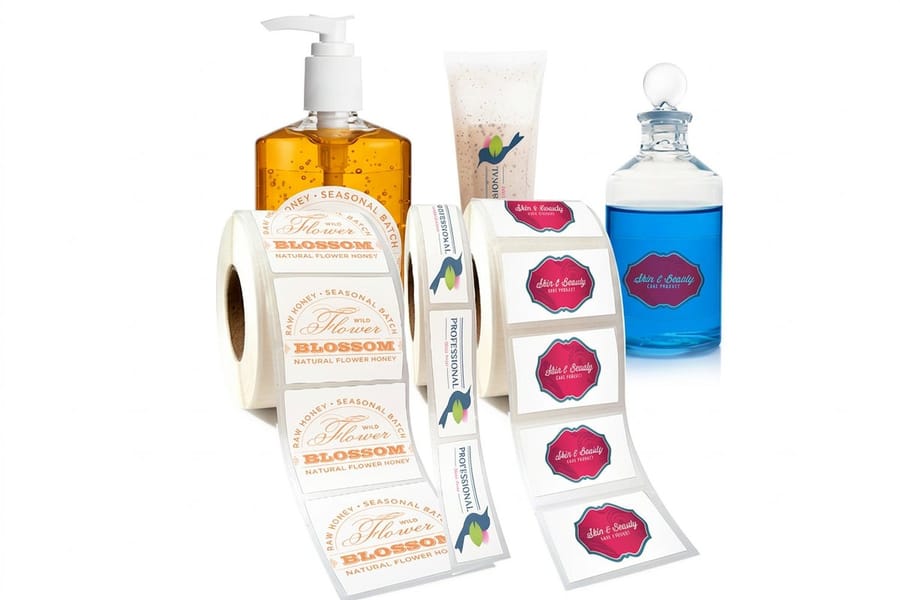
Coated paper is the cheapest and the right answer for anything indoors, dry and short lived: shelf tags, pick labels, retail cartons. It scuffs, it wrinkles when damp, and a wrinkled bar is a wrong bar. BOPP and vinyl films survive moisture, oils and handling, which is why product labels on bottles, jars and anything refrigerated get printed on film rather than paper. Paper vs vinyl vs clear labels compares the three faces properly.
Clear film needs one extra decision. Transparent stock has no background, so the scanner ends up reading the bars against the container behind them. On a white bottle that is fine. On amber glass or a dark plastic tub the contrast disappears entirely, and the fix is a white ink layer printed under the symbol only, which keeps the rest of the label transparent. Ask for it explicitly on roll clear labels, because a design that looks right on screen gives no hint of the problem.
Two more things decide the material. A curved surface pulls a rigid face stock away at the edges, so a barcode wrapped around a small diameter needs a conformable film and a stronger adhesive. And laminate helps against abrasion but hurts against glare, so matte laminate is the compromise on anything a hand scanner will fight with. If the labels ship on cartons rather than products, how to label a package for shipping covers placement on corrugated.
Printing a Different Barcode on Every Label in One Run
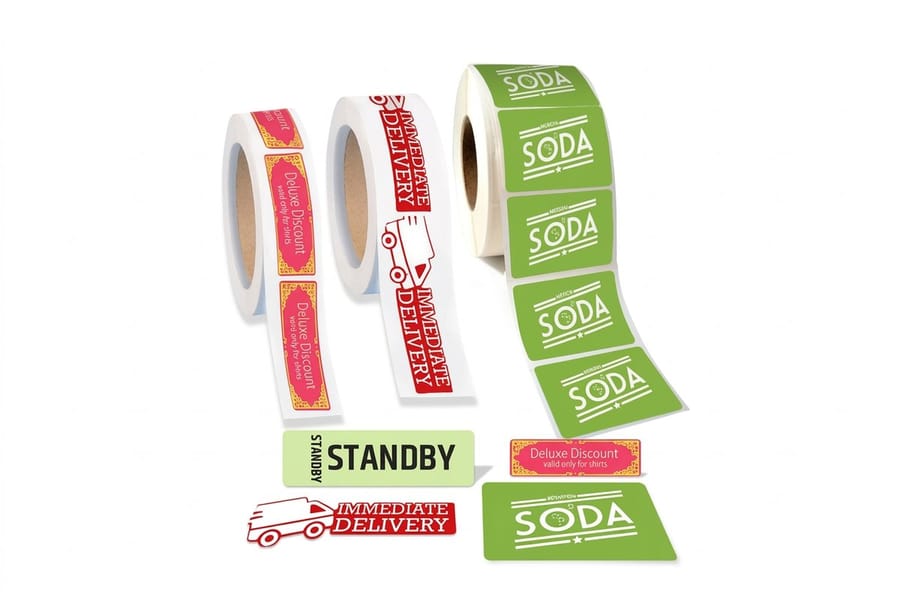
Serial numbers, asset tags, lot codes and unique coupon codes all need a different symbol on every single label. That is variable-data printing, and the important thing to understand is that it happens in the same pass as everything else. There is no extra press run and no per-code setup, so a thousand unique barcodes cost what a thousand identical ones cost at the same quantity.
What changes is the file handoff. Send a CSV with one row per label and a column holding the exact code string, tell us the symbology to generate from it, and make sure the row count matches the quantity you are ordering, because 1,000 labels against 998 rows is a decision somebody has to make mid-run. Leading zeros are the classic trap: a spreadsheet strips them from a number column, so format the code column as text before you export or the codes come out short.
Sequences want a check at both ends, not just the first one. We proof the first and the last record so you can confirm the range is what you asked for, and it is worth scanning that proof with the reader that will actually be used in production rather than a phone. The variable data printing guide lists what else to ask a printer before you hand the file over.
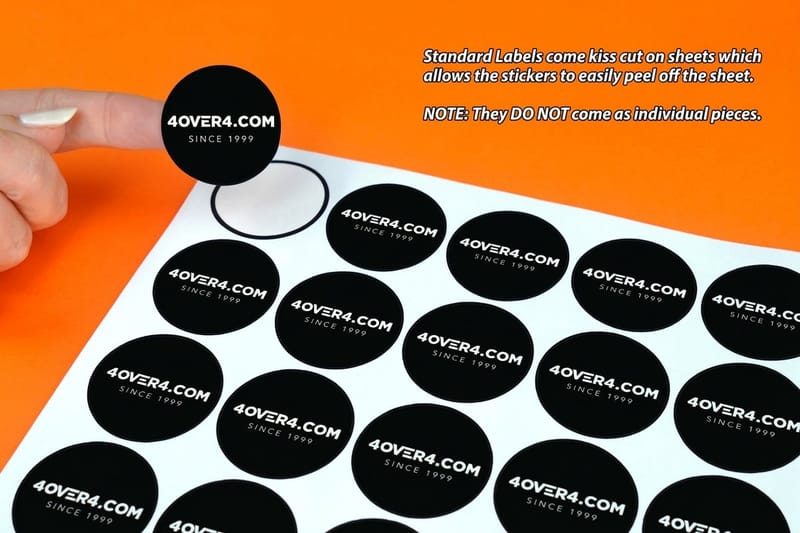
Format follows application. If a machine applies the labels, order roll labels and specify the wind direction and core size the applicator needs. If a person peels them, standard custom labels on sheets start at $23.88 and make a short test batch cheap. That price gap is real: roll labels start at $322.98 because they run in the thousands, so print a sheet, scan it, and only then commit to a roll.
Wally explains the quiet zone
The blank space is part of the barcode
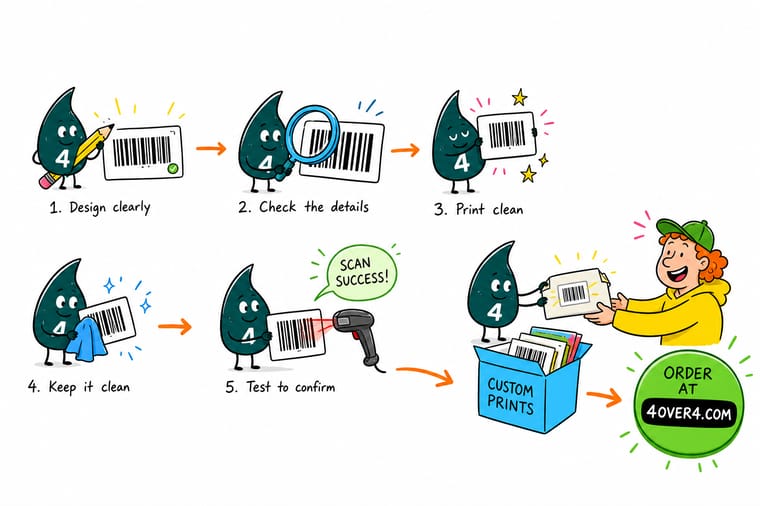
Wally keeps 9 blank modules on each side of a UPC-A, which is about 0.117 inches of nothing at full size. That white space tells the scanner where the code starts. Push the product name into it, run a hairline border through it, or trim the label tight to the bars, and the reader hunts and gives up. The bars themselves go down as solid black, never red and never rich black, on a light matte background. Then Wally picks the face stock for where the label lives: paper for a dry shelf, film for a cooler, and a white ink layer under the symbol on any clear label.
Order custom labels →Specs and pricing
Label formats, sizes, and starting prices
Sheets for short runs and hand application, rolls for applicators and volume. Configure the size, the face stock and the quantity below, with starting prices straight from the 4OVER4.COM configurator.


Print it
Order barcode labels that read first time
Explore more
Where to go next

By the numbers
Label printing you can count on at 4OVER4
Common Questions
Your barcode label questions, answered
How do I make barcode labels that actually scan?
Four decisions, in this order. Choose the symbology for where it will be scanned, generate the symbol as vector art rather than an image, size it by magnification with the full quiet zone left blank on both sides, and print the bars as solid 100 percent black on a light, non-glossy background. Then order the labels on a material that suits the surface and the environment. Almost every unreadable label fails on one of those four, usually the quiet zone.
What size should a barcode label be?
The barcode sets the floor and the label wraps around it. A UPC-A at nominal size is 1.469 inches wide and 1.020 inches tall including its quiet zones, and it can legally print between 80 and 200 percent of that, so the smallest compliant symbol is roughly 1.175 by 0.816 inches. Add at least an eighth of an inch of clear space beyond the quiet zone before any border, plus room for the product name and any legal copy. In practice that puts most retail barcode labels at 2 by 1 inches or larger. Our guide on how to choose the correct label size walks through the same maths for non-barcode work.
Can I put a barcode on a clear label?
Only with a white ink layer under it. A red laser reads the contrast between dark bars and a light background, and on clear film the background is whatever the bottle behind it happens to be. Printing a white block under the symbol solves it, and it is a standard option on roll clear labels. On an amber or cobalt bottle with no white underprint, the scanner sees nothing.
Do I need to buy a GS1 barcode number?
If the product will be sold through retailers or listed on most marketplaces, yes. Retail UPC and EAN numbers are licensed from GS1, and the prefix identifies you as the brand owner. If the barcode is only for your own warehouse, your own asset tags, or an internal pick-and-pack workflow, no licence is needed and Code 128 over your own numbering scheme is the usual choice. We print whatever number you supply, we do not issue GS1 prefixes.
Can you print a different barcode on every label?
Yes. Variable-data printing merges a data file into the layout so each label carries its own code, and it runs in the same pass as the rest of the artwork. Send a CSV with one row per label and a column holding the exact code, tell us which symbology to generate or supply the symbols as vector art already, and confirm the total row count matches the quantity you are ordering. We proof the first and last records so you can check both ends of the sequence before the run starts.
Sheet labels or roll labels for barcodes?
It depends on how they get applied. Sheets suit hand application and short runs, and standard custom labels start at $23.88, which makes a test batch cheap. Rolls suit an applicator or a hand dispenser and any run in the thousands, but roll labels start at $322.98 because they are made in volume. If a machine applies the label, the answer is a roll and the wind direction matters. If a person peels it, sheets are usually fine.
Why does my barcode scan on my phone but not at the register?
Phone cameras are far more forgiving than a laser. A camera reads the whole image and can work around a shortened quiet zone, a slightly blurred edge or a low-contrast background. A retail laser scanner sweeps a line and needs the widths inside tolerance, the quiet zones intact and a print contrast that grades C or better on the ISO scale. Passing a phone test proves the number is encoded correctly, nothing more.
Get Started
Ready to print barcode labels that scan?
Send the artwork or the data file, pick a face stock that suits the surface, and we print labels on sheets or rolls with the quiet zones intact.
Legal Disclaimer
Gold Standard guarantees apply to all standard orders placed through 4over4.com. Price match requires verifiable proof of a competitor's published price for an equivalent product with matching specifications and turnaround time. Satisfaction guarantee covers manufacturing defects and print quality issues. Contact support with order number and documentation. On-time delivery rate based on tracked orders 1999 to 2026. Individual results may vary based on shipping carrier performance.
