
Foil Sticker Paper Explained and How It Differs From Foil Stamping


Two ways to put metal on a sticker, and they behave nothing alike. Here is what the stock does to your colors, what a stamp can and cannot hold, and which one your artwork is asking for.
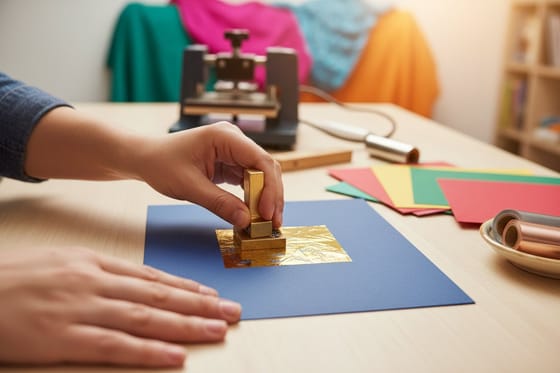
Foil sticker paper is a facestock with a metallized layer under the print surface, so the shine appears wherever you leave ink off. Spot foil stamping is the opposite arrangement: a heated die presses foil onto an already printed sticker, so the metal lands only where you drew it and the rest of the label keeps normal color. Stock gives you a metallic background cheaply but turns every white area silver. Stamping gives you an exact metallic shape, on white stock, in solid vector only.
Quick answer
One shines by subtraction, the other by addition
On foil sticker paper the metal is already there and your ink covers it up. Whatever you leave empty in the file comes back as a mirror, which is why a whole metallic background costs no more than a metallic corner, and why anything meant to read white comes out silver. A foil stamp adds metal instead: a heated die transfers foil from a carrier film onto a printed label, only in the die area, so white stays white and process colors stay accurate. Stock suits large shiny areas and metallic backgrounds. Stamping suits one exact metallic mark inside normal artwork.
What Foil Sticker Paper Is Made Of
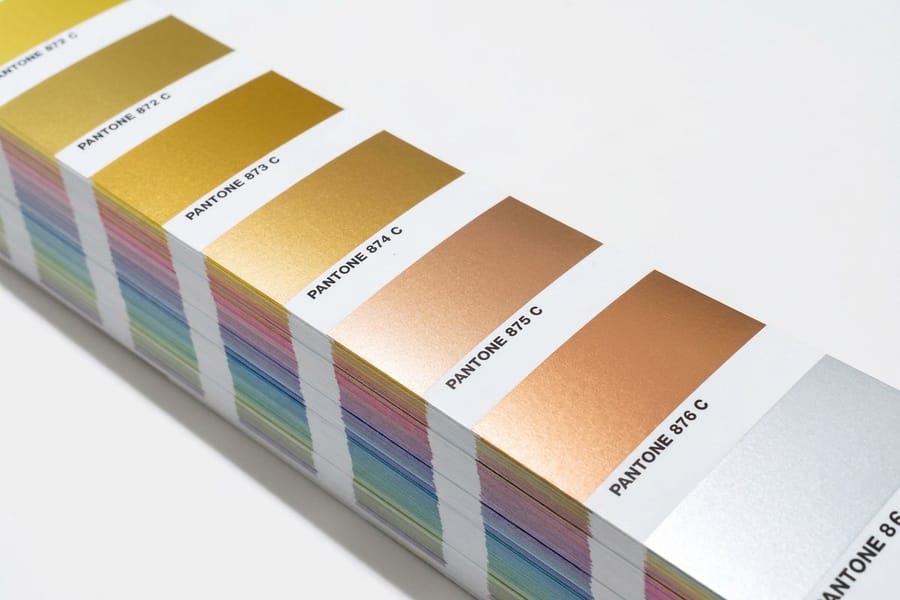
The face is the interesting one. A thin coat of aluminum is deposited onto film or paper in a vacuum chamber, then sealed with a coating that will hold ink, which is why the sheet behaves like a mirror underneath and like a printable stock on the surface.
That single fact drives every rule that follows. Your ink hides the metal. The shine is what you did not print. Designers who come to metallic stock from ordinary white paper tend to build the artwork the other way around, adding shiny elements, when the job is really to decide what stays uncovered.
Holographic sticker paper works the same way with one extra step: the metallized layer is embossed with a microscopic diffraction pattern before the coating goes on, which is what splits the reflection into rainbow color as the sticker moves. Same anatomy, same white ink problem, more visual noise behind small type. If you are weighing that route, the holographic and lenticular comparison covers where each one falls apart.
They start at $322.98 for 100, and 500 print for that same $322.98, which is worth knowing before you order a small test batch.
Foil Sticker Paper Against Spot Foil Stamping
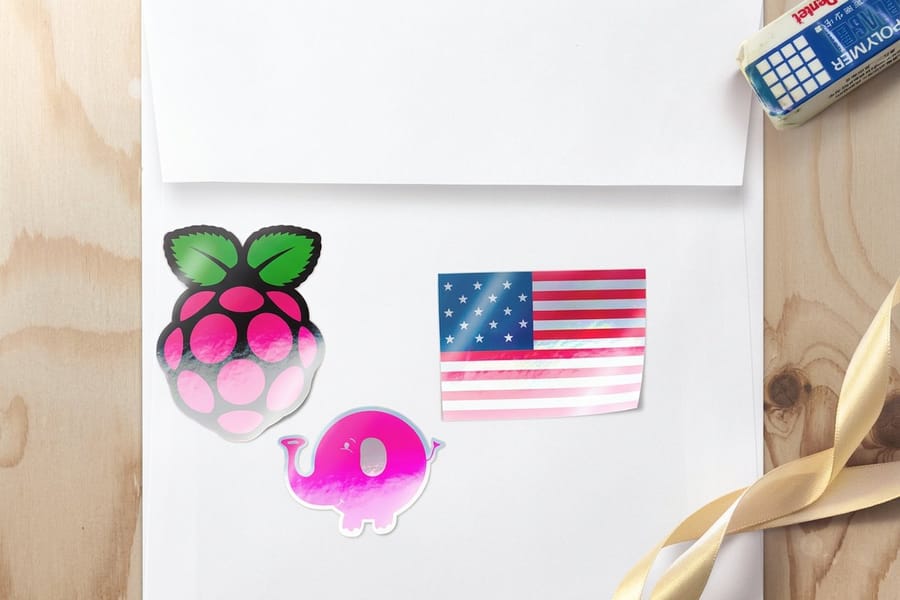
Both give you metal on a label. They arrive by opposite routes, and the route decides what your artwork is allowed to do.
| Method | Where the shine comes from | What it costs you | Best for |
|---|---|---|---|
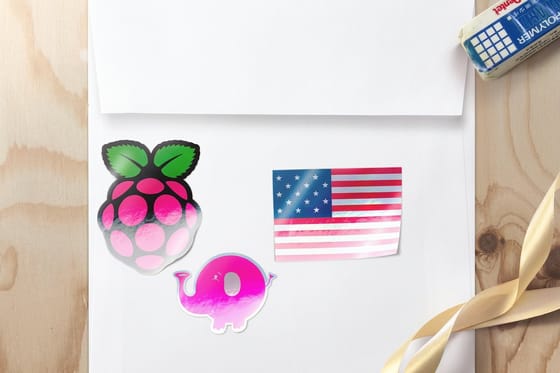
| Foil sticker paper | The metallized facestock, showing through anywhere ink is absent. | No white ink, so whites go silver and process colors shift over the mirror. | Large shiny areas, metallic backgrounds, seals and jar labels meant to read as metal. |
| Spot foil stamping | Foil transferred from a carrier film by a heated die, only where the die touches. | A die, a second pass, and vector-only artwork with no gradients. | An exact metallic logo or lettering sitting inside otherwise normal full-color art. |
| Holographic film | A metallized layer embossed with a diffraction pattern, so it splits light into color. | Everything metallic stock costs you, plus a busy background that fights small type. | Retail, event and collector stickers where movement and rainbow are the point. |
| Printed faux foil | A CMYK gradient that imitates metal. No metal is involved. | Nothing extra, and no actual reflection. It looks like grey or tan under any light. | Cheap runs where the metallic look is a nice-to-have rather than the reason to print. |
Read the second column and the choice usually makes itself. If the design wants a metal background, the stock is the sane answer. If one logo has to be metal and the rest of the label has to hold accurate color and true white, that is a stamp. Our metallic stickers take the second route: full-color CMYK on a semi-gloss label face, a real foil accent added on top, then a high gloss UV coating, starting at $108.75 for 500 in 20 sizes from one and a half by three and a half inches up to six by nine.
The same split exists on card stock, where it is easier to see side by side. Foil stamping against raised foil walks the flat and raised versions of that finish, and foil business cards show what a stamped accent looks like at a larger size.
How to Choose Between Them in Four Questions
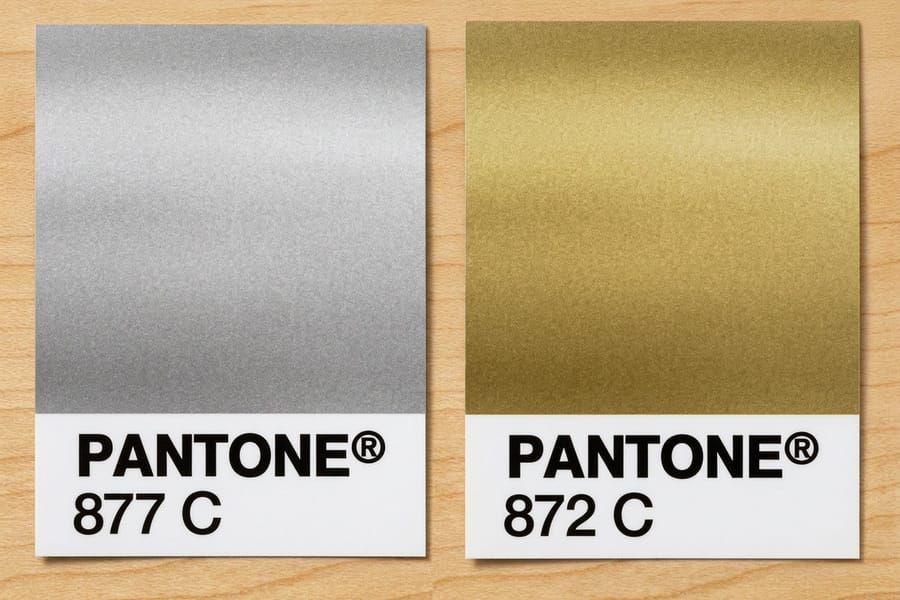
Work down this list with your artwork open. Most jobs resolve on the second or third question.
- Is there any true white in the design? If your logo knocks out to white, if there is white type, or if a product photo has a white background, metallic stock will turn all of it silver. That answer alone sends the job to a printed face with a foil accent.
- How much of the sticker should shine? More than roughly half, and the stock is cheaper and cleaner. A logo, a monogram or a line of lettering, and a stamp gives a sharper result with less compromise elsewhere.
- Does the metallic element have gradients or fine detail? A die cannot do a gradient, a screen or a photograph. It transfers foil at full strength or not at all. Gradients that must appear metallic have to sit on metallic stock and be built as ink over the mirror.
- Where will the sticker live? Outdoors, on a cooler, or through repeated handling, and the face material matters more than the shine. Choose a BOPP face with lamination, or move to vinyl stickers for a small run on a rougher surface.
Two file habits save most of the reprints we see. Convert type to outlines and supply artwork at full size, exactly as you would for any print job, and keep the foil layer separate and named so nobody has to guess which shapes are meant to be metal. Our file setup guide for foil shows the layer structure, and you can start from a correctly sized layout in the blank template library.
If you are still deciding on the base material rather than the shine, read choosing the right material for your stickers first. The face decides durability, adhesion and how the color prints. The metallic decision sits on top of that one.
Where a Metallic Sticker Earns Its Price
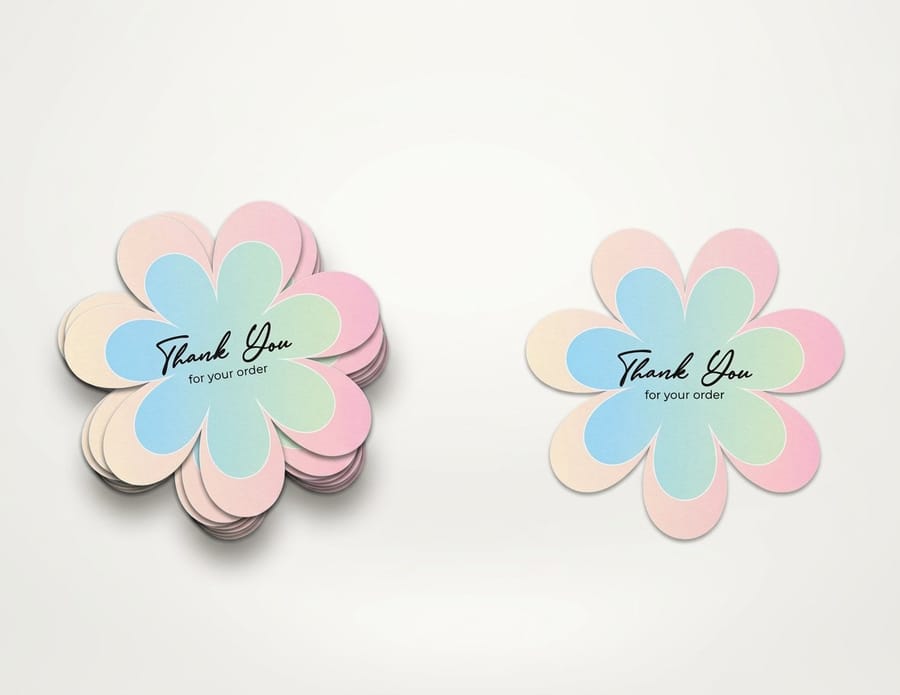
A shiny sticker works where the piece is picked up and looked at rather than scanned and discarded. Product labels on glass and dark packaging are the strongest case, because the mirror reads against the surface behind it and the label stops looking like paper. Seals on a box lid, jar labels, and the closing sticker on a mailer all get held for a second longer than the sender expects.
The weaker cases are worth naming. A sticker covered in dense text does not want a metallic background, because the reflection cuts contrast at exactly the sizes people struggle to read. Anything with a barcode should sit on a white face, since scanners need a clean quiet zone and a reflective background is a real failure mode. Compliance labels, ingredient panels and shipping information all belong on plain stock, with the metal saved for the brand mark. For those jobs, die-cut stickers on a semi-gloss or matte paper face do the work for less.
On price, the two products land in different places for a reason. Neither is a premium version of the other. They solve different design problems, and the answer to which you need is usually sitting in your file already.
Browse the full range on sticker printing, or compare printed shine against real metal on gold and silver foil printing before you commit a run.
Wally explains foil sticker paper
Cover the mirror, or press the metal on
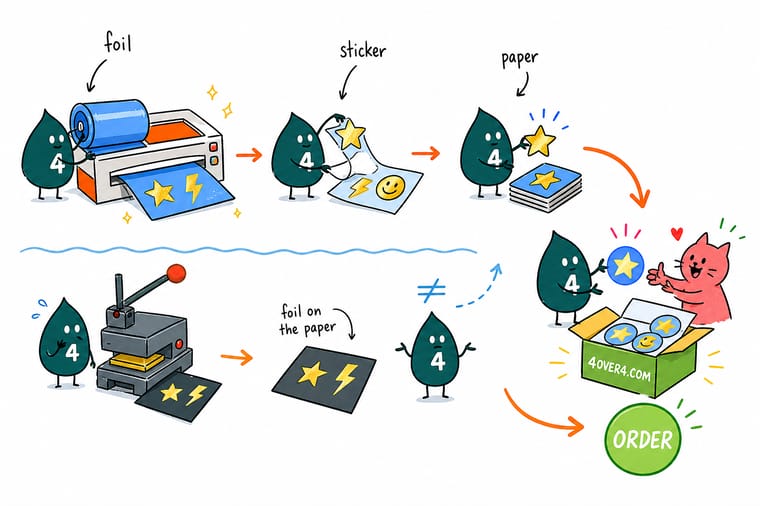
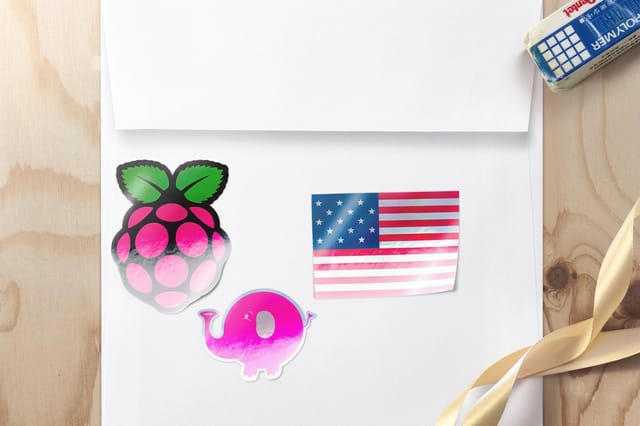
Wally holds two stickers that look similar and are built backwards from each other. The silver one is metallic all the way across, and his ink hides the parts that should not shine, so anything he left blank turns into a mirror and anything he wanted white turns into a mirror too. The other one printed on white paper first, then a hot die pressed foil onto the logo alone, so the metal has a crisp edge and the rest of the label kept its real color. Pick the stock when most of the sticker should be metal. Pick the stamp when one mark should be.
Order foil stickers →Specs and pricing
Metallic sticker options, sizes, and starting prices
Compare the metallic face against the foil accent side by side, with live material and size choices and starting prices straight from the 4OVER4.COM configurator.
Print it
Order the metallic sticker your artwork actually needs
Explore more
Where to go next


By the numbers
Sticker printing you can count on at 4OVER4
Common Questions
Your foil sticker paper questions, answered
What is foil sticker paper?
Foil sticker paper is a self-adhesive facestock that carries a metallized layer, usually a thin coat of aluminum deposited onto film or paper, finished so it can take ink. You print your artwork on top of that mirror. Wherever ink lands the metal is hidden, and wherever you leave the file empty the metal shows and throws a shine. At 4OVER4.COM the bright shiny silver metallic foil face is one of the four materials offered on foil stickers, alongside white gloss, white BOPP and clear BOPP.
Is foil sticker paper the same as foil stamping?
No, and confusing them is what leads to a reprint. Foil sticker paper is the material: the shine is already there and your ink covers the parts you do not want shiny. Foil stamping is a finishing pass that happens after printing, where a heated die presses foil from a carrier film onto specific areas of an already printed label. Stamping gives you an exact metallic shape on ordinary white stock. Metallic sticker paper gives you a metallic background that your design sits on.
Can you print white on foil sticker paper?
Only if the press lays a white underbase, and standard CMYK does not. This catches people out constantly: a logo with a white knockout, a white product photo background, or white body text all come back silver on a metallized face, because the printer simply leaves those areas free of ink and the stock takes over. The safest habit is to design for a silver background from the start, treat silver as one of your colors, and reserve any true white for a stamped or accented job instead.
Why does my gold logo look dull on metallic stock?
Because process inks are semi-transparent and the silver underneath changes what you see. Yellow over silver reads as a muted brass rather than a bright gold, and mid-tone screens go grey and murky where they would look clean on white. Solid, saturated colors hold up best on metallic stock. If the brand gold has to be exact, print on a white face and add the gold as a foil accent, which is how metallic stickers are built.
Which one is waterproof?
The face material decides that, not the shine. On our foil stickers, white BOPP and clear BOPP are the two faces rated for indoor and outdoor use, so a label headed for a cooler, a workshop or a shipping crate should sit on one of those and take gloss or matte lamination on top. Treat the silver metallic face as an indoor and short-handling material unless you laminate it. Vinyl stickers cover the same ground when the run is small and the surface is rough.
How do I set up artwork for a foil stamp?
Build the foil as its own layer of solid vector shapes in 100 percent black, name it clearly, and keep it out of the CMYK artwork so it does not print twice. No gradients, no tints, no photographic images: the die either touches or it does not. Keep strokes at half a point or heavier, hold the foil an eighth of an inch back from the trim, and avoid a hairline gap between a foil shape and a printed shape, because the two passes carry a small registration tolerance and a tight sliver will show it.
Get Started
Ready to print something that catches the light?
Pick a metallic face or a foil accent, choose your size and shape, and we cut and print stickers that read as metal on the shelf.
Legal Disclaimer
Gold Standard guarantees apply to all standard orders placed through 4over4.com. Price match requires verifiable proof of a competitor's published price for an equivalent product with matching specifications and turnaround time. Satisfaction guarantee covers manufacturing defects and print quality issues. Contact support with order number and documentation. On-time delivery rate based on tracked orders 1999 to 2026. Individual results may vary based on shipping carrier performance.
