
How to Print Posters on Cardstock That Stay Flat


Cover weight is what keeps a poster standing on an easel instead of curling off the wall. Here is the weight to ask for at each size, the point where cardstock stops working, and what to mount when it does.
Print a poster on cardstock when it has to hold its own shape: 14 pt to 16 pt cover stays flat on an easel or a counter, where 100 lb text weight curls the moment it comes out of the tube. The trade is size and shipping. Cardstock runs sheetfed, so it tops out around 24 by 36 inches and it creases rather than rolls, which means it ships flat in a box. Above that size, or when the piece must stand with nothing behind it, mount the poster on 3/16 inch foam core instead of asking for thicker paper.

Quick answer
Caliper buys rigidity, and rigidity is the only reason to pay for cardstock
Cardstock and poster paper print the same colors, so the decision is entirely about whether the sheet has to hold itself up. A point is one thousandth of an inch, which makes 16 pt cover twice the caliper of 100 lb text and far more than twice as stiff. That is enough to keep an 18 by 24 poster flat with a pin in each top corner, and just short of enough at 24 by 36. Cardstock cannot be rolled without cracking, cannot be printed larger than the press sheet, and cannot go outdoors at any thickness, so past 24 by 36 the answer is mounting rather than more paper.
Cardstock Posters vs Paper Posters, Measured Where It Matters

Both stocks take the same ink and hold the same color. The difference is caliper, and caliper decides everything a poster does after it leaves the box.
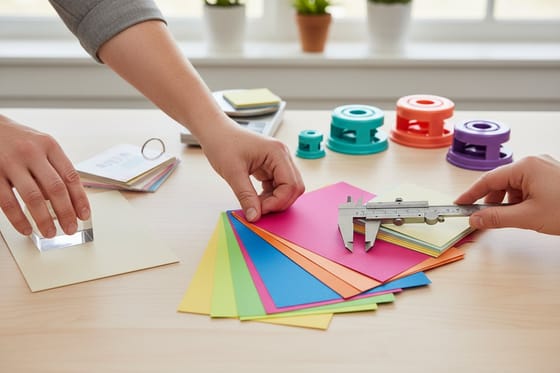
Paper weights confuse people because two different scales are in use. Text weight is measured in pounds per ream of a large parent sheet, so 100 lb text is a thin, flexible poster paper. Cardstock is cover weight, and printers measure it in points, where one point is one thousandth of an inch. That is why 16 pt tells you something useful and 100 lb does not: 16 pt is 0.016 inches, full stop.
| Stock | Caliper | Holds its shape | Ships as | Where it belongs |
|---|---|---|---|---|
| 100 lb text | About 0.008 in | No, curls off a wall and hammocks between two pins. | Rolled in a tube. | Volume campaign posters that get taped up flat and thrown away. |
| 100 lb cover | About 0.010 in | Mostly, up to roughly 12 by 18 inches. | Flat or gently rolled. | Small posters and photo prints that get handled a few times. |
| 14 to 16 pt cover | 0.014 to 0.016 in | Yes at 18 by 24, with a slight bow at 24 by 36. | Flat in a box. | Counter and easel posters, menu boards, prints that live in a portfolio. |
| Print on 3/16 in foam core | 0.1875 in | Completely, at any size we print. | Flat, corner protected. | Trade shows, lobbies, anything standing without a wall behind it. |
Read the third column and the fourth together. Cardstock is not the upgrade for every poster, it is the upgrade for posters that get touched. If a poster is going up with tape and coming down in a week, 100 lb text on standard posters does that job for less and rolls into a tube without complaint. The stock comparison in our cardstock vs paper stock explainer goes deeper on how the two scales relate.
When Rigid Cardstock Wins, and When It Is Wasted Money

Rigid stock earns its price in one situation: the poster has to hold its own shape without a wall doing the work. Everything else is a preference.
Cases where cardstock is the right call, with a reason attached to each:
- It stands on an easel or a counter. An easel supports two edges at most. Text weight folds over the rail within an hour; 16 pt does not.
- It gets carried, propped and repositioned. Open house signage, classroom displays and event directionals move several times a day, and every move creases a thin sheet a little more.
- People read it up close. A menu board or a price list is read at arm's length, where a rippled sheet looks careless in a way a wall poster never does.
- It has to last past the event. Anything filed in a portfolio, pinned in an office for a year, or sold as art print benefits from a stock that does not remember its own curl.
Where the extra money does nothing: a hundred posters for a campus drop, anything mailed in a tube, and any poster that goes up with tape at all four corners and comes down at the end of the week. In those cases the wall is the rigidity, so paying for a stiff sheet is paying for nothing. For a comparison across every poster substrate, the poster material breakdown lines up cardstock against canvas, vinyl and fabric on the same criteria.
One more limit worth naming before you commit: cardstock is not an outdoor material, no matter how thick it is. Paper fibers take on moisture, the sheet ripples within a day, and the coating does not save it. Outdoor work goes to the rigid signs range on plastic or aluminum.
How Big a Cardstock Poster Can Actually Go

There are two ceilings, and they arrive one after the other. The first is the press. Cardstock runs sheetfed, so the largest press sheet in the building is the largest poster you can print on it, which puts cardstock posters in the 11 by 17 to 24 by 36 range at most commercial shops.
The second ceiling is physics, and it shows up before the press does. Stiffness rises roughly with the cube of thickness, so going from 0.008 to 0.016 inches buys far more than double the resistance to bending, but the span between two supports works against you just as hard. A 16 pt sheet at 18 by 24 inches sits flat with a pin in each top corner. The same stock at 24 by 36 develops a visible bow across the middle, and the fix is a support along the whole top edge or a mount, not another two points of caliper.
Above 24 by 36, posters move to wide-format printing on roll stock, and roll stock is thin by definition since it has to wind onto a core. That is the honest answer to why a 40 by 60 poster does not come in cardstock: the machine that prints that size cannot feed a rigid sheet. If you need both the size and the rigidity, you print large format and mount it. Sizes and their standard uses are laid out in our large format poster size guide, and the whole wide-format range sits under large format printing.
While you are choosing a size, set the artwork resolution to the reading distance rather than to a habit. A poster read from three feet or more looks sharp at 150 ppi at full size. A counter poster read at arm's length wants 300 ppi. Start from a correctly sized layout in the blank template library so the bleed and safety margins are right before you place a single image.
Mounting Options When Cardstock Is Not Rigid Enough

Once a poster passes 24 by 36 inches, or once it has to stand unsupported in a room full of people, mounting solves the problem that thicker paper cannot. Four routes, in order of how rigid they leave the finished piece.
Laminate. A film bonded to both faces adds noticeable stiffness and a surface you can wipe down or write on with a dry erase marker. It does not make a poster rigid, so it will still bow at 24 by 36, but it survives kitchens, gyms and anywhere hands touch the print. Laminated posters start at $25.
Mounted on a rigid backer. The printed poster is bonded to a board, so the artwork and finish are the poster you already chose and the board supplies all the rigidity. This is the route when you want a specific poster stock and a specific finish and simply need it to stand. Mounted posters start at $39.99.
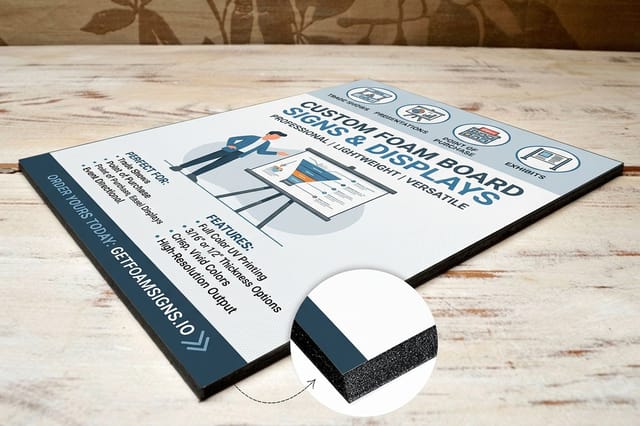
Printed foam core. Here the piece is built as board signage from the start, on 3/16 inch foam core, which stays dead flat at any size and weighs almost nothing on an easel. Its weakness is the edge: a knock dents the foam permanently and the corner never comes back, so it travels in a corner-protected carton and it is a one-event piece if it travels a lot. Foam core signs start at $49.99. The foam core vs PVC comparison is worth reading if the piece has to be reused.
Framed. The heaviest and the most permanent, for work that hangs in a lobby or a home for years rather than for a season. Framed posters start at $87.86.
If you are still weighing the finish before you commit to a build, gloss vs matte on cardstock covers how each one behaves under store lighting, and the full range of stocks and sizes is priced live under poster printing.
Wally explains cardstock posters
Same ink, same colors, completely different behavior
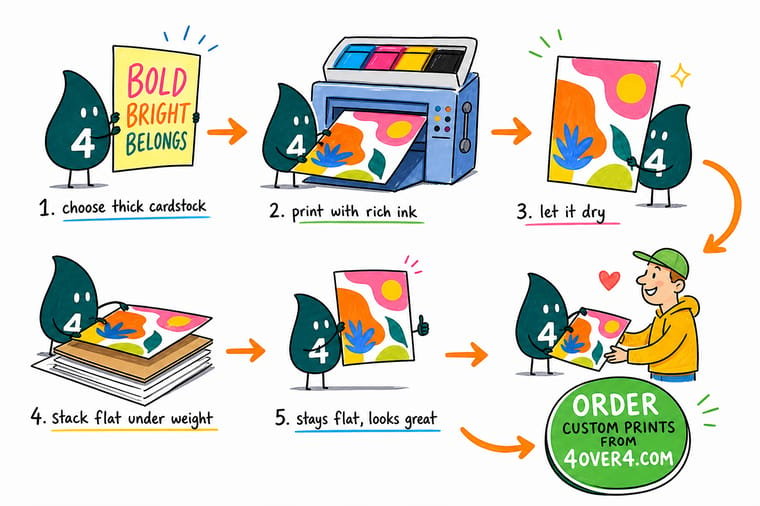
Wally prints one poster on 100 lb text and one on 16 pt cover, then pins both by the top corners. The thin one hammocks in the middle and tears at the pin holes by the second day. The cardstock one sits flat, comes down clean, and goes straight into a portfolio. Then he tries a 30 by 40 in cardstock, watches it bow anyway, and mounts it on foam core, which is where the argument always ends.
Order posters on heavy stock →Specs and pricing
Poster stocks, sizes, and starting prices
Compare a flat poster against a mounted one and a printed foam core board, with live configuration choices and starting prices straight from the 4OVER4.COM configurator.


Print it
Order a poster that holds its shape


Explore more
Where to go next


By the numbers
Poster printing you can count on at 4OVER4
Common Questions
Your cardstock poster questions, answered
What weight cardstock should a poster be printed on?
For anything up to 18 by 24 inches, 14 pt to 16 pt cover holds itself flat on a wall or an easel and still feels like a poster rather than a sign. At 24 by 36 inches, 16 pt is the sensible floor and it will still bow slightly if you pin only the top two corners. Above that size, thickening the stock stops helping and mounting starts. If you want the caliper numbers laid out against paper weights, our guide to cardstock weights explained in pt covers the full ladder.
Can I print a poster on cardstock at home?
Usually only up to 11 by 17 inches, and only if your printer has a rear or straight-through paper path. Cardstock will not bend around the tight roller path in a typical desktop tray, so it jams or arrives with a roller crease. Most home inkjets stop accepting anything past about 80 lb cover, and home laser fusers scorch heavy coated stock. The practical ceiling at home is a letter-size sheet on light cardstock, which is why anything sized like a real poster gets printed on a commercial press.
Will a cardstock poster fit in a mailing tube?
Do not put one in a tube. Cover stock has enough caliper that rolling it to a three inch diameter cracks the coating along the fold and leaves a permanent line through the artwork, and the sheet keeps the curl afterward. Cardstock posters ship flat in a rigid box. If a poster genuinely has to travel in a tube, print it on 100 lb text weight and accept the curl, or mail a mounted board in a corner-protected carton.
Is a mounted poster the same as a foam core sign?
They arrive looking similar and they are built for different jobs. A mounted poster is a printed poster bonded to a rigid backer, so the print quality and finish are the poster you already chose. A foam core sign is a print made for the board from the start, sized and finished as signage for easels, lobbies and trade show tables. Order mounted posters when the artwork is a poster; order foam core signs when the piece is doing a sign job.
Does a cardstock poster work outdoors?
No. Cardstock is a paper product, so a few hours of humidity swells the fibers, the sheet ripples, and one rain finishes it. Even under an awning it goes soft. Outdoor work belongs on corrugated plastic, PVC or aluminum, which is what the rigid signs range is for. Foam core is also indoor only, since its paper facing absorbs moisture the same way.
Should a cardstock poster be gloss or matte?
Gloss makes photographs and saturated color snap, and it is the right call for retail and event artwork viewed from a distance. Matte kills reflections, which matters under downlights or on a poster people read from two feet away, and it takes pen and marker where gloss beads up. The catch with gloss is fingerprints on a piece that gets handled, and the catch with matte is that dark solids look slightly flatter. Matte posters start at $25.
Get Started
Ready to print a poster that stands up?
Pick your size, choose a heavier stock or a mounted board, and we print posters that stay flat on an easel and arrive without a roller crease through the artwork.
Legal Disclaimer
Gold Standard guarantees apply to all standard orders placed through 4over4.com. Price match requires verifiable proof of a competitor's published price for an equivalent product with matching specifications and turnaround time. Satisfaction guarantee covers manufacturing defects and print quality issues. Contact support with order number and documentation. On-time delivery rate based on tracked orders 1999 to 2026. Individual results may vary based on shipping carrier performance.
