
Foil Asset Tags for Equipment Tracking With Barcodes and Serial Numbers


What goes on the tag, why the barcode needs a matte window on a metallic face, how sequential numbering is ordered, and the point where a printed tag should be an etched plate instead.
A foil asset tag is a durable printed label carrying one unique serial, usually as a barcode plus the same number in readable type, on a metallic face that marks the item as company property. The one rule that decides whether it works: the barcode goes in a matte white knockout window, never on the bare foil, because a mirrored surface reflects the scanner beam away instead of scattering it back. Numbering is supplied as a single spreadsheet column and merged at press with variable data printing.
Quick answer
The serial does the work, the foil does the signalling
Build the tag around the number, then decide how it looks. A barcode plus the matching human readable serial, an owner line, and a site prefix if assets move between locations. Put the code inside a matte white window with a quiet zone ten times the narrow bar width at both ends, keep the narrow bar at 10 mil or wider, and let the metallic area carry the branding. Send the serials as one spreadsheet column, check the proof at the first, middle and last record, and use an etched metal plate instead whenever the asset gets washed, solvent wiped or left outdoors.
What a Foil Asset Tag Is, and Where It Stops Working
An asset tag has one job: tie a physical object to a row in a database. A foil asset tag does that job on a stock with a metallic face, which reads as company property rather than as a sticker somebody stuck on. That perception matters more than it sounds. Tags that look temporary get picked at.
The word foil causes most of the confusion in quotes. It is not an anodized aluminum plate. Photo-anodized and laser-etched aluminum tags survive solvents, steam and a decade on a roof, and they cost several times more per tag with a longer lead time.
Name the limit before you order. Skip a printed tag on anything that gets pressure washed, wiped with solvent, cycled through an autoclave, or parked outside year round. The face may hold up fine while the adhesive gives up at the edges, and a tag that lifts at one corner is a tag that catches on a sleeve and disappears. For those assets, an etched metal plate mechanically fastened is the honest answer, even though we do not print it.
Laying Out the Barcode So It Actually Scans
Here is the rule that saves a reprint: the barcode never goes on bare foil. A decoder needs the spaces between bars to send light back to the sensor. A mirrored surface sends that light off in one direction instead, so the scanner sees dark where it needs white and returns nothing, then reads perfectly the one time you tilt the tag just right. Intermittent scanning drives warehouse staff to write serials down by hand, which is the failure you were buying the tag to prevent.
Knock a matte white window into the foil, sit the code inside it, and let the metallic area carry the border, the logo and the owner line. That single layout decision is worth more than any material upgrade.
Then get the geometry right. Keep the narrow bar at 10 mil, meaning 0.010 inches, or wider. Give the bars at least a quarter inch of height so an angled swipe still crosses all of them. Leave a quiet zone of clean white at both ends measuring at least ten times the narrow bar width, and keep every logo, rule and border out of it. Crowded quiet zones cause more no-reads than thin bars do.
| Symbology | What it holds | Smallest sensible tag | Where it wins |
|---|---|---|---|
| Code 39 | Uppercase letters, digits and a few symbols, no check character unless you add one. | About 2.5 in wide for a 10 character serial. | Legacy systems and scanners already configured for it. |
| Code 128 | Full ASCII, with a mandatory check character built into the symbol. | About 1.75 in wide for the same serial. | Most new asset fleets. Denser, and a bad read fails instead of returning a wrong number. |
| Data Matrix | The same serial in a small square, with error correction built in. | Around 0.4 in square. | Small tools, cable ends and anything narrower than an inch. |
| QR Code | Serial plus a URL, so a phone can open the asset record. | Around 0.6 in square. | Self service checks where staff use phones rather than handhelds. |
Check one thing before you choose a 2D code: whether your handhelds are imagers or laser scanners. A laser scanner cannot read Data Matrix or QR at all, and finding that out after 2,000 tags are on the wall is an expensive afternoon. Our guide to barcode stickers goes deeper on symbology and scan testing.
How to Order Sequentially Numbered Tags, Step by Step
Variable data printing is what makes every tag in the run different. The layout stays fixed and one field changes per record, so a thousand tags come off with a thousand serials and matching barcodes. Five steps, in order.
- Decide the numbering scheme first. A site or department prefix, then a fixed width serial with leading zeros so sorting works later. FAC-004821 sorts correctly, FAC-4821 does not once you pass ten thousand. Lock the width now, because widening it later breaks your sort order across the whole fleet.
- Strip the ambiguous characters. Nobody misreads a barcode, but people read the printed serial aloud over the phone. Zero against O, one against I, five against S. Either drop those letters from the scheme or set the human readable line in a typeface with a slashed zero.
- Build the spreadsheet. One row per tag, one column with the serial exactly as it should print, prefix and leading zeros included. Format the column as text so a spreadsheet program does not helpfully delete the zeros. Your order quantity equals the row count.
- Set the artwork on a template. Start from a correctly sized layout in the blank template library, place the white knockout window, and mark where the variable field sits. Convert type to outlines everywhere except the field we merge.
- Read the free proof like an auditor. We show the first record, one from the middle and the last. Check the range endpoints, check the prefix, and check the human readable line matches what the barcode encodes. A proof that only shows record one hides the exact error you are looking for.
Print a test tag and scan it with your own handheld before the full run goes ahead if you can. Ten minutes there is cheaper than a reprint. If numbering is new to your team, what to ask a variable data printer covers the questions worth raising up front, and how label printing works walks the production side end to end.
Picking the Stock, the Size and the Adhesive

Match the face stock to where the asset lives, not to the look you want in the photo. Foil and metallic faces earn their price on equipment people see: reception AV, conference room gear, rental inventory handed to a customer. A plain synthetic face does the same tracking job for a fraction on a tag hidden under a desk.
| Stock | Face | Suits | Starts at |
|---|---|---|---|
| Foil Labels | Metallic foil, high shine. | Visible equipment where the tag should read as permanent property. | $322.98 |
| Metallic Labels | Metallic finish, softer sheen. | The same look on a larger fleet at a lower entry price. | $108.75 |
| Plastic Labels | Synthetic white face, matte or gloss. | Hidden tags, humid rooms, anything that gets wiped down regularly. | $25 |
| Die-Cut Labels | Cut to any outline you supply. | Curved tool handles, cable flags and odd equipment faces. | $93.37 |
| Vinyl Stickers | Flexible vinyl, conformable. | Textured cases, carts and equipment that flexes in use. | $25 |
On size, two inches by one inch is the workhorse. It fits a Code 128 serial at a 10 mil narrow bar with the quiet zones intact and still leaves room for an owner line. Go down to one inch by half an inch only if you switch to Data Matrix. Go up to three by two on machinery, where the tag gets read from several feet away and there is room for a safety or service line.
Then respect the adhesive, because it fails long before the print does. Powder-coated metal, textured plastic and anything with a mold release agent give the adhesive very little real contact area. Wipe the spot with isopropyl alcohol rather than a household spray, since silicone in the cleaner leaves a film the adhesive cannot bond through. Apply at room temperature, press firmly along the whole tag rather than the middle, and give it a day before that asset goes back into rough handling. On a curved surface, keep the tag short along the direction of the curve or the ends will lift. Choosing the right material covers surface matching in more depth, and the full label printing range shows every stock priced live.
Wally explains asset tags
Shiny border, matte window, one serial per row
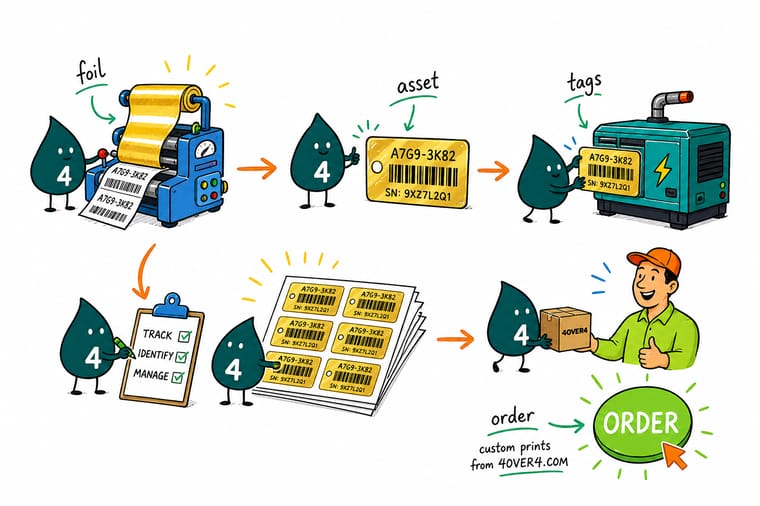
Wally scans two tags. The first has its barcode printed straight onto the foil, so the beam skids off the mirror and nothing decodes until he tilts it. The second has a matte white window knocked into the foil with the bars inside, clean space at both ends, and it reads first time from across the aisle. Then he opens the spreadsheet: one row per tag, one column of serials with the leading zeros kept, and the press prints every tag with a different number.
Order foil labels with sequential numbering →Specs and pricing
Asset tag stocks, sizes and starting prices
Compare the three faces most asset tags are printed on, with live configuration choices and starting prices straight from the 4OVER4.COM configurator.

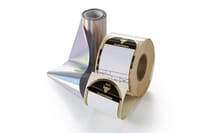

Print it
Order tags that scan on the first pass
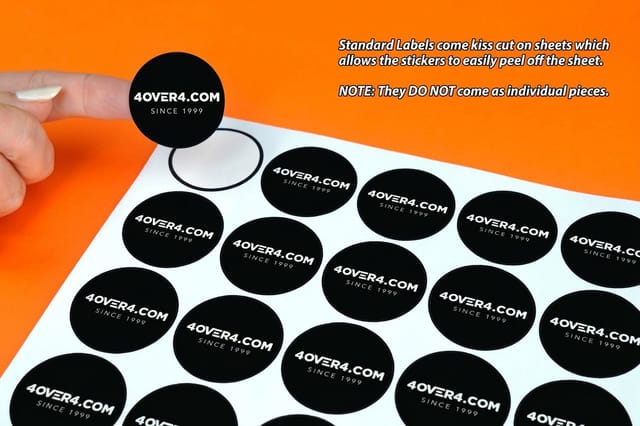

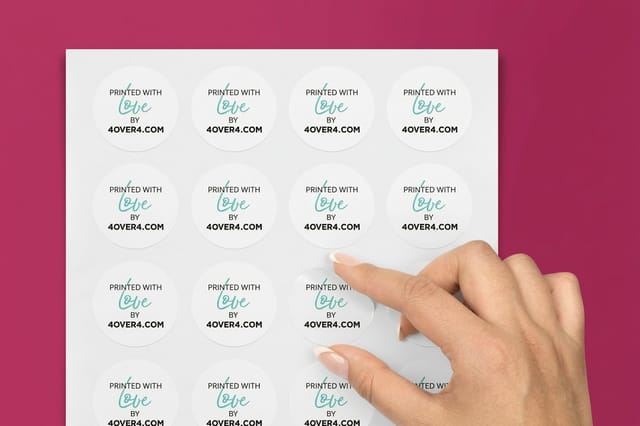
Explore more
Where to go next




By the numbers
Numbered label runs you can count on at 4OVER4
Common Questions
Your foil asset tag questions, answered
What is a foil asset tag?
It is a durable printed label carrying a unique identifier for one piece of equipment, printed on a stock with a metallic foil surface so it reads as a permanent property tag rather than a sticker. The identifier is usually a barcode plus the same serial in human readable type, often with a department prefix and an owner line such as Property of Facilities. The foil does no technical work. It signals permanence, it resists scuffing better than an uncoated paper face, and it makes a tag that someone is far less likely to peel off and throw away.
Can a scanner read a barcode printed directly on foil?
Usually not, and this is the single most common reason a batch of asset tags gets reprinted. A decoder needs contrast between bars and spaces, which depends on the light coming back from the space. A mirrored foil surface reflects almost all of it in one direction, so at most angles the scanner sees a dark space and reads nothing, then reads perfectly when you happen to tilt it. Design the tag with a matte white or opaque knockout window behind the code and keep the foil for the border, the logo and the owner line.
Which barcode should I use on an asset tag?
Code 128 for most fleets, because it is denser than Code 39 for the same data and carries a mandatory check character, so a partial read fails instead of returning a wrong serial. Code 39 still shows up in older systems and it is fine if your scanners and software already expect it, just budget roughly a third more width. Use Data Matrix when the tag is smaller than about an inch wide, since a 2D code holds the same serial in a square a fraction of the size. Confirm your handhelds are imagers rather than laser scanners before you commit to a 2D code.
How small can the barcode be?
Practically, keep the narrow bar at 10 mil, which is 0.010 inches, and the bar height at a quarter inch or more so an angled swipe still crosses every bar. Leave a quiet zone of blank white at least ten times the narrow bar width at both ends of the code. Most no-read complaints trace to a logo or a border crowding that quiet zone rather than to the bars themselves. A code that scans on a desk under a benchtop reader at 4 mil will disappoint you at arm length in a warehouse aisle.
Are foil asset tags tamper evident?
Not by default. A standard foil or polyester label lifts off in one piece with a blade and a little heat, which means a tag can be moved between two assets without leaving evidence. Genuine tamper evidence needs a destructible face stock that fragments when lifted, or a void pattern that stays on the equipment. If that is a hard requirement for your audit, raise it before the order goes to press so the right material gets quoted, rather than assuming the foil face provides it.
What information belongs on the tag?
The barcode, the same serial in human readable type, and an owner line. That is enough for most inventories. Add a site or department prefix if assets move between locations, because a serial alone tells a technician nothing when a tag turns up on a shelf. Skip the phone number and the asset description. Descriptions go stale the first time a machine is reassigned, and a tag that has to be reprinted because a department name changed is a tag that will not be reprinted.
How do I send you the sequential numbers?
One spreadsheet, one row per tag, one column holding the serial exactly as it should appear including any prefix and leading zeros. Keep the serial as text so a program does not strip the zeros. Your quantity equals the row count. We merge the column into the approved layout and send a free proof showing the first record, a record from the middle of the run and the last one, so you are checking the numbering itself and not just the artwork.
Get Started
Ready to number a whole fleet?
Pick the face stock, send one column of serials, and we print every tag with its own barcode and matching readable number. Free proof before anything runs.
Legal Disclaimer
Gold Standard guarantees apply to all standard orders placed through 4over4.com. Price match requires verifiable proof of a competitor's published price for an equivalent product with matching specifications and turnaround time. Satisfaction guarantee covers manufacturing defects and print quality issues. Contact support with order number and documentation. On-time delivery rate based on tracked orders 1999 to 2026. Individual results may vary based on shipping carrier performance.
