
Warning Label Printing That Survives an ANSI, OSHA and GHS Audit


Pick the standard that applies, build the label from the parts it requires, then print it on a material that keeps all of it legible. Here is the order to work in.
A compliant warning label follows one standard end to end: ANSI Z535.4 for labels on a product or machine, OSHA 1910.145 for facility signs and tags, GHS under 1910.1200 for chemical containers. Choose the one that applies, then build the label from its required parts, which for ANSI means the safety alert symbol, a signal word panel in the assigned safety color, and a message that runs hazard, then consequence, then how to avoid it. Print the safety colors as Pantone spot inks on a vinyl or polyester face stock with an overlaminate, and keep the artwork and material spec on file.
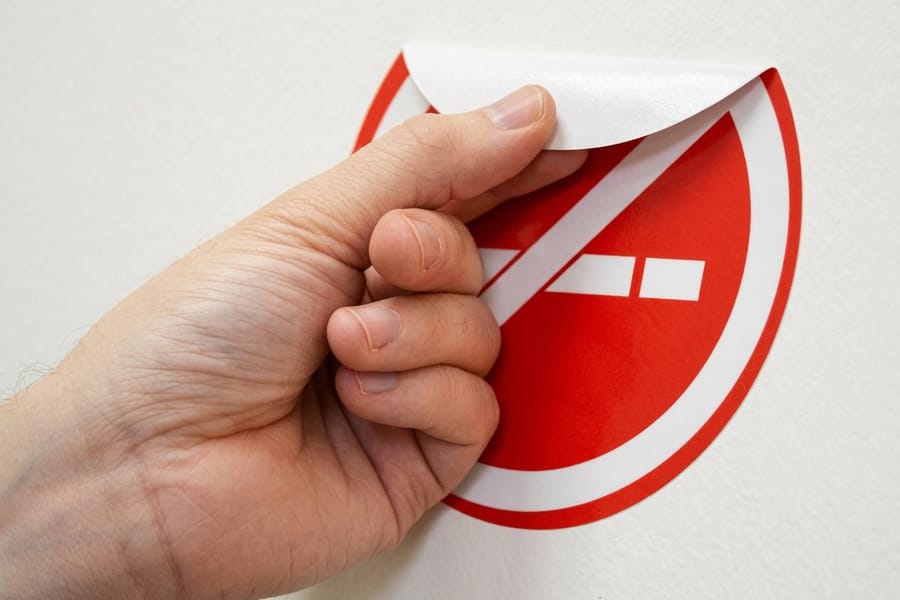
Quick answer
One standard, its required parts, and a material that outlives the hazard
Compliance is not a style, it is a rulebook you commit to. ANSI Z535.4 governs labels on equipment, OSHA 1910.145 governs signs and tags around a facility, and GHS governs the chemical container. Once the standard is settled, the parts are no longer up for debate: the signal word tier sets the color, the safety alert triangle marks a human-injury hazard, and the message names the hazard before the consequence before the action. The rest is production. Order the safety colors as spot inks, print small legal text at 100 percent black, choose vinyl or polyester with an overlaminate, and record a revision code so you can prove years later which version was in service.
Three Rulebooks, and Only One of Them Governs Your Label
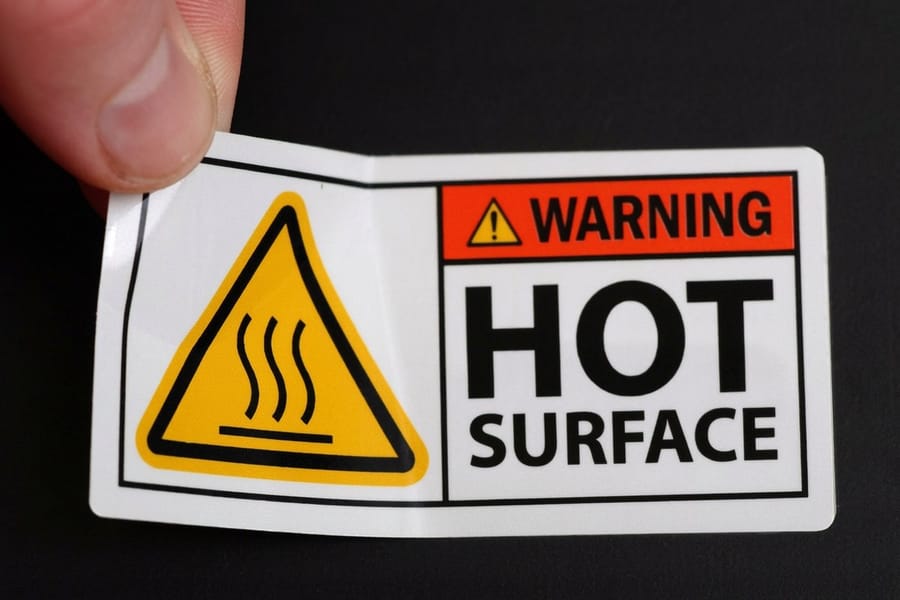
Before any layout work, settle which standard the label falls under. The parts, the colors and even the vocabulary change depending on the answer, and a label assembled from two rulebooks fails both.
| Standard | What it covers | Signal words it allows | What triggers it |
|---|---|---|---|
| ANSI Z535.4 | Safety labels applied to a product, machine or piece of equipment. | DANGER, WARNING, CAUTION, plus NOTICE for non-injury messages. | You build, sell, rebuild or modify equipment that someone else operates. |
| OSHA 29 CFR 1910.145 | Accident-prevention signs and tags posted around a facility. | DANGER, CAUTION, safety instruction signs, and the biological hazard tag. | You run the workplace where the sign or tag is posted. |
| GHS, 29 CFR 1910.1200 | Labels on containers of hazardous chemicals. | Danger and Warning only. No CAUTION tier exists. | You ship, repackage or store a hazardous chemical. |
| ISO 3864-2 and ISO 7010 | Symbol-first safety labels for markets outside the United States. | None. The severity is carried by the surround shape and color. | The equipment is exported, or the reader may not read English. |
The fourth row catches people out. A machine sold in the United States and again in the European Union usually needs both treatments, because ANSI leans on a written message while ISO deliberately avoids text so it survives translation. The practical fix is a bilingual layout: the ISO pictogram in its own panel, the ANSI signal word panel above it, and the message in the language of the destination.
Facility signage is the easy one to get right and the easy one to forget. If the message is about the building rather than the machine, it belongs on a sign, and the OSHA and ANSI safety color guide covers which color carries which meaning before a word is read.
What Each Standard Actually Requires on the Label
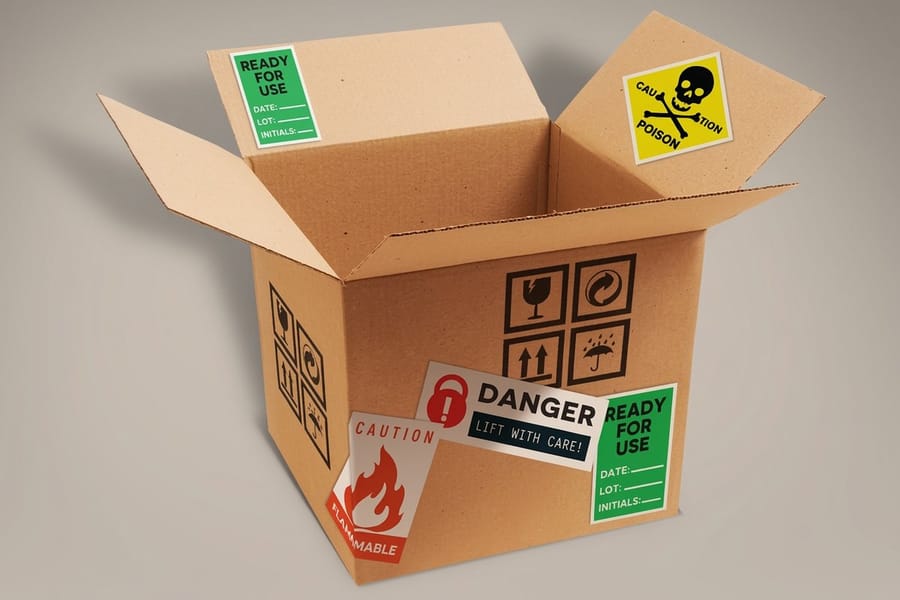
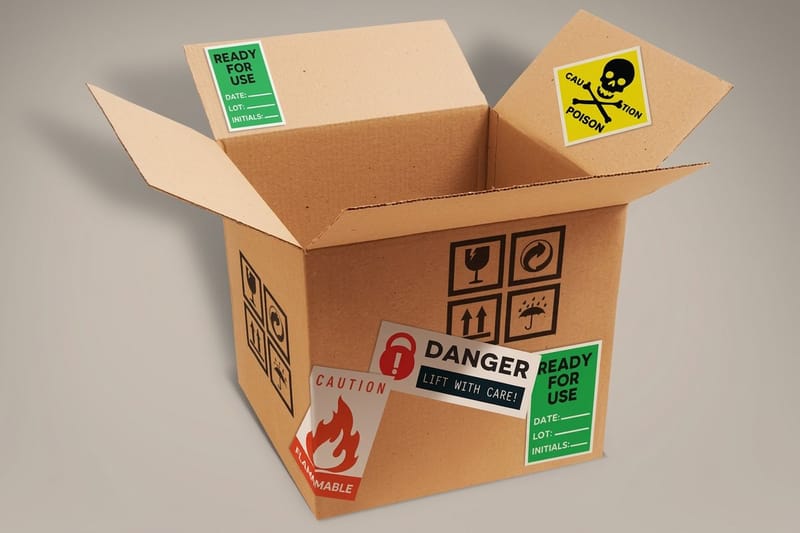
An ANSI Z535.4 label has four working parts, and each one has a rule attached. The safety alert symbol, that triangle with the exclamation point, marks the label as being about human injury. The signal word panel carries DANGER in white on safety red, WARNING in black on safety orange, or CAUTION in black on safety yellow. The message panel names the hazard, states the consequence, then gives the avoidance action. The pictorial panel repeats the message without words for anyone who does not stop to read.
Word order inside the message is the part most drafts get backwards. Hazard, consequence, avoidance. Moving blade. Will cut fingers. Lock out power before opening. Lead with the instruction and the reader has been told what to do before being given any reason to do it.
A GHS container label is a different animal, and it is prescriptive. Six elements, every time:
- Product identifier matching the name on the safety data sheet.
- Pictogram in the black-on-white diamond with a red frame, and the frame must be red even on a single-color job.
- Signal word, Danger or Warning, and only one appears on a given label.
- Hazard statement in the standardized wording assigned to that classification.
- Precautionary statements for prevention, response, storage and disposal.
- Supplier identification with name, address and telephone number.
Two details cost reprints. An empty red diamond with no symbol inside it is not permitted on a shipped container, so blank pictogram frames left in as placeholders have to go. And the pictogram frame stays red, which means a job you were planning to run in one color is a two-color job. If the label also needs a barcode or a lot code, the layout work in our industrial label guide shows where those sit without crowding the hazard message.
Specifying It So the Red Stays Red and the Small Type Stays Legible

A compliant design still fails if it is printed on the wrong material or the color drifts. Five specification choices decide whether the label is still doing its job in year three.
Spot colors, not process builds. Safety red, orange and yellow are defined by the standard, and the print equivalents are ordered as Pantone spot inks: 186 C for safety red, 151 C for safety orange, 116 C for safety yellow, 355 C for safety green. Built in CMYK they shift with press, stock and coating, and a replacement label that reads slightly warmer than the one already on the machine is the sort of thing an auditor photographs.
Black type at 100 percent K. Rich black built from four inks needs perfect registration, and any misregistration on 6 point precautionary text turns it into a fuzzy grey. One ink, sharp edges, legible at arm's length.
Face stock chosen for the surface, not the budget. White vinyl handles most equipment and outdoor exposure. Polyester holds up where solvents, heat or steam cleaning are involved. Paper belongs indoors only, and it belongs nowhere near a wash-down. Our paper, vinyl and clear label comparison lays out where each one gives up.
An overlaminate on anything outdoors. Ultraviolet light attacks safety yellow first, and a faded yellow label stops reading as a warning and starts reading as an old sticker. A laminate also takes the abrasion from gloved hands and cleaning cloths that would otherwise scrub the print off. This is the cheapest line on the order and the one people cut.
Adhesive matched to what it sticks to. Powder-coated housings, polypropylene and textured plastics are low-surface-energy substrates and need an aggressive permanent adhesive; a general-purpose acrylic lifts at the corners within a season. Clean the surface with isopropyl alcohol rather than a household degreaser, which leaves a film, and apply above roughly 50F so the adhesive can flow.
Set the artwork up with the same discipline as any print job: full bleed, fonts converted to outlines, and the signal word and alert symbol kept clear of the die radius on a rounded label. Start from a correctly sized layout in the blank template library rather than guessing at the trim.
Proving It Later, and the One Thing a Label Cannot Do
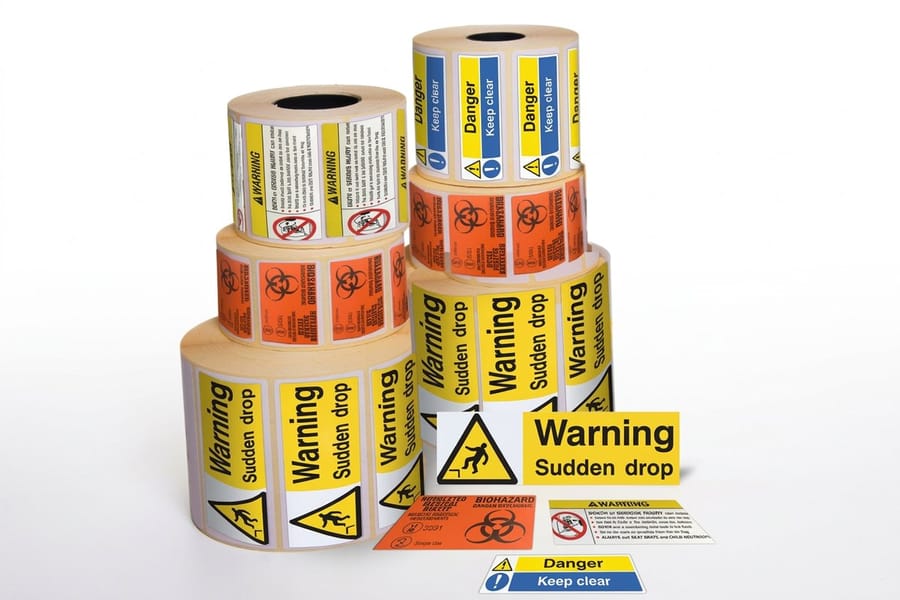
Compliance is a paperwork question as much as a design question, and the answer is needed years after the label is printed. Put a small revision code in a corner of the artwork, something like REV C 2026, set in 5 or 6 point. It costs nothing and it lets you prove which version was on a machine when an incident is reviewed, and it lets a maintenance team see at a glance that a label predates the last guarding change. Keep the print-ready file, the material spec and the order record together for the life of the product.
Now the limit worth stating plainly. A warning label is the last line of defence, not the first. Guarding the hazard, designing it out, or interlocking the access panel all outrank the label, and a label applied instead of a guard does not transfer responsibility to the operator. Design the hazard out where you can, then label what is left.
For quantities, order past the machine count. Labels get torn during installation, painted over during refurbishment, and scrubbed off during cleaning, and the reorder always takes longer than the shutdown allows. Standard Warning Labels start at $23.88 and suit indoor equipment and short runs. Premium Warning Labels start at $29.16 with the heavier durable construction for machinery and outdoor use. Roll Warning Labels start at $322.98 and make sense once you are applying hundreds of the same label in a line.
Chemical drums, wash-down areas and anything that sees water want a moisture-proof face stock, so Premium Waterproof Labels at $84.68 are the honest choice there rather than a coated paper. If you are still weighing formats, the full range sits on the warning labels printing page, and the wider label printing catalog covers product and packaging work in the same materials.
Wally explains compliant warning labels
Pick the rulebook, then build the label out of its parts
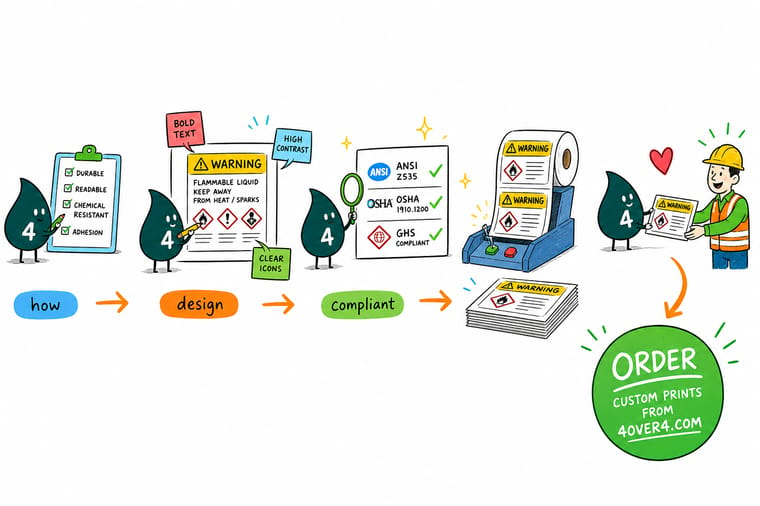
Wally decides first whether the label is going on a machine, on a wall, or on a chemical container, because that answer picks the standard. Then he fills in the parts that standard demands: the alert triangle for a hazard that can hurt someone, the signal word in its assigned color, and a message that says what the hazard is, what it does to you, and how to avoid it. Last he orders the safety colors as spot inks on vinyl with a laminate, so the label reads the same in year three as it did on day one.
Order premium warning labels →Specs and pricing
Warning label formats, sizes, and starting prices
Compare the sheet and roll formats side by side, with live configuration choices and starting prices straight from the 4OVER4.COM configurator.


Print it
Order warning labels that stay legible


Explore more
Where to go next


By the numbers
Safety label printing you can count on at 4OVER4
Common Questions
Your warning label questions, answered
Does OSHA approve or certify a warning label?
No. There is no agency that reviews artwork and issues an approval, and no printer can sell you a certified label. Compliance is something you demonstrate after the fact: the label follows the standard that applies to the equipment or the container, it carries the required elements, it is legible where the worker actually stands, and you kept the artwork and the material spec on file. A supplier that offers to certify your label for you is describing something that does not exist.
What is the real difference between DANGER, WARNING and CAUTION?
Severity, defined the same way in ANSI Z535.4 and in OSHA guidance. DANGER means the hazard will cause death or serious injury if it is not avoided, and it is deliberately rare. WARNING means it could. CAUTION covers hazards that could cause minor or moderate injury. NOTICE, set in blue, is not a personal-injury tier at all: it flags practices that damage property or equipment. Marking a pinch point DANGER because it feels more serious dilutes the word on the label that genuinely needs it.
Does every warning label need the safety alert triangle?
Only labels about hurting a person. The triangle with the exclamation point inside is the safety alert symbol, and under ANSI Z535.4 it accompanies DANGER, WARNING and CAUTION when the hazard can injure someone. It is not used with NOTICE, and it is not used with a CAUTION message about property damage only. Designers add or drop it for balance, which quietly changes what the label says.
Do containers that never leave my building need full GHS labels?
The container that ships out does. For workplace containers that stay in-house, the HazCom standard allows an alternative in-plant system as long as workers get the product identifier plus words, pictures or symbols that convey the same hazard information, backed by the safety data sheet and training. Most facilities still print the full GHS format for both, because one artwork, one reorder and one review is cheaper than running two systems and explaining the difference to an inspector.
Can I print safety colors in CMYK instead of spot colors?
You can, and for a one-time run on a single machine it is usually fine. The problem shows up on the reorder. Safety orange and safety yellow built from process inks drift with press, stock and coating, so the replacement label sits next to the original and reads as a slightly different color, which is exactly what a safety audit notices. Ask for Pantone spot colors on the order and the match holds across runs.
What does warning label printing cost, and how many should I order?
At 4OVER4.COM, Standard Warning Labels start at $23.88 and Premium Warning Labels at $29.16, with Roll Warning Labels starting at $322.98 for high-volume application straight off a roll. Order more than the equipment count. Labels are destroyed during installation, damaged by cleaning, and needed again when a machine is repainted, and a missing label is the failure mode that actually costs you, not the extra sheet.
Get Started
Ready to print the labels your equipment is missing?
Send us the artwork, pick a durable face stock and an overlaminate, and we print warning labels that still read correctly after a few winters and a lot of cleaning.
Legal Disclaimer
Gold Standard guarantees apply to all standard orders placed through 4over4.com. Price match requires verifiable proof of a competitor's published price for an equivalent product with matching specifications and turnaround time. Satisfaction guarantee covers manufacturing defects and print quality issues. Contact support with order number and documentation. On-time delivery rate based on tracked orders 1999 to 2026. Individual results may vary based on shipping carrier performance.
