
Standard Trifold Size and the Exact Panel Widths That Fold Right


Every trifold size we print, the exact panel width for each one, and the sixteenth of an inch that decides whether the finished brochure closes flush or springs open.
The standard trifold size is an 8.5 by 11 inch flat sheet folded into three panels, finishing at about 3.67 by 8.5 inches. The three panels are not equal thirds: the tuck-in panel measures 3.625 inches and the two outer panels 3.6875 inches each, so the panel that folds in first clears the spine instead of jamming against it. Legal at 8.5 by 14, plus 9 by 12, 11 by 17 and 11 by 25.5, all trifold on the same rule.

Quick answer
One sheet, three panels, and a sixteenth of an inch
A standard trifold is 8.5 by 11 flat and 3.67 by 8.5 folded. The panel that folds in first is 3.625 inches wide, narrower than the 3.6875 inch panels on either side of it, because it has to sit inside them once the brochure closes. Every larger sheet follows the same rule: divide the width by three, shave a sixteenth off the tuck-in panel, split the remainder between the other two. Get that wrong and the brochure will not lie flat no matter how good the artwork is.
The Standard Trifold Size and the Panel Math Behind It
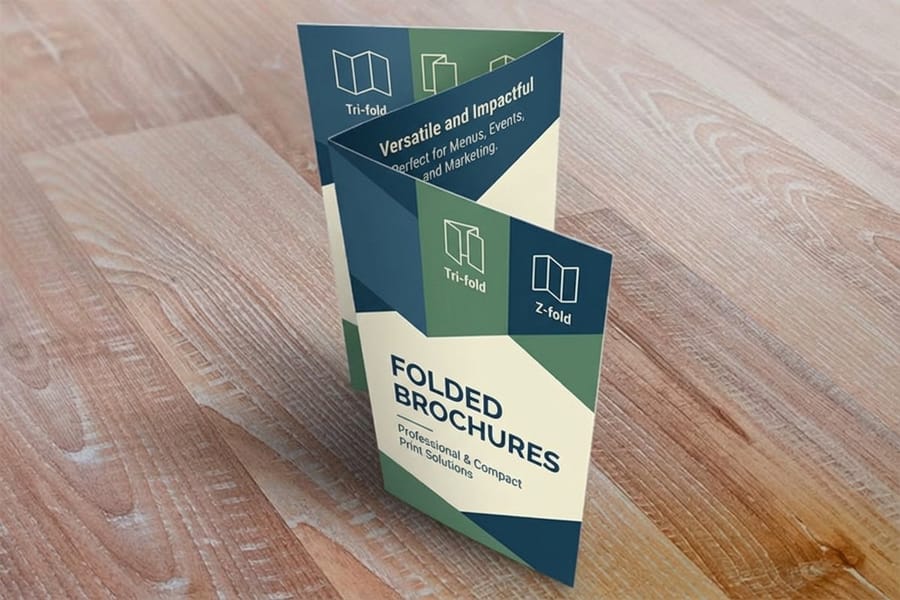
Ask for a trifold and you get an 8.5 by 11 inch sheet folded twice into three panels, finishing at about 3.67 by 8.5 inches. That much is settled. What trips people up is the assumption that three panels on an 11 inch sheet means three panels of 3.667 inches.
They are not equal, and they cannot be. The panel that folds in first sits inside the other two once the piece is closed, so it has to travel a slightly shorter distance. Give it the same width as its neighbours and its edge runs into the second fold. The brochure will not lie flat, the front edge springs open, and on a stack of five thousand the fold roller starts pushing that panel out of position.
The fix is one sixteenth of an inch. On a letter sheet the tuck-in panel is 3.625 inches and the two outer panels are 3.6875 inches each. That still adds to exactly 11 inches, and the folded piece closes flush.
| Flat sheet | Tuck-in panel | Other two panels | Folded size |
|---|---|---|---|
| 8.5" x 11" | 3.625" | 3.6875" | 3.67" x 8.5" |
| 8.5" x 14" | 4.625" | 4.6875" | 4.69" x 8.5" |
| 9" x 12" | 3.9375" | 4.03125" | 4.03" x 9" |
| 11" x 17" | 5.625" | 5.6875" | 5.69" x 11" |
| 11" x 25.5" | 8.4375" | 8.53125" | 8.53" x 11" |
The rule generalises: take the sheet width, divide by three, shave a sixteenth off that number for the tuck-in panel, then split whatever is left evenly between the other two. Every size above runs on our standard brochures, and the fold choice is a dropdown on the configurator rather than a custom quote.
Every Trifold Size We Print, and When a Bigger Sheet Pays Off
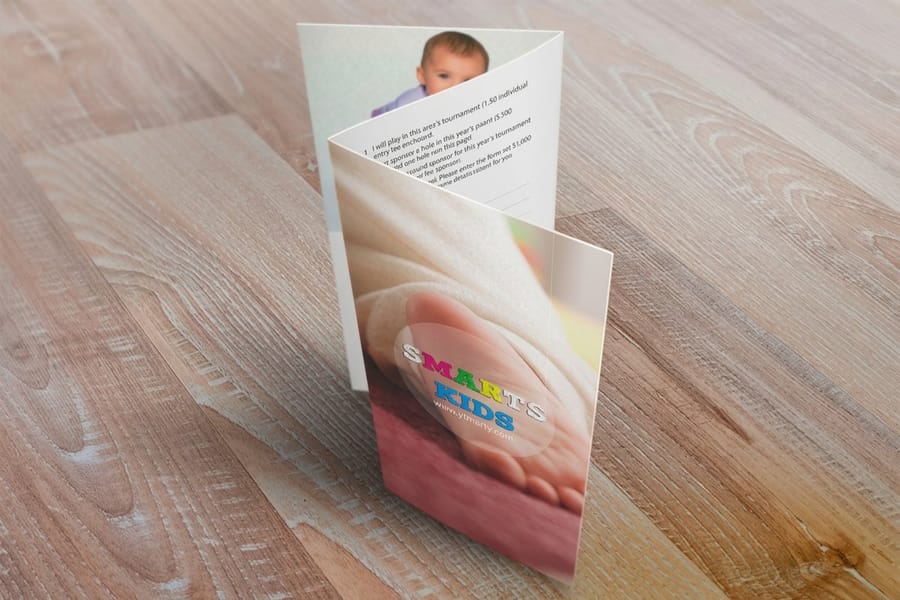
Five flat sizes take a trifold cleanly. Each one solves a different problem, and the deciding factor is almost always how the brochure reaches the reader.
- 8.5" x 11". The default. Fits a #10 envelope, fits a standard literature rack, and costs the least per piece because it is a stock cut. Start here unless something forces you elsewhere.
- 8.5" x 14". Legal stock, folded to a 4.69 inch panel. You gain about an inch of panel width, which is the difference between a cramped price list and a readable one. It no longer fits a #10, so factor in a 6 by 9 envelope.
- 9" x 12". Taller panels at 9 inches, useful when the content is a vertical product photo or a full-height chart. It squeaks into a #10, but if the job is going through a mailing house, hand them a sample first.
- 11" x 17". A tabloid trifold with 5.69 inch panels. This is menu and specification-sheet territory, where each panel has to hold a table rather than a paragraph.
- 11" x 25.5". The big one, folding to a full 8.5 by 11 panel. Real estate packets, conference programmes, anything where the open spread is doing the selling.
What a bigger sheet actually buys you is panel width, not page count. A trifold always has six faces regardless of size. If you need more than six, you have outgrown the format and the honest answer is a saddle-stitched piece: standard booklets start at $240.55 and give you eight pages minimum, which reads better than cramming a trifold. Going the other way, if the content fits on one side of a sheet, a flat standard flyer at $39.54 costs less than a folded brochure at $57.11 and skips the folding pass entirely.
One size to avoid: a 5.5 by 8.5 sheet trifolded gives 1.83 inch panels, narrow enough that a two-word headline wraps. Use a half fold at that sheet size instead.
Setting Up the File So the Folds Land Where You Drew Them
Build a trifold as two flat spreads, not as six separate pages. Each spread is 11 by 8.5 inches with 0.125 inches of bleed on all four sides, so the working canvas is 11.25 by 8.75. Guides go at the two fold positions, measured from the left edge of the spread.
The outside spread, left to right, is back panel, tuck-in panel, front cover. The inside spread is the three inner panels reading as one continuous canvas. That order catches people out constantly, because the cover is not where you expect it: it sits on the right of the outside spread, and the narrow tuck-in panel sits in the middle of the outside, not the inside. Print a proof on your desktop printer and fold it by hand before approving anything.
Three setup rules that save reprints. Keep type at least 0.125 inches clear of every fold line as well as every trim edge, because folding tolerance shifts a hair and copy that touches the crease looks crooked on part of the run. Avoid running a solid dark background across a fold on coated stock, since the crease will show a lighter line where the coating splits. And if a photograph must cross a fold, put the fold through a quiet part of the image rather than through a face.
Bleed and trim covers the geometry in full, how to design a trifold brochure walks through the layout decisions, and the blank template library plus our free trifold templates give you the fold guides already positioned so you never measure a panel by hand.
Stock, Scoring, and the Fold That Cracks

Size decides the layout, stock decides whether the fold survives. 100lb gloss text is the standard trifold stock, and it is standard because it folds without scoring, stands up in a rack without flopping, and holds ink density on a photograph. For most jobs there is no reason to leave it.
The moment you move to cover weight, folding becomes a mechanical problem. Cover stock has to be scored before it is folded, which means a crease is pressed into the sheet so the fibres bend rather than break. Even scored, coated cover often shows a fine white line along the crease where the clay coating cracks and exposes the paper underneath. Uncoated cover cracks less because there is no coating to split, so if you want the heft of a cover weight trifold, uncoated is the safer specification. Our breakdown of trifold brochure paper goes stock by stock.
Two more decisions worth making before you order. If the brochure mails without an envelope, USPS treats it as a folded self-mailer, which means the final fold goes along the bottom edge and the open edge has to be tabbed closed. And if you are choosing between a trifold and something else at the same flat size, the fold types guide compares a trifold against z-fold, gate and roll fold, all of which use the same sheet and change how the content is revealed.
Ready to price a run, choose your fold and land on a stock? Folded brochures start at $57.11, and the whole family of stock sizes sits in the standard printing collection alongside the flyers and postcards you may want to pair with the campaign.
Wally measures a trifold
Two panels at 3.6875, one at 3.625
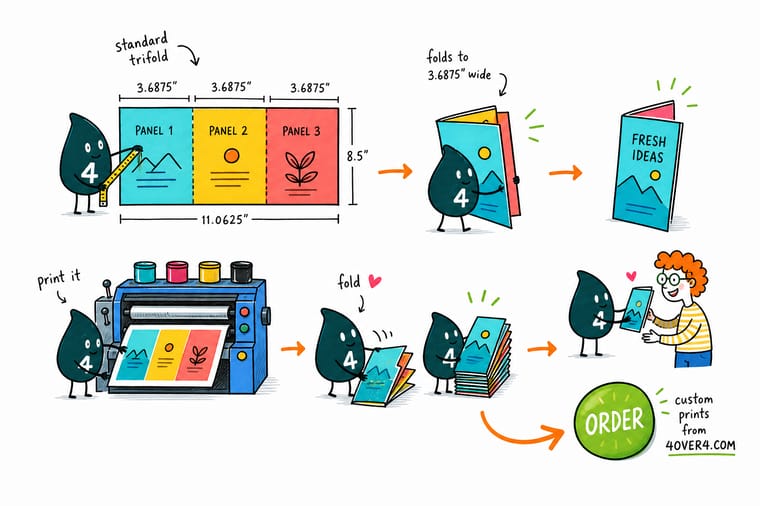
Wally lays the sheet flat, 11 inches across, and marks the folds. Two panels get 3.6875 inches. The one that folds in first gets 3.625, a sixteenth narrower, so its edge tucks behind the others instead of shoving them apart. Add them up and you are back at exactly 11 inches. Scale the same trick to legal, to 11 by 17, to 11 by 25.5. Skip it and your brochure fans open on the table like it is trying to escape.
Price a trifold brochure →Specs and pricing
Sizes, folds, and starting prices
Pick the flat sheet and the fold on the configurator, with live options and starting prices straight from 4OVER4.COM.



Print it
Order a trifold that closes flush

Explore more
Where to go next



By the numbers
Brochure printing you can count on at 4OVER4
Common Questions
Your trifold size questions, answered
What is the standard trifold brochure size?
A flat sheet of 8.5 by 11 inches folded into three panels, finishing at about 3.67 by 8.5 inches. It is the default for a reason: the sheet is a stock size so nobody pays for an odd cut, the folded panel fits a #10 business envelope, and it sits comfortably in a rack or a jacket pocket. When a designer, a printer or a template says trifold with no other detail, this is the size being described.
Are the three panels of a trifold the same width?
No, and this is the single most common setup mistake. The panel that folds in first has to be slightly narrower so its edge clears the spine rather than jamming against it. On an 8.5 by 11 sheet the tuck-in panel is 3.625 inches and the other two are 3.6875 inches each, which still adds up to exactly 11 inches. Divide the sheet into three equal 3.667 inch panels instead and the finished brochure bulges open along the front edge, and the fold on the tuck-in panel creeps toward the artwork.
Will a trifold brochure fit in a #10 envelope?
A letter trifold will. The finished 3.67 by 8.5 panel sits inside a #10 envelope, which has an interior of roughly 4.125 by 9.5 inches, with clearance on both dimensions. A 9 by 12 trifold finishes at about 4 by 9 and technically fits, but the margin is thin enough that a machine inserter will fight you. A legal trifold at 4.69 by 8.5 needs a 6 by 9 catalog envelope, and an 11 by 17 trifold needs a 9 by 12.
What paper weight should a trifold brochure be?
100lb gloss text is the standard choice and the one most trifolds are printed on. It has enough body to stand in a rack without curling and folds cleanly with no scoring. Go up to cover weight and the fold has to be scored first, and even scored, coated cover often cracks a white hairline along the crease where the coating splits. If you want a heavier feel, uncoated cover cracks less than coated. The full comparison sits in our guide to trifold brochure paper.
How much bleed does a trifold brochure need?
0.125 inches on all four sides of the flat sheet, so an 11 by 8.5 trifold is built on an 11.25 by 8.75 canvas. Bleed applies to the outside trim only, not to the folds, because nothing is cut at a fold. What the folds do need is a safety margin: keep type and logos at least 0.125 inches away from each crease, because folding tolerance shifts by a small fraction and a headline that runs right up to the fold ends up looking crooked on some copies and not others.
Can I trifold a sheet smaller than letter size?
You can fold it, but the result is usually unusable. A 5.5 by 8.5 sheet trifolded gives panels of about 1.83 inches, which is too narrow for a headline, a photograph or a body paragraph at readable size. At that sheet size a half fold makes far more sense and gives you a 4.25 by 5.5 panel. Trifolding earns its place from letter size upward, where each panel is wide enough to carry real content.
Which way do the panels fold, and which one is the cover?
On a right-hand fold, the rightmost panel of the outside spread is the front cover, the middle panel becomes the back, and the narrow tuck-in panel on the left folds inward first. That means the outside of your sheet carries the back panel, the tuck-in panel and the cover, in that left-to-right order, while the inside spread reads as one continuous three-panel canvas. Getting that order wrong is why so many first proofs come back with the cover printed on the inside.
Get Started
Ready to fold the right panel widths?
Choose your flat size, pick the trifold, and we set the panels so the brochure closes flush the first time. Templates with the fold guides already placed are free to download.
Legal Disclaimer
Gold Standard guarantees apply to all standard orders placed through 4over4.com. Price match requires verifiable proof of a competitor's published price for an equivalent product with matching specifications and turnaround time. Satisfaction guarantee covers manufacturing defects and print quality issues. Contact support with order number and documentation. On-time delivery rate based on tracked orders 1999 to 2026. Individual results may vary based on shipping carrier performance.
