
How to Design a Church Booklet That Tells Your Story


Map the order of service, count the pages in fours, pick the binding that stays open in a congregant's hand, then set type a back row can read. That order, and the booklet designs itself.
Design a church booklet by fixing the page count first, because folded sheets make pages in multiples of four, then laying the order of service across facing pages so nobody turns a leaf mid hymn. Choose saddle stitch under 48 pages so the booklet lies flat while people sing, and perfect bound above that for anniversary books kept on a shelf. Print inside pages on uncoated or matte 70 lb text to kill glare, set body type at 11 to 12 point and responsive readings at 14, and save the full width photograph for the centre spread, the one spread printed on a single sheet.
Quick answer
Page count first, then binding, then type
A church booklet works when the page count is settled before anyone opens a layout file. Every folded sheet carries four pages, so the booklet grows 4, 8, 12, 16, and a six page order of service becomes an eight page booklet with two leaves to fill. Saddle stitch lies flat in the hand and covers 8 to 48 pages, which suits every weekly and occasion booklet. Perfect bound takes over above that for anniversary books, at the cost of a spine that wants to close. Inside pages go on uncoated or matte text stock so the overhead lights do not glare off them, and the centre spread is the one place a photograph can cross the fold cleanly.
What a Church Booklet Is Actually Carrying
Three jobs sit under the same word, and they want different booklets.
The weekly order of service. Four or eight pages, printed in quantity, read once and mostly recycled. It carries hymn numbers, readings, the sermon title, and the announcements. It has to be cheap enough to reprint every Sunday and clear enough to follow while standing. If yours is a single folded sheet rather than a stitched booklet, our church bulletin printing guide covers that format specifically.
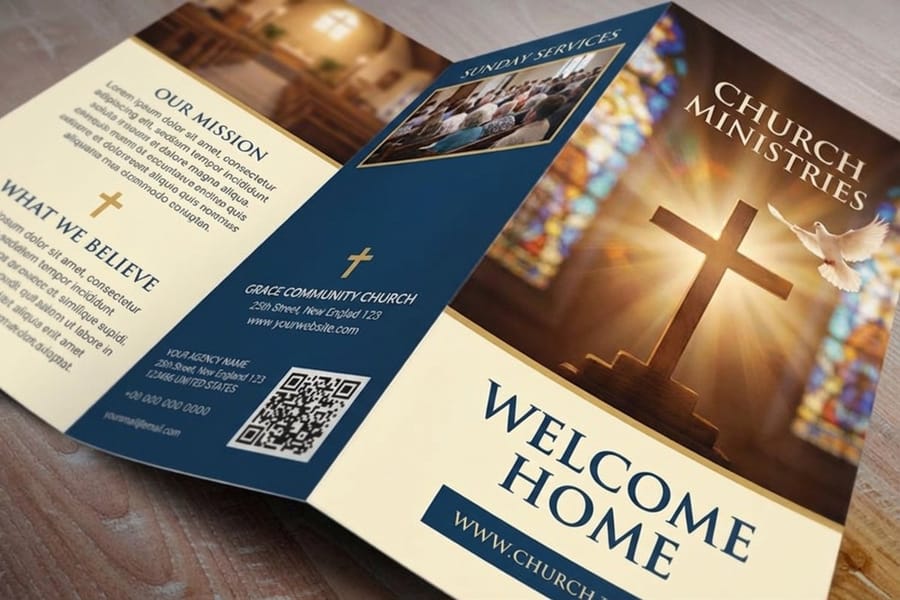
The occasion booklet. Easter, Christmas, a baptism, a wedding, a funeral. Eight to sixteen pages, kept by the people who attended, often mailed to those who could not. This is the one where a photograph and a short written history earn their space, because someone will still have it in a drawer in ten years.
The anniversary or ministry book. Twenty four to forty eight pages or more, telling the congregation's history, listing donors, introducing the staff. It has a shelf life measured in decades and it is the only one of the three that justifies a glued spine.
Write down which of the three you are making before you open a layout file. The page count, the binding, the paper, and the budget all follow from that one decision, and changing it halfway costs you the whole layout.
Map the Content Page by Page Before You Design Anything
Most church booklets go wrong at the planning stage, not the design stage. Somebody lays out a beautiful cover, then discovers the order of service needs three pages instead of two and the whole thing has to shift.
Build the map first. Here is an eight page order of service that works for a standard Sunday service, and it scales to twelve by splitting the service across three pages instead of two.
| Page | What sits there | Why it belongs there |
|---|---|---|
| Front cover | Church name, the date, the season or occasion, one image or mark. | It is the only page a visitor sees before they sit down. Keep it to four elements. |
| Page 2 | Welcome, service times, wifi, giving details, where to find the nursery. | The first inside page is where a first time visitor looks for practical answers. |
| Pages 3 and 4 | The order of service itself: call to worship, hymns, readings, sermon, offering, benediction. | A facing pair means nobody turns a page mid hymn. |
| Page 5 | The scripture reading printed in full, or the responsive reading. | Printing the text means the congregation reads together instead of hunting for a verse. |
| Page 6 | This week's announcements, dated, with the contact name under each one. | Undated announcements get read three weeks after the event. |
| Page 7 | Prayer list, ministry contacts, small group times. | The page people fold back and take home, so leave white space to write on. |
| Back cover | Address, service times, phone, website, one line about what you believe. | Booklets get left on car seats and kitchen counters, face down. |
Notice pages 4 and 5 in that map. On an eight page saddle stitched booklet those two are printed on the same sheet, which makes the centre the only spread where a photograph can cross the fold with the halves lining up exactly. If you want a full width picture of the congregation, put it there and nowhere else.
Designing a Cover That Reads From the Back Pew
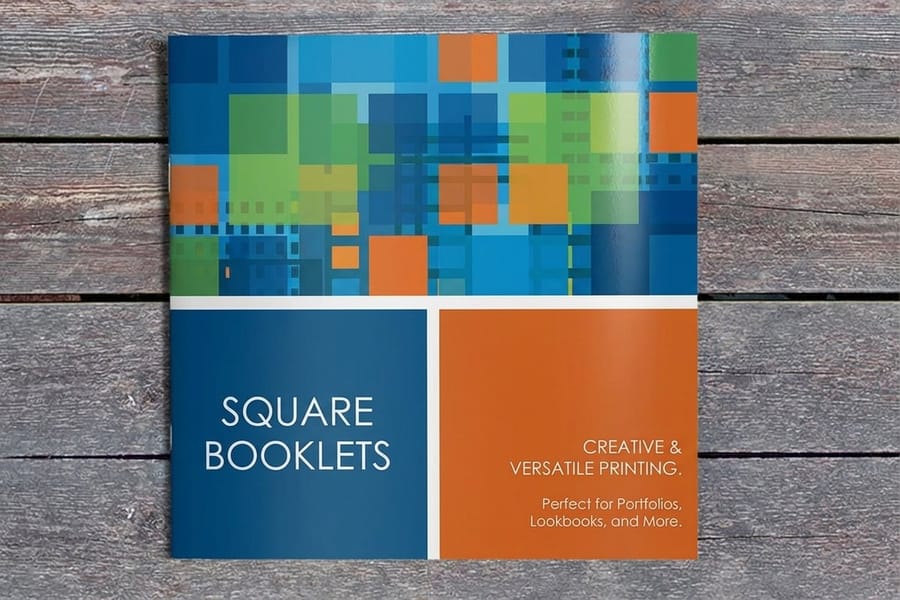
A church booklet cover has one job: tell someone which service they are holding. Four elements is the working limit. Church name, occasion, date, and one image or mark. Add a fifth and the eye stops sorting them.
Set the church name in the largest type on the page, not the occasion. Visitors recognise the name; regulars already know the occasion. Keep the date in a size that survives being read at arm's length, because that is how people check whether the booklet on the pew is this week's.
Inside pages want the opposite discipline. Use one type family with two weights, one accent colour, and the same left margin on every page. Vary the layout only where the content genuinely changes shape: the order of service is a list, the welcome is prose, the announcements are short blocks. Three treatments, repeated, beats seven treatments used once each. Our booklet typography guide covers spacing and hierarchy in more depth.
Two things to leave alone. Do not run a decorative border to the edge of the page unless you have set up bleed correctly, because trimming moves by up to a sixteenth of an inch and an uneven border is obvious. Do not centre every element on every page; a centred order of service is harder to scan down than a left aligned one with the hymn numbers in a column.
Size, Page Count and the Binding Decision
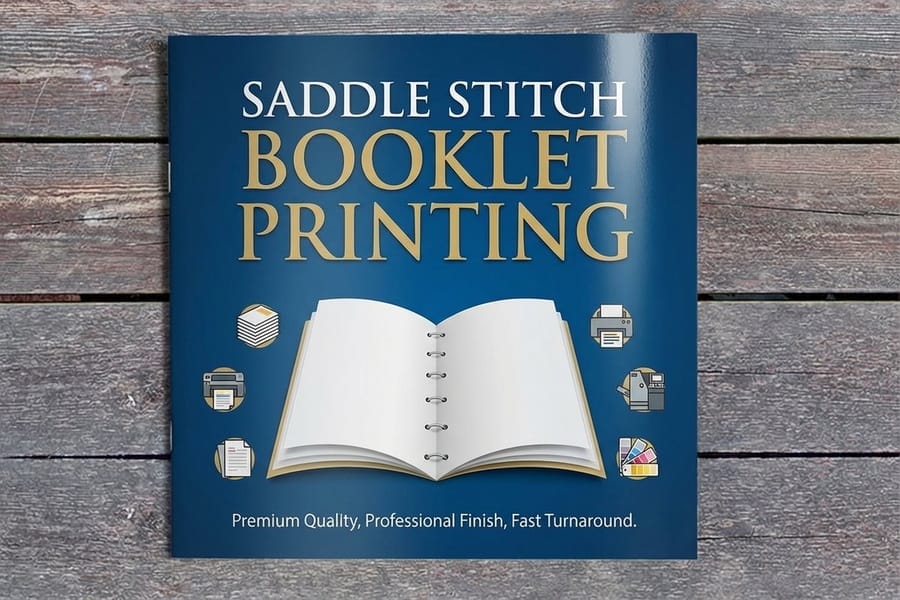
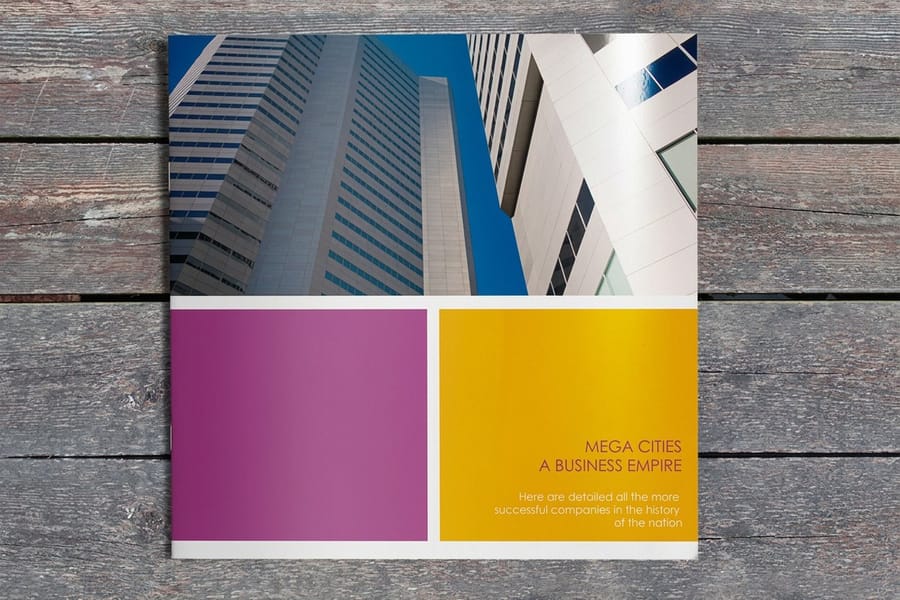
Start with 5.5 by 8.5 inches for a weekly order of service. It comes from a folded letter sheet, so it costs the least of any booklet size, it fits a hymnal shelf, and it sits comfortably in one hand. Move up to 8.5 by 11 only when the content genuinely needs the room, which usually means photographs. Standard booklet sizes lists the rest, including square formats that suit photo heavy memorial books.
Then the binding. The honest comparison is not about looks, it is about whether the booklet stays open in someone's hand.
| Binding | Page range | Lies flat | Spine | Best for |
|---|---|---|---|---|
| Folded sheet | 4 pages only | Yes | A fold, no stitch | The weekly bulletin at the lowest cost per copy. |
| Saddle stitch | 8 to 48 pages | Yes, fully | Folded and stapled, no printable spine | Orders of service, Easter and Christmas booklets, wedding and funeral programs. |
| Perfect bound | 40 pages and up | No, it wants to close | Square glued spine you can print on | Anniversary books, ministry yearbooks, anything kept on a shelf. |
Read the middle column first. A congregation holds a booklet open while singing, often with a hymnal in the other hand, and a perfect bound book springs shut when they let go. That single behaviour rules out perfect bound for anything used during a service, no matter how good the spine looks. Above 48 pages saddle stitch starts fighting back too: the staple struggles, the middle pages bulge, and creep shaves the outer margins of the inner leaves. That is the crossover point, and our binding methods guide works through the numbers.
Saddle stitch booklets and standard booklets both start at $240.55, and perfect bound books start at $375.05, so the binding decision costs less than most churches expect.
Paper and Finish, and Why Gloss Inside Is a Mistake
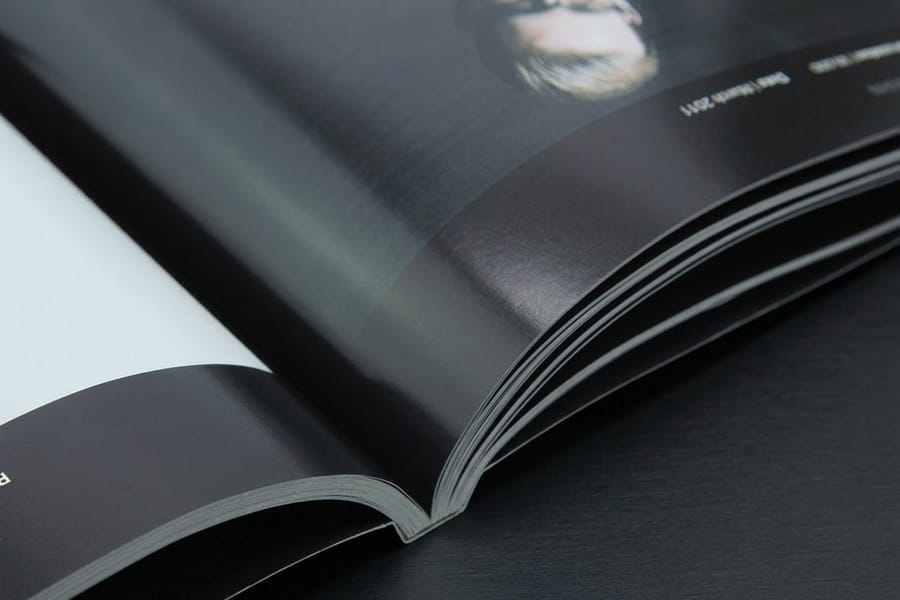
Sanctuary lighting comes from above, and gloss text pages send it straight back into the reader's eyes. That alone settles most of the paper question for an order of service.
- Inside pages, 70 lb or 80 lb text. Uncoated or matte. It reads without glare, it takes a ballpoint pen, and it folds cleanly when someone tucks the booklet into a pocket.
- Cover, 100 lb cover stock. Gloss or matte coated. It survives a rainy walk to the car and keeps the cover image saturated.
- Photo heavy memorial or anniversary books. Matte coated text inside instead of uncoated. Coated stock holds skin tones and dark suits far better, and nobody is writing in the margins of a memorial book.
- Anything mailed. Heavier cover, lighter text. A 100 lb cover with 70 lb text pages keeps the booklet under the postage break that a full 80 lb build can cross.
Skip the aqueous gloss on the inside pages even when it is offered free. Skip full page dark backgrounds behind body text as well; they double the ink, they show every fingerprint, and reversed type at 11 point is the hardest thing in the booklet to read. If you are weighing stock weights against each other, choosing the right booklet paper, finish and binding lays out the combinations we print most.
Type Sizes That Work for Everyone in the Room
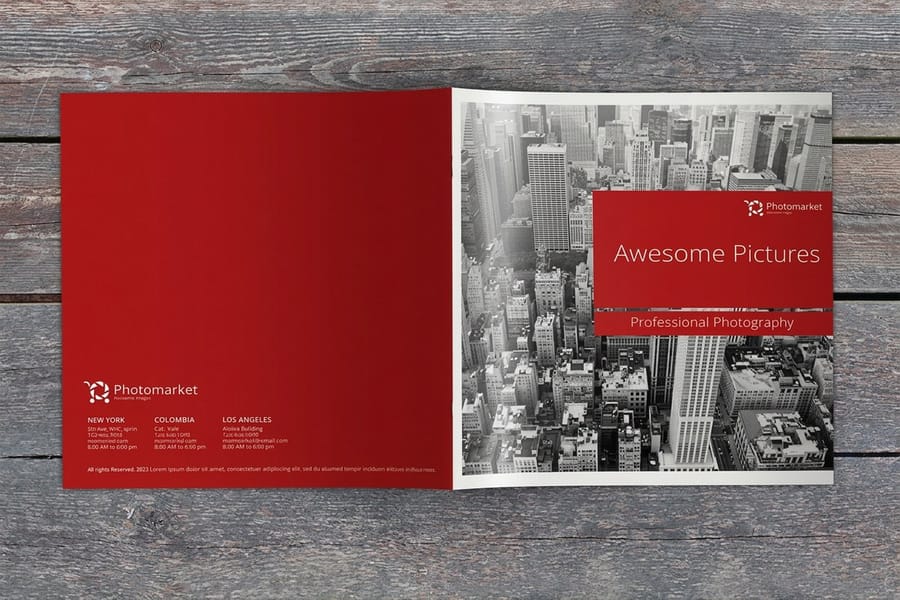
Design a church booklet for the person in the back row who left their reading glasses at home. That constraint improves the layout for everyone else too.
- Body text 11 to 12 point in a serif face, set on roughly 16 point leading. Serifs help at small sizes on uncoated paper.
- Responsive readings and anything said aloud together, 14 point. People read these standing, holding the booklet at arm's length, in dimmer light.
- Headings 16 to 20 point, bold rather than larger. Jumping a heading to 28 point eats a line of content and adds nothing.
- Hymn numbers in their own column, right aligned. The eye finds a number in a column faster than a number inside a sentence.
- No type under 8 point anywhere, including the credits and the copyright lines. Below that, ink spread on uncoated stock starts closing up the counters in letters like e and a. Our note on the smallest font size you should use for printing explains where the floor sits.
Contrast matters as much as size. Black on white or very near it, always, for body copy. Grey text at 60 percent looks refined on a monitor and disappears on paper under warm sanctuary lights. If your brand colour is a mid tone, use it for headings and rules, not for the text people have to read.
Getting the File Print Ready and Placing the Order
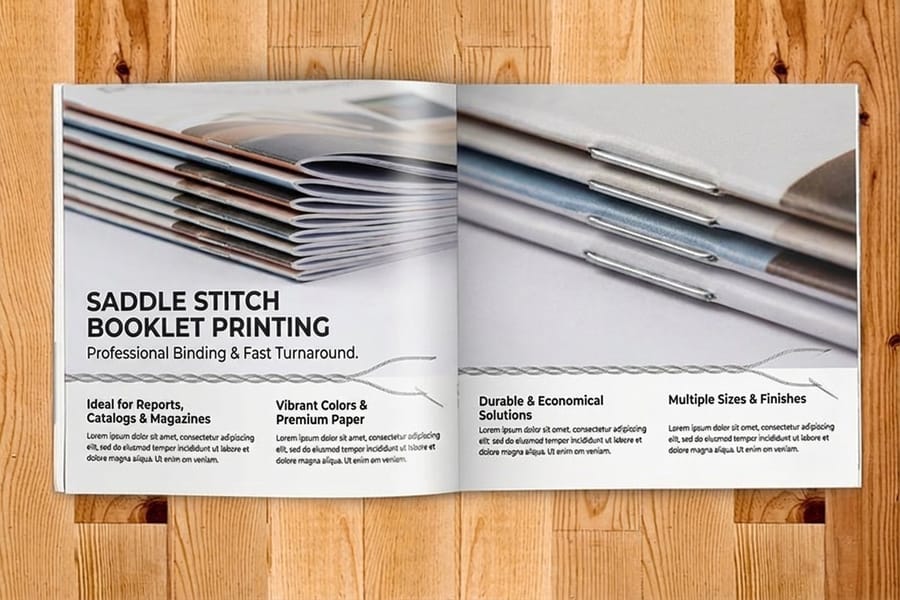
Supply single pages in reading order, not spreads, and let the press impose them. Page 1 is the front cover, page 2 is the inside front, and the file ends on the back cover. Sending pre-imposed spreads is the fastest way to get pages in the wrong order.
- Bleed 0.125 inch on every edge where colour runs off, and keep anything you cannot afford to lose 0.25 inch inside the trim.
- Page count a multiple of four, confirmed before export. If you land on ten, decide now what fills pages eleven and twelve.
- CMYK, not RGB. Deep blues and purples shift most, which matters on liturgical colour.
- Fonts embedded or outlined, images at 300 dpi at their placed size. A photo pulled from a phone gallery at screen resolution prints soft.
- One PDF, one file. Proof the names in any memorial or donor listing twice, out loud, with a second person.
Start from a correctly sized layout in the blank template library rather than building a page geometry from scratch, and read how to use free booklet templates if this is your first booklet file. When the file is ready, configure page count, stock and quantity on booklets and catalogs, or browse the rest of what we print for congregations in the church printing collection. Churches that also mail an invitation alongside the booklet usually pair it with church brochures printed on the same run.
Wally explains the church booklet
One folded sheet, four pages, and the centre is special
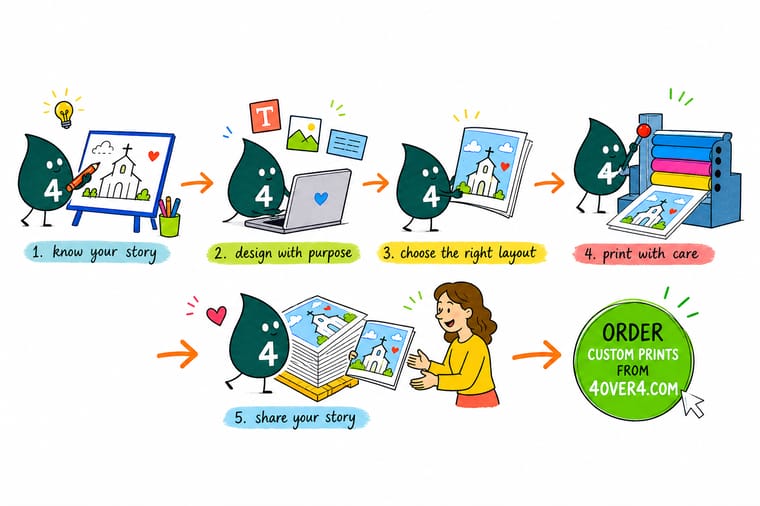
Wally folds a sheet once and gets four pages, which is why a booklet counts 4, 8, 12, 16 and never 6. He nests a second sheet inside the first and staples through the fold, so the booklet opens flat and stays open while the congregation sings. Then he points at the middle: pages 4 and 5 are printed on one sheet, so that is where a photo can cross the fold without the halves stepping. Everywhere else, keep the picture on one page.
Configure a saddle stitch booklet →Specs and pricing
Booklet formats, page counts and starting prices
Compare the three booklet builds a church actually orders, with live configuration choices and starting prices straight from the 4OVER4.COM configurator.


Print it
Order the booklet your congregation will keep
Explore more
Where to go next



By the numbers
Booklet printing you can count on at 4OVER4
Common Questions
Your church booklet questions, answered
How many pages should a church booklet have?
Count the service, then round up to the next multiple of four. A standard Sunday order of service fits eight pages: cover, welcome, the service itself across two or three pages, hymns, announcements, and a back cover with service times. An Easter or Christmas service with extra music usually runs twelve. Anniversary and memorial books run sixteen to forty eight because they carry photographs and written tributes. If your content lands on six pages you print eight, so plan the two extra leaves as something useful rather than blank paper.
Why do booklet pages have to be a multiple of four?
One sheet of paper folded once gives you four printable pages: two on the front, two on the back. There is no way to add a single page to a stitched booklet without adding its partner on the other side of the same sheet. That is why a printer quotes 8, 12, 16 and 20 page booklets and never a 10. Our guide on booklet page counts, multiples of four and creep walks through what happens on thicker booklets, where the inner pages push outward and the trim shaves the outside edge.
Should a church anniversary book be saddle stitched or perfect bound?
Perfect bound, if it runs past about 48 pages and people will keep it on a shelf. The glued square spine takes printed text, so the year and the church name are readable when the book is filed away, and it holds a heavy page count without the middle pages bulging. The trade off is that a perfect bound book does not lie flat, so it is the wrong choice for anything held open during a service. Saddle stitch is better under 48 pages and costs less because there is no spine to glue and cure.
What font size works for a congregation?
Body text at 11 or 12 point in a serif face, headings at 16 to 20 point, and anything the congregation reads aloud together at 14 point. Sanctuary lighting sits well below office lighting and a good share of any congregation is over sixty. Line spacing matters as much as size: set 12 point type on about 16 point leading so the lines separate. Avoid light or condensed weights, and never reverse small type out of a dark photograph, which is where church booklets most often become unreadable.
What paper should we use for an order of service?
Inside pages on 70 lb or 80 lb uncoated or matte text stock, cover on 100 lb gloss or matte cover. Uncoated inside pages do not bounce the overhead lights back at the reader and they take a pen, which matters because people write down names and prayer requests. A coated cover survives being carried out to the parking lot and folded into a bag. Full colour photographs look better on a matte coated text page than on uncoated, so a memorial book with lots of pictures is the one case worth switching the inside stock.
How far ahead should we order a church booklet?
Send the file at least a week before the service, and two weeks for anything above 24 pages or anything perfect bound, because the glued spine needs curing time before trimming. Standard booklets start at $240.55 and perfect bound books at $375.05 at 4OVER4.COM. Build in a day for proofing: the single most common late change on a church booklet is a name spelling in a memorial listing, and that is much cheaper to fix before the press than after.
Get Started
Ready to print this Sunday's booklet?
Pick your page count in fours, choose saddle stitch or a glued spine, set the stock, and we print an order of service that opens flat and reads from the back row.
Legal Disclaimer
Gold Standard guarantees apply to all standard orders placed through 4over4.com. Price match requires verifiable proof of a competitor's published price for an equivalent product with matching specifications and turnaround time. Satisfaction guarantee covers manufacturing defects and print quality issues. Contact support with order number and documentation. On-time delivery rate based on tracked orders 1999 to 2026. Individual results may vary based on shipping carrier performance.
