
Why Booklet Page Counts Come in Fours and What Creep Does to Your Margins


Booklet page counts and creep are the same problem seen from two ends. The sheet math and the imposition pairing set the margins that stop the trim from eating your layout.
Saddle stitched booklets run in multiples of four because every folded sheet carries four pages, two on each side, and the cover is one of those sheets. Creep is what nesting those sheets does next: the inner ones have to wrap around everything inside them, so they push out at the fore edge, and trimming the stack flush removes more paper from the middle pages than from the cover. Content on those pages ends up sitting closer to the outside edge.

Quick answer
Four pages per sheet, and the middle pages push out
One folded sheet is four pages, so the total has to be a multiple of four, covers included. Nest those sheets and the inner ones reach further at the fore edge, because they wrap around the bulk of everything inside them. The three knife trim cuts the stack flush and takes more off the middle pages than off the cover, so their content sits closer to the outside edge and their gutter looks wider. Estimate the push-out as the number of sheets minus one, times the caliper of your stock. Keep live content 0.25 inch inside the trim, more on the fore edge above 32 pages, and let prepress apply the shingling correction.
Why the Count Lands on 4, 8, 12, 16

A saddle stitched booklet is not assembled from pages. It is assembled from sheets, each one folded down the middle and dropped inside the one before it, with staples driven through the common fold. A sheet has two sides, the fold cuts each side in two, and that is four pages of finished booklet from one piece of paper.
So the arithmetic runs in fours whether anyone likes it or not. Twelve pages is three sheets. Twenty pages is five. Fourteen pages is nothing, because you cannot fold half a sheet into the middle of a stack and staple it. When you send us 14 pages of content for saddle stitch booklet printing, someone has to decide what the other two pages are, and that decision is better made by you than by prepress.
Count the cover. This is where most page-count arguments start. On a saddle stitched booklet the cover is a sheet like any other: front cover is page 1, inside front is page 2, inside back is the second to last, back cover is the last. A 16 page booklet gives you twelve interior pages. If you order a heavier separate cover, it is still four pages, and the text block inside it has to be a multiple of four on its own, so a heavy-cover 16 page job is a 4 page cover plus a 12 page text block.
Pages that share a sheet are locked together. On any one sheet, the two page numbers on a given side always add up to the total plus one. In a 16 page booklet that means 16 pairs with 1, and 8 pairs with 9. Once you see the pairing, it is obvious why you cannot delete a single page late in the process: you would orphan its partner.
| Sheet | Outer side carries | Inner side carries | Where it sits |
|---|---|---|---|
| Sheet 1 | Pages 16 and 1 | Pages 2 and 15 | Outermost. This is the cover. |
| Sheet 2 | Pages 14 and 3 | Pages 4 and 13 | Wraps sheets 3 and 4. |
| Sheet 3 | Pages 12 and 5 | Pages 6 and 11 | Wraps sheet 4. |
| Sheet 4 | Pages 10 and 7 | Pages 8 and 9 | Innermost. Pages 8 and 9 are the only true facing pair. |
Note the last row. The center spread, 8 and 9 in this example, is the single spread that lives on one side of one sheet. It is the only place an image can cross the gutter with no chance of a step, which makes it the natural home for a map, a wide product shot or a timeline.
What Creep Is and Which Pages It Hits

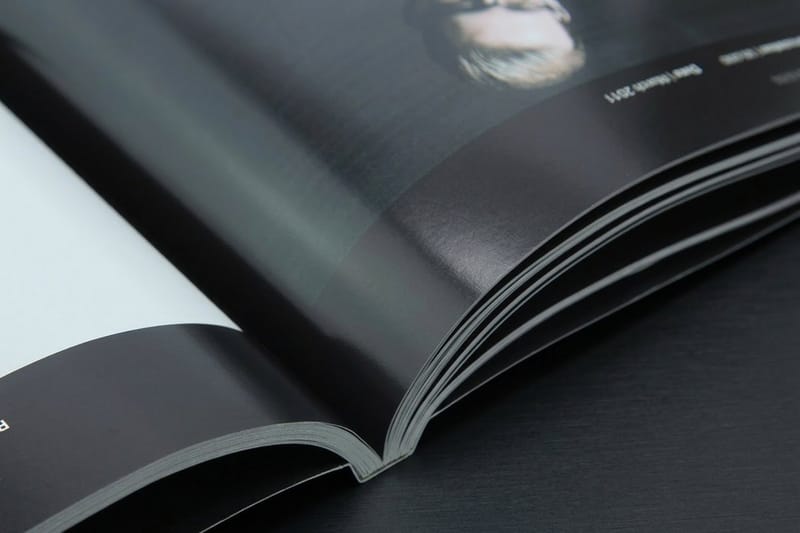
Creep is the push-out you get from nesting. Each sheet has to bend around everything folded inside it, so its fold sits a little further back and its leaves reach a little further forward at the fore edge. Before trimming, an open booklet has a stepped edge, like a fanned deck of cards. The three knife trimmer then cuts the whole stack flush, and every step is removed by taking more paper off the inner pages than off the cover.
The consequence is a margin problem, not a printing problem. Artwork that sat 0.25 inch from the trim line on every page of your file ends up closer than that on the middle pages, and the gutter margin on those same pages looks wider. On a short booklet nobody sees it. On a fat one, a page number placed near the outside edge marches inward as you flip through, and that is the giveaway your reader notices without knowing why.
How much creep you get is a function of two things only: how many sheets are nested, and how thick each one is. A workable estimate is the number of sheets minus one, multiplied by the caliper of your stock. Measure the caliper rather than reading it off the weight, because two papers at the same basis weight can bulk very differently. The numbers below assume a stock measuring four thousandths of an inch, which is a reasonable middle-of-the-road text sheet.
| Pages | Folded sheets | Push-out at the center | What it means for the layout |
|---|---|---|---|
| 8 | 2 | About 0.004 in | Invisible. Standard margins absorb it entirely. |
| 16 | 4 | About 0.012 in | Still thinner than a sheet of paper. No action needed. |
| 32 | 8 | About 0.028 in | Measurable. Keep folios and rules well back from the trim. |
| 48 | 12 | About 0.044 in | Visible on a boxed page border. Widen the outside margin. |
| 64 | 16 | About 0.06 in | Near the top of what saddle stitch handles comfortably. |
Read the pattern rather than the exact figures. Creep grows in a straight line with page count and with paper bulk, which is why a 32 page booklet on a heavy uncoated stock can creep more than a 48 page booklet on a thin coated one. Paper choice and page count are the same decision, and the guide to booklet paper, finish and binding covers how the stock behaves once it is folded.
Prepress corrects for this with shingling: each page is nudged toward the spine by a share of the total push-out, most at the center, none at the cover. That correction happens during imposition, on our side, from the actual caliper of the stock you ordered.
Margins and File Setup That Survive the Trim
Everything you actually control sits in the file. Get these five habits right and creep stops being your problem.
- Bleed 0.125 inch on every outside edge. Any color or image meant to run off the page extends that far past the trim line. A background that stops exactly at the trim will show a white sliver somewhere in the run.
- Keep live content 0.25 inch inside the trim, and give the outside edge more on long booklets. Above roughly 32 pages, push the fore edge margin toward 0.375 inch. That extra eighth of an inch is what the shingling correction eats into.
- Set page numbers back from the edge. Folios are the most creep-sensitive element on the page because the eye tracks their position from spread to spread. Sit them 0.375 inch from the trim and they stay put.
- Keep type out of the gutter. Text that crosses the fold gets swallowed as the booklet is held open, and on any spread other than the center it can also step. Images can cross. Words should not.
- Supply single pages in reading order, not reader spreads. A PDF of spreads has to be split before it can be imposed, and that step is where page order errors appear. One page per PDF page, page 1 first, blanks included.
One more, and it is the mistake that costs a reprint: do not shift your artwork to compensate for creep yourself. The imposition applies its own correction, and a file that was already shifted gets corrected twice. The center pages come back with a fat outside margin and body copy leaning into the fold. Send the file clean and let the correction do its single job.
If you are still choosing between a stitched booklet and a folded piece, the format comparison is worth reading before you build the layout, because a brochure has no page-count rule at all and no creep to plan for. For layout ideas that hold up once the piece is folded and trimmed, there are seven booklet design approaches worth borrowing.
When the Page Count Outgrows Saddle Stitch
Saddle stitch has a ceiling, and it is set by physics rather than preference. Somewhere around 64 to 80 pages on ordinary text stock, two things go wrong at once. The staple has to pierce and close through the full spine, and the creep at the center gets large enough that the middle pages are noticeably narrower than the cover. Heavy or bulky paper brings that ceiling down fast.
The signals that you have passed it are easy to spot. The booklet no longer stays shut. The fore edge looks uneven even after a clean trim. Page numbers drift. If you are seeing any of those, the fix is a different binding, not a tighter margin.
Perfect binding glues the leaves into a flat spine. Page counts only need to be a multiple of two, because each leaf is a single sheet rather than a folded one, and you gain a printable spine. The trade-off is real: the glue takes over part of the inner margin, so the gutter needs more room, and the book resists lying flat. Wire-o and coil also run in multiples of two, lie perfectly flat on a table, and need a clear punch margin along the binding edge, which is why they suit manuals and workbooks. The binding methods guide walks through each one with the page-count rule attached.
For most marketing work the decision never gets that far, because the content fits inside 32 pages and saddle stitch is both the cheapest and the flattest-opening option at that size. If you are weighing a stitched booklet against a simpler folded piece, the booklet versus brochure comparison puts the cost difference in plain terms, and the rest of our product explainer guides cover how the other formats are built. When you are ready, saddle stitch booklets start at $240.55 and the configurator will only offer page counts that actually fold.
Wally explains page counts and creep
Four pages per sheet, and the middle ones stick out
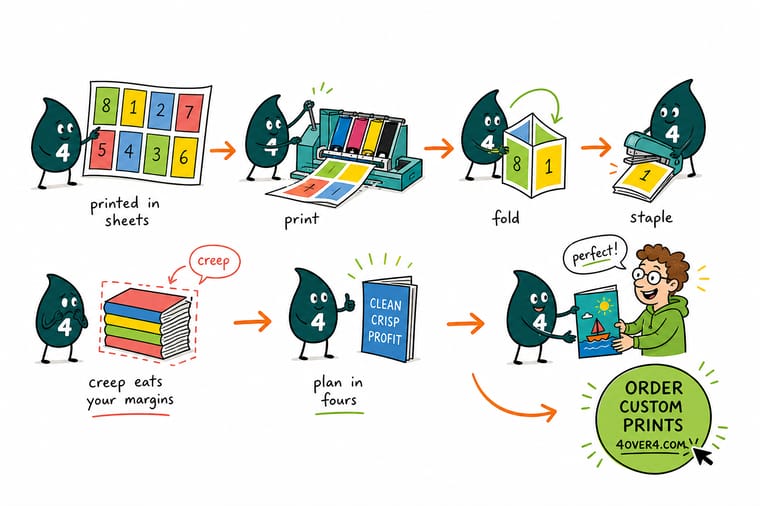
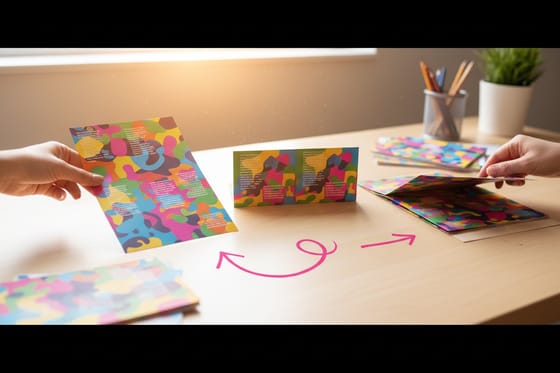
Wally folds a sheet and gets four pages. He folds three more, drops them inside each other, and staples the common fold. The sheets in the middle have to bend around everything nested inside them, so their edges reach further out than the cover does. When the trimmer cuts the stack flush, it takes more paper off those middle pages. That is creep. Wally fixes it in imposition by nudging each page toward the spine, which is exactly why you should not nudge them yourself.
Configure saddle stitch booklets →Specs and pricing
Sizes, page counts and starting prices
Every page count in the configurator is already a multiple of four, with live size, stock and quantity choices straight from 4OVER4.COM.
Print it
Print a booklet that trims clean
Explore more
Where to go next

By the numbers
Booklet orders land in a shop this size
Common Questions
Your booklet page count questions, answered
Why does a saddle stitched booklet have to be a multiple of four?
Because the booklet is built from sheets that are folded once and nested inside each other. A single folded sheet has a front and a back, and the fold splits each of those into two pages, so one sheet is always four pages. Three sheets give 12 pages, four give 16, and there is no arrangement of paper that produces 14. If your content lands on 14, you either add two pages of material or two blanks, or you cut back to 12.
Does the cover count toward the page count?
Yes, on a saddle stitched booklet the cover is one of the sheets. The front cover is page 1, the inside front is page 2, the inside back is the second to last page and the back cover is the last. So a 16 page booklet gives you 12 interior pages plus four cover pages. If you order a separate heavier cover stock, that cover is still four of the pages, and the text block that sits inside it also has to be a multiple of four on its own.
What do I do if my content ends at 14 pages?
Add two pages and decide what goes on them rather than letting the printer guess. The usual moves are a notes page, a contact or credits page, a full bleed image, or a page of specifications you cut earlier. Blanks are perfectly acceptable and cost the same as printed pages, but a blank on the inside back cover reads as an oversight while a notes page reads as a choice. Whatever you pick, supply it in the file so the page order stays exactly as you intend.
Which direction does creep move my content?
Toward the fore edge, the outside edge opposite the fold. The inner sheets have to wrap around everything nested inside them, so before trimming they stick out further at that edge. The three knife trim cuts the whole stack flush, which removes more paper from the inner pages than from the cover. Artwork that was centred on the untrimmed page therefore ends up sitting closer to the outside edge on the middle pages, and the gutter margin looks correspondingly wider.
Should I apply creep compensation myself before sending the file?
No. Send single pages at final trim size with bleed, in reading order, and let prepress handle the shingling. Imposition software already shifts each page toward the spine by a calculated amount when it builds the printing form. A file that has been pre-shifted gets shifted a second time, and the center spread comes back with too much fore edge margin and artwork drifting into the gutter. Your job is to keep live content away from the trim so the correction has room to work.
How many pages can a saddle stitched booklet hold?
The practical ceiling is around 64 to 80 pages on ordinary text stock, and it drops as the paper gets heavier or bulkier. Two things fail at the top end: the staple has to close through the whole spine, and creep becomes large enough that the middle pages look visibly narrower than the cover. Past that point a different binding is the right answer, and page counts only need to be a multiple of two because the leaves are single sheets rather than folded ones.
Can an image run across the center spread?
Yes, and the center spread is the one place a crossover works cleanly, because those two pages are the front and back halves of the same side of one sheet. On every other spread the image is split across two different sheets, so a small misregistration or the creep correction can leave a visible step. Keep type off the gutter entirely, and avoid crossovers with hard horizontal lines or faces landing on the fold.
Get Started
25 saddle-stitched booklets cost $240.55 and run 7 business days
Pick your size, land the page count on a multiple of four, and we handle the imposition, the shingling and the trim.
Legal Disclaimer
Gold Standard guarantees apply to all standard orders placed through 4over4.com. Price match requires verifiable proof of a competitor's published price for an equivalent product with matching specifications and turnaround time. Satisfaction guarantee covers manufacturing defects and print quality issues. Contact support with order number and documentation. On-time delivery rate based on tracked orders 1999 to 2026. Individual results may vary based on shipping carrier performance.
