
Holographic vs Metallic Pearl vs Diamond Glitter Business Cards Compared


Three specialty stocks that all catch the light, and three very different bills, minimums and deadlines. The shine sits in a different place on each one, and each belongs to a different job.
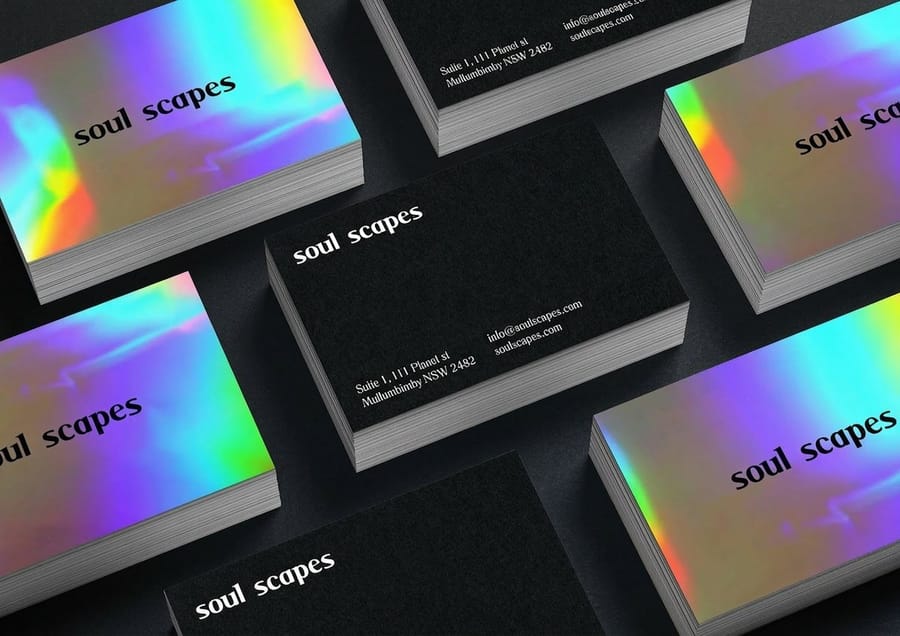
Holographic cards carry a rainbow film under the ink, metallic pearl carries the shimmer inside a 26pt sheet, and diamond glitter carries a sparkling coating over the front only. That decides everything else: holographic needs open artwork and starts at $251.36 for 250 cards on 15 business day production, metallic pearl shimmers on both sides from $39.11 for 50, and diamond glitter is the cheapest way onto a specialty stock at $31.84 for 50 with a plain back for your small print.
Quick answer
Under the ink, inside the paper, or on top of it
The three finishes differ by which layer holds the effect. Holographic puts a rainbow film beneath the printed image on 32pt or 48pt laminated stock, so heavy ink coverage cancels it out. Metallic pearl builds the shimmer into a 26pt Metallic Pearl Ice sheet, which is why it is the only one of the three that looks the same on the back. Diamond glitter coats the front of a 17pt cover, leaving the reverse plain and perfectly readable. Price and schedule follow the same order: $251.36 per 250 and 15 business days for holographic, $39.11 per 50 and 5 business days for pearl, $31.84 per 50 and 5 business days for glitter.
Where the Shine Lives on Each of the Three
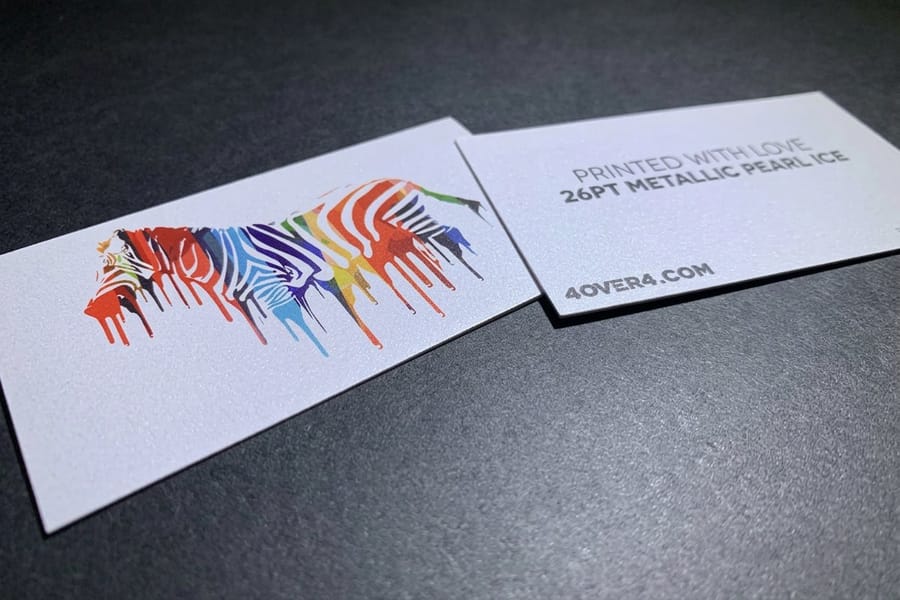
Three finishes, three different layers. Once you know which layer carries the effect, every design rule on this page explains itself.
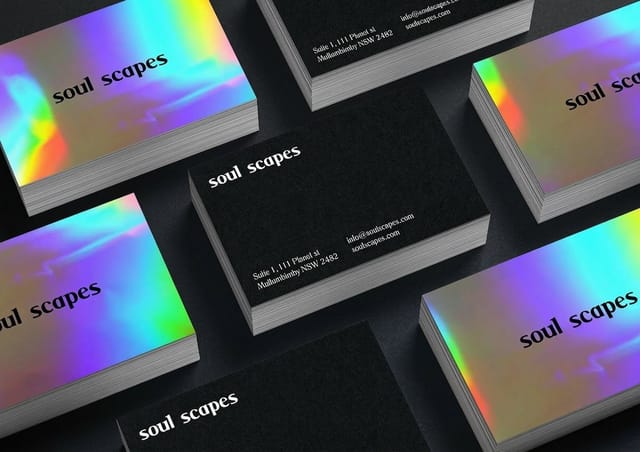
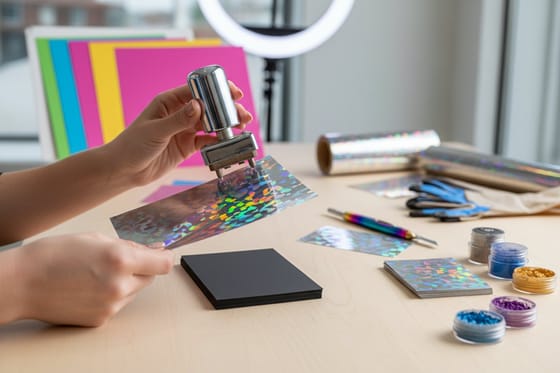
Holographic sits under the ink. The card is built on 32pt or 48pt silk or velvet laminated stock, and a holographic film runs beneath the printed image. Light passes through the ink, hits the film, splits, and comes back as a spectrum that moves when the card turns. That is why holographic business cards only perform where the ink lets light through.
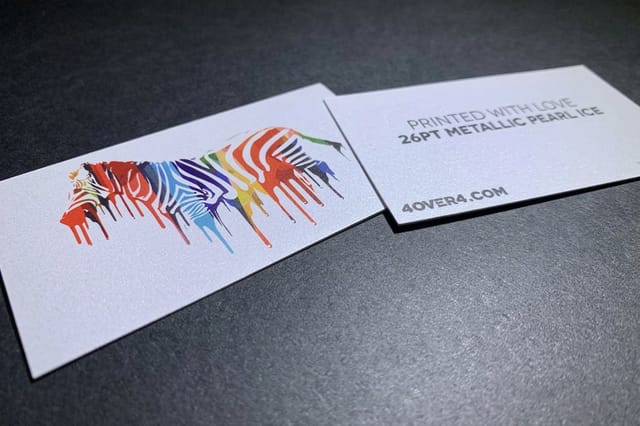
Metallic pearl sits inside the paper. There is no film and no coating. The 26pt Metallic Pearl Ice sheet has pearlescent pigment through it, so the shimmer glows out of the paper itself in the open areas of the design. Both faces behave the same way, which no other option here can claim. Our guide to pearlescent paper covers how ink sits on that surface.
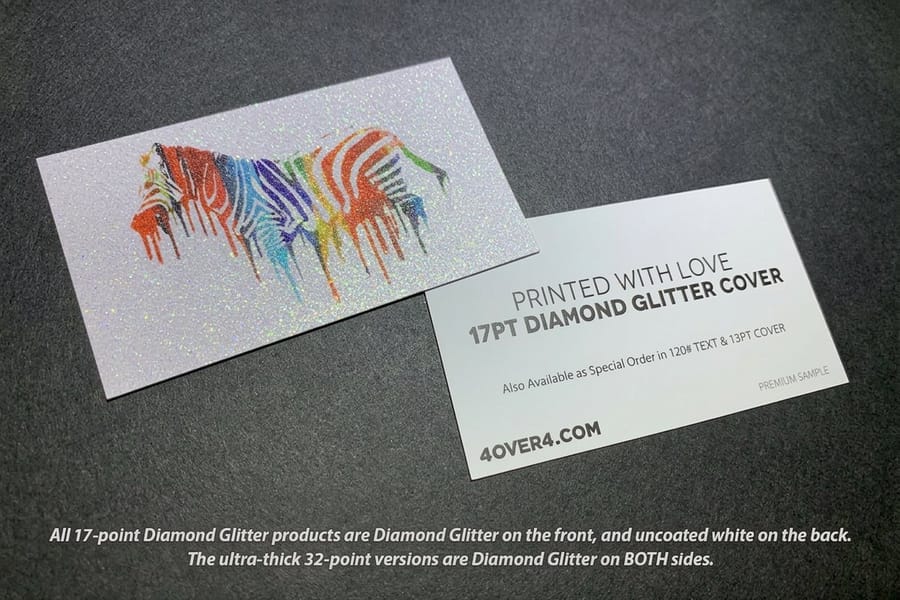
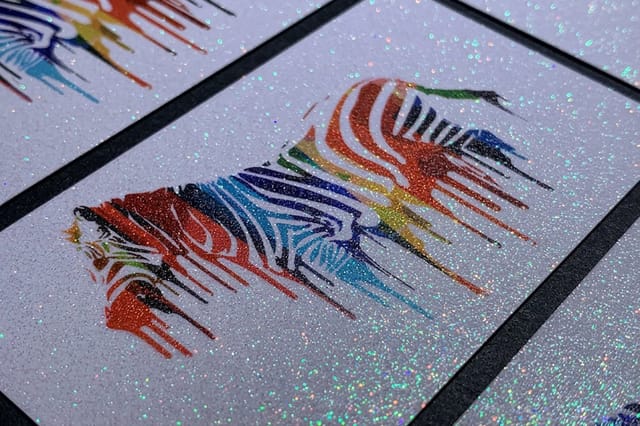
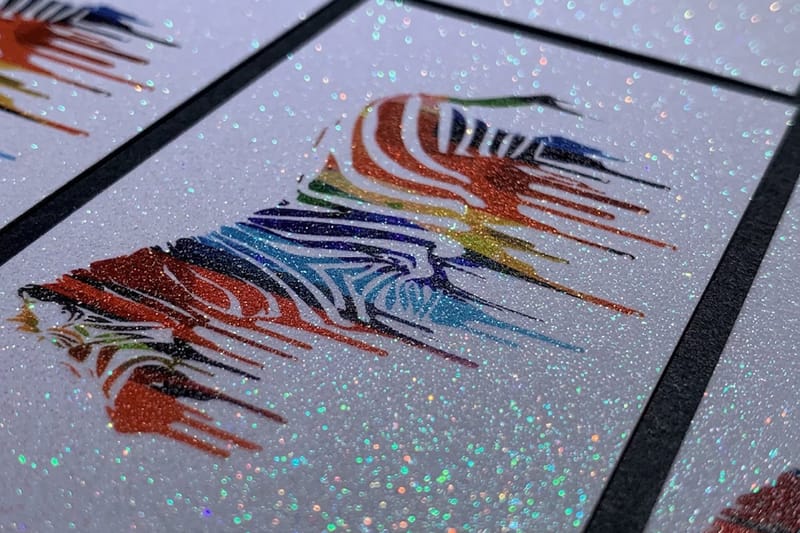
Diamond glitter sits on top. A sparkling coating is applied across the front of a 17pt Diamond Glitter cover. The sparkle is the outermost layer, which is why it reads instantly across a room and why the reverse of the card is plain uncoated stock.
So: rainbow under the ink, pearl in the sheet, glitter over the front. Hold that and the rest is bookkeeping.
Holographic, Metallic Pearl and Diamond Glitter Compared
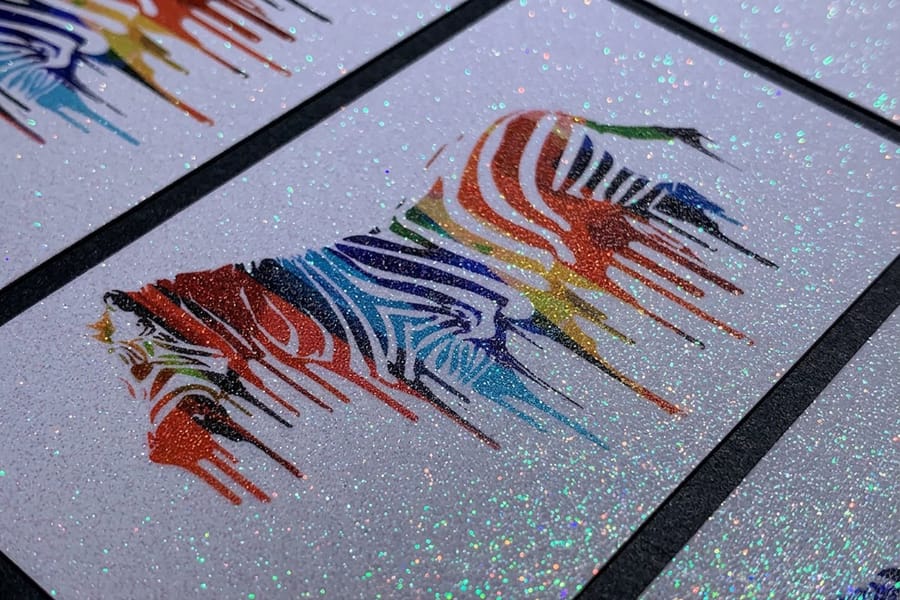
The specs that actually change a decision are the stock, the order minimum, the lead time and the price per card. Everything else is preference.
| Finish | Stock | Back of the card | Minimum and lead time | Starts at |
|---|---|---|---|---|
| Holographic | 32pt or 48pt silk laminated, or 32pt or 48pt velvet laminated. | Same laminated stock, no rainbow unless the film is left open. | 250 cards, 15 business days. | $251.36 per 250, about $1.01 a card. |
| Ultra thick metallic pearl | 26pt Metallic Pearl Ice, one stock, no coating needed. | Shimmers exactly like the front. | 50 cards, 5 business days, Same-Day rush available. | $39.11 per 50, about 78 cents a card. |
| Diamond glitter | 17pt Diamond Glitter cover with the coating on the front. | Plain uncoated cover, blank, black or full color. | 50 cards, 5 business days, Same-Day rush available. | $31.84 per 50, about 64 cents a card. |
| Standard, for scale | 14pt or 16pt gloss, matte or uncoated. | Prints normally on both sides. | Small runs, fast turnarounds. | $17.57, the flat baseline. |
Read the fourth column before the fifth. A 15 business day standard production on holographic is the single most common reason a job changes finish late, because nobody notices it until the event date is counted backwards. Pearl and glitter both run in 5 business days with rush tiers underneath, so they survive a schedule that moves. If the deadline is the binding constraint, compare ultra thick metallic pearl business cards against diamond glitter business cards and leave holographic for the next print run.
Per-card cost tells a different story at volume. Both the pearl and the glitter card fall toward roughly a dime each by 10,000, while holographic tops out at 2,000 and never gets near that. Against standard business cards at $17.57, all three are a deliberate spend, and it only pays where the card gets handed over rather than posted in bulk.
Setting Up Artwork for a Card That Shines
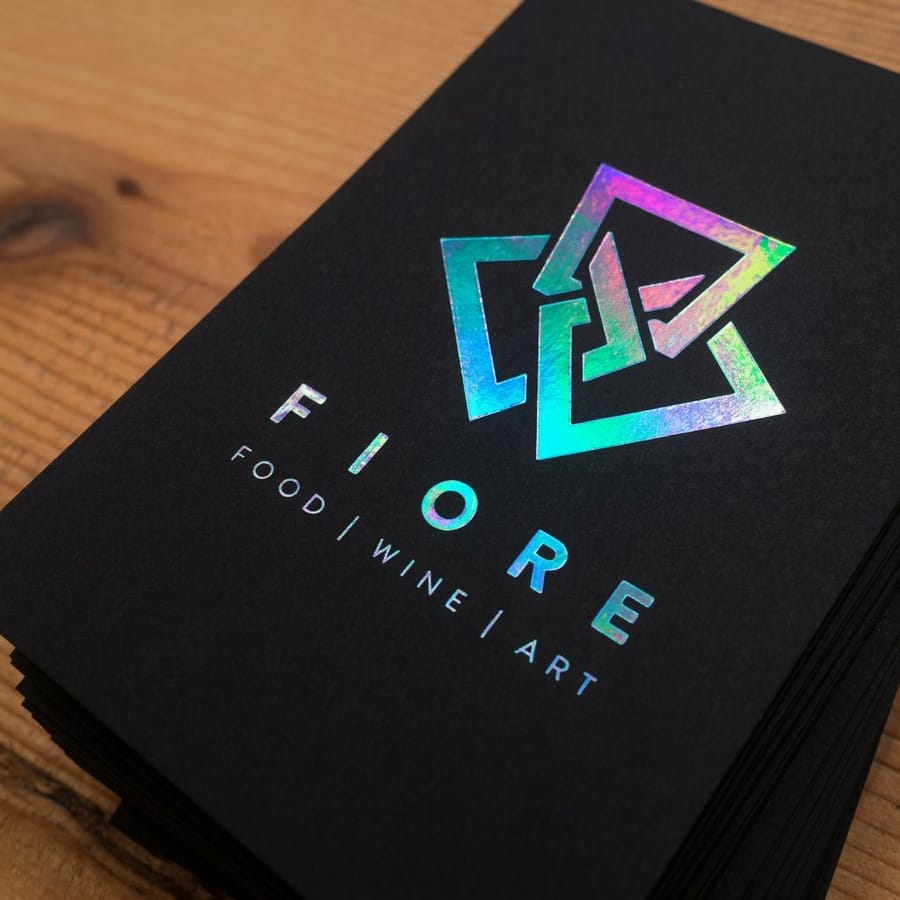
Most disappointing specialty cards were designed as if the stock were white. It is not, and each of the three punishes that differently.
On holographic, the enemy is coverage. Ink is not opaque enough to sit unaffected over a rainbow film, so pale tints go strange and full-bleed dark backgrounds simply switch the effect off. Design it the way you would design a foil job: pick the two or three elements that should catch light, keep them open, and build the rest in solid ink. A logo mark left unprinted so the film shows through is the single best use of the product.
On metallic pearl, the shimmer runs under everything, so light colors gain a slight warmth and heavy solids look flatter than they do on a proof. Ink density that would be fine on white can look muddy here. Push contrast a little, avoid delicate pastel gradients, and remember that a blank area is not empty on this stock. It is the pearl showing.
On diamond glitter, texture is the issue rather than color. The coated front scatters light at close range, so 6 point legal text, hairline rules and thin reversed type lose their edges. Keep the front bold and move the detail to the uncoated back, which prints like any normal card. That split also solves scanning: put the QR code on the plain side.
All three want the same file hygiene as any print job, with fonts outlined and artwork supplied at final size with bleed. Start from the correct trim in the blank template library, and if you want the color shift specifically, our walkthrough on how to make holographic business cards goes deeper on masking the film.
Which One to Order, and When to Skip All Three
Pick by the job, not by the sample that looked best on screen.
Choose holographic when the card itself is the conversation. Launch events, nightlife, music, streetwear, anything aimed at people who will photograph it. Budget close to a dollar a card, order 250 or more, and start three weeks out. Add spot UV or edge painting while you are there, since holographic is the only one of the three that accepts that finishing.
Choose ultra thick metallic pearl when the card has to look expensive and still be read. It is the safest of the three for professional services, real estate and wedding work, and the 26pt weight does as much as the shimmer. Matching ultra thick metallic pearl invitations exist if the card is part of a set.
Choose diamond glitter when you want reach for the money. It is the cheapest way onto a specialty stock, it starts at 50 cards, and the sparkle does the work in beauty, salon, kids party and event settings. Diamond glitter invitations pair with it for the same event. Our closer comparison of glitter and metallic business cards is worth a read if those two are your shortlist.
Skip all three when the card is going into a mailer by the thousand, when the recipient will scan it rather than keep it, or when the design depends on precise small type. Money spent on 16pt stock and a clean layout beats a specialty finish that fights the content. Browse the full lineup on business cards printing, or compare finishes across products in the holographic printing collection and the diamond glitter printing collection.
Wally explains the three shiny stocks
Rainbow underneath, pearl inside, glitter on top
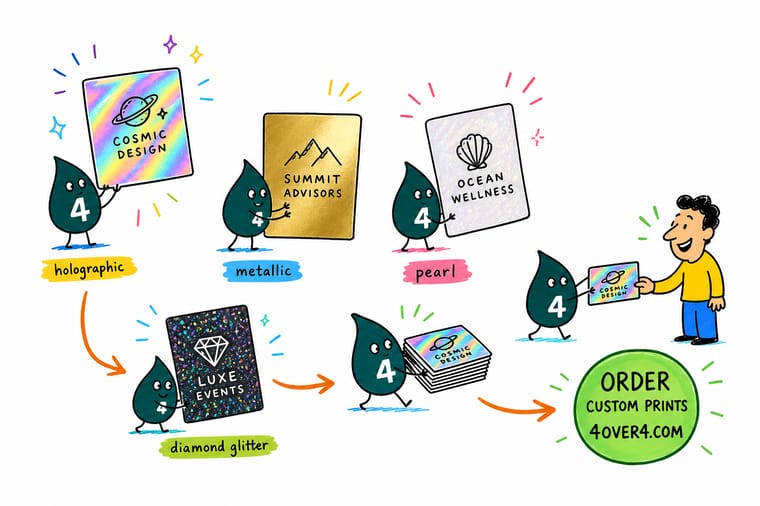
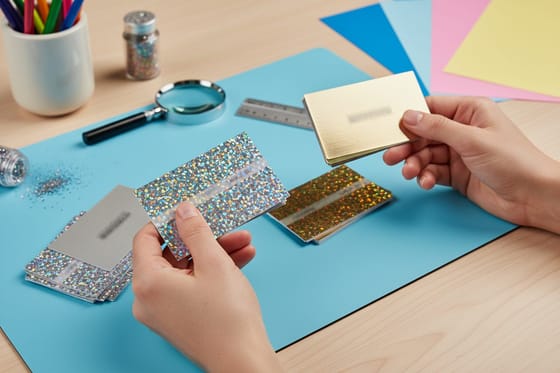
Wally holds three cards up to the light. The holographic one splits it into a spectrum because the film sits under the ink, so he keeps the artwork open where he wants the color to move. The metallic pearl one glows from inside the sheet, front and back the same, which is why he uses it when the card must still look serious. The glitter one sparkles off its coated face and stays plain on the reverse, so that is where he puts the small print and the QR code. Same idea, three layers, three prices.
Compare all business card stocks →Specs and pricing
Sizes, stocks and starting prices side by side
The live configuration choices and starting prices for all three, straight from the 4OVER4.COM configurator.
Print it
Order the finish that fits the job
Explore more
Where to go next
By the numbers
Specialty card stocks inside the wider product count
Common Questions
Your specialty card questions, answered
Which of the three looks the most expensive in the hand?
Metallic pearl, in most rooms. The 26pt Metallic Pearl Ice stock is the thickest of the three shipped as a single sheet, and the shimmer is quiet enough to read as a finish rather than a novelty, which is why it suits law firms, real estate and wedding work. Holographic draws the most attention but reads as the least formal, because the color shift is a strong effect. Diamond glitter is the most playful of the three and sits closer to salon, beauty and event work than to a boardroom.
Can I print a QR code on a holographic or glitter card?
Put it on the plain side. A scanner needs flat contrast between the dark modules and the light background, and both a shifting rainbow film and a glitter coating scatter light across that boundary, so scans get slower and less reliable at an angle. On diamond glitter the back is uncoated 17pt cover, so the QR goes there and works normally. On holographic, place the code inside a solid white or solid light block so the film is masked underneath it.
Why is holographic four times the price of the other two?
Three reasons stack up. The holographic effect comes from a laminated film applied to the sheet rather than from the paper itself, the card is built on 32pt or 48pt laminated stock, and the minimum run is 250 rather than 50. That is $251.36 for 250 cards, close to a dollar each, against $31.84 for 50 diamond glitter cards at about 64 cents each. The gap narrows as quantities climb, but it never closes.
Does the glitter rub off or shed?
No. The diamond glitter is a coating bonded to the 17pt cover during manufacture, not loose glitter dusted on afterwards, so it does not come off in a wallet or a card case. What it does do is add texture, which is why small type and fine hairlines lose crispness on the coated front. Keep body text at a sensible weight, or move the fine print to the uncoated back.
Can I get foil stamping or spot UV on top of these finishes?
On holographic, yes. That product carries foil stamping, spot UV, embossing, debossing, die cutting, rounded corners, edge painting and edge gilding, which is part of what the price buys. Ultra thick metallic pearl and diamond glitter are simpler builds, with rounded corners at 1/8 inch or 3/8 inch available on the glitter card and the pearl card offered in 4/0, 4/1 and 4/4 ink layouts. If a raised finish matters more to you than the stock, look at raised foil and raised spot UV instead.
What sizes do the three come in?
All three offer the standard 2 by 3.5 inch card and a 1.5 by 3.5 inch slim. After that they split. Holographic adds a 2.5 by 2.5 inch square and takes custom sizing up to 3 by 4 inches. Metallic pearl and diamond glitter both add a 2 by 2 inch square and take custom sizing up to 2 by 4 inches. Start from a correctly sized layout in the blank template library rather than resizing an old file.
Get Started
Order 50 diamond glitter cards from $31.84
Pick the rainbow film, the pearl sheet or the glitter coating, upload your artwork, and we proof it before it goes to press.
Legal Disclaimer
Gold Standard guarantees apply to all standard orders placed through 4over4.com. Price match requires verifiable proof of a competitor's published price for an equivalent product with matching specifications and turnaround time. Satisfaction guarantee covers manufacturing defects and print quality issues. Contact support with order number and documentation. On-time delivery rate based on tracked orders 1999 to 2026. Individual results may vary based on shipping carrier performance.
