
Flyer vs Brochure and Which One Earns Its Print Run


Sofia is our design and templates voice, built from the knowledge of our production team, with over 20 years in printing.
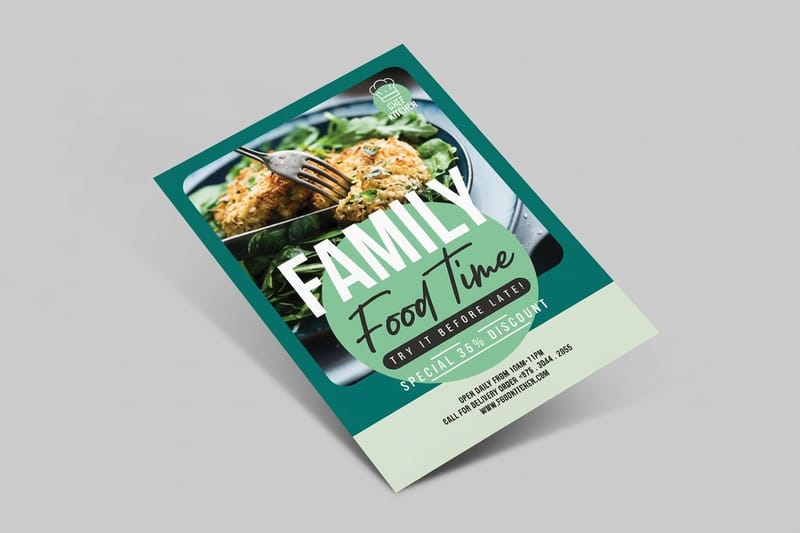
Same sheet, same press, one fold apart. Here is what the fold costs, how many panels you actually need, and how each file has to be built.
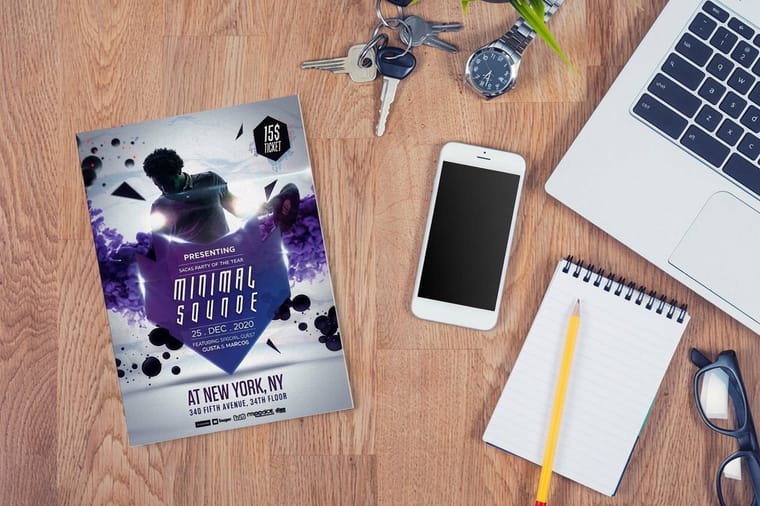
Print a flyer when one message has to land in a few seconds, and a brochure when the reader has already agreed to spend a minute with you. A flyer is a flat sheet with two printed surfaces and starts at $39.54. A tri-fold brochure is the same sheet folded into six panels, starts at $57.11, and asks you to fill every panel honestly. Count your content sections first: one or two means flyer, three to five means brochure, six or more means booklet. Once the flyer vs brochure call goes to the fold, the brochure printing range lists every size and fold.
Quick answer
Two surfaces or six panels, off the same sheet
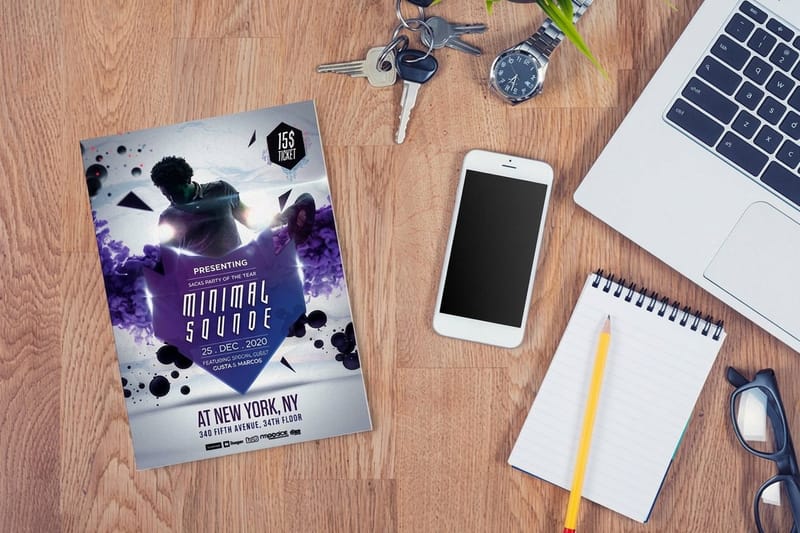
The fold is the only real difference, and it decides everything else. A flyer hands the reader one message on two surfaces and survives being pinned, posted or slid under a door. A tri-fold brochure sequences six panels for someone who is already holding it and willing to open it. The gap at 4OVER4.COM runs from $39.54 to $57.11 on the same 8.5 by 11 sheet, which is cheap per panel and noticeable per piece. Pick by content depth, then by where the reader will physically be.
What the Fold Actually Changes
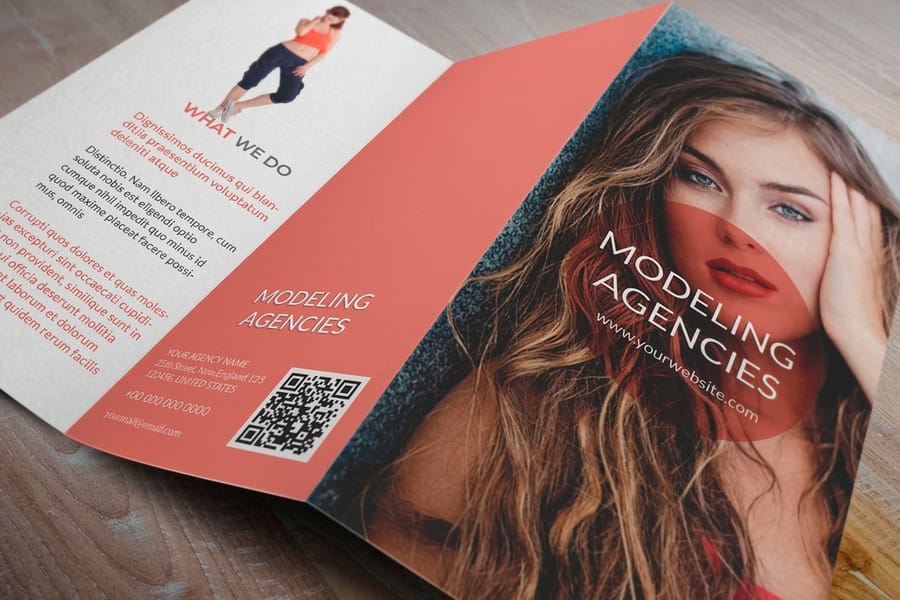
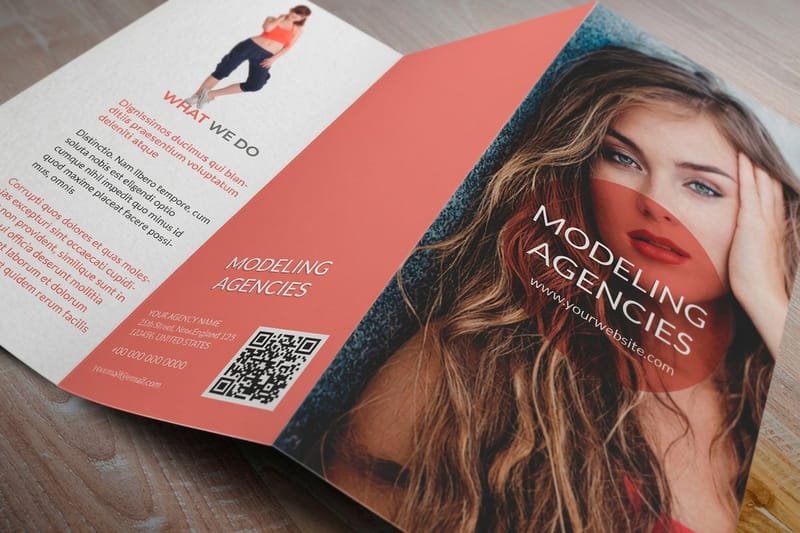
Take one 8.5 by 11 sheet. Leave it flat and you have a flyer with two printed surfaces. Fold it twice and you have a tri-fold brochure with six panels, each one about 3.67 inches wide.
The panel count is not the interesting part. What changes is the order the reader meets your content. On a flyer, the eye lands wherever the biggest element sits, and the whole message competes for that first second. On a brochure, you control the sequence: the front cover has to earn the first fold, the inside spread pays that off, and the back panel carries contact details or a mailing area. That sequence is a gift when you have a genuine story, and a trap when you do not, because a reader who opens panel one and finds filler never opens panel two.
The other change is physical. A flat sheet takes abuse. It goes under a windshield wiper, gets pinned to a corkboard, slides under a door. A folded piece needs a rack, a hand, or a table to work at all. Ask where the piece will physically be at the moment someone reads it, and the format usually picks itself. Our flyer printing and brochure printing categories carry the same stocks, so the choice really is about format rather than quality.
What Each Format Costs and Where It Sits
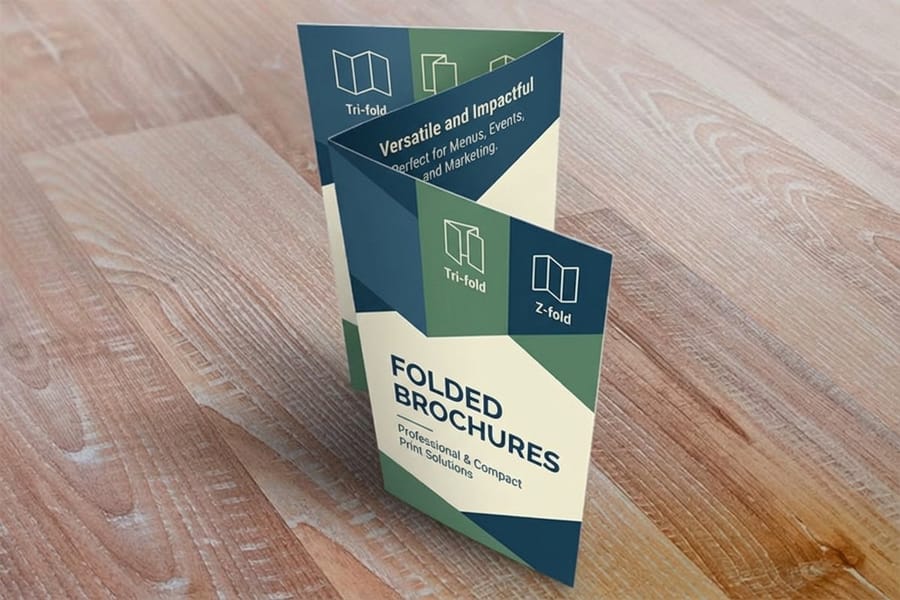
Starting prices at 4OVER4.COM tell you where the fold and the binding show up in a quote. All five of these run on the same presses, so the gaps are almost entirely finishing and paper.
| Format | Reading surfaces | Starts at | Where it belongs |
|---|---|---|---|
| Standard Flyers | 2, front and back | $39.54 | One offer, handed out in volume or posted where people pass. |
| Standard Rack Cards | 2, in a narrow 4 by 9 format | $42.84 | Display racks and counters, where width is limited and the header has to read from a distance. |
| Standard Brochures | 6 on a tri-fold | $57.11 | A service explained in sections, a menu, a program, a leave-behind after a conversation. |
| Folded Flyers | 4 on a bi-fold | $68.54 | More room than a flyer without the tri-fold sequence, on lighter stock than a brochure. |
| Standard Booklets | 8 pages and up, saddle stitched | $240.55 | Catalogs, full product ranges, anything a reader will return to more than once. |
Read the gap between the first and third rows. Roughly 44 percent more buys you the folding pass and four extra surfaces, which is cheap per panel and expensive per piece. Order 250 flyers and 250 brochures and the difference is real money at the counter, not on the spreadsheet. The jump to booklets is a different order of magnitude, because saddle stitching adds a bindery step and a minimum page count in multiples of four.
Side by side, the flyer and the brochure differ in fold and stock more than in size.
| Spec | Standard Flyers | Standard Brochures |
|---|---|---|
| Sizes | Nine, from 4.25 by 5.5 to 11 by 25.5 inches. | Six, from 5.5 by 8.5 to 11 by 25.5 inches. |
| Stocks | 100# gloss or silk text, 70# uncoated text, 80# or 100# cover, 14pt gloss or uncoated cover. | 100# gloss or silk text, 70# uncoated text, 14pt gloss cover. |
| Fold | Flat. Folded Flyers add half, tri, Z and gate folds. | Flat or half fold on the order form. |
| Full color front, or both sides. | Full color front, or both sides. | |
| Run and time | From 50, 3 business days. | From 50, 3 business days. |
Both take a PDF at the flat trim size with bleed, and both offer a free online proof, which is where you check panel order on a folded piece before it prints.
The Content Test That Settles It
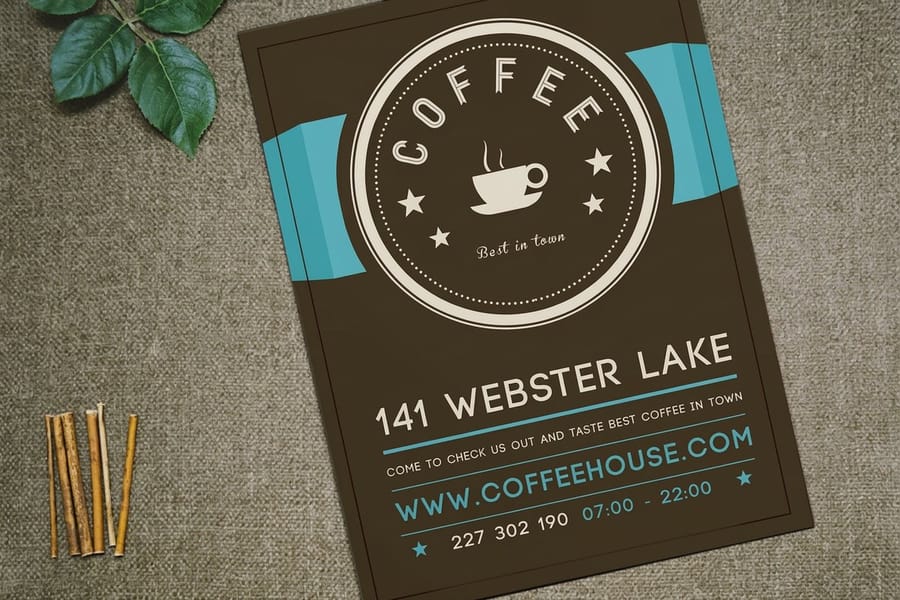
Write your content before you pick the format. Then count the sections, not the words.
- One section. A date, a price, an opening, a sale. Print a flyer and give the message the whole sheet.
- Two sections. An offer and the proof behind it. Still a flyer, using the back for the proof.
- Three to five sections. Services, tiers, a process, a schedule. This is brochure territory, and each section gets its own panel.
- Six or more. You have outgrown panels. Look at a booklet, where readers can flip back to page two without refolding anything.
The failure case is the three-section brochure padded out to six panels with stock photography and a mission statement. Readers notice the padding before they notice the content, and you paid the folding cost for the privilege. A flyer with three tight sections beats a brochure with three sections and three panels of filler every time.
There is a second test worth running. Read your copy out loud and time it. Under fifteen seconds means a flat piece. A minute or more means the reader has to be seated, holding it, already interested, which is exactly the situation a brochure is built for. If you are still torn, the three-way format comparison adds the booklet to the same decision.
Setting Up Each File Without a Reprint
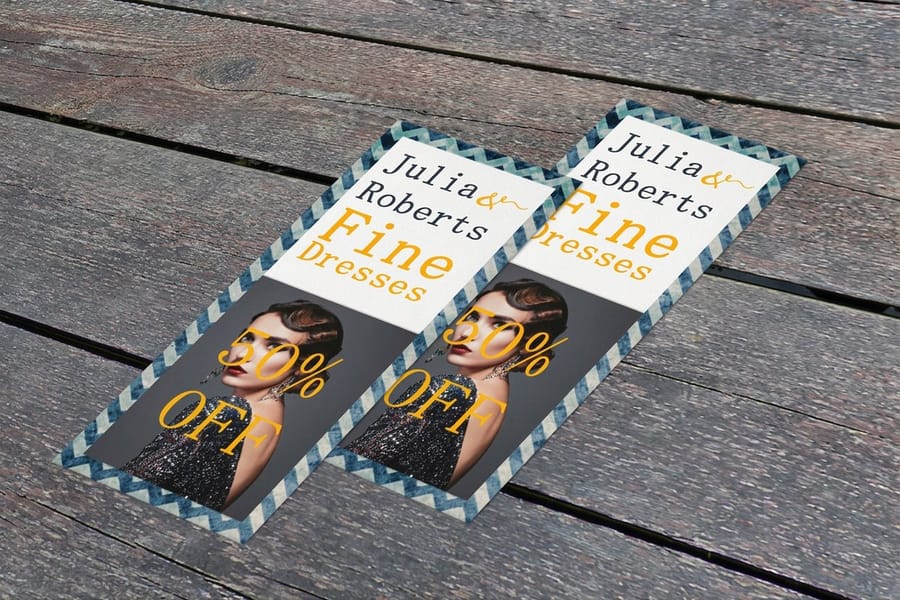
A flyer file is the simpler of the two by a wide margin. Build front and back at final size, add an eighth inch of bleed on every edge, keep live text an eighth inch inside the trim, and supply CMYK at 300 dpi. That is the entire brief. Our bleed and trim guide covers what happens at the cutter if you skip the margin.
A brochure file adds the fold, and the fold adds three specific traps. First, the panels are different widths. On an 11 inch tri-fold, the tuck-in panel is trimmed to about 3.625 inches while the other two sit at 3.6875, because a panel folding inside three layers of paper needs the clearance. Build on three equal columns and your artwork drifts off the crease by a sixteenth, which is visible on any panel with a background color.
Second, keep type away from the fold. A quarter inch of clearance on both sides of every crease is the working minimum, and headlines that straddle a fold read as a mistake even when the fold is perfect. Third, do not print the fold marks. Supply the artwork clean and let the bindery position the score, because a printed guide line becomes a printed guide line on 500 pieces.
Panel order catches people out too. The outside spread reads tuck panel, back cover, front cover from left to right, which feels backwards until you fold a proof by hand. Print one, fold it, and check before you upload. The brochure sizes and folds guide shows the panel maps for each fold, and the blank templates already carry the correct widths. Our guide to blank brochure templates explains how the panel guides in each file work.
Wally sizes up the fold
Two surfaces in one hand, six panels in the other
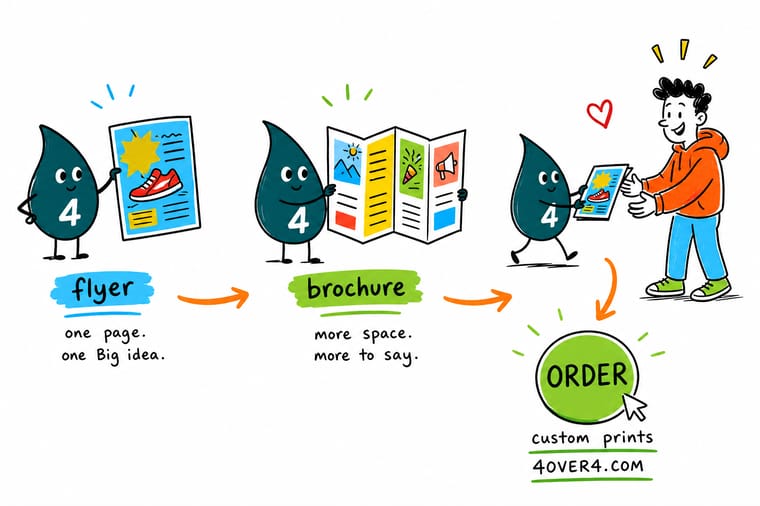
Wally holds the same sheet twice. Flat, it is a flyer with a front and a back, and it survives a windshield, a corkboard and a doorway. Folded twice, it is a brochure with six panels that only works once someone opens it. He counts content sections before he counts panels: one or two sections stay flat, three to five earn the fold, six or more head for a booklet. And he trims the tuck-in panel a sixteenth narrower, so the brochure closes flat instead of buckling at the spine.
Compare flyer and brochure pricing →
Specs and pricing
Sizes, stocks and starting prices, side by side
Flyers run nine sizes from 4.25 by 5.5 to 11 by 25.5 inches on text and cover stocks from 50 sheets. Brochures run six sizes from 5.5 by 8.5 to 11 by 25.5 inches on 100# gloss or silk text, 70# uncoated or 14pt gloss cover, flat or half folded, from 50. Both print in 3 business days, and each panel below shows the live options and price.


Print it
Order the format your content actually needs
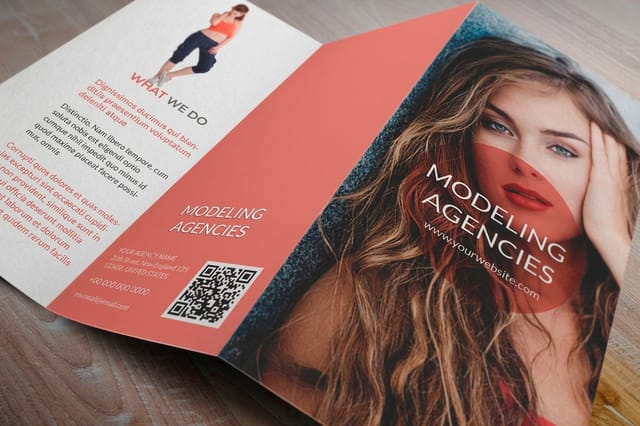
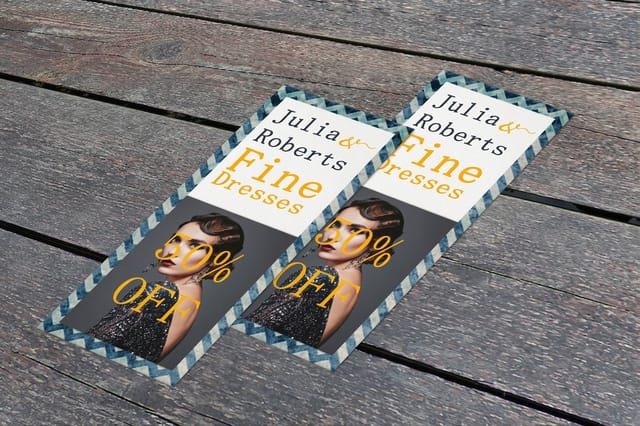
One or two sections go on a flyer from 50 sheets, three to five on a brochure, and a display rack takes a 3.5 by 8.5 or 4 by 9 inch rack card on cover stock, from 50 at $42.84.

Explore more
Where to go next
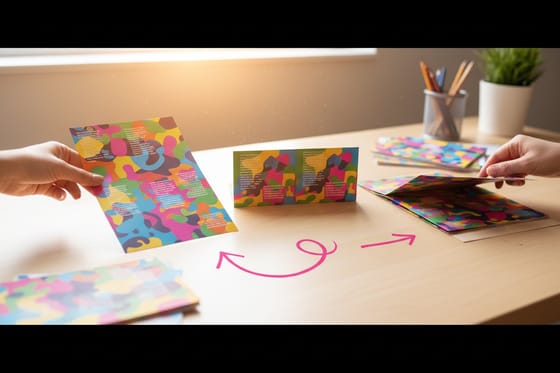
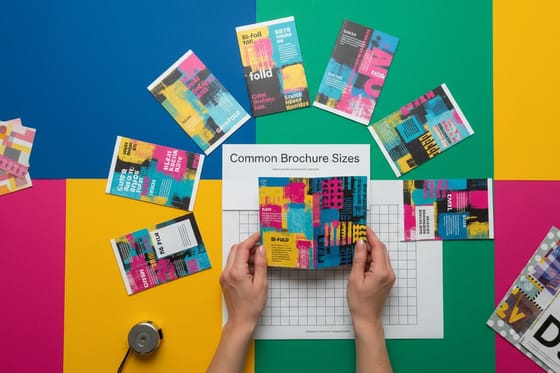
The cards below add the booklet to the decision, map every brochure size and fold, cover where flyers get taken, and explain why a text weight sheet folds best.

By the numbers
Twenty five years of flyer and brochure runs, counted
Common Questions
Your flyer and brochure questions, answered
Is a flyer or a brochure better for a trade show?
Bring both and give them out at different moments. A flyer works for the person walking past who takes it without stopping, because the whole message has to land while they are still moving. A brochure works after a conversation, when someone has told you what they need and you want them to leave with the pricing, the specs and a way to reach you. Handing a brochure to everyone who passes the booth is the fastest way to print 500 pieces and recover 60 of them from the floor.
Can I just print a flyer and fold it myself?
You can, and it will look folded by hand. Machine folding scores the sheet before it creases, which stops the coating from cracking along the fold on anything with a gloss finish. Hand folding a 100lb gloss cover sheet leaves a white line down the crease within a day. If budget is the reason, the cheaper route is a smaller flat piece rather than a hand-folded big one. Our folded brochures price the fold into the job at $57.11 to start.
What paper should each one be on?
Flyers handed out in volume run well on 100lb gloss text, which is light enough to carry a stack of 250 and cheap enough that unread copies do not sting. Anything meant to be kept, pinned up, or left on a counter earns 100lb gloss cover. Brochures almost always want cover weight, because a text-weight tri-fold flops open in a rack and refuses to stand. The flyer paper weight guide covers the trade-off in more detail.
Which format works better for direct mail?
Neither, usually. A flat flyer in an envelope adds envelope cost and an extra opening step, and a brochure mailed loose gets mangled unless it is tabbed shut. For mail, a heavier self-mailer beats both, which is why postcards start at $16.48 and outperform folded pieces on cost per delivered impression. Use the brochure as the leave-behind after the postcard brings someone in.
How many panels do I actually need?
Count your sections first, then pick the fold. Three sections plus a cover and a contact panel fits a standard tri-fold with room to breathe. Two sections means you wanted a flyer. Six or more means you are heading toward a booklet, and at that point booklets at $240.55 give you saddle-stitched pages that stay in order instead of panels that unfold into a mess. The fold types guide maps each fold to a panel count.
Do brochures need a different file setup than flyers?
Yes, and this is where most first-time brochure files fail. A flyer is two artboards, front and back, with a standard bleed. A brochure is two spreads, and the panels inside each spread are different widths, so artwork built on three equal columns will drift off the fold. Build the outside spread with the tuck panel narrower, keep type at least a quarter inch off every fold line, and never print the fold marks themselves. Start from a correctly built file in the blank template library.
Get Started
50 flyers cost $39.54, 50 folded brochures $57.11
Pick your size and stock, upload the file, and we print flat flyers or scored tri-fold brochures on the same presses with the same color.
Legal Disclaimer
Gold Standard guarantees apply to all standard orders placed through 4over4.com. Price match requires verifiable proof of a competitor's published price for an equivalent product with matching specifications and turnaround time. Satisfaction guarantee covers manufacturing defects and print quality issues. Contact support with order number and documentation.
