
How to Order Bulk Booklet Printing and Cut the Cost Per Copy


Where the price per copy actually falls, which binding your page count allows, and what to send a printer so a large quote comes back right the first time.
Bulk booklet printing gets cheaper per copy because the expensive part is paid once. Prepress, press makeready and the bindery setup cost about the same at 250 copies as at 5,000, so the unit price falls as the run grows until paper and ink become a floor it cannot go below. Most of that saving arrives inside the first thousand copies. After that, the levers that still move the quote are binding, page count and stock, not a bigger number.

Quick answer
Fixed cost divided by the run, with paper as the floor
Volume pricing on booklets is one idea repeated at every stage. Prepress, makeready and bindery setup are paid once, so every extra copy makes each one cheaper, while paper and ink scale straight through and stop the curve at a floor. The steep part of that curve sits in the first thousand copies. Beyond it, choosing saddle stitch over Wire-O, dropping four pages, or staying on 80 lb text instead of 100 lb will each save more than another thousand copies would.
Why a Bigger Booklet Run Costs Less Per Copy
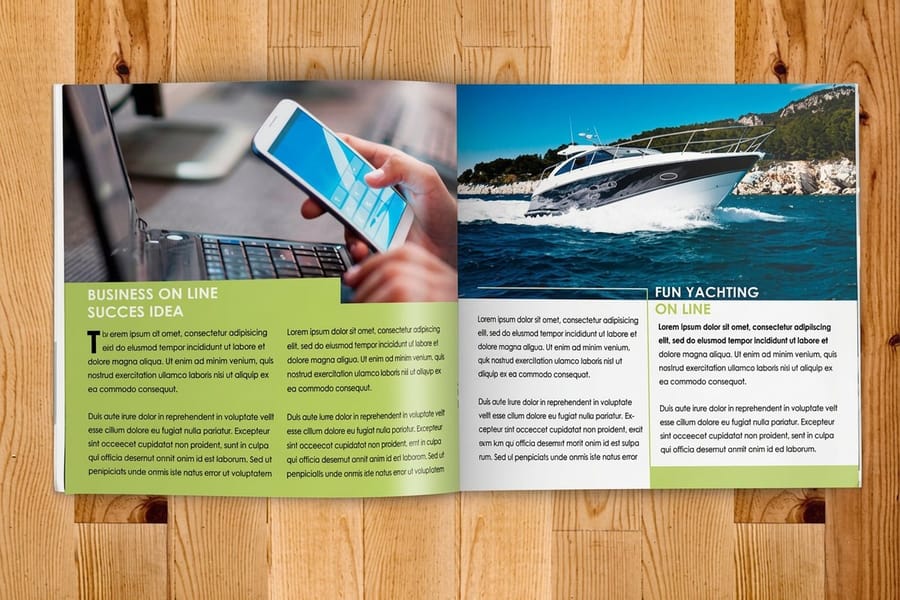
A booklet has two kinds of cost sitting inside it, and only one of them cares how many you order.
The fixed side is prepress, imposition, plates or a digital raster, press makeready, and the bindery setup for folding, stitching and trimming. A press operator spends the same time bringing color up to the proof whether the run is 250 or 5,000. The bindery spends the same time setting fold plates and knife positions. That work is paid once and then divided by however many copies come off the end.
The variable side is paper, ink and the click or impression charge. It scales one to one. Print twice as many copies and you buy twice as much paper, with no discount hiding in the arithmetic beyond ordinary stock pricing.
Put those together and you get the curve in the diagram above. The steep part, where each extra hundred copies visibly cuts the unit price, lives in the first thousand. After that the fixed cost is already thin and you are essentially buying paper, so the line flattens and never touches zero. Standard Booklets start at $240.55 for a full configured run, and the way to move that number down per copy is quantity first, then stock, then page count.
There is a second effect once the run gets large enough to justify offset. Digital printing charges by the impression with no plate cost, which makes short runs cheap and long runs linear. Offset charges for plates and makeready up front but runs sheets far more cheaply, so it wins once the quantity is high enough to absorb the setup. For a 16 to 32 page booklet that handover usually lands in the high hundreds to low thousands of copies, and it shifts with page count and how many colors are on the sheet. Our comparison of digital and offset printing for booklets covers where your job is likely to sit.
Binding Options and How Each One Behaves at Volume
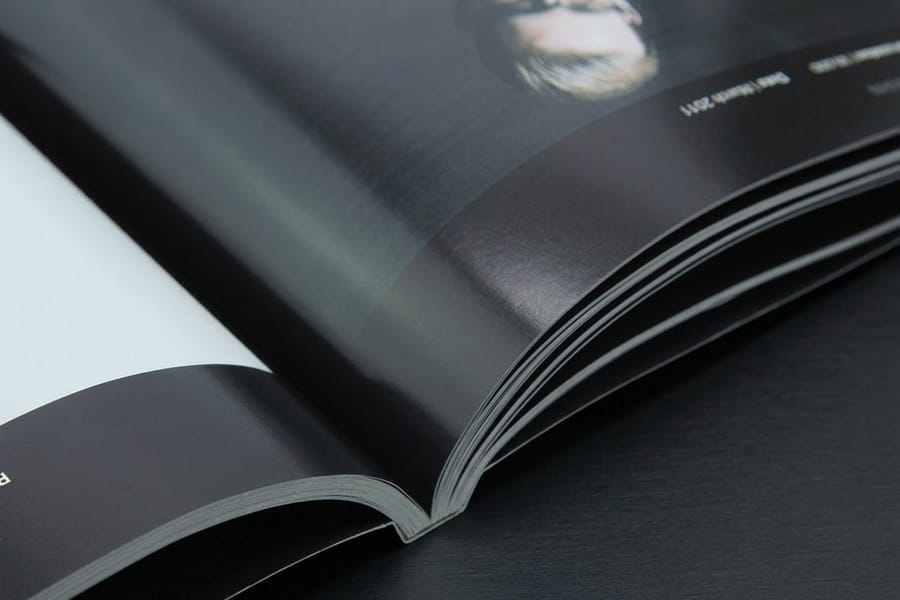
Binding is not a style decision on a bulk job. It is set by page count first, then by how the reader has to use the booklet, and it changes how well the run scales.
| Binding | Page range it suits | How it opens | How it behaves in bulk |
|---|---|---|---|
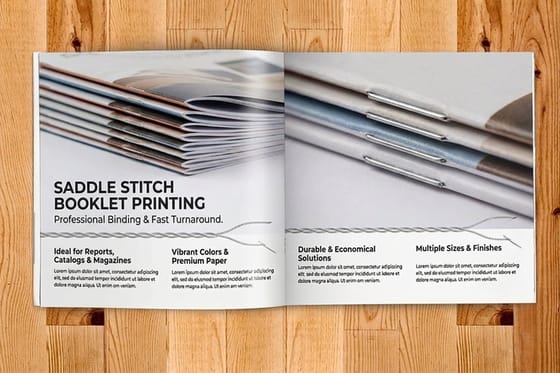
| Saddle stitch | 8 to about 64 pages, in multiples of four | Opens near flat, spine is folded and stapled, no printed spine | The cheapest to set up and the fastest through the bindery, so it scales better than anything else here |
| Perfect bound | Roughly 40 pages and up | Flat printed spine, does not lie open on its own | Glue and cover scoring add a setup step, but the per copy cost still falls hard with quantity |
| Wire-O and coil | Almost any count, no multiple of four rule | Lies completely flat and folds back on itself | Binding is mechanical and part hand fed, so the unit cost flattens earlier and saves less at volume |
| Square trim | Follows its underlying binding | Same as the binding used | Trim shape changes the sheet layout, so confirm the sheet yield before committing to a large run |
Read the last column when you are ordering volume. Saddle stitch is the format that rewards a big quantity most, because folding and stitching are continuous machine operations. Wire-O is the opposite: the binding step involves handling, so a run of 5,000 costs close to five times a run of 1,000, and the quantity break you were hoping for is thin.
Two limits are worth naming honestly. Saddle stitch stops being pleasant somewhere near 64 pages on normal text stock, because the spine bulges and the booklet fights being closed. Perfect binding has a floor rather than a ceiling: below roughly 40 pages there is not enough thickness for glue to hold a square spine reliably. Between those two numbers you have a genuine choice. Outside them you do not. The full binding types guide goes deeper, and our binding service covers work bound from sheets we did not print.
Page Count and Paper, the Two Levers That Move a Big Quote
Once quantity has done its work, page count and stock are what is left to move.
Page count moves in fours on any folded booklet, because one folded sheet carries four pages. A 30 page manuscript becomes a 32 page booklet, and you pay for all 32. That rounding is worth knowing before layout rather than after, since dropping two pages of loose content can take a 34 page draft back down to 32 and remove a whole sheet from every single copy in the run. On 5,000 copies that is 5,000 sheets. Our guide to booklet page counts and creep works through both the arithmetic and the trimming problem that comes with thick booklets.
Paper is the other lever, and at volume it is the bigger one.
- Interior text stock. 80 lb text is the everyday choice and holds ink well on a coated finish. 100 lb text feels more substantial and hides show-through on heavy ink coverage, at a real price difference multiplied across the run.
- Cover stock. A plus cover on 100 lb gloss cover or a 12pt board protects the booklet and takes a lamination. A self cover, printed on the same text stock as the inside, is cheaper and thinner and is fine for a short internal document.
- Coating and finish. Gloss lifts photography, matte reads better under office lighting, and uncoated takes a pen. Aqueous or a soft touch lamination on the cover adds cost per copy but survives handling, which matters on a catalog people flip through repeatedly.
- Weight. Heavier stock thickens the spine, worsens creep on a saddle stitched job, and raises the freight bill on a pallet. Three separate costs move together when you upgrade paper.
If the booklet is a product catalog rather than a marketing piece, the calculus shifts slightly toward durability, because catalogs get reread. Standard Catalogs start at $240.55 and take the same bindings; the difference is editorial, and booklets versus catalogs lays out which one your content really is.
Setting Up a Booklet File That Survives a Large Run
A file error on 250 copies is annoying. The same error on 5,000 is a reprint, so the setup rules matter more as the quantity climbs.
- Supply single pages in reader order. Page one is the front cover. Imposition software builds the printer pairs; a hand assembled spread file is where page transpositions creep in on long documents.
- Bleed 0.125 inch, safety 0.25 inch. Extend any background past the trim on all four sides and keep type, folios and logos comfortably inside it. Trimming a thick stack has more variation than trimming a few sheets.
- Mind the creep on thick booklets. Inner sheets push out past the outer ones, and the face trim cuts them shorter. On anything above about 32 pages, pull the inner margins wider or ask for creep compensation at imposition.
- Land the count on a multiple of four. Before you export, confirm the total. Add a notes page or a back cover message rather than shipping a file that has to be padded at the printer.
- CMYK, 300 ppi, fonts embedded or outlined. Export PDF/X-1a, place images at their final size, and convert any RGB artwork yourself so you see the color shift before the press does.
- Order a proof on a large run. A hard copy proof costs one booklet and a day. It is the cheapest insurance available on a four figure quantity.
Cross-check the whole file against how to order booklet printing before you upload, and if you are pricing several bound formats at once the binding options collection shows what each one needs from the file.
Getting a Volume Quote Worth Comparing

A booklet quote is only comparable when every variable is written down, and most quotes that come back wildly different are describing different jobs.
Give the printer these seven things and the numbers line up: flat and finished size, total page count including the cover, interior stock and cover stock, ink coverage on each, binding, quantity, and the date you need it in hand. Ask for two or three quantities on the same sheet rather than one. Seeing 1,000 next to 2,500 next to 5,000 shows you exactly where your own curve flattens, which is the single most useful number in the conversation.
You can configure most of that yourself. Pick your size, page count, stocks and quantity on Standard Booklets and the price updates live, which makes it easy to test one variable at a time. Change only the quantity and watch the per copy figure; then change only the paper and watch it again. That is a faster way to find the efficient spec than describing it in an email.
On genuinely large runs, ask about the price match guarantee before you place the order, not after. Bring the competing quote with the full spec attached so the two jobs can be compared line for line, since a rival price on a lighter stock or a self cover is not the same booklet. For a run big enough to matter, that one email is worth more than any coupon.
Lead Times, Freight and What Actually Slows a Big Run Down
Printing is rarely the long pole on a bulk booklet. Finishing and freight are.
Once the press is set, sheets come off quickly, and the difference between 1,000 and 5,000 copies on press is smaller than most people expect. The bindery is where quantity turns into hours: folding, collating, stitching or gluing, and trimming all touch every copy. Add a lamination or a die cut and the job takes another pass through another machine, with its own queue.
Freight is the second surprise. A few thousand multi page booklets on 100 lb text is heavy enough to travel as palletized freight rather than parcel, which brings a delivery appointment, a receiving requirement, and a different transit calculation. Before you order, confirm the delivery address can take a pallet and that somebody is there to sign for it. If the booklets go out over months rather than weeks, ask whether part of the run can ship now and the rest later, because a pallet in a small office is a problem you only discover once.
Plan backward from the date you need them in hand and leave room for a proof. Working forward from your file being ready is how a launch date gets missed by two days. If your project is smaller or unbound, folded brochures start at $57.11 and skip the bindery entirely, and bulk notebook printing covers the same quantity break logic for a different bound product.
Wally explains bulk booklet pricing
One setup, divided by however many you order
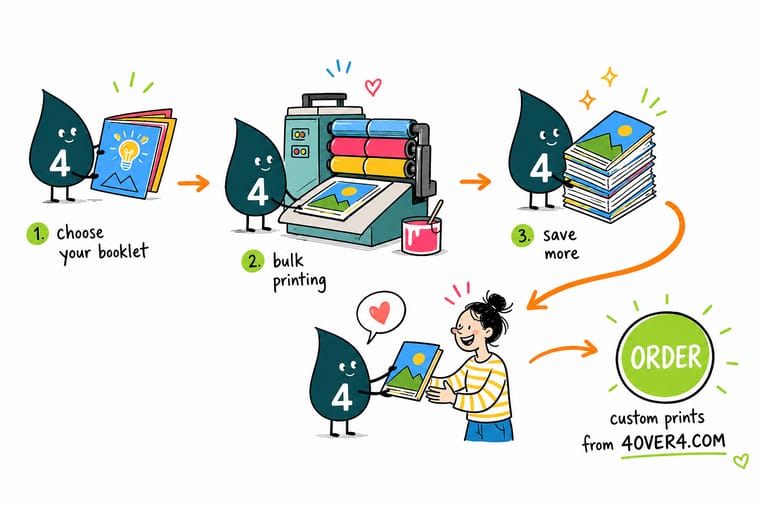
Wally pays for the plates, the makeready and the bindery setup once. Then he splits that bill across the run. At 250 copies each booklet carries a big slice of it. At 2,500 the slice is thin, and what is left is mostly paper, which never gets free. That is why the price per copy dives early and then flattens out. When it flattens, Wally stops adding quantity and starts looking at binding, page count and stock instead.
Configure a booklet run →Specs and pricing
Bound formats, page ranges, and starting prices
Compare the three bound formats side by side, with live size, stock and quantity choices and starting prices straight from the 4OVER4.COM configurator.


Print it
Order the booklet run at the quantity that pays

Explore more
Where to go next

By the numbers
Booklet runs from a shop 150,000+ businesses have used
Common Questions
Your bulk booklet questions, answered
What quantity is the sweet spot for bulk booklet printing?
For most marketing booklets the curve bends somewhere between 500 and 2,500 copies. Below 500 the setup is still a large share of every unit, so each extra hundred copies knocks a visible amount off the per-copy price. Above about 2,500 the setup has already been diluted and you are mostly buying paper, so the unit price barely moves. If you are choosing between 2,500 and 5,000, decide it on shelf life rather than on price, because the saving per copy at that end of the range is small and the storage and obsolescence risk is not.
How many pages can a saddle stitched booklet hold before I have to change binding?
On 80 lb or 100 lb text stock, saddle stitch stays comfortable to roughly 64 pages. Past that the folded sheets stack up at the spine, the booklet stops lying flat, the staples work harder, and creep pushes the inner pages so far out that trimming eats into your margins. When a project keeps growing past 64 pages, move it to a perfect bound book, which glues a flat printed spine and handles a few hundred pages without complaint.
Why does my page count have to be a multiple of four?
A booklet is built from folded sheets, and one folded sheet carries four pages: two on the front, two on the back. There is no way to add a single leaf to a saddle stitched booklet without leaving a stub, so the count moves in fours. If your content lands on 14 pages you will print 16 and two pages will be blank or filled with a notes page. Deciding this before layout is cheaper than discovering it after the file is built, and our guide to booklet page counts and creep walks through the arithmetic.
Should I supply spreads or single pages?
Single pages, in reader order, starting with the front cover as page one. Imposition software rearranges them into printer pairs, and it does that far more reliably than a human reshuffling a file by hand. Supplying reader spreads means someone has to split them, which is where pages get transposed on long documents. Export a print ready PDF with 0.125 inch bleed on all four sides and keep anything you care about at least 0.25 inch inside the trim.
Does a larger run change my paper options?
It changes the economics of them more than the availability. Paper is the variable cost, so a stock upgrade that adds a modest amount to 250 copies multiplies straight through on 5,000. Going from 80 lb to 100 lb gloss text across a 32 page booklet is a small decision at short run and a real budget line at volume. Heavier interior stock also thickens the spine, which pulls a saddle stitched job closer to its page limit and makes creep worse.
How long does a large booklet run take, and how does it ship?
Print time barely changes with quantity because the press runs fast once it is set up. Bindery and finishing are what stretch, since folding, collating, stitching or gluing and trimming all happen copy by copy. Weight is the other thing that changes. Several thousand multi page booklets is pallet freight rather than a parcel, so confirm the delivery point can receive a pallet, and ask about a staged release if you do not have room for all of it at once.
Get Started
25 booklets start at $240.55, a perfect bound book at $375.05 for 10
Set your size, page count, stocks and quantity, then compare two or three quantities on the same spec and order at the point where the curve flattens.
Legal Disclaimer
Gold Standard guarantees apply to all standard orders placed through 4over4.com. Price match requires verifiable proof of a competitor's published price for an equivalent product with matching specifications and turnaround time. Satisfaction guarantee covers manufacturing defects and print quality issues. Contact support with order number and documentation. On-time delivery rate based on tracked orders 1999 to 2026. Individual results may vary based on shipping carrier performance.
