
The 6-Piece Edge Painted Luxury Card Set That Makes a Small Brand Look Expensive
A painted edge is one detail, and one detail is not an identity. These six pieces share a stock, a thickness and a color so the card, the mailer and the follow-up all read as the same company. Every price below comes straight from the configurator.
An edge painted set is six pieces built on the same thick body, so the color on the edge is the thing that ties them together. Edge painted business cards and postcards use 32pt UltraWhite uncoated with 16 paint colors, edge gilded and majestic cards use 32pt or 48pt laminated stock with 19 mirror foils, layer cake reaches a colored edge through a dyed core, and ultra thick gives you the same 32pt body bare. Paint needs an uncoated card, foil does not, and that one rule decides which of the six you order.
The picks
The six pieces, priced live
Start here. These are the six products in the set, numbered from the anchor card outward, each priced live from the configurator. Order the ones you need together so the stock, the edge color and the turnaround stay aligned, then read on for what each piece does and where it stops working.
Stock and edge
What each piece is made of, and what its edge actually does
Six pieces, two families. The painted ones need an uncoated body, the gilded ones need a laminated one, layer cake builds the color into the card itself, and the ultra thick card leaves the edge bare on purpose. Read the row, then jump to the piece.
| Piece | Stock and thickness | What the edge does | From |
|---|---|---|---|
| 1. Edge painted business cards | 32pt UltraWhite uncoated cover | Hand-painted band in 1 of 16 colors, all four sides | $141.70 per 250 |
| 2. Edge painted postcards | 32pt UltraWhite uncoated cover | Same 16 paint colors on a 4.25 by 5.5 up to 5 by 7 card | $302.06 per 250 |
| 3. Edge gilded business cards | 32pt or 48pt silk or velvet laminated | Mirror foil in 1 of 19 colors, applied to the cut edge | $328.42 per 250 |
| 4. Layer cake business cards | 32pt to 60pt UltraWhite, plus 40pt and 56pt gloss | A dyed center layer that reads as a stripe, 5 seam colors | $39.11 per 50 |
| 5. Ultra thick business cards | 32pt, 48pt, 64pt, 80pt uncoated, 40pt to 72pt gloss | Left bare, so the white core is the edge | $36.62 per 50 |
| 6. Majestic business cards | 32pt or 48pt silk or velvet laminated | Paint or gilding, combined with foil, emboss, deboss or spot UV | $251.36 per 250 |
1. Edge painted business cards: the piece the whole set is built around
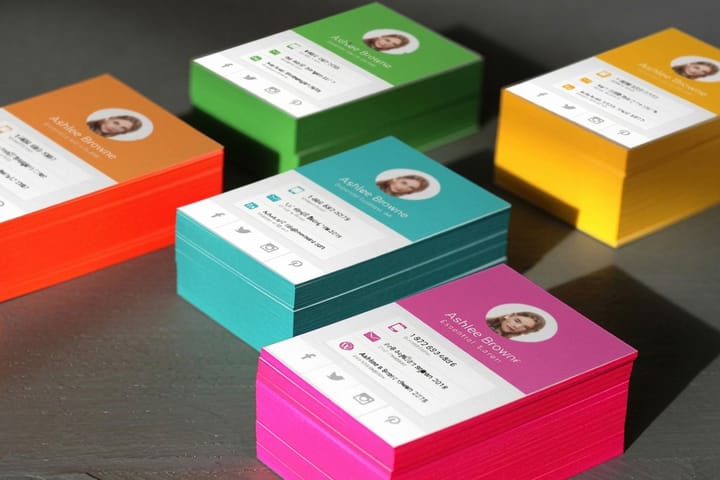
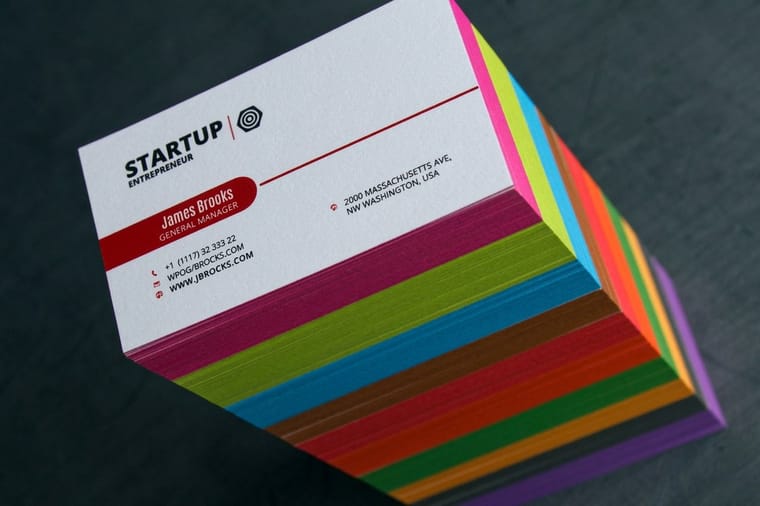
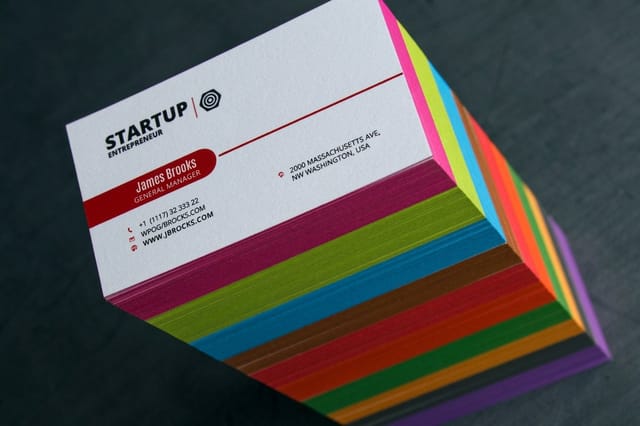
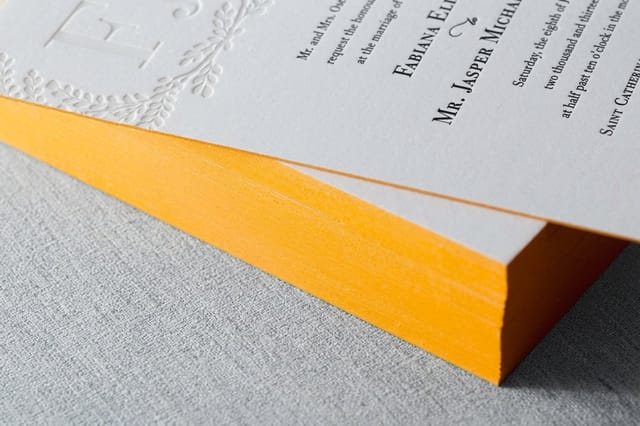
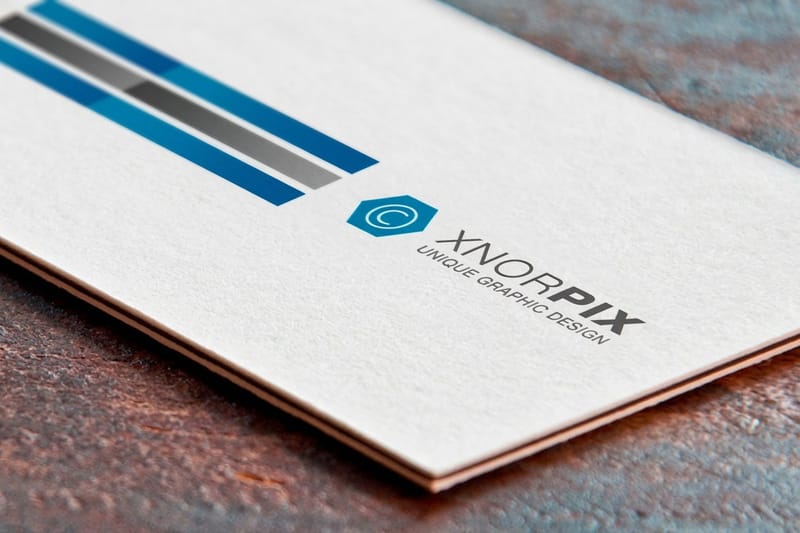
This is the anchor. An edge painted business card is a 32pt UltraWhite uncoated cover printed full color on the face, with all four cut edges painted in one of 16 colors. A set of 250 starts at $141.70, which is about 57 cents a card, and the per-card cost slides toward 24 cents by the time you reach 2,000.
The reason the stock is uncoated is not a style choice. Paint has to bite into exposed paper fiber to sit flat and stay put, and a laminated card presents a strip of plastic film at the edge instead. That is why our laminated stocks get gilded rather than painted, and it is the single fact that sorts these six pieces into two families.
The cost of that uncoated body is on the printed face. Ink dries down flatter on uncoated 32pt than it does on gloss, so a photograph loses some of its snap and deep blacks sit a shade lighter. Give this card type, a logo and flat blocks of color. Keep the face pale and let the edge carry the contrast, because a white card ringed in black or oxblood reads from across a table while a dark full-bleed face with a dark edge just looks like a thick card.
Two things to get right in the file. Hold your type back from the trim, since a painted edge draws the eye straight to the border and any drift there is obvious. And pick the edge color against the face, not against your logo. If you have never set one of these up, our walkthrough on how painted edge business cards are made covers the build, and cardstock weights explained puts 32pt in context against the 14pt and 16pt everyone else hands out.
2. Edge painted postcards: the same edge on something that arrives in the mail

Same body, bigger canvas. Edge painted postcards use the identical 32pt UltraWhite uncoated cover and the identical 16 paint colors, in sizes from 4.25 by 5.5 inches up to 5 by 7, with custom sizing to the same 5 by 7 ceiling. A set of 250 starts at $302.06, about $1.21 each, easing to roughly 96 cents at 1,000.
Match the paint color to the card and the two pieces read as one identity, which is the whole point of buying them together. The card goes in a hand, the postcard goes in an envelope, and the shared band of color does the work that a logo alone cannot.
Be honest about what this is for. At $1.21 a piece it is not a prospecting mailer. It is a thank-you after a signed contract, an invitation to a private view, a leave-behind at the end of a pitch, a list of 250 names you can put a face to. Check the mailing class before you commit to a thousand as well, because a 32pt card is stiff enough that it does not behave like an ordinary machinable postcard, and most people send these inside an envelope anyway.
You do not have to start from an empty artboard. Our design templates give you correctly sized layouts with the trim and safety already marked, and the online designer lets you set the type and drop your logo in the browser before you choose an edge color.
3. Edge gilded business cards: a mirror edge instead of a matte one
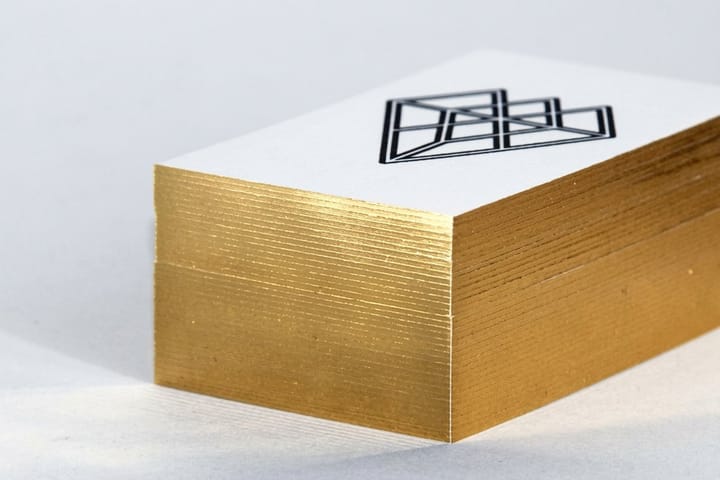
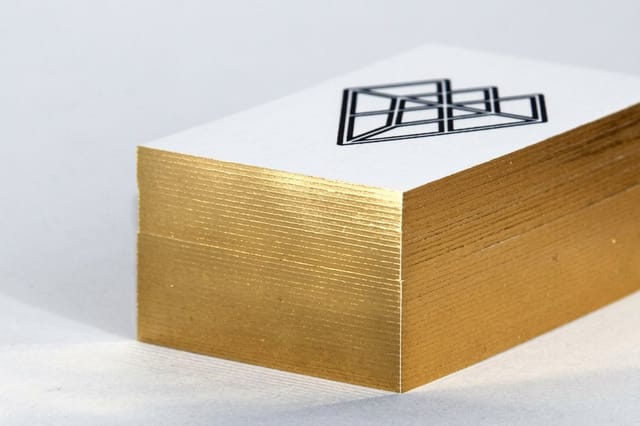
Gilding is the laminated answer to the same idea. Edge gilded business cards come on 32pt or 48pt stock in silk or velvet lamination, with the cut edge carrying one of 19 mirror foils including gold, silver and holographic gold. Sets of 250 start at $328.42, around $1.31 a card, dropping to about 44 cents at 2,000.
The difference from paint is behavior under light. Paint is matte and absorbs, so it holds one flat block of color from any angle. Foil is mirrored and reflects, so it throws a highlight that moves as the card moves. In a bright office both read well. In the warm, low light of a restaurant or a gallery, the gilded edge is the one that still announces itself, and that is usually the room these cards are meant for.
Two limits worth naming. This is the most expensive piece in the set, and a gilded edge fights a busy printed face, because two things competing for the same attention cancel each other out. Give it a quiet card. If you want the metal on the face as well, the 48pt option takes an optional foil stamp on the printed side, which is a lot of shine on one rectangle and a decision to make deliberately rather than by accident. Our guide to what actually makes a business card premium is a useful gut check before you spend at this level.
4. Layer cake business cards: a colored edge with no paint at all
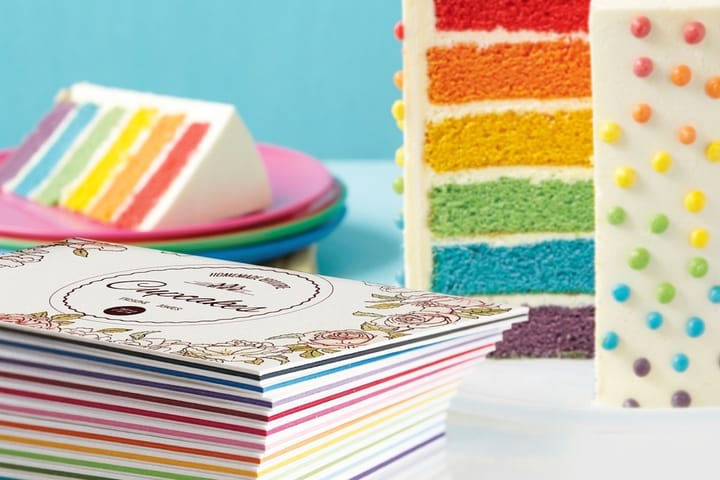
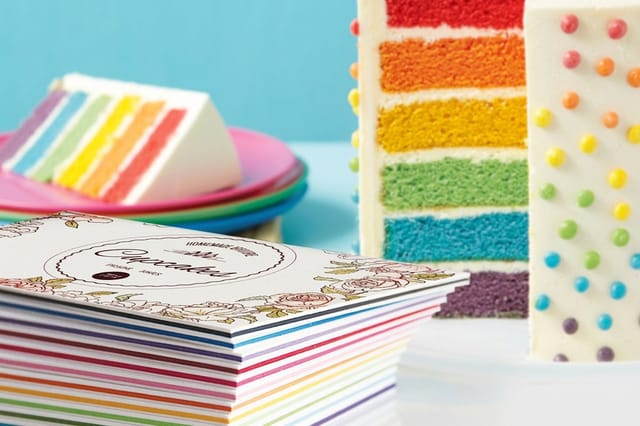
Here is the budget route to the same effect. A layer cake business card sandwiches a dyed center layer between two printed outer sheets, so every cut side shows a stripe of color without anything being applied afterwards. Stocks run from 32pt UltraWhite up to a 60pt build, with 40pt and 56pt gloss options, and 50 cards start at $39.11.
Compare it fairly. The five seam colors are black, blue raspberry, orange fizz, red and pacific breeze, against 16 paint colors on the painted card. And the stripe is a line running down the middle of the edge rather than a solid band across the whole thickness, so it reads as a detail rather than a frame. What you get in return is a card that goes thicker than anything in the painted line and costs a fraction as much.
Pick layer cake when any of these is true:
- You need several hundred cards for a whole team and the painted version blows the budget.
- One of the five seam colors is already a brand color, so nothing is compromised.
- You want maximum thickness, since 60pt is heavier than the 32pt painted body.
- You are testing the look before committing to a painted run.
Pick the painted card instead when the exact color matters, or when you want the color to fill the full edge. If any of the stock terms here are new, the plain-language definitions live in our printing terms reference.
5. Ultra thick business cards: the same body, left bare

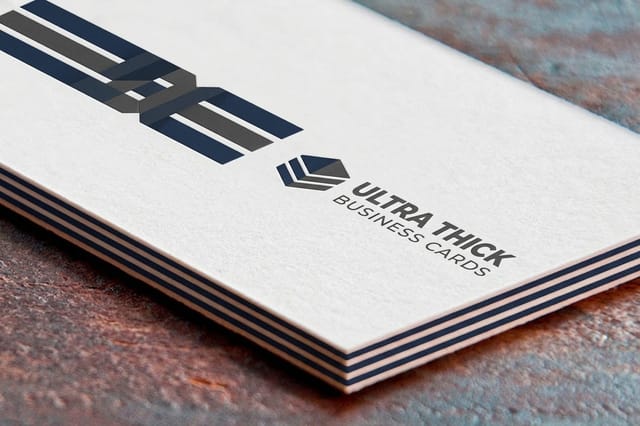
Strip the edge treatment off and you get the base of the whole set. Ultra thick business cards print on UltraWhite uncoated cover in 32pt, 48pt, 64pt and 80pt, plus gloss cover in 40pt, 56pt and 72pt. Fifty start at $36.62, roughly 73 cents each, and the per-card price falls toward 10 cents as the run climbs to 10,000. A standard card runs 14pt to 16pt, so even the lightest option here is double.
It earns its place in an edge set for two practical reasons. First, the 32pt UltraWhite here is the same body the painted card is built on, so a short run tells you whether 32pt feels right in your hand before you pay for paint. Second, it solves the team problem. Principals carry the painted card, everyone else carries the plain 32pt version at a fraction of the cost, and both feel like the same company because the stock is the same stock.
The catch is what a bare edge does over time. An unpainted uncoated edge is a raw white surface, and raw white picks up gray from a pocket, a wallet and a card case. A painted or gilded edge seals that face; a bare one does not. Order a 64pt or 80pt card and you also want to check it fits your card holder before you buy 1,000, because 80pt is thicker than most slots expect. For the finish decision on the face, our comparison of matte, gloss and soft touch finishes lays out how each one ages.
6. Majestic business cards: the one that combines the edge with everything else
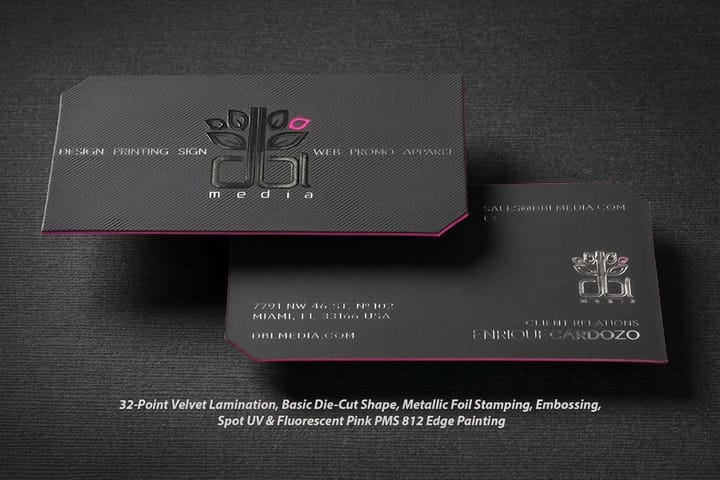
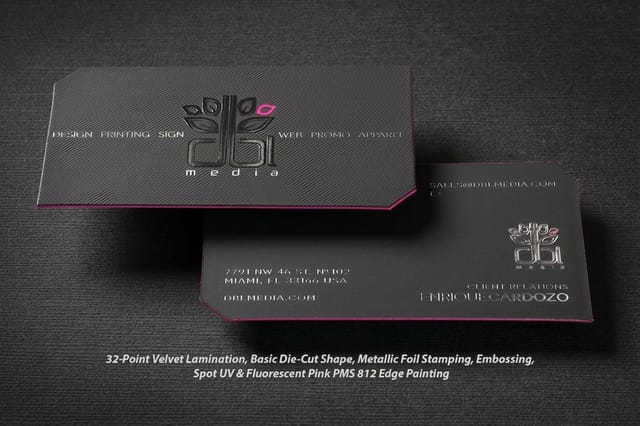
The sixth piece is the one that stops treating the edge as the only idea. Majestic business cards print on 32pt or 48pt silk or velvet laminated stock and accept six finishes: foil stamping, embossing, debossing, spot UV, edge painting and edge gilding, on the front, the back or both. A set of 250 starts at $251.36, about $1.01 a card, sliding to roughly 38 cents at 1,000.
Restraint is the skill here. A deboss of the logo plus a gilded edge is two moves and looks resolved. Foil, an emboss, spot UV and a painted edge on the same 2 by 3.5 rectangle is four, and four reads as a print shop sample rather than a company. Choose the pair that fits the brand and leave the rest of the menu alone.
Now the limit nobody mentions until it is too late. Majestic cards carry a 15 business day standard production time, and so do letterpress business cards, the other stock in our range that takes edge painting and edge gilding. Edge painted cards run 5 business days. If the conference is in two weeks, the decision has been made for you, and our same-day printing options tell you which pieces can still be rescued on a short clock.
Both of the laminated finishes here have a companion on the face. If it is texture you are after rather than metal, suede business cards give you a 16pt soft-touch surface, and spot UV lays a clear gloss over just the logo so it lifts against the matte around it.
Specs and pricing
The two ends of the set: painted edge and layer cake
These two are the decision most people are actually making, one painted after trimming and one colored from the inside out. Here are the live specs and the price ladders for both, straight from the configurator.

| Quantity | Price Per Unit | Total |
|---|---|---|
| 250 | 56.7¢ | $141.70 |
| 500 | 37.1¢ | $185.63 |
| 1,000 | 28.4¢ | $284.49 |
| 2,000 | 24.1¢ | $482.19 |
| Quantity | Price Per Unit | Total |
|---|---|---|
| 50 | 78.2¢ | $39.11 |
| 100 | 67.8¢ | $67.85 |
| 200 | 53.0¢ | $106.03 |
| 300 | 47.7¢ | $143.16 |
| 400 | 39.5¢ | $158.17 |
| 500 | 33.9¢ | $169.66 |
| 600 | 30.0¢ | $180.28 |
| 700 | 27.3¢ | $190.87 |
Wally explains the edge
Paint needs uncoated, foil needs laminated
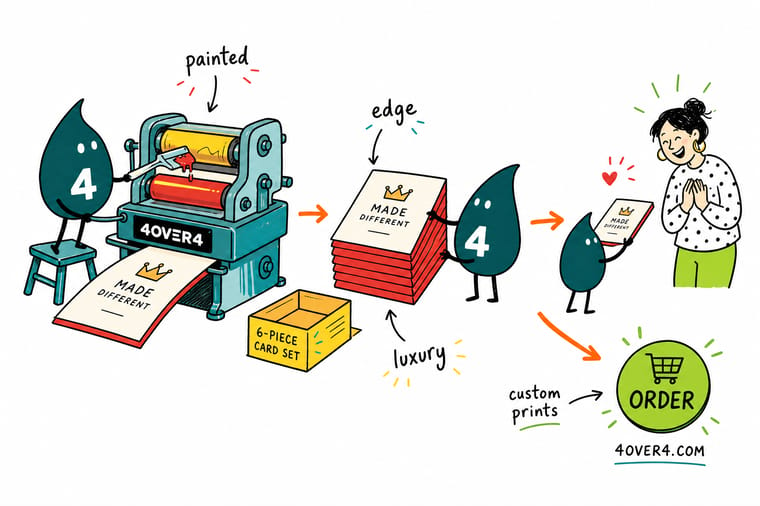
Wally turns the card sideways, because that is where the money went. Paint sinks into the fiber of a 32pt UltraWhite uncoated card and holds one flat color. Foil mirrors onto the edge of a laminated 32pt or 48pt card and throws light back at you. Layer cake skips both and builds a dyed layer into the middle of the card. Pick the family first, then the color, and the six pieces in this set will all look like they came from the same company.
Shop premium printing →See it in use
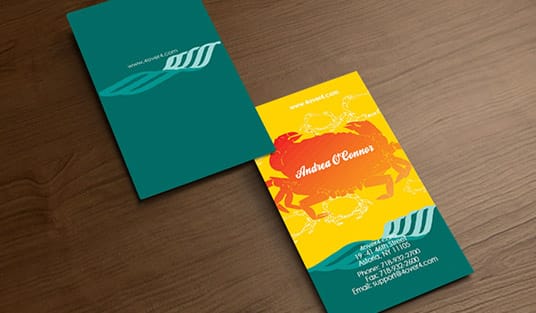
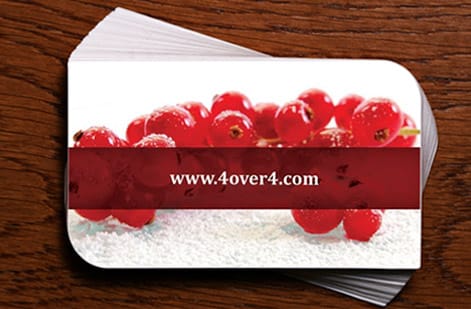
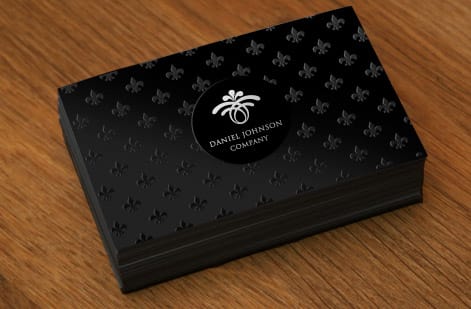
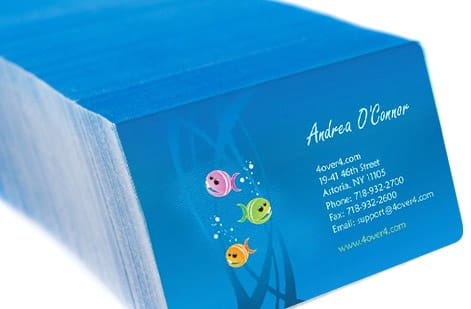
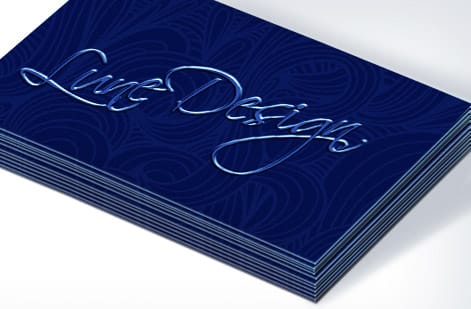
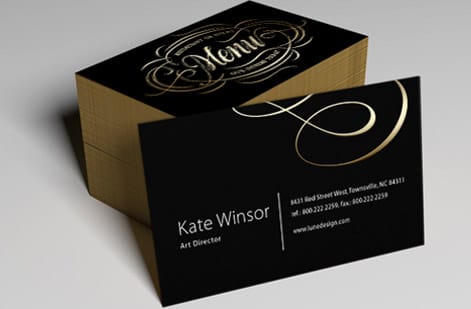
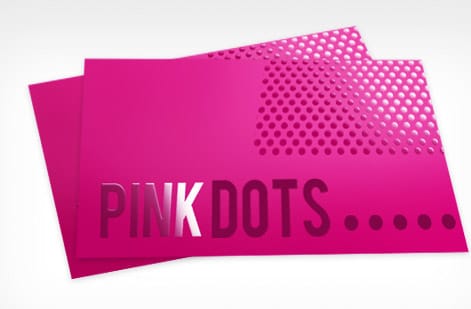
Edge painted business cards, painted edge included
Buying order
How to buy the set without wasting money
Nobody needs all six at once. This is the order that keeps you from paying twice for the same decision.
- Order a short run of ultra thick cards in 32pt UltraWhite first. That is the same body the painted card uses, so you find out whether 32pt is the right weight in your hand before paint is part of the bill.
- Choose the family. Uncoated and matte means paint, laminated and reflective means gilding. That single choice removes half the catalog.
- Pick one edge color and lock it. It has to work on the card, on the postcard and on anything you print next year.
- Order the edge painted cards and the matching postcards in the same run so the two paint batches sit next to each other.
- Add majestic cards only when there is a reason for a second finish, and only when you have 15 business days to spare.
If this set is going into a wider brand rollout, the brand launch essentials kit covers the pieces that sit around the card, and where to print business cards is worth reading before you split an order across two shops and end up with two whites.
Explore more
Where to go next

By the numbers
Printing that holds a painted edge straight
Common Questions
Common questions about edge painted cards
How thick does a business card have to be for edge painting?
At 4OVER4.COM the painted edge starts at 32pt, and that is not an arbitrary floor. The painted band is exactly as tall as the card is thick, so a standard 14pt or 16pt card would give you a hairline that nobody notices from a normal viewing distance. Edge painted business cards and edge painted postcards both use 32pt UltraWhite uncoated cover for that reason, and the layer cake line goes as high as 60pt if you want more edge to look at.
What is the difference between edge painting and edge gilding?
Edge painting brushes matte color into the exposed paper fiber of an uncoated card, so the edge holds one flat block of color from every angle, with 16 colors to pick from. Edge gilding applies a mirror foil to the cut edge of a laminated card, in 19 colors including gold, silver and holographic gold, so the edge reflects and throws a highlight as the card moves. Paint needs an uncoated body, foil does not, which is why the painted pieces are 32pt UltraWhite and the gilded ones are silk or velvet laminated.
What is the cheapest way to get a colored edge on a business card?
Layer cake business cards, which start at $39.11 for 50. Instead of painting the edge, they sandwich a dyed center layer between two printed outer sheets, so every cut side shows a stripe of color as part of the card construction. You are limited to five seam colors, and the color reads as a line down the middle of the edge rather than a full band, but against $141.70 for 250 painted cards the saving is real.
Does a painted edge rub off in a wallet?
The paint is worked into the exposed fiber of the uncoated stock rather than sitting on top of a coating, so it wears far better than most people expect from something applied after trimming. A bare uncoated edge is actually the one that ages worse, because a raw white surface picks up gray from a pocket while a sealed colored one does not. Deep colors on a white core show a scuff more readily than mid tones, so a black edge asks for a card case and a burgundy or navy edge is more forgiving.
Can I have edge paint and foil on the same card?
Yes, on two products. Majestic business cards and letterpress business cards both print on 32pt or 48pt silk or velvet laminated stock and take foil stamping, embossing, debossing, spot UV, edge painting and edge gilding. The trade is time: both carry a 15 business day standard production, against 5 business days for a plain edge painted card. Pick two finishes rather than all six, because a card wearing four different effects stops reading as a brand and starts reading as a demonstration.
Which edge color works with a white card?
Anything with real contrast against the face, which is why black, navy, burgundy and forest hold up best on a white or pale card. The mistake is matching the edge to a dark full-bleed face, because the band then disappears into the card and you have paid for a finish nobody can see. Keep the printed side quiet, pick the edge color against the face rather than against the logo, and hold your type well back from the trim so the eye is not pulled to the border.
Can you paint the edges of cards printed somewhere else?
No. The edge is finished on our own trimmed decks as part of the production run, so the paint or the foil goes on cards that were printed and cut here. If you have artwork sitting with another printer, bring the file over instead of the finished cards. Our rundown of where to print business cards covers what to send and in what format.
How long does an edge painted order take?
Edge painted business cards run a 5 business day standard turnaround, with a free online proof step before anything is printed. Ultra thick business cards run the same 5 business days. Majestic and letterpress cards, the two that combine an edge treatment with foil or embossing, need 15 business days of standard production. Build backwards from the date you need them in hand and add the shipping transit on top rather than counting it inside the production window.
Get Started
Edge painted business cards start at 250 for $141.70
Build the set at 4OVER4.COM. Pick the stock, the thickness and the edge color, and watch the price update live as the quantity climbs.
Legal Disclaimer
Gold Standard guarantees apply to all standard orders placed through 4over4.com. Price match requires verifiable proof of a competitor's published price for an equivalent product with matching specifications and turnaround time. Satisfaction guarantee covers manufacturing defects and print quality issues. Contact support with order number and documentation. On-time delivery rate based on tracked orders 1999 to 2026. Individual results may vary based on shipping carrier performance.
