
How to Validate a Business Idea Before You Spend Real Money


A working method for testing demand in two weeks: who to interview, what to ask, how to build an offer people can actually buy, and the number that tells you to stop.
You validate a business idea by getting strangers to give up something they value before the product exists: money, a refundable deposit, a signed order, or a booked slot. Interviews come first, and they ask what people did last time rather than what they would do next time. Then you put one specific offer with a real price in front of 200 or so people you can describe, and you decide the pass mark before you look at the result.

Quick answer
The only evidence that counts is evidence that cost someone something
Rank every validation signal by what the customer gave up to produce it. Encouragement and survey answers cost nothing, so they predict nothing. An email address costs four seconds and predicts very little. A deposit, a signed letter of intent, or a second purchase costs real money or real reputation, and those are the results worth acting on. Set the pass mark before the test runs, keep the test under a few hundred dollars, and change one variable at a time when the answer comes back weak.
What Validation Proves, and What It Only Feels Like Proving
Every validation method sits somewhere on a single scale: how much the customer had to give up in order to say yes. That is the whole framework, and it explains why so many founders build something nobody wanted despite doing their research.
| Signal | What it costs the person | What it actually proves | Trust it? |
|---|---|---|---|
| A friend likes the idea | Nothing, and social awkwardness if they say no | That they like you | No |
| Survey says "I would buy this" | Thirty seconds and no consequence | The question was phrased agreeably | No |
| Waitlist email signup | An address they already give away daily | Curiosity, and that the headline worked | Weakly |
| Refundable deposit paid | Real money, plus the effort of a refund | The price is inside their range | Yes |
| Signed letter of intent | Their name and their reputation internally | A budget holder believes it | Yes |
| A second purchase | Money again, after seeing the first one | The thing worked | Strongest |
The trap sits in row three. Waitlist numbers rise fast, they look like momentum, and they are the easiest metric to celebrate in a founder update. But an email address is close to free, so a list of 2,000 signups tells you a headline resonated, not that a business exists underneath it.
One limit is worth naming: a strong validation result does not prove the business works. It proves that at this price, to this group, at this moment, the offer is buyable. Margin, delivery cost, repeat rate and churn are separate questions, and our guide to the business metrics that matter covers the ones that decide whether a validated idea survives its first year.
The Conversations That Produce Answers You Can Use
Most founder interviews fail for the same reason: they ask people to predict their own future behavior, and people are terrible at it. Not dishonest, just optimistic. Rewrite every question so it points backward instead.
- Instead of "would you use an app for this?" ask "walk me through the last time you dealt with this. What did you actually do?"
- Instead of "would you pay $40 a month?" ask "what do you spend on this problem right now, including the hours?"
- Instead of "is this a big problem for you?" ask "when did it last cost you money, and how much?"
- Instead of "what features would you want?" ask "what did you try that did not work, and why did you stop using it?"
Three signals mean you have found a real problem: the person has already spent money trying to solve it, they can name the last time it hurt, and they have a workaround they are embarrassed about. A spreadsheet held together by hope is the best market research finding there is. Someone who says the idea is interesting but has never tried to solve the problem is telling you it is not a priority, in the politest way available.
Practical notes that change the quality of what you hear. Never pitch first. The moment you describe your idea, the person switches from reporting facts to grading your plan, and you lose the interview. Take notes in their words, not your summary of their words, because the phrase they use for the problem becomes your headline later. And leave something behind with a way to reach you: a business card costs almost nothing and gets you the follow up call where people say the blunt thing they held back in person.
Recruiting is the hard part, not the asking. Go where the problem already gathers people: an industry meetup, a supplier trade counter, a facilities manager group, a market stall on a Saturday. If you cannot find ten people who have the problem, that is a finding, and it arrived cheaply.
Running a Real Offer Test in Two Weeks

Once the conversations point one way, stop asking and start selling. An offer test puts a price, a description and a payment step in front of people who have never met you, before the product exists. The output is a number, not a feeling.
The minimum viable version has four parts. One, a specific offer: what they get, when they get it, what it costs. Vague beats nothing is false here, because vague offers get polite clicks and no conversions. Two, a price. Free tests validate nothing, since demand at zero is not demand. Three, a commitment step that takes money, a deposit, or a signature. Four, honesty: say the product ships on a date, and refund anyone who changes their mind. Taking preorders for something you may never build is a reputational cost you cannot refund.
For the online version, one page does the job, and our landing page persuasion guide covers how to structure it so the price does not arrive as a surprise. Send it 200 to 400 people from a source you can describe in a sentence, because traffic you cannot characterise produces a conversion rate you cannot interpret.
For anything local, physical, or aimed at people who do not spend their day online, print carries the test better and costs less than the ad budget it replaces. Hand 250 flyers to real people at the place they already stand and you learn something the same afternoon. Standard flyers start at $39.54 and print in a range of sizes, so a two version test with different prices on each is genuinely affordable. Put a distinct code or a separate phone number on each version and you can attribute every response.
If your buyer has an address and not a browsing habit, mail the offer. Standard postcards start at $16.48, and the format forces the discipline this test needs, since a postcard has room for one offer and one call to action and nothing else. The five step direct mail walkthrough covers list, sizing and postage. Whatever you send, order the whole run from the marketing materials range at once so both versions print on the same stock and the only variable is the message.
Where to Stand a Test Up in the Real World

Online tests measure people who were already searching. That is a narrow slice, and for a lot of ideas it is the wrong slice. Four offline formats produce faster and cleaner reads.
- A market stall or a table at an event. You watch faces, hear objections in real time, and learn which of your three descriptions makes people stop. One Saturday is worth a month of analytics.
- A pop up. A short lease and a small stock order tests location, price and presentation together. Our guide to running a pop up shop covers the practical setup.
- A mailed offer to a named list. The most precise test available if you can define the buyer by address: one street, one industry park, one professional register.
- A trade counter or partner referral. Ask an existing business to mention the offer to their customers. If they will not, ask why, because they know that customer better than you do.
All four share the advantage that people cannot scroll past you. The trade off is honest: they take your Saturday, they do not scale, and the sample is geographically biased. Use them to learn what people say and object to, and use the online test to measure conversion at volume. The two answer different questions.
One warning that costs founders real money. Do not order 5,000 of anything for a test. Print the smallest run that gives you a readable response, read it, then reprint with what you learned. Every print product at 4OVER4.COM has quantity tiers, so the difference between a test run and a launch run is a dropdown, not a different supplier. If the test works, the reprint is a happy problem, and pricing the real thing becomes the next decision.
The Validation Checklist, and the Number That Ends It

Write the stopping rule before you write the offer. Founders who decide the threshold afterward never fail a test, because there is always a reason the result was unfair. Fill this in first, on paper, and hold yourself to it.
- Name the customer narrowly enough to find them. "Small business owners" is not a customer. "Independent dog groomers in Queens with one location" is.
- Name the problem in their words, lifted from an interview, not from your own description.
- Write the riskiest assumption as one sentence. It is almost always "they will pay for this", not "we can build it".
- Interview 10 to 15 people who have the problem and are not your friends.
- Confirm they already spend money or hours on the problem today.
- Write one specific offer with a price and a delivery date.
- Set the kill number now. Example: 200 people see the offer, fewer than 5 pay a deposit, the idea stops.
- Choose one test channel and run it for a fixed window, two weeks or one weekend.
- Take money or a signature. If nothing changes hands, the test did not happen.
- Compare the result to the kill number without adjusting the number.
Reading the outcome is simpler than it feels. A clear pass means enough people paid, and the next question becomes whether you can deliver at a margin. A clear fail means silence at the price step, and the correct move is to change one variable and rerun rather than abandon everything, since the customer, the price, and the offer are three separate things and usually only one of them was wrong. The ambiguous middle, where a couple of people paid and the rest were warm, means the offer was not specific enough to force a decision. Narrow it and run it again.
When the answer is finally yes, the work changes shape: you move from proving demand to building something and pricing it properly. Prototyping is the next step, and if you are still choosing what to sell in the first place, start further back with product research before you validate anything. First time founders can also work through the launchpad guide, which covers the sequence from idea to first sale.
Wally tests the idea
A nod is free. A deposit is data.
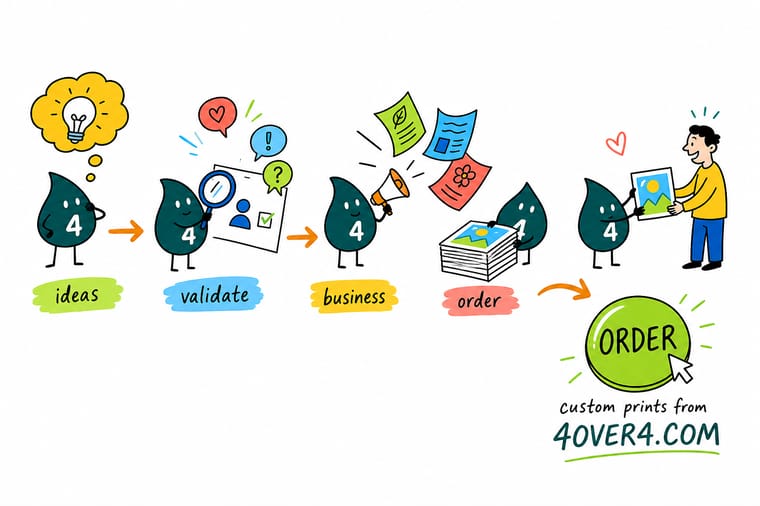
Wally stopped asking people whether they liked his idea, because everybody liked it and nobody bought it. Now he writes one offer with a real price and a real date, prints it, and hands it to 200 people who have never met him. He decides the pass mark before he counts. If five of them pay, he builds. If nobody reaches for a wallet, he changes one thing and runs it again, and he has lost a weekend instead of a year.
Print a test offer on flyers →Specs and pricing
What a test run actually costs to print
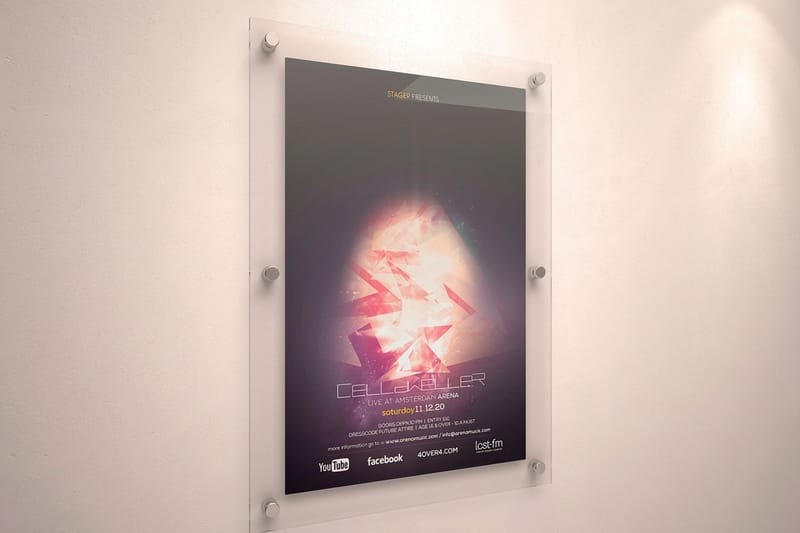
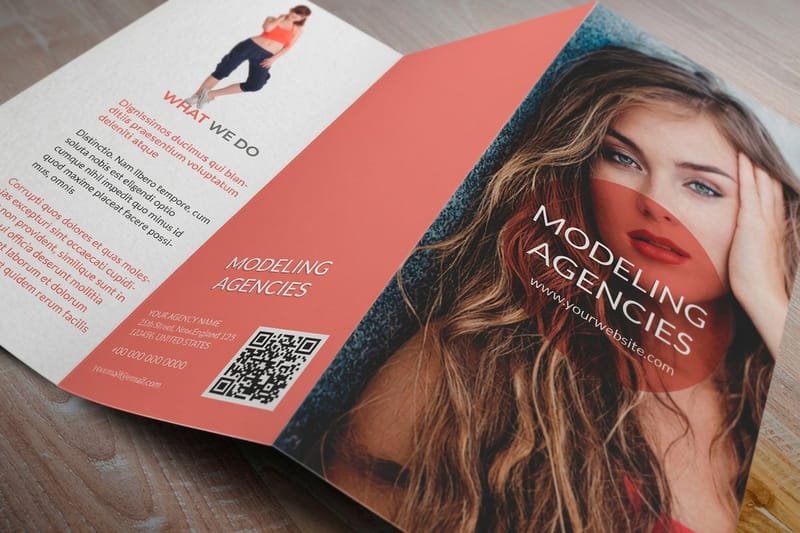
The three formats most validation tests run on, with live sizes, stocks and starting prices from the 4OVER4.COM configurator. Order the smallest tier that gives you a readable response, then reprint once the answer is in.


Print it
Put the offer in someone's hands



Explore more
Where to go next


By the numbers
The print partner founders test with at 4OVER4
Common Questions
Your idea validation questions, answered
How many customer conversations do I need before I trust the answer?
Ten to fifteen conversations with people who genuinely have the problem is usually enough to hear the pattern, and you will notice it yourself: around the eighth or ninth interview people start telling you things you have already heard. That is the signal to stop interviewing and start testing an offer. What matters far more than the count is who you talk to. Fifteen conversations with strangers who currently pay to solve this problem beats fifty with friends, classmates, or anyone who wants you to feel good.
Is a waitlist signup real validation?
It is a weak signal, useful for measuring interest and nothing else. An email address costs a person about four seconds and carries no commitment, which is why waitlists routinely convert at under 10 percent when the product finally ships. Treat signups as a list of people to run a real test on, not as proof. The moment you ask that list for a small refundable deposit, the number that comes back is the honest one.
What if I cannot legally charge money yet?
Ask for the next strongest thing the person can give. In business to business, that is a signed letter of intent naming a quantity and a price, which costs the buyer reputation rather than cash. For consumer ideas, ask for a booked appointment, a scheduled delivery slot, or a refundable deposit held and returned. If a person will not put their name on anything, you have your answer, and you got it before spending on inventory.
How much should I spend validating an idea?
Less than the cheapest version of the thing you want to build, and ideally under a few hundred dollars. A typical offline test runs on a printed offer and a weekend: 250 standard flyers start at $39.54 at 4OVER4.COM, 500 postcards for a mailed offer start at $16.48, and business cards start at $17.57. If a validation plan costs more than a few hundred dollars, it has stopped being a test and turned into a soft launch you cannot afford to walk away from.
What does a failed validation actually look like?
It rarely looks like rejection. It looks like warmth with no action: people say the idea is great, they share it, they ask to be kept posted, and nobody buys. Enthusiasm with a zero conversion rate is the most common failure mode and the easiest one to misread as early traction. The other version is silence at the price step, where people follow every link right up to the moment money is mentioned. That is not a marketing problem to fix later. It is the result.
Can I validate an idea nobody is searching for yet?
Yes, but not with search data, and not with a landing page waiting for traffic that will not come. Categories that do not exist have no keyword volume, so you go to the people instead of waiting for them: trade shows, industry groups, a market stall, a mailed offer to a list you can name. Talk to enough of them and the language they use to describe the problem becomes the words you sell with. That language, not the idea itself, is usually the valuable thing you take away.
Get Started
Flyers run 50 for $39.54, enough to test one offer
Print one specific offer, hand it to 200 people who have never met you, and count who reaches for a wallet. Flyers, postcards and cards ship fast enough to run the test this week.
Legal Disclaimer
Gold Standard guarantees apply to all standard orders placed through 4over4.com. Price match requires verifiable proof of a competitor's published price for an equivalent product with matching specifications and turnaround time. Satisfaction guarantee covers manufacturing defects and print quality issues. Contact support with order number and documentation. On-time delivery rate based on tracked orders 1999 to 2026. Individual results may vary based on shipping carrier performance.
