
The Testing Mindset That Turns Marketing Guesses Into Decisions


Most marketing decisions are beliefs nobody has checked. Some beliefs are worth buying an answer to, the answer can be bought cheaply, and there is a point where you stop asking and commit.
The testing mindset is the habit of treating a marketing decision as a question you can buy an answer to, rather than an opinion to argue about. It runs on one rule: before you commit the full budget, spend a small slice to find out whether the assumption underneath the plan is true. A test earns its place only when being wrong costs more than finding out, which is why the offer is worth testing and the paper color usually is not.

Quick answer
Buy the answer before you buy the campaign
A test is worth running when the mistake costs more than the test. That single comparison sorts nearly every candidate. Testing the offer on 500 postcards before mailing 20,000 is cheap insurance on an expensive error. Testing the shade of blue at that volume is a slow way to learn nothing, because the difference is smaller than the random variation in the responses. Decide the rule before the data lands, change one thing per version, and stop when repeated tests keep landing inside the noise.
What the Testing Mindset Actually Changes

It changes the moment before the money moves. Without it, a plan gets approved because somebody senior likes it and nobody has a better idea. With it, someone asks a duller question first: what are we assuming here, and what would it cost to find out?
That is the whole shift. Not more data, not more dashboards. Just the habit of separating the things you know from the things you believe, and noticing that most plans rest on two or three beliefs that have never been checked. A new mailing usually assumes the list is right, the offer is compelling, and the format gets opened. Any one of those can be wrong on its own, and the campaign fails without telling you which one broke.
The mindset has a cost that people rarely admit. Tests are slower than decisions, and speed has value. A team that tests everything moves at the pace of its slowest experiment and starts to look indecisive, which is its own kind of failure. So the skill is not testing more. It is knowing which handful of assumptions carry the weight, testing those, and deciding the rest in an afternoon.
There is also an emotional cost, and it is the reason most companies say they test and do not. A real test can tell you the idea you presented to the board is worse than the boring alternative. Anyone unwilling to hear that will find a way to run tests that cannot lose, and those tests teach nothing. For the wider picture of where this fits, our digital marketing guide for small business maps the channels the tests will run through.
Deciding What Deserves a Test in the First Place

Three filters kill most candidates before they waste a week. Would the answer change what you do? Can you get the answer before the decision goes stale? Is being wrong more expensive than finding out? A question that fails any one of them is a decision, not an experiment.
The third filter is the one people skip, and it is worth drawing. Put the cost of the test on one axis and the cost of the mistake on the other. Cheap test, expensive mistake is where testing pays for itself. Slow test, trivial mistake is where testing quietly eats the quarter.
| What you are testing | Typical effect on response | Time to a usable answer | Worth a test? |
|---|---|---|---|
| The offer | Largest. Changes what the reader is being asked to do. | One mailing cycle, two to four weeks. | Almost always. Test this before anything else. |
| The audience or list | Large. The same piece performs differently by segment. | One cycle, if each segment is coded separately. | Yes, and it is the cheapest lever to move. |
| The format | Moderate. A postcard is read on the way to the bin, a brochure is not. | One cycle, and both versions must go out together. | Once, then keep the winner for a year. |
| The creative | Small to moderate. Headline matters more than color. | Same cycle, but the effect is easy to lose in noise. | Only at volumes where a small lift is real money. |
Read the bottom row honestly. Creative tests are the most common and the least valuable at small volumes, because the difference they produce is smaller than the random variation in a few hundred responses. That does not mean design is unimportant. It means design should be decided by judgement and craft, and the test budget should be aimed at the offer.
One more rule saves a lot of arguing: change one thing per cell. If version B has a new headline and a new offer and a new format, a win tells you nothing about which change earned it, and you cannot carry the lesson to the next campaign. Our A/B testing guide goes through split mechanics and sample size in detail.
Running Cheap Tests in the Physical World

Online tests are free and instant, which is exactly why they get over-trusted. A click costs the reader nothing, so it measures curiosity. A printed piece that arrives at a house and produces a phone call has already passed a harder filter, and the response rate you measure is closer to a buying decision than a browsing one.
The practical objection is cost, and it is smaller than people think. Short runs make a test cell affordable: standard postcards start at $16.48, standard flyers at $39.54, and standard brochures at $57.11. Two versions of a postcard is a decision you can make without a meeting. The real expense in a mail test is postage and the list, which is why the per piece cost breakdown is worth reading before you size the run.
A print test only works if you can tell the responses apart, and that is a setup problem, not a printing problem. Three methods work. Give each version its own landing page URL, short enough to type. Put a distinct QR code on each, which our postcard QR code guide covers step by step. Or print a code the caller reads out, which is old fashioned and still the most reliable in trades where people phone rather than click.
Keep the variables that are not being tested identical, including the drop date. If version A mails on Tuesday and version B on Friday, you have tested the day of the week as much as the copy. The same rule applies to hand distribution, where the route matters more than the leaflet; flyer distribution practice goes into how to split territory fairly. If you are laying out two versions from scratch, the blank template library keeps both files on identical dimensions so nothing shifts between cells.
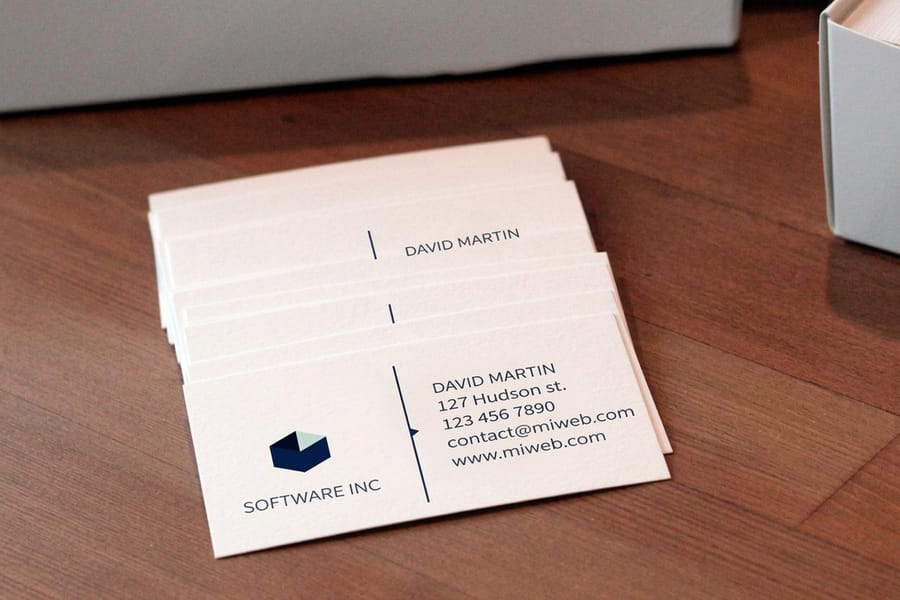
Business cards are worth a mention as the quietest test of all. Order a short run of standard business cards at $17.57 with a different call to action on the back, hand out both for a month, and see which one comes back as a conversation. It is small, but it is real, and it costs less than the meeting where you would otherwise argue about it. The direct mail collection lists the formats that can be tested and mailed in the same run.
Reading the Result Without Fooling Yourself
The dangerous result is not the one that fails. It is the one that succeeds slightly, because it is the easiest to believe and the hardest to check. A hundred pieces per version producing nine responses against six looks like a fifty percent improvement in a summary slide. It is three responses, and running the same test again would very likely reverse it.
Two habits do most of the protecting. First, write the threshold before the data arrives: state what result keeps the idea alive, and state what result kills it. Second, treat any surprising win as provisional until it repeats. A finding that does not survive a second run was never a finding.
Watch for the three failures that produce confident nonsense. Stopping early, where somebody checks on day three, sees version B ahead, and calls it. Slicing after the fact, where a flat overall result is rescued by discovering that version B won among one postcode, which is what randomness looks like when you look hard enough. And the novelty effect, where a new format outperforms simply because it is unfamiliar, then settles back once the audience has seen it twice.
Then there is the result nobody plans for and everybody gets: no difference. That is a real answer and a useful one. It means the variable you tested does not matter at your volume, and you are free to choose it on cost, taste, or speed and stop thinking about it. Once a campaign is live, measuring it well is a different discipline, and our marketing analytics and ROI guide covers the tracking side.
Knowing When to Stop Testing and Commit

Testing has a stopping point, and missing it is a more common failure than never testing at all. Three signals say the work is done. Repeated tests keep landing inside the margin of error. The remaining questions cost more to answer than the difference they could produce. Or the answer stopped mattering because the market moved while you measured it.
There is also a cost that never appears on an invoice. A business is recognized by consistency, and a company that redesigns its cards, changes its colors, and rewrites its promise every quarter reads as unsettled to the people who see it repeatedly. Lock the elements that have earned their place and keep the experiments aimed at the offer, where the money actually is.
A workable rhythm for a small company is one real test per campaign cycle, on one variable that matters, with the decision rule written down first. That is roughly a dozen honest answers a year, which compounds into a marketing operation that knows things its competitors are still guessing at. Compare that to running six tests a quarter on typography and concluding nothing.
When you do commit, commit properly: print the volume, hold the format for a full year, and let the winner build recognition instead of resetting it. If you want the broader strategy this sits inside, the marketing strategy guides hub covers campaign planning, and the standard printing collection has the short-run formats that make the next test cheap.
Wally explains the testing mindset
Two versions, one difference, one decision written down first
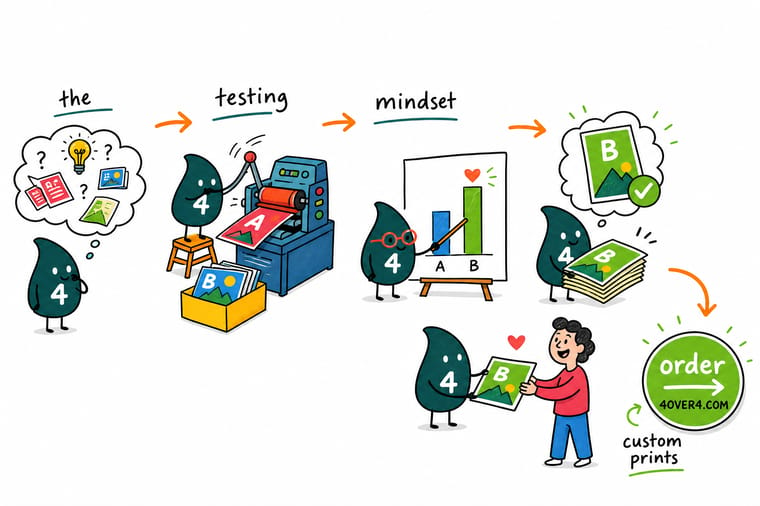
Wally does not argue about which postcard is better. He prints both, changes one thing between them, mails them on the same day, and writes down beforehand what result would make him keep version B. A month later the answer is on the desk instead of in an opinion. When both versions come back the same, that is also an answer, and he picks the cheaper one and moves on to a question that matters.
Order postcards for a test run →Specs and pricing
What a test cell costs in each format
Sizes, quantities and starting prices straight from the 4OVER4.COM configurator, so you can price two versions before you commit to the full run.



Print it
Print two versions and let the response decide


Explore more
Where to go next



By the numbers
Short runs and full runs, printed by 4OVER4
Common Questions
Your testing questions, answered
What is a testing mindset?
It is the habit of treating business decisions as questions that can be answered cheaply, rather than opinions to be settled by whoever argues hardest. In practice it means three things: you notice when you are guessing, you buy a small answer before you commit the full budget, and you write down in advance what result would change your mind. The mindset is separate from the mechanics. You can know how to run an A/B test perfectly and still never run one, because nobody in the room stopped to ask whether the plan was a guess.
How is a testing mindset different from just running A/B tests?
An A/B test is a tool. The mindset decides when to reach for it and, more often, when not to. Somebody with the mindset spends most of their time deciding which questions deserve an answer, and rejects the ones where the answer would not change any action. Somebody without it runs tests on button colors because the tool makes it easy, and never tests the offer, which is the one variable that usually moves the number. If you want the mechanics, our guide to how A/B testing works covers sample size and random assignment properly.
What should a small business test first?
The offer, then the audience, then the format, then the creative, roughly in that order of impact. The offer is what you are actually promising, and changing it can double or halve response while a design change moves it a little. The audience is who receives it, which for a mailing means the list. Format is postcard against flyer against brochure. Creative is the headline, the photo, the color, and it is where most people start because it is the most fun and the least consequential.
How much does a real print test cost?
Less than most people expect, because the minimum quantities are low. Standard postcards start at $16.48 and standard flyers at $39.54 at 4OVER4.COM, so two versions of a postcard is a two figure decision rather than a budget line. The expensive part of a print test is never the printing. It is the postage, the list, and the weeks between sending and knowing, which is why the test should answer a question worth waiting for.
How do you know when a test result is real?
Look at the size of the difference next to the size of the sample, and be suspicious of anything that looks spectacular. Twelve responses against eight is not a fifty percent lift, it is four responses. Two habits protect you: decide the threshold before you look, and repeat any result you intend to bet the year on. A finding that does not survive a second run was noise the first time.
When should you stop testing and commit?
When the remaining questions are smaller than the cost of asking them, or when repeated tests keep landing inside the margin of error. There is also a brand cost that nobody puts on the invoice. Customers recognize a business by its consistency, and a company that changes its look every quarter in pursuit of a two percent lift reads as unsettled. Lock the things that have earned their place, and keep the testing pointed at the offer.
Get Started
Postcards run 50 for $16.48, two versions for $32.96
Print two versions on a short run, mail them the same day, and let the replies settle the question. Postcards, flyers and cards all start small enough to make a test cheap.
Legal Disclaimer
Gold Standard guarantees apply to all standard orders placed through 4over4.com. Price match requires verifiable proof of a competitor's published price for an equivalent product with matching specifications and turnaround time. Satisfaction guarantee covers manufacturing defects and print quality issues. Contact support with order number and documentation. On-time delivery rate based on tracked orders 1999 to 2026. Individual results may vary based on shipping carrier performance.
