
The Business Model Blueprint That Proves an Idea Before You Build It


Nine blocks on one page, the four numbers that say whether it pays, and the cheapest ways to find out before you spend a year building the wrong thing.
A business model blueprint is a one page description of who pays you, what they get, how the money moves, and what it costs you to deliver. It is finished when nine blocks agree with each other and one customer returns more margin than it cost to win them. Everything else, the deck, the plan, the forecast, is downstream of that single test.
Quick answer
Nine blocks, and one test they all feed
Write the segment, the problem, the offer, the proof, the channel, the price and frequency, the cost to serve, the key resources and the cost structure. Fill them top down, because the segment sets the channel and the offer sets the price ceiling. Then run the only test that matters: margin per order, times orders inside twelve months, minus what it cost to win that customer. If the answer is positive and the payback is quick enough to fund itself, you have a model. If it is negative, changing a block is the fix. Spending more is not.
The Nine Blocks, and the Order to Fill Them In
Fill the blocks top down, because each one narrows the next. Choose the segment and the channel shortlist writes itself. Choose the offer and the price has a ceiling. Founders who start at the revenue block end up with a price they cannot justify to anybody in particular.
| Block | The question it answers | Where it usually goes wrong |
|---|---|---|
| 1. Customer segment | Who exactly pays, and could you name twenty of them by tomorrow? | Written as "small businesses". That is a market, not a segment, and no channel targets it. |
| 2. The problem | What do they already spend money or hours on because of this? | Solving an irritation nobody has ever budgeted for. |
| 3. The offer | What changes for them, described in their words, at one price? | A feature list where an outcome should be. |
| 4. The proof | What can a stranger check before trusting you? | Claims with nothing behind them. A sample, a demo or a named reference is proof. An adjective is not. |
| 5. The channel | How does this person find out you exist, repeatedly? | One channel assumed to work because it worked for a company with a different segment. |
| 6. Price and frequency | What triggers a payment, and how often does it happen? | One-off pricing on something that costs you every month to keep running. |
| 7. Cost to serve | What does the tenth customer cost you that the first one did not? | Counted as zero, which is only ever true for software and rarely even then. |
| 8. Key resources | What do you need that is genuinely hard to replace? | Founder time booked as free, so the model looks profitable until the founder stops. |
| 9. Cost structure | Which costs stay flat as you grow, and which grow per customer? | The two are mixed together, so nobody in the business knows the real margin on an order. |
Read the middle column aloud and answer each question with a specific. If an answer survives having your business swapped for a completely different one, it is filler and the block is still empty. The segment block is where most of the value sits, and it is the one people rush. Our first-time entrepreneur launchpad walks the same ground from the other direction, starting with the twenty conversations rather than the grid.
The Arithmetic That Decides Whether the Model Works

Four numbers decide it, and they can be worked out on the back of an envelope long before you have accounting software.
Margin per order is the price minus everything it costs to deliver that specific order. Orders per customer is how many times they buy inside a window you name, and twelve months is the honest limit for a new business, because anything longer is a guess dressed as a forecast. Acquisition cost is total channel spend divided by customers won, with your own hours priced in if you would otherwise be billing them. Payback period is how many months of margin it takes to repay that acquisition cost.
Two shapes work, and they pull in opposite directions. High price and low frequency means one sale has to repay acquisition on its own, so you can afford a long sales cycle and a short target list, and you live or die on close rate. Low price and high frequency usually means the first order loses money, the model only pays from the second or third, and churn quietly becomes more important than price. Both are viable. Building the first and pricing it like the second is not.
Then there is the trap that catches profitable businesses. Contribution margin can be comfortably positive while the cash timing kills you: the customer pays on sixty day terms, the ad platform and the supplier want paying in week one, and the gap between those two dates is funded out of your own pocket. Watch the payback period as closely as the payback size. Where volume is part of the plan, understanding how print price breaks work changes the cost-to-serve block, because the same brochure costs meaningfully less per unit at 500 than at 50.
Take the Blueprint Outside and Let Strangers Argue With It

A blueprint is a set of assumptions in a tidy layout. The only thing that converts an assumption into a fact is a stranger deciding whether to pay. Run the cheapest tests first.
Twenty conversations. Not about your idea. About what they use now, what it costs them, and what happened the last time they tried to fix it. The useful answers are the ones that describe a budget that already exists.
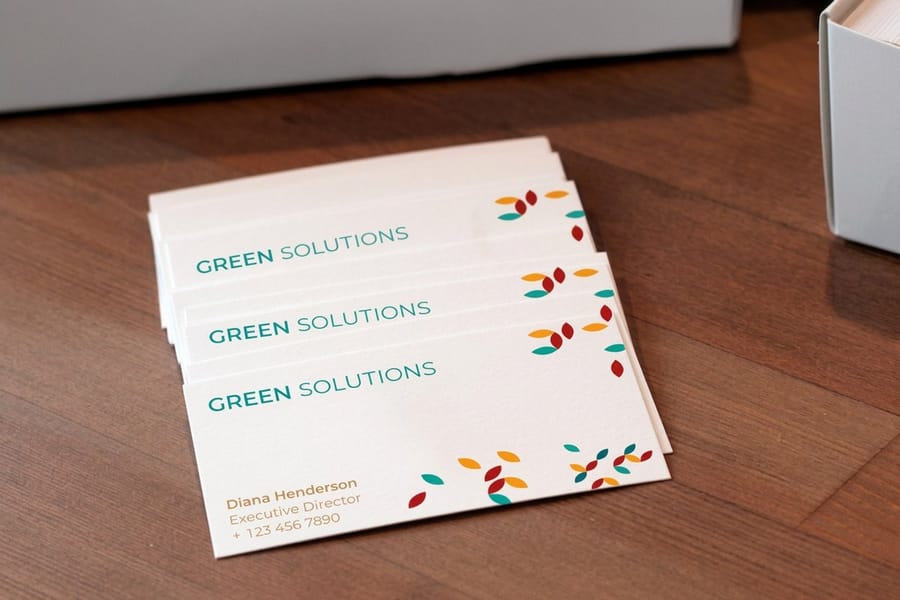
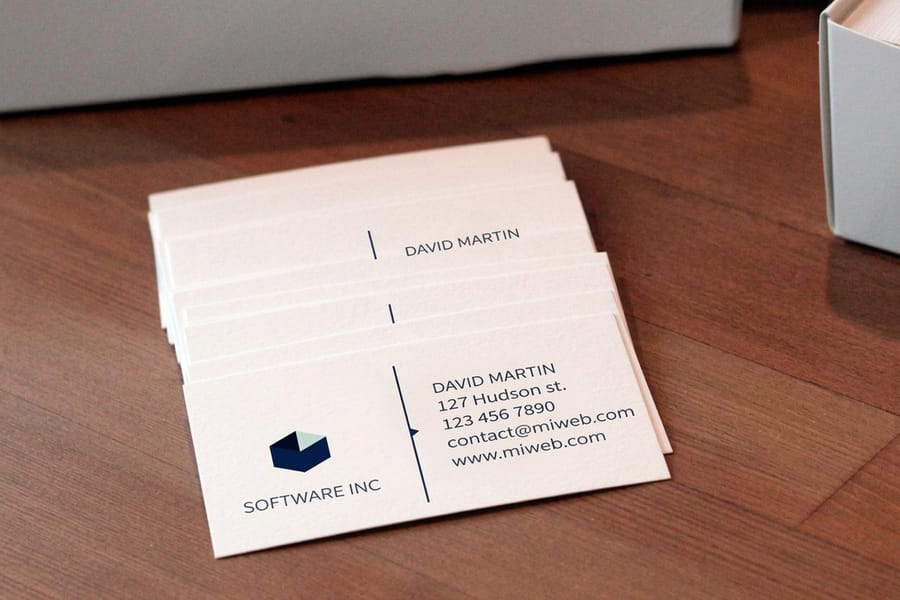
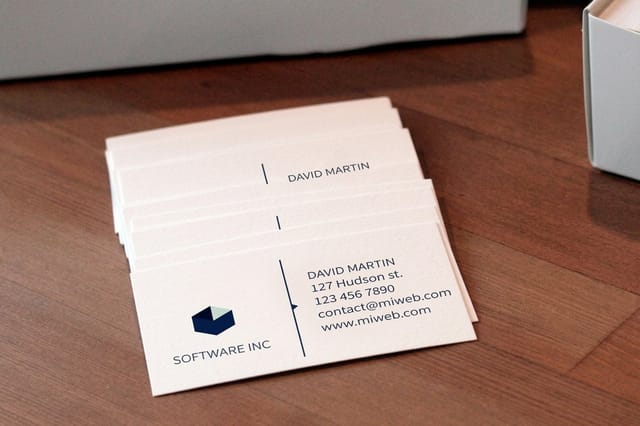
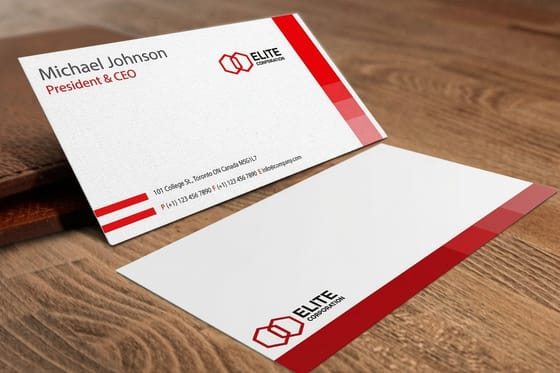
A priced offer in front of the segment. This is where the model stops being theoretical, and where print is worth its cost when your segment is local or physical: trades, clinics, gyms, restaurants, salons, events, anything with an address. At 4OVER4.COM standard flyers start at $39.54, so two versions carrying different offers can go into the same neighborhood in the same week and tell you which promise people respond to. Standard postcards start at $16.48 and work against a bought list where you know exactly who received what. Standard brochures at $57.11 earn their place as the leave-behind after a conversation that went well, and standard business cards at $17.57 exist so the conversation has a next step at all. The marketing materials range covers the rest of the formats, and what business cards actually cost and why explains where the price comes from.
Name the limit before you spend anything. Print tests proximity. If your segment is four hundred specialists scattered across three continents, a flyer is the wrong instrument and a narrowly targeted ad or a written approach to a named list will answer the same question faster and for less. Choose the channel that reaches the segment you wrote in block one, not the one you enjoy running. If the mailing route is the right one, postcard printing pricing sets out what a drop costs at real quantities.
Choosing How You Charge, and What Each Model Costs You

Pick the revenue model that matches the shape of your costs, not the one that reads best in a pitch. A subscription attached to a service with a high cost to serve turns into unpaid overtime by month four.
| Revenue model | When the cash lands | What kills it | What it suits |
|---|---|---|---|
| One-off sale | At purchase, in full. | A permanent hunt for the next buyer. | Infrequent, considered purchases where repeat is unrealistic. |
| Repeat product sale | At every purchase. | A first order that never becomes a second. | Consumables, replacements, refills, anything that runs out. |
| Retainer | Monthly, usually in advance. | Scope creeping upward while the fee stays flat. | Ongoing work with a named person attached to it. |
| Subscription | Monthly or yearly, in advance. | Quiet churn, canceled in month three by somebody who never got started. | Access and software where the cost to serve is genuinely low. |
| Usage based | After the work, in arrears. | A customer whose usage falls without anybody noticing. | Anything metered: per print, per seat, per call, per shipment. |
| Commission | Only when both sides transact. | Both sides meeting once and then dealing directly. | Marketplaces solving a trust or discovery problem that is real. |
Read the third column before the fourth. Every model has one characteristic failure, and knowing yours in advance tells you which number to put on the wall. Retainers live and die on scope, so write the boundary into the agreement rather than into your evenings. Subscriptions live on the first thirty days, because a customer who never onboards cancels on schedule. The agency growth blueprint takes the retainer case apart in detail, including how average contract value and months retained multiply rather than add.
What Actually Breaks a Business Model

Models rarely fail because the idea was wrong. They fail on one of a short list of structural faults, and each one shows up long before the bank balance does.
- The segment needs the word "anyone". Then no channel targets it and no message lands, so marketing spend goes out as a fine spray. Narrow it until you can name the trade publication they read. Brand messaging for small business covers how a narrow segment produces a message people repeat.
- The price was built up from cost. Cost tells you the floor and nothing else. The ceiling is set by what the buyer would otherwise do, including doing nothing. Price from the alternative, then check the floor.
- The channel only works while you personally work it. Referrals from your own network are a launch, not a channel. A channel is something a person who is not you can run next quarter.
- Cost to serve rises with every customer. If the tenth customer costs more to look after than the first, a bigger month is a worse month, and growth is the thing hurting you.
- One client is more than a third of revenue. That is a job with extra risk and no notice period. Fix it while the client is happy, because after they leave there is no time.
- Founder hours are counted as free. They are the most expensive input in the business and the easiest to hide. Price them at what somebody else would charge, then look at the margin again. The Eisenhower matrix is a practical way to find out where those hours are actually going.
When two or more of these are true at once, rewriting the blueprint is the cheaper move. Founders resist it because the document feels like commitment. It is a working sketch, and a sketch you refuse to redraw stops being a tool. If the offer itself is what needs rebuilding, building a startup brand picks up from there.
Wally draws the blueprint
Nine blocks, then one honest sum
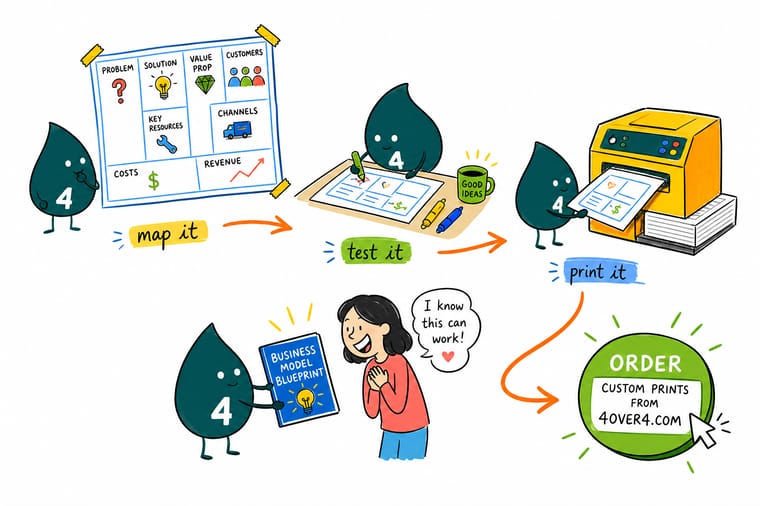
Wally starts at the top left with the person who pays, and refuses to write anyone. He works down through the offer, the proof and the channel, because each block narrows the next. At the bottom he does the sum out loud: this is what one order earns, this is how often they come back, this is what it cost to find them. If the number is positive he buys more of the same channel. If it is negative he redraws a block, because a bigger budget on a broken model just loses money faster.
Shop the marketing materials range →Specs and pricing
What a real channel test costs to print
The three formats founders use to put a priced offer in front of a segment, with live configuration choices and starting prices straight from the 4OVER4.COM configurator.


Print it
Put the offer in front of somebody who can say no


Explore more
Where to go next




By the numbers
The print partner behind a lot of first tests
Common Questions
Your business model questions, answered
What is a business model blueprint?
It is a one page description of who pays you, what they get, how the money moves, and what it costs you to deliver. Nine blocks cover it: customer segment, the problem, the offer, the proof, the channel, the price and frequency, the cost to serve, the key resources, and the cost structure. The blueprint is finished when the blocks agree with each other and one customer returns more margin than it cost to win them. Everything longer than that page is either a plan or a pitch deck.
How is a business model different from a business plan?
The model is the machine, the plan is the schedule for building it. A model says a dental practice pays 300 dollars a month for patient recall mailings, the mailing costs 90 dollars to produce and post, and one practice usually stays about two years. A plan says who you hire in month four and what the bank is being asked for. Investors and lenders ask for the plan. You need the model first, because a plan built on a model that does not pay back is a schedule for losing money on time.
Do I need a business model canvas, a lean canvas, or a blueprint?
They are the same nine or so blocks in different layouts, and arguing about which grid to use is a way of avoiding the hard part. Pick any one of them and fill it in with specifics you could defend to somebody who works in that industry. The layout has never been the problem. The word "everyone" in the customer segment box is the problem.
How long should the blueprint take to write?
An afternoon for the first draft, and it should be uncomfortable to write because every block forces a decision you would rather postpone. The slow part is not the writing, it is the testing that follows: twenty conversations with people who actually have the problem, then a priced offer put in front of them. Founders who spend three weeks on the document and three days on the testing have the ratio backwards.
How do I know when to change the model instead of trying harder?
Three signals, and any one of them is enough. First, people say yes to the idea and no to the invoice, which means the value proposition is agreeable rather than valuable. Second, the acquisition cost is not falling after a few hundred customers, which means the channel does not compound and you are renting attention forever. Third, your cost to serve climbs with every new customer, so a bigger month is a worse month. None of those are fixed by working longer hours.
What does it cost to test a business model offline?
Less than most founders expect, which is why it is worth doing before the website. At 4OVER4.COM standard flyers start at $39.54, standard postcards at $16.48, standard business cards at $17.57 and standard brochures at $57.11. Two versions of a flyer with different offers, dropped in the same neighborhood in the same week, tell you which promise people respond to. That is a real answer bought for roughly the price of one working day.
Get Started
Flyers run 50 for $39.54 on 100# Gloss Text
Print two versions of the offer, put them in front of the segment you wrote in block one, and let the response decide which assumption was wrong.
Legal Disclaimer
Gold Standard guarantees apply to all standard orders placed through 4over4.com. Price match requires verifiable proof of a competitor's published price for an equivalent product with matching specifications and turnaround time. Satisfaction guarantee covers manufacturing defects and print quality issues. Contact support with order number and documentation. On-time delivery rate based on tracked orders 1999 to 2026. Individual results may vary based on shipping carrier performance.
