
Standard Catalog Sizes and Booklet Formats


Emma is our prepress and print production voice, built from the knowledge of our production team, with over 20 years in printing.
Booklet and catalog sizes come down to six trims, with 8.5 by 11 inches the standard in North America and A4 nearly everywhere else, and trim size, page count, and binding are the three decisions that define a catalog. Every standard size and booklet format sits below, with the page-count math that trips people up and the file specs that keep it sharp.
A catalog format is the combination of trim size, page count, and binding you print. The most common catalog sizes are 8.5 x 11 in (letter), 5.5 x 8.5 in (digest), 6 x 9 in, and 9 x 12 in. Page counts run in multiples of four, and binding is saddle stitch under about 48 pages or perfect bound above roughly 60. Pick the format first, then design to fit.

Start here
Trim, pages, and binding, settled
A catalog format is the trim size, page count, and binding you choose before you design a single page. Standard catalog sizes are 8.5 x 11 in, 5.5 x 8.5 in, 6 x 9 in, and 9 x 12 in. Page counts land in multiples of four, and binding is saddle stitch for thin books or perfect bound for thick ones. Lock those decisions first and the layout, the file setup, and the price all fall into place. The size diagram further down compares the common formats at true scale.
Standard catalog sizes
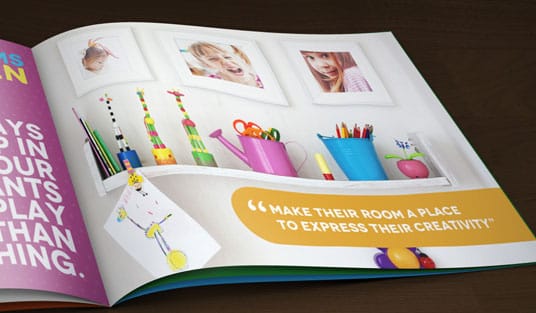
Six trim sizes cover almost every catalog and booklet that gets printed, and a standard catalog size is one of two: 8.5 by 11 inches (216 by 279 mm) in North America, and A4 at 210 by 297 mm nearly everywhere else. Both fill a full press sheet with no waste and mail at standard rates, which is why they stay the default. The other four rows are where you go when the merchandise, the mailbox, or the budget asks for something different.
| Size | Inches | Millimeters | Best for |
|---|---|---|---|
| Letter | 8.5 x 11 in | 216 x 279 mm | The default, a full press sheet with no waste |
| Digest | 5.5 x 8.5 in | 140 x 216 mm | Pocket catalogs and event booklets |
| Trade | 6 x 9 in | 152 x 229 mm | Compact, mail-friendly catalogs |
| Tabloid | 9 x 12 in | 229 x 305 mm | Photography-led catalogs and lookbooks |
| A4 | 8.27 x 11.69 in | 210 x 297 mm | International distribution |
| A5 | 5.83 x 8.27 in | 148 x 210 mm | The international digest equivalent |
Read the table by the job, not by the number. Letter and A4 hold three columns of products across a page and are the safe pick for a price list or an annual product catalog. Digest, A5, and 6 by 9 inches cut the postage weight and feel like a booklet in the hand, which suits event programs, takeaway guides, and anything that has to fit a jacket pocket. Tabloid at 9 by 12 inches gives product photography room to breathe and reads as a lookbook rather than a list. Custom trim sizes print fine, but every step away from these six adds cost and can push you into a non-standard mailing rate.
Two rules apply to every row. The page count has to be a multiple of four, because each folded press sheet yields four pages, so plan for 8, 12, 16, 20, or 24 rather than 15 (our guide explains what a saddle stitched booklet is and why pages come in fours). And the binding follows the thickness: saddle stitch from roughly 8 to 48 pages, perfect binding from about 60 pages up. Whichever size you choose, build the file with 0.125 inch of bleed on every outside edge and keep text and logos at least 0.25 inch inside the trim. The same sizes and the same math apply to a booklet, and the dimensions are already set correctly in our design templates.
On the order form the choices narrow to these:
| Book | Stock trims | Page counts | Paper | First run |
|---|---|---|---|---|
| Saddle stitched catalog or booklet | 5.5 x 8.5, 8.5 x 11, 11 x 11 in | 8 to 60 | Seven inside stocks from 100# gloss text to 14pt cover; self-cover or an 80# or 14pt gloss plus-cover; full color or black | 25 copies |
| Perfect bound book | 5.5 x 8.5, 6 x 6, 6 x 9, 8.5 x 11 in | 40 to 300 | 100# gloss or silk/matte text or 70# uncoated inside; 80# or 14pt gloss cover with an optional laminate | 10 copies |
Send one print-ready PDF of single pages with the bleed and safe margin above, and pick long or short edge binding on the order.
Why the catalog format decides whether yours gets used
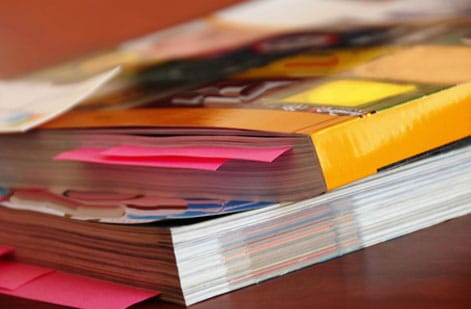
A catalog has to survive a mailbox, sit open on a desk, and get flipped through a hundred times without falling apart. A 24 page saddle stitched book at 8.5 by 11 inches manages all three; a 70 page book needs a glued spine to survive the flipping. Whether it manages all three has less to do with the design and more to do with the format you picked before the design ever started.
Format is the trim size, the page count, and the binding. Choose them well and the catalog feels right in the hand, mails without a surcharge, and lies flat on the page it matters most. Choose them carelessly and you get an awkward size that costs extra to send, a page count that leaves blanks in the middle, or a spine that cracks the third time someone opens it.
This guide walks through every standard catalog and booklet size, the page-count math that trips up first-timers, the two binding styles worth knowing, and the file specs that keep the whole thing sharp. When you are ready to build one, our online designer and design templates already have the correct dimensions baked in, and you can print the result from the Standard printing collection.
What is a catalog format?

A catalog format is the combination of three specifications working together: the trim size (the finished width and height of a single page), the page count (how many pages, always counting both sides of every sheet), and the binding (what holds those pages together). Change any one and you have a different format with a different feel, price, and mailing profile: a 24 page, 8.5 by 11 inch saddle stitched catalog is one format, and the same 24 pages at 5.5 by 8.5 is another.
It helps to keep the vocabulary straight. A spread is the two pages you see when the catalog is open. A signature is one folded press sheet that yields four pages. The cover can be the same stock as the interior (self-cover) or a heavier stock (plus-cover) that protects the pages and stiffens the outside. If a term ever throws you, our printing terms glossary defines the rest.
These same three decisions apply whether you are printing a slim booklet, a full product catalog, or a folded brochure. The canvas and the job change. The format logic does not. If you want a design-services head start rather than a blank page, the online designer and our template library both hand you a correctly sized document to work inside.
Understanding catalog page counts (and the rule of four)

The single most common catalog mistake is planning content around an odd number of pages. Saddle-stitched and folded catalogs are printed on large sheets that fold and nest inside one another, and each folded sheet produces four pages. That means the finished page count is always a multiple of four: 8, 12, 16, 20, 24, 32, and up.
So if your content naturally lands on 15 pages, you either trim to fit, expand to 16, or leave one page intentionally blank to reach the multiple. Planning ahead is easier than reflowing later: sketch your sections against full four-page signatures so nothing important gets stranded next to a surprise blank. A short table of contents, a cover, and a back page all count toward the total.
Catalog page layout follows from there. Reserve the front cover for the hook, use the inside front and first spread for your strongest products or your story, and keep a consistent grid so every spread feels part of one book. If you are pairing the catalog with a mailer or reply piece, our guides on standard envelope sizes and direct mail formats help the whole package line up.
Standard catalog and booklet sizes

Four trim sizes handle the vast majority of catalogs and booklets. 8.5 x 11 inches (letter) is the default: it uses a full press sheet with zero waste, mails at standard rates, and gives a comfortable grid for mixed text and photography. 5.5 x 8.5 inches (digest or half-letter) makes a pocket-friendly booklet that feels approachable and cheap to mail. 6 x 9 inches sits neatly between the two and reads as a touch more upscale.
Go bigger with 9 x 12 inches when product photography is the entire pitch, apparel, home goods, or a lifestyle lookbook, since the extra area lets images breathe. 11 x 17 inches is an oversized statement format that also folds down to letter for mailing. Custom trim sizes are always possible, but every step away from a standard adds cost and mailing complexity, so start standard unless you have a reason not to.
The diagram below compares the common sizes at true relative scale. For neighboring formats, our standard brochure sizes guide and the broader print specifications reference cover folds and dimensions the catalog world borrows from.
A5 Catalog and Booklet Size Compared With US Sizes
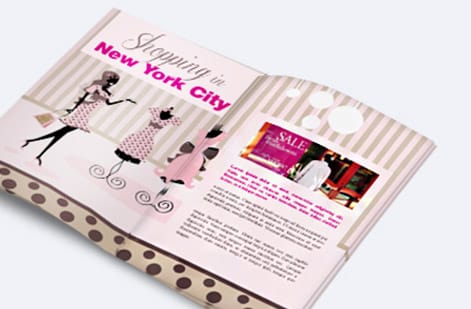
An A5 booklet is 5.83 by 8.27 inches, 148 by 210 mm, half of an A4 page. The closest US size is digest, 5.5 by 8.5 inches, which is 0.33 inch narrower and 0.23 inch taller, so an A5 layout moves to digest with a light reflow. Letter at 8.5 by 11 inches plays the part A4 plays abroad.
An 8 by 10 inch book is not one of the standard sizes on this page. It prints as a custom trim, and like any step away from the standards it adds cost and can change the mailing rate. From our catalog, the stock trims are 5.5 by 8.5, 8.5 by 11 and 11 by 11 inches on saddle stitched catalogs and booklets, with 6 by 6 and 6 by 9 inches added on perfect bound books.
Booklet binding formats: saddle stitch vs perfect bound
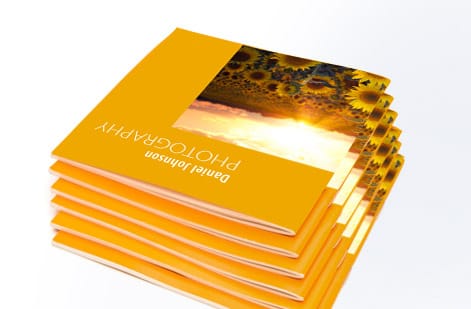
Two binding styles cover almost every catalog. Saddle stitching folds the pages and staples them through the spine. It is fast, economical, opens reasonably flat, and works beautifully from about 8 to 48 pages. Most booklets, programs, and lighter catalogs use it. The moment your page count climbs past roughly 48, the staples start to strain and the pages fan out at the edge.
Perfect binding glues the folded pages into a square, flat spine like a paperback. It suits thicker catalogs, roughly 60 pages and up, and gives you a printable spine plus a bookstore-grade feel that signals quality. The trade-off is a slightly higher cost and the fact that very thin books cannot be perfect bound at all, there is not enough spine to glue.
Thin and quick, saddle stitch. Thick and premium, perfect bound. Your page count usually makes the call for you. If you are undecided between a booklet and a folded piece entirely, weigh it against our common brochure sizes and fold options before you commit ink to stock.
Catalog layout specifications: bleed, margins, and color

Once the format is set, the file setup is what keeps the print clean. Build a 0.125 inch bleed on every outside edge so any color or image that runs to the edge extends past the trim line, which prevents thin white slivers after cutting. Keep all live text and logos at least 0.25 inch inside the trim, the safe margin, so nothing critical is lost at the knife.
Give the gutter (the inner margin near the spine) a little extra breathing room, especially on saddle-stitched pieces, so text does not disappear into the fold. Set images at 300 dpi at their final printed size, and export everything in CMYK rather than RGB, because presses print in CMYK and colors shift if you leave the file in screen color. Our guide on formatting artwork for CMYK walks through the conversion step by step.
Deliver the finished catalog as a single print-ready PDF with all fonts embedded and images placed, not linked. If you would rather start from a document that already has bleed, margins, and dimensions in place, grab a matching layout from our print size templates and drop your content in.
File review for peace of mind

A catalog has more pages to go wrong than almost anything else you print, which is exactly why every file gets a human look before it runs. Our prepress team checks your uploaded PDF for the things that quietly ruin a job: missing bleed, low-resolution images, text sitting on the trim line, page counts that do not resolve to a multiple of four, and color set in RGB instead of CMYK.
If something looks off, we flag it before the press starts rather than after the boxes ship. That review is part of the service, not an upsell, and it is the difference between catching a 72 dpi logo on your cover and discovering it in a pallet of finished catalogs. It pairs with our reprint guarantee, so a piece that leaves our facility is a piece we stand behind.
You can help the review go fast by uploading a flattened, print-ready PDF and confirming your page count and trim size in the order. When you are ready to see real stock before committing, order free paper samples so the cover and interior weights are a known quantity, not a guess.
Catalog mailing specifications
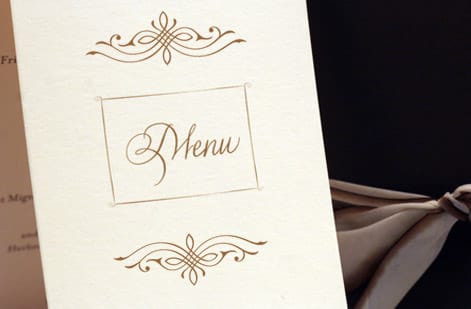
If the catalog is going in the mail, the format decisions you already made will either help or haunt you. Standard sizes like 8.5 x 11 and 6 x 9 inches move through USPS cleanly, while oversized or unusually shaped pieces can jump into a higher postage bracket. Weight matters too: heavier stocks and higher page counts push the total weight up, so a premium paper choice is also a postage choice.
Leave a clear address area on the back cover or a wrapper, keep it free of busy artwork, and follow the placement and clear-zone rules for the mailing class you are using. Self-mailers may need a tab or wafer seal to stay closed in transit. Bulk and saturation programs have their own geometry, which our guides on USPS mailing guidelines and the EDDM step-by-step lay out in plain terms.
Designing a mail-order catalog from scratch involves more than the piece itself. If that is your goal, our guide on how to start a mail-order catalog company covers the list, the offer, and the logistics around the print.
Custom catalog printing options and what they cost

With the standards understood, custom is where a catalog gets its personality. You can print a plus-cover on a heavier stock for durability and shelf feel, add a matte or gloss coating, choose an uncoated interior for a tactile, editorial look, or step up to a fully custom trim size when a standard will not do. Each option changes how the catalog reads in the hand and how much it costs to produce and mail.
Pricing is refreshingly simple to reason about. It scales with quantity (more copies lower the per-copy price), trim size, total page count, the cover and interior stocks, and the binding. At 4OVER4.COM you set each of these in the configurator and the price updates live, so you can trade a few pages against a larger quantity and watch the number move. Standard catalogs start around $240.55 for a run, with the per-copy cost dropping as volume climbs.
The fastest path is to open the specs and pricing panel below, dial in your format, and see the live number. When it looks right, print it from the Standard printing collection, or order free paper samples first so you know exactly how your cover and pages will feel.
Wally explains catalog format
Pick the size, the page count, and the binding first
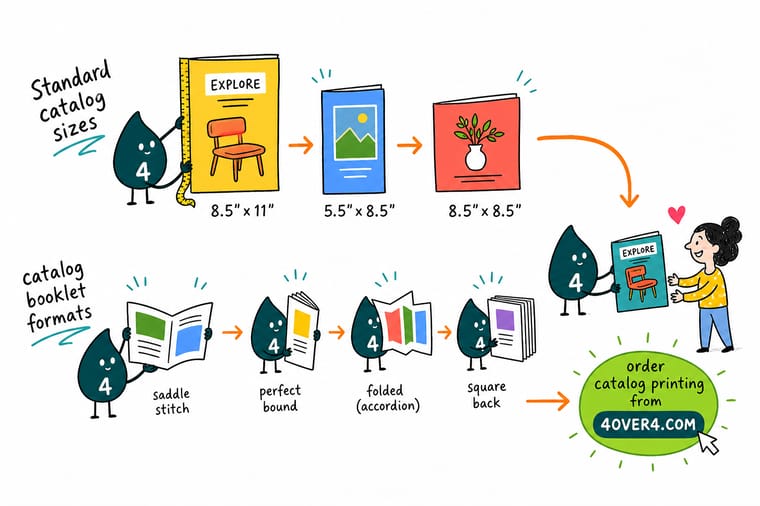
Wally sizes up every catalog the same way: settle the trim size, count the pages in fours, then choose saddle stitch for a thin book or perfect binding for a thick one. Get those three right and the layout, the mailing, and the price all fall into line. Sketch your spreads to fit the format, then let 4OVER4 print it clean on the stock and size you choose.
Configure your catalog →
Size diagram
Standard catalog and booklet sizes at true scale
Five formats at one scale: 5.5 x 8.5 digest, 6 x 9, 8.5 x 11 letter, 9 x 12 and 11 x 17 tabloid. Letter is the default. Go smaller for pocket booklets, larger when photography is the pitch.
Sizes are drawn to scale relative to one another. Custom trim sizes are available, but every standard size keeps cost and USPS mailing simple.
Specs and pricing
Catalog specs and live pricing
Once your format is set, the price follows size, page count, stock, and quantity. Here are the live specs and price-per-copy for standard catalogs at 4OVER4.COM, straight from the configurator.

| Quantity | Price Per Unit | Total |
|---|---|---|
| 25 | $9.62 | $240.55 |
| 50 | $6.04 | $302.06 |
| 100 | $3.61 | $361.37 |
| 200 | $2.22 | $444.85 |
| 300 | $1.65 | $495.38 |
| 400 | $1.29 | $515.14 |
| 500 | $1.06 | $531.61 |
| 600 | 91.5¢ | $549.19 |
Print it
Print your catalog or booklet at 4OVER4

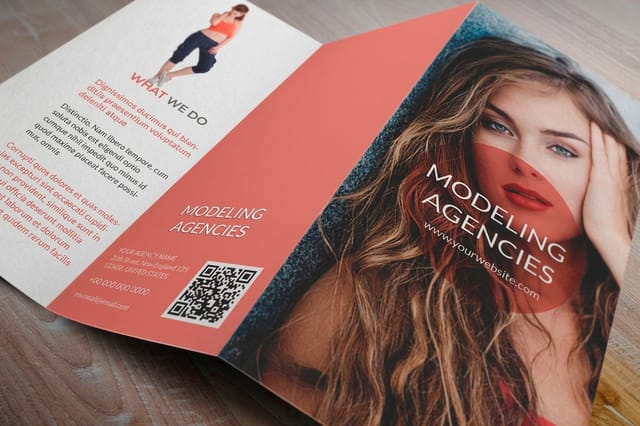
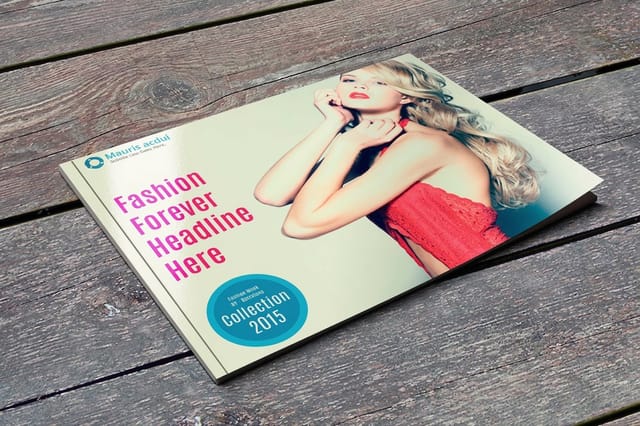
See it in use
Catalogs from the print showcase





%22%2F%3E%3Ccircle%20cx%3D%2244%22%20cy%3D%221%22%20r%3D%2219%22%20fill%3D%22%23a78bfa%22%20opacity%3D%220.15%22%2F%3E%3Ccircle%20cx%3D%2240%22%20cy%3D%2250%22%20r%3D%225%22%20fill%3D%22%23a78bfa%22%20opacity%3D%220.1%22%2F%3E%3Crect%20x%3D%2274%22%20y%3D%22-7%22%20width%3D%2229%22%20height%3D%2210%22%20rx%3D%224%22%20fill%3D%22%23a78bfa%22%20opacity%3D%220.08%22%20transform%3D%22rotate(9%2080%2030)%22%2F%3E%3C%2Fsvg%3E)
Explore more
Where to go next


By the numbers
The bindery behind a saddle-stitched catalog
Common Questions
Common questions about catalog sizes and booklet formats
What is a catalog format?
A catalog format is the combination of three specifications: the trim size (the finished width and height of the page), the page count, and the binding style that holds the pages together. Change any one of the three and you have a different format. A 5.5 by 8.5 inch, 16-page, saddle-stitched booklet and a 9 by 12 inch, 96-page, perfect-bound catalog are both catalogs, but they are formatted for very different jobs. Deciding the format before you design keeps your layout, your file setup, and your budget aligned from the first page.
What is the most common catalog size?
The most common catalog size is 8.5 by 11 inches (216 by 279 mm) in North America, and A4 at 210 by 297 mm across the UK, Europe, and most of the rest of the world. Both use a full press sheet with no waste and mail at standard rates, which is why they remain the default for product catalogs, price lists, and annual reports. The common pocket sizes below them are the digest at 5.5 by 8.5 inches (140 by 216 mm) and its international equivalent A5 at 5.83 by 8.27 inches (148 by 210 mm). Whichever you choose, keep the page count in multiples of four.
What are the standard catalog sizes?
The four sizes that cover most catalogs are 8.5 by 11 inches (letter), 5.5 by 8.5 inches (half-letter or digest), 6 by 9 inches, and 9 by 12 inches. Letter is the workhorse because it uses a full press sheet with no waste and mails cleanly. The 5.5 by 8.5 and 6 by 9 sizes make compact, mail-friendly catalogs that feel more like a booklet. The larger 9 by 12 gives premium product photography room to breathe. You can also print custom trim sizes, but sticking to a standard keeps cost and mailing simple.
Why do catalog page counts have to be multiples of four?
Saddle-stitched and folded catalogs are printed on large sheets that get folded and nested inside one another. Each folded sheet produces four pages (two on the front, two on the back), so the total page count of the finished piece always comes out in multiples of four: 8, 12, 16, 20, 24, and so on. If your content lands on an odd number like 15 pages, you either add a page or leave one intentionally blank to reach 16. Planning your sections to fill full four-page signatures avoids surprise blanks in the middle of the catalog.
What is the difference between saddle stitch and perfect binding?
Saddle stitching folds the pages together and staples them along the spine. It is fast, economical, lies reasonably flat, and works best from about 8 to 48 pages. Perfect binding glues the folded pages into a square, flat spine like a paperback book and suits thicker catalogs, roughly 60 pages and up, where a printable spine and a bookstore feel matter. As a rule of thumb: thin and quick, saddle stitch. Thick and premium, perfect bound. Your page count usually makes the decision for you.
What size should a booklet be?
The most common booklet sizes match the common catalog sizes: 8.5 by 11 inches for a full-size program or lookbook, 5.5 by 8.5 inches for a pocket-friendly guide or event booklet, and 6 by 9 inches when you want something between the two. For a product catalog, let the merchandise decide: apparel and lifestyle photography reward the larger sizes, while a parts or price catalog reads fine at 5.5 by 8.5. Whatever size you pick, keep the page count in multiples of four and leave room in the margins.
How do I set up bleed and margins for a catalog?
Add a 0.125 inch bleed on every outside edge, so any background color or image that runs to the edge extends past the trim line and prints cleanly with no white slivers. Keep all live text and important logos at least 0.25 inch inside the trim (the safe margin) so nothing critical is lost when the pages are cut and bound. On saddle-stitched pieces, give the inner (gutter) margin a little extra room so text near the spine stays readable. Export the finished file as a print-ready PDF in CMYK at 300 dpi. Our team also reviews every file before it runs.
What does catalog printing cost and how is price set?
Catalog price is driven by a handful of levers: quantity (more copies lower the unit cost), trim size, total page count, paper stock for the cover and the interior, and the binding style. At 4OVER4.COM you set each of these in the configurator and the price updates live as you adjust, so you can trade page count against quantity and see the effect immediately. Standard catalogs start around $240.55 for a run, and the per-copy price falls as the quantity climbs. Order free paper samples first if you want to feel the stock before you commit.
Get Started
Print 25 catalogs from $240.55
Bring your format to 4OVER4.COM and print it on the size, stock, and binding that fits the job. Catalogs and booklets both run 7 business days in production.
Legal Disclaimer
Gold Standard guarantees apply to all standard orders placed through 4over4.com. Price match requires verifiable proof of a competitor's published price for an equivalent product with matching specifications and turnaround time. Satisfaction guarantee covers manufacturing defects and print quality issues. Contact support with order number and documentation.
