
How to Design Custom Makeup Boxes That Fit Every SKU


Makeup packaging fails on geometry far more often than on graphics. Here is how to size a carton from the filled product, pick the style each SKU needs, and place the copy the label rules require.
Design a custom makeup box by measuring the filled, capped product at its widest point, adding about 1/16 inch of clearance per side, and building the artwork onto that dieline. Match the style to the SKU, since a slim eyeliner wants a tall straight tuck carton, a palette wants a rigid magnetic box, and a shipped order wants a mailer around the retail carton. Then reserve panel space for the product identity, net quantity, INCI ingredient list and barcode before a single graphic is placed.
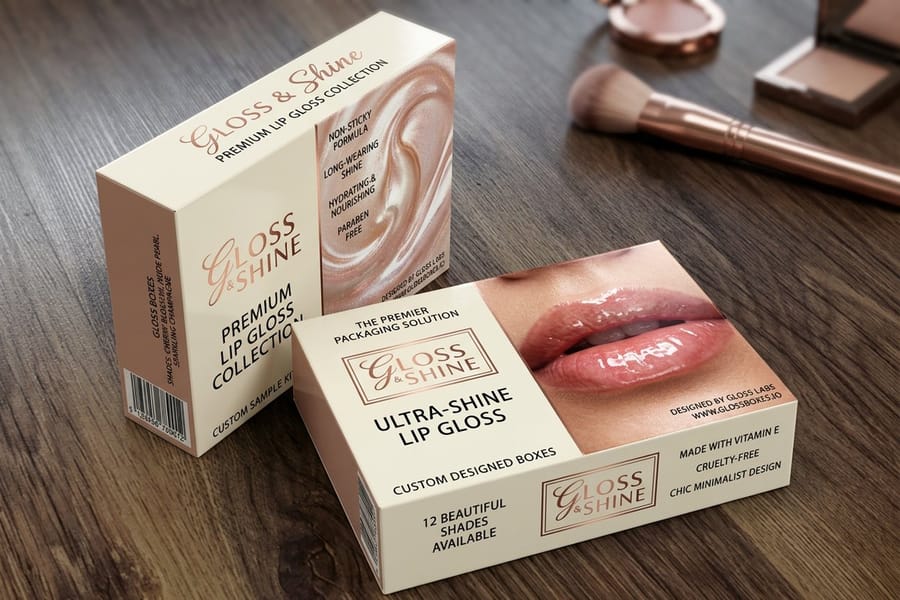
Quick answer
The product sets the box, and the box sets the artwork
Start with a caliper, not a canvas. Measure the makeup filled and capped at its widest point, remember that a hexagonal pencil is 1.155 times wider corner to corner than flat to flat, add roughly 1/16 inch of clearance per side, and lock those internal dimensions into the dieline. Choose the style from how the SKU is stocked and shipped, choose the finish from where the box will be handled, and reserve a panel for the required cosmetic copy before the design starts. Everything after that is graphics, and graphics are the cheap part to change.
Start From the Filled Product, Not a Round Number
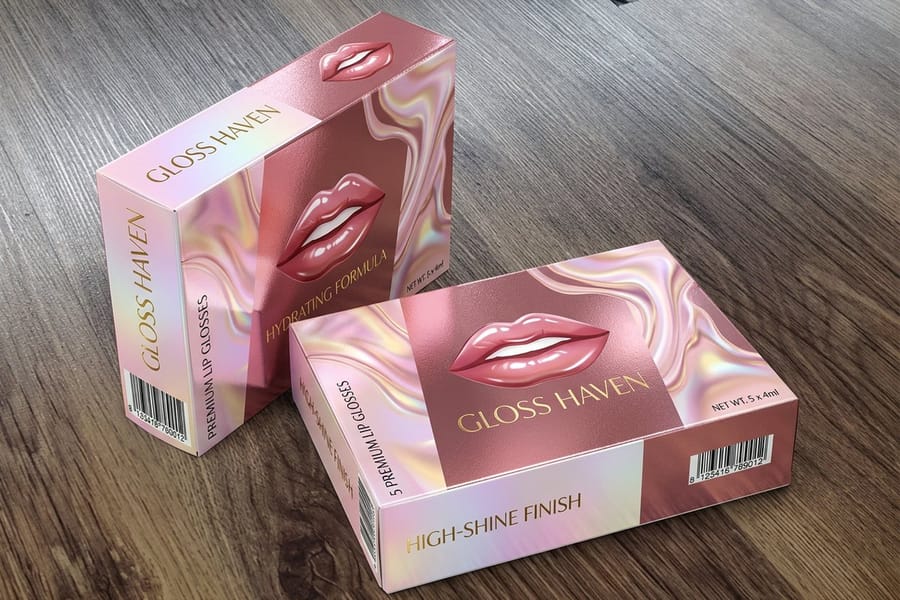
Every makeup box argument that ends in a reprint starts with a measurement taken off the drawing rather than off the product. Measure the item filled, capped, and with any shrink band or applicator in place, because that is the thing that has to go in the box.
Three shapes cause most of the trouble. A hexagonal or triangular pencil barrel is wider across its corners than across its flats, by a factor of 1.155 for a regular hexagon, so a caliper laid on two flats gives you a number that will not tuck shut. A pump foundation grows in height when the actuator is up, and it ships with the pump down but arrives with a customer who presses it. A jar with a threaded lid and a tamper band is a few thousandths wider at the band than at the body, and that band is exactly where the carton wall touches.
Add clearance once you have the true widest dimension. Roughly 1/16 inch per side lets a hand packer drop the product in without a fight. Go looser than that and the product rattles, the carton loses the rigidity the product was giving it, and it crushes in a shipper. Go tighter and the packing line slows to a crawl. If you have nothing to measure yet because the component is still in tooling, start from the box size chart by product type and confirm against a sample before the die is cut.
Write the internal dimensions on the dieline, not the external ones. Board thickness eats the difference, and a 16pt board takes real space out of a small carton. Our packaging file setup guide covers how to hand the dieline over so nothing shifts between your artboard and the cutting die.
Which Box Style Each Makeup SKU Actually Wants

Beauty ranges get into trouble when one box style is forced across every SKU for the sake of a consistent look. A mascara and a palette want opposite things from a box, and the shelf does not reward a compromise between them.
| SKU | Box that fits | Why | Watch for |
|---|---|---|---|
| Eyeliner, brow, mascara | Gloss Boxes, tall straight tuck | Narrow panels, wipe clean film, colour holds on deep shades. | Long panels bow. Straight tuck beats reverse tuck above about 5 inches. |
| Lipstick, balm, small jar | Pillow Boxes or a short tuck carton | Short and stout, easy to hang or tray, cheap per unit in a set. | A pillow box has curved ends. Keep type off the curve or it distorts. |
| Palette, compact, brush set | Magnet Boxes | Rigid walls and a magnetic lid protect pressed pigment from cracking. | Rigid board needs a wrap, so tiny type and hairlines sit near the wrap seam badly. |
| Full line facing a shelf | Retail Boxes | Built for a planogram face, consistent height across a range. | Decide the shelf orientation first. Vertical artwork on a horizontal facing is wasted. |
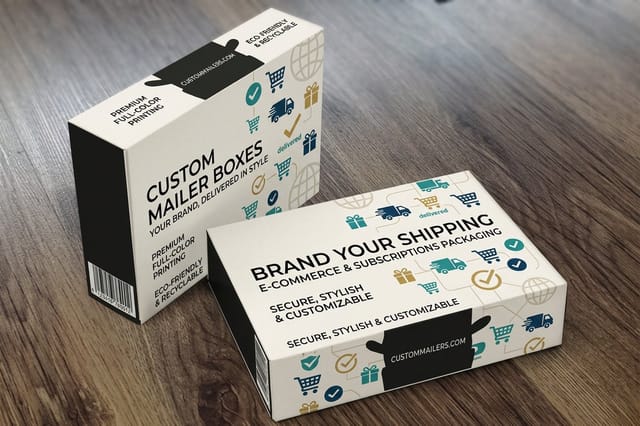
| DTC order, PR kit | Custom Mailer Boxes | Corrugated survives carriers, and the inside panel is the unboxing. | The retail carton still goes inside. A mailer is not a substitute for the primary box. |
Read the last column before the second. Most of the money lost on a first packaging run goes to a style that was chosen for its look and then failed at something mechanical: a slim carton that bowed, a curved panel that stretched a logo, a mailer that arrived as the only box and left the product loose inside. If you are choosing between formats in the abstract, how to choose the best box style walks the same decision from the product outward.
Board and Finish, Judged by Where the Box Lives

Makeup packaging gets handled more than almost any other category, and the finish that photographs best is often the one that ages worst. Pick it for the box's real life, not for the render.
Soft touch lamination feels like nothing else in the hand, which is why prestige beauty uses it. It is also a magnet for finger oil and shows a scuff as a pale line that never comes out. On a shelf carton that a customer picks up once, it is a strong choice. On a box that travels in a handbag next to keys, it looks tired fast. Gloss lamination is the opposite trade: less character, far more resilience, and it wipes clean when a balm or a foundation leaks against it. Matte laminate sits between them and shows fingerprints more than people expect, especially under spot UV, where the contrast between the matte field and the gloss varnish makes every print visible.
Foil and metallic effects work on a solid mark and fail on thin strokes. A brand name set in a hairline serif at 6 point will break up on foil no matter how careful the artwork is, so foil the mark and print the fine text. Keep foil away from the barcode entirely, because a reflective surface under a scanner is a checkout problem you will hear about from the retailer rather than from us.
Board choice follows the same logic. A coated white board holds shade critical colour predictably, while uncoated kraft warms every colour on the sheet and absorbs any oil that reaches it. If you want the kraft look with a pastel range, print a kraft coloured field on a white coated board. The full comparison of styles and constructions sits in the tuck box guide, and the wider beauty view is in our custom cosmetic packaging guide.
Give the Required Copy a Panel Before You Design

The layout that arrives at proof stage with nowhere to put the ingredient list is the most predictable delay in beauty packaging. Reserve the space first and design around it, because the copy is not negotiable and the artwork is.
For a cosmetic sold in the US, the front panel carries the identity of the product and the net quantity of contents. An information panel carries the ingredient declaration in INCI names in descending order of concentration, the name and place of business of the manufacturer, packer or distributor, and any warnings the formula requires. Where a package is too small to carry the ingredient list legibly, the rules allow it on a firmly affixed tag, tape or card instead. The period after opening symbol, the open jar mark with a number of months, is a European requirement rather than a US one.
Three practical habits keep that block from wrecking the design. Set a minimum type size for the ingredient panel and hold it, because an unreadable list satisfies nobody. Give the barcode a full quiet zone on a plain field, and never place it across a fold, a wrap seam or a foil area. Keep the batch code and expiry out of the printed artwork and onto an applied label or an inline print, so a formula change does not obsolete a pallet of cartons. Premium Packaging Labels start at $29.16, which is what makes the batch code a label decision rather than a carton decision.
Proof the copy panel separately from the design panels. Our checklist for checking a packaging proof before approval covers what to compare against what, and in which order.
The Carton Is Not the Whole Package
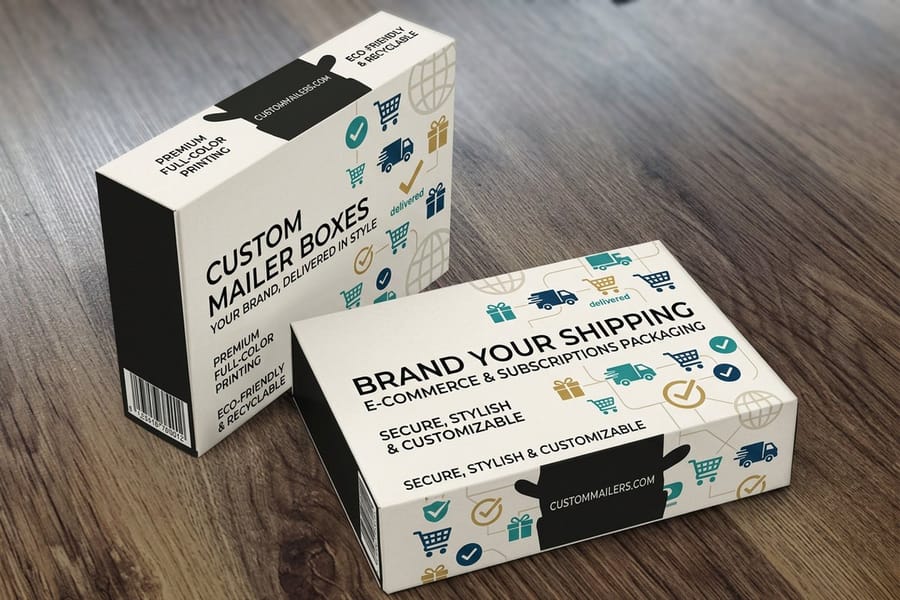
A makeup box has two jobs that pull in different directions. On a shelf it has to face out and survive being picked up. In an ecommerce order it has to survive a carrier, and the carton that looks right in a store is not the thing you ship loose in a bag.
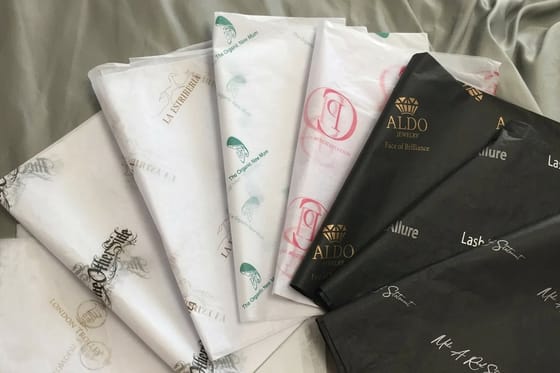
For direct orders and PR sends, the retail carton goes inside a shipper. Custom Mailer Boxes start at $711.78 and the inside face is worth as much as the outside, because it is what the customer sees at the moment they open it. Custom Tissue Paper starts at $126.32 and does more than look nice: it stops a glass foundation bottle sliding into a corner of the shipper.
Shade extensions are where a range gets expensive if you plan them badly. A twelve shade launch does not need twelve printed cartons. Print one neutral carton and change the face with Packaging Sleeves, which start at $438.25, or with a shade label. The limit worth knowing up front: once each shade carries its own GTIN, the barcode has to travel with the shade, which means it moves onto the sleeve or the label and needs its quiet zone respected there.
When the whole package is specified, order everything in one run so the board batches match. Browse the custom printing collection for the carton, the sleeve and the label together, or the wider packaging printing collection if you are still comparing formats. Sizes, options and starting prices sit in the widgets further down the page.
Wally sizes a makeup box
Corners first, then the dieline, then the artwork
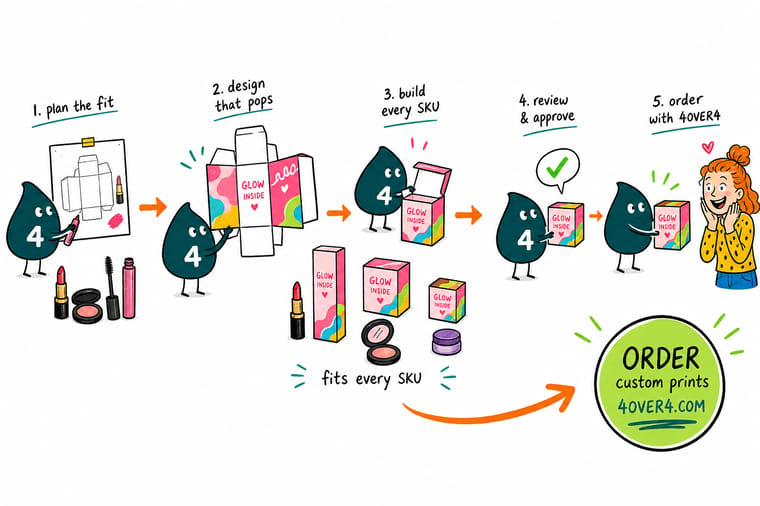
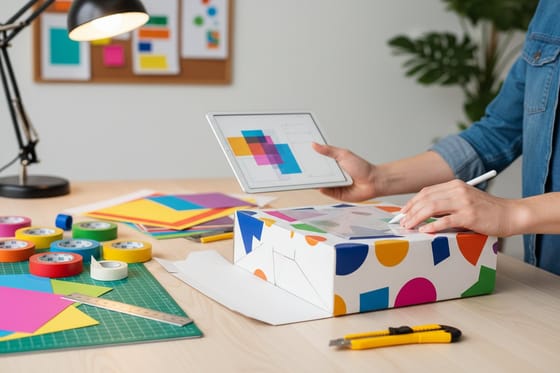
Wally puts the caliper on the pencil corner to corner, not flat to flat, because a hex barrel is wider that way and a carton sized off the flats never tucks shut. He adds a sliver of clearance on each side so a packer can drop the product in, writes the internal dimensions on the dieline, and blocks out the panel for the ingredient list and the barcode. Only then does he start on the pretty side. Shade extensions get a sleeve, not a whole new box.
Order printed makeup cartons →Specs and pricing
Makeup box formats, options, and starting prices
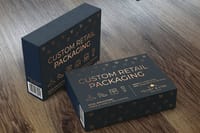
The three formats a beauty range usually needs, with live configuration choices and starting prices straight from the 4OVER4.COM configurator.


Print it
Order the carton, the rigid box, and the shipper


Explore more
Where to go next
By the numbers
Beauty packaging printed at 4OVER4
Common Questions
Your makeup box questions, answered
What size box does an eyeliner or mascara need?
Measure the pencil or wand with the cap on, at its widest point, then add roughly 1/16 inch of clearance on each side. Hex and triangular barrels are the trap: a hexagonal pencil measures about 1.155 times wider across its corners than across its flats, so a carton sized from a caliper laid on two flats will be too narrow to tuck shut. Height is set by the capped length plus enough headroom that the top tuck flap can fold without pressing on the cap. Slim cartons also bow along the long panels, so a straight tuck end holds its shape better than a reverse tuck on anything over about 5 inches tall.
Should a makeup box be soft touch or gloss?
It depends on whether the box lives on a shelf or in a bag. Soft touch lamination has the most convincing premium feel in the hand, and it is also the finish that shows finger oil, scuffs and scratches soonest, which matters on a box a customer carries around with the product. Gloss lamination wipes clean, resists the oil in foundation and balm, and holds colour saturation on deep shades. A common compromise is gloss on the carton and soft touch reserved for a gift or PR box that gets opened once. Gloss Boxes start at $711.78 at 4OVER4.COM for a printed run.
What has to be printed on a cosmetic box sold in the US?
The front panel, which the rules call the principal display panel, needs the identity of the product and the net quantity of contents. An information panel needs the ingredient declaration in INCI names in descending order of concentration, plus the name and place of business of the manufacturer, packer or distributor, and any required warnings. Very small packages are allowed to carry the ingredient declaration on a firmly affixed tag, tape or card instead of the carton itself. The period after opening symbol, the little open jar with a number, is a European requirement rather than a US one, though plenty of US brands print it anyway for export.
Can one carton cover several shades?
Yes, and it is the cheapest way to run a shade range. Print a neutral carton in one run, then differentiate with a printed sleeve or a shade label. Packaging Sleeves start at $438.25 and Premium Packaging Labels start at $29.16, so adding a twelfth shade costs a label run rather than a twelfth box run. The catch is the barcode: if each shade has its own GTIN, the barcode has to move onto the sleeve or the label, and it needs its full quiet zone there rather than being crowded against the sleeve edge.
Is kraft board a good choice for makeup packaging?
It reads well for a botanical or refill-led brand and it fights you on two things. Uncoated kraft absorbs oil, so a leaking balm or a foundation dribble stains the board permanently rather than wiping off. It also shifts every printed colour warm, because the ink sits on a brown sheet rather than a white one, and pale pinks and cool greys are the first to look muddy. If the range is pastel or shade critical, a white coated board with a kraft coloured print is more predictable than real kraft.
How many boxes do I have to order?
Custom printed cartons are die cut and run in production quantities, which is why a printed box run starts at $711.78 for Gloss Boxes, Retail Boxes and Custom Mailer Boxes, while a magnetic rigid box starts at $19.68 and Pillow Boxes start at $284.49. If you are still testing a shade or a launch, order the small format first and use labels on a plain box, then commit to a printed carton once the SKU has a settled size. Changing the die after a run is the expensive mistake, not the run itself.
Get Started
Ready to put your shades in a box that fits?
Send the dieline or start from ours, pick the board and the finish, and we print cartons, rigid boxes, sleeves and labels from the same run.
Legal Disclaimer
Gold Standard guarantees apply to all standard orders placed through 4over4.com. Price match requires verifiable proof of a competitor's published price for an equivalent product with matching specifications and turnaround time. Satisfaction guarantee covers manufacturing defects and print quality issues. Contact support with order number and documentation. On-time delivery rate based on tracked orders 1999 to 2026. Individual results may vary based on shipping carrier performance.
