
Box Size Chart by Product Type and Industry


The right box protects the product, cuts shipping cost, and looks intentional the moment it lands. This chart maps common box sizes to what goes inside them, product by product and industry by industry.
Match the box to the product, not the other way around. Small goods like jewelry and cosmetics fit a 6 by 4 by 2 in mailer, folded apparel wants roughly 12 by 9 by 3 in, boxed retail items sit well in 8 by 8 by 4 in, and multi-item bundles or subscription boxes need about 8 by 6 by 3 in and up. Leave a little room for protective fill and pick a stock that survives the trip.
Start here
Product, padding, then the box
Pick the smallest box that holds the product with room for protection. Light accessories go in small mailers near 6 by 4 by 2 in, folded apparel in flat mailers near 12 by 9 by 3 in, boxed retail goods in cube styles near 8 by 8 by 4 in, and subscription or bundle orders in roughly 8 by 6 by 3 in and up. The chart below turns those rules into concrete numbers by product type and by industry.
Small Products and Lightweight Items
Small, light products reward compact boxes. Jewelry, cosmetics, accessories, phone cases, and printed samples rarely need more than a snug mailer, and going smaller keeps both dimensional weight and postage down. A footprint around 6 by 4 by 2 in covers most of these, with 8 by 6 by 2 in as the next step up when the item is a touch larger.
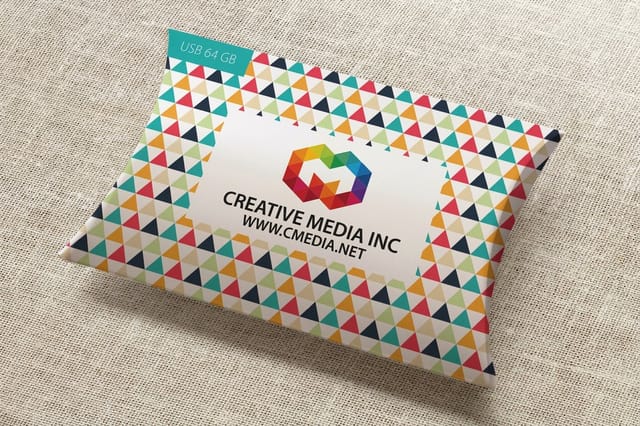
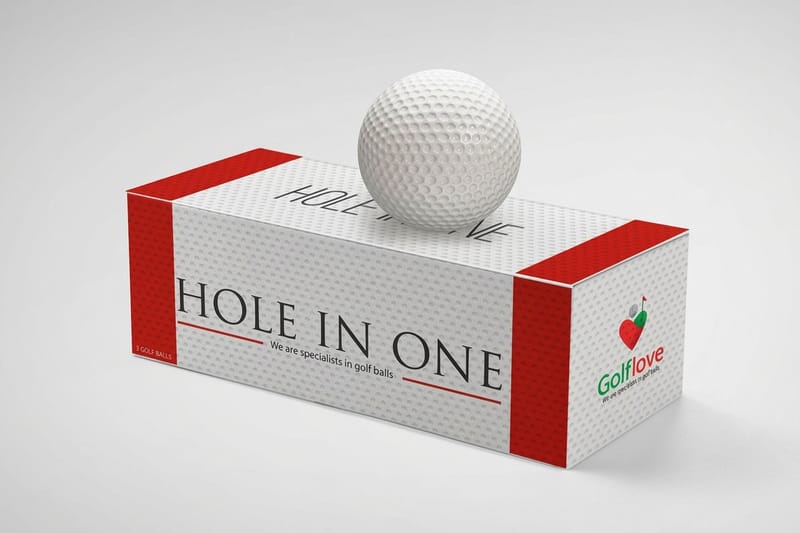
For tiny or oddly shaped goods, a shaped box does the protecting for you. Our golf ball boxes and pillow boxes hold round or slim items without a lot of fill, while a small cube box suits candles, jars, and gift trinkets. Because these ship in volume, printing your brand on the outside turns every delivery into a small ad.
Keep at least a quarter inch of clearance on each side for a thin layer of protection, and choose a sturdier stock if the contents are fragile. When you are ready to nail down materials, our guide on how to make custom boxes walks through stock and construction choices.
Apparel and Foldable Products
Two boxes get called a clothing box, so name the job first. A shirt box is the flat retail box a folded shirt is presented in, which is shallower than the mailer you would ship it in: the shirt box sells the garment under a lid, the mailer gets it through the carrier. Standard shirt box dimensions are 11 by 8.5 by 1.5 in for a folded dress shirt, 14 by 9.5 by 2 in for a sweater or an oversized tee, and 17 by 11 by 2.5 in for a coat, robe, or two-piece set. Depth is the tell: a retail shirt box stays at or under 2.5 in so the fold reads flat, while a shipping mailer for the same shirt starts at 2 in and grows with the bulk of the garment.
| Clothing box | Size (L x W x D) | What it holds |
|---|---|---|
| Shirt box, standard | 11 x 8.5 x 1.5 in | One folded dress shirt or blouse, retail or gift presentation |
| Shirt box, large | 14 x 9.5 x 2 in | Sweater or oversized tee, with tissue and an insert card |
| Hoodie gift box | 15 x 9.5 x 3 in | One folded hoodie or fleece, presented flat with tissue |
| Robe and coat box | 17 x 11 x 2.5 in | Coat, robe, or a folded two-piece gift set |
| Single-shirt mailer | 10 x 8 x 2 in | One folded t-shirt shipped on its own |
| Hoodie or two-piece mailer | 12 x 9 x 3 in | A hoodie, a set, or two folded garments |
| Multi-item apparel mailer | 14 x 10 x 4 in | Bulkier or multi-garment apparel orders |
Clothing is the classic best size box for shipping clothes puzzle, and the answer is a flat mailer sized to the folded garment. A single folded t-shirt fits comfortably in roughly 10 by 8 by 2 in, while a hoodie or a two-piece set wants closer to 12 by 9 by 3 in. Bulkier or multi-item apparel orders step up to 14 by 10 by 4 in. If you are selling the shirt in a box and shipping that box, put the 11 by 8.5 by 1.5 in shirt box inside the 12 by 9 by 3 in mailer rather than trying to make one box do both jobs.
Fold consistency is what keeps these boxes efficient. Fold to a repeatable size, slide the garment into a snug mailer, and you avoid both a rattling oversized box and a cramped one that wrinkles the fabric. Fold a tee in thirds to about 10 by 7 in and it drops into the 10 by 8 by 2 in mailer with a quarter inch of clearance on every side. A roll end tuck top box is a strong pick here because it opens flat for easy packing and closes clean for a premium unboxing.
Apparel brands lean on the box as a brand moment, so a printed interior or a thank-you insert earns its keep. Size the insert card to the box footprint, 10.5 by 8 in for the standard shirt box, so it lies flat on top of the fold instead of buckling. For inspiration on turning the package itself into marketing, see innovative packaging ideas for small businesses.
Retail Products and Boxed Goods
Retail goods that already live in a box, think mugs, candles, ceramics, electronics, and homeware, need a box that fits the product and doubles as shelf presence. A footprint near 8 by 8 by 4 in suits many single boxed items, while flatter goods do well in 9 by 6 by 3 in. The box has two jobs at once: survive the supply chain and look good facing out on a shelf.
That dual role is why print quality matters as much as dimensions. A cube box gives clean faces for artwork on every side, and a sales presentation box adds a premium open-and-reveal for higher-ticket items. Pair the box with matching packaging labels to seal, brand, and add batch or SKU details.
If the product will be designed as a full retail package rather than a plain carton, our complete walkthrough on how to design packaging for a product covers structure, print, and finish end to end.
Product Bundles, Kits, and Multi-Item Orders
The moment more than one item ships together, sizing becomes about arrangement, not just volume. Subscription boxes, gift sets, and multi-item kits usually land between 8 by 6 by 3 in for a small curated set and 12 by 9 by 5 in for a fuller box. The goal is a layout where items sit snug, inserts have a home, and nothing shifts in transit.
Subscription brands in particular treat the box as the product. A little extra depth leaves room for tissue, a card, and a considered reveal, which is what makes the unboxing feel worth the subscription. A roll end tuck top box or a presentation box both give that structured, deliberate open.
Plan the internal layout before you lock the outer dimensions, and add a printed insert or coupon to drive the next order. For a broader look at packaging formats and when each fits, read our guide on the types of packaging.
Box Sizes by Industry
Different industries settle on different defaults because their products cluster around common shapes. Beauty and cosmetics live in small mailers and cube boxes near 6 by 4 by 2 in to 8 by 8 by 4 in. Apparel and footwear span flat mailers around 12 by 9 by 3 in up to shoe-box footprints near 13 by 8 by 5 in, with retail shirt boxes at 11 by 8.5 by 1.5 in and large shirt or sweater boxes at 14 by 9.5 by 2 in sitting beside them for in-store and gift presentation. Print custom apparel boxes to those exact numbers so the retail shirt box and the mailer that carries it are built as one set instead of two guesses. Food and specialty goods favor rigid cube and folding-carton styles that protect and display at once.
Electronics and homeware trend toward sturdier cube boxes with protective fill, while subscription and gifting brands prioritize depth and interior finish over raw size. Knowing your industry norm gives you a starting point, then you tune it to your exact product. Explore the full range in the packaging collection or browse buildable stock in custom box printing.
Whatever the category, a right-sized box lowers dimensional-weight surprises and reduces damage claims. When you order with us, our free file check reviews your artwork so the printed box matches the dieline before it runs.
How to Choose the Right Box Size
Start with a caliper or ruler and record the product at its longest, widest, and tallest points. Add a quarter to a half inch per side for protection, more if the contents are fragile, then round to a stock or buildable size. That measured number, not a rough eyeball, is what keeps postage predictable and damage rare.
Next, weigh the trade-off between a snug fit and a branded experience. Ecommerce and shipping-heavy sellers optimize for the smallest protective box to control dimensional weight, while gifting and subscription brands add a little room for a richer reveal. Both are valid; the point is to choose on purpose. Our online design tool lets you lay artwork onto the exact box footprint before you commit.
Finally, set your specs and watch the price move. Size, stock, quantity, and finish all feed the number, and you can see each change live in the configurator. Use the specs and pricing panel below to build your box, or read how to prepare files for packaging products so your dieline exports clean.
Wally sizes the box to the product
The right box protects, ships light, and looks intentional
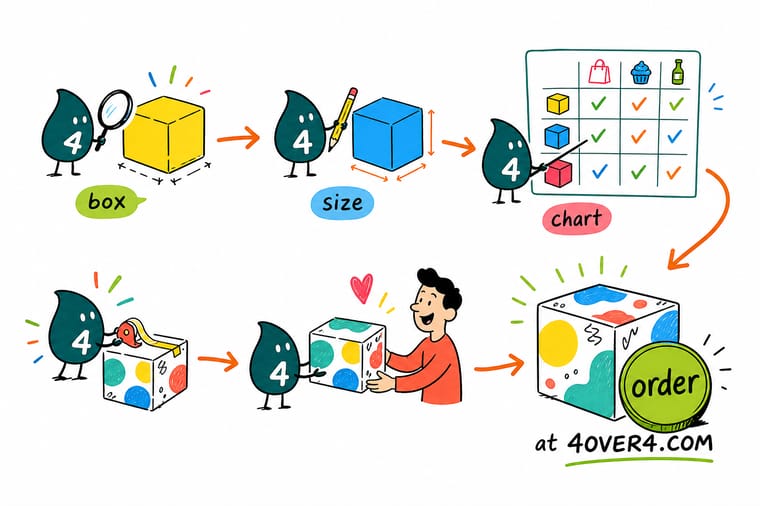
Wally measures the product first, adds a little room for protection, then snaps to the nearest box footprint. Small goods get a compact mailer, folded apparel gets a flat mailer, and a subscription set gets depth for a real reveal. Right-size it, print your brand on every face, and 4OVER4 runs it clean off the dieline.
Order custom boxes →Quick reference
The box size chart at a glance
Common starting dimensions by what goes inside. Measure your product, add room for protection, then round to the nearest stock or buildable size.
| Product type | Common size (L x W x H) | Why it matters |
|---|---|---|
| Jewelry, cosmetics, samples | 6 x 4 x 2 in | Compact mailers keep dimensional weight and postage low for light goods. |
| Shirt box, retail or gift | 11 x 8.5 x 1.5 in | Standard shirt box dimensions: one folded dress shirt presented flat under a lid. |
| Shirt or sweater box, large | 14 x 9.5 x 2 in | Holds a sweater or oversized tee with tissue and an insert card on top. |
| Robe and coat box | 17 x 11 x 2.5 in | The deepest presentation box before you are into shipping cartons. |
| Folded apparel (single item) | 10 x 8 x 2 in | A flat mailer sized to one folded garment ships wrinkle-free and cheap. |
| Apparel sets and hoodies | 12 x 9 x 3 in | Extra depth holds bulkier or multi-piece clothing orders without crushing. |
| Boxed retail goods | 8 x 8 x 4 in | Cube footprints protect mugs, candles, and homeware and display well. |
| Subscription and gift bundles | 8 x 6 x 3 in | Room for a curated set plus tissue and inserts for a deliberate reveal. |
| Round or shaped products | 3 x 3 x 3 in | Shaped boxes cradle round items with little or no void fill. |
| Shipping cartons (multi-pack) | 12 x 12 x 12 in | A sturdy master carton for bulk or wholesale multi-unit orders. |
Step by step
Choose your box size in 6 steps
- Measure the product at its extremes Record length, width, and height at the longest points, including any handles, lids, or protrusions.
- Add clearance for protection Add a quarter to a half inch per side, more for fragile contents, so fill and padding have space.
- Decide fit versus experience Ship-heavy sellers optimize for the smallest protective box; gifting brands add room for a reveal.
- Match to a box style Pick cube, mailer, pillow, or presentation based on the product shape and how it should open.
- Round to a stock or buildable size Snap your number to the nearest available footprint so it prints and ships efficiently.
- Proof the dieline and order Lay artwork on the exact footprint, run the free file check, and set quantity and stock live.
Infographic
Box sizes by product type
Four everyday starting points, from small mailers to bundle boxes. Match the closest one to your product, then fine-tune from the full chart above.
Every dimension here is a starting point. Measure your actual product, add protection, and round to the nearest buildable size before you order.
Specs and pricing
Custom cube box specs and live pricing
Once you have the size, stock, quantity and finish are what is left. Cube boxes run 50 for $213.09, which is $4.26 a box.

| Quantity | Price Per Unit | Total |
|---|---|---|
| 50 | $4.26 | $213.09 |
| 100 | $2.50 | $250.42 |
| 150 | $1.89 | $283.38 |
| 200 | $1.59 | $317.44 |
| 250 | $1.43 | $356.98 |
| 500 | 76.7¢ | $383.34 |
| 1,000 | 42.7¢ | $427.27 |
| 2,500 | 29.0¢ | $723.84 |
Order it
Order the right box for your product
Explore more
Where to go next
By the numbers
Every box on this chart, from one supplier
Common Questions
Common questions about box sizes
What is the most common mailer box size?
There is no single universal size, but a compact mailer near 6 by 4 by 2 in covers most small light goods, while a flat mailer near 12 by 9 by 3 in is the go-to for folded apparel. The right choice always starts from the product: measure it, add room for protection, and round to the nearest stock or buildable footprint. That measured approach keeps postage predictable and protects the contents better than picking a size by habit.
What size box is best for shipping clothes?
A single folded t-shirt ships well in roughly 10 by 8 by 2 in, and a hoodie or a two-piece set fits closer to 12 by 9 by 3 in. The key is folding to a consistent size so the garment sits snug without a rattling gap or a cramped fit that wrinkles the fabric. For larger or multi-item apparel orders, step up to about 14 by 10 by 4 in and consider a roll end tuck top box for a clean, brandable open.
What are typical subscription box sizes?
Most subscription boxes land between 8 by 6 by 3 in for a small curated set and 12 by 9 by 5 in for a fuller box. Subscription brands usually add a little depth beyond the bare minimum so there is room for tissue, an insert, and a deliberate reveal, since the unboxing is part of what customers pay for. Plan the internal layout first, then set the outer dimensions around it.
How much clearance should I leave inside a box?
Leave about a quarter to a half inch on each side of the product for a thin layer of protection, and more for fragile or breakable contents that need real cushioning. Too little room risks damage and crushing; too much wastes material, invites shifting, and can raise dimensional-weight shipping cost. The goal is snug but padded, which usually means the smallest box that still holds the product plus its fill.
Does a bigger box cost more to ship?
Often, yes, because carriers bill on dimensional weight as well as actual weight, so an oversized box padded with fill can cost more than a snug one holding the same item. Right-sizing the box lowers that dimensional weight, reduces the amount of void fill you buy, and tends to protect the product better. Choosing the smallest protective size is one of the simplest ways to control shipping cost.
What does custom box printing cost and how is it priced?
Custom box price scales with a few levers: size, stock, quantity, and finish. Larger footprints and heavier or specialty stocks raise the unit cost, while higher quantities lower it, so a bigger run drops the per-box price. You set each option in the configurator and the total updates live as you adjust, letting you weigh a premium stock or a larger order against the number before you commit.
Get Started
Order 50 golf ball boxes from $269.11
Build a custom box to your exact dimensions, stock, and artwork at 4OVER4.COM. Adjust size, quantity, and finish and watch your price update live.
Legal Disclaimer
Gold Standard guarantees apply to all standard orders placed through 4over4.com. Price match requires verifiable proof of a competitor's published price for an equivalent product with matching specifications and turnaround time. Satisfaction guarantee covers manufacturing defects and print quality issues. Contact support with order number and documentation. On-time delivery rate based on tracked orders 1999 to 2026. Individual results may vary based on shipping carrier performance.
