
Custom Logo Packaging for Boxes, Mailers, Tape and Tissue


Five surfaces can carry your mark on a shipped order, and they are nowhere near the same price. Here is what each one costs, what it commits you to, and the order to buy them in.
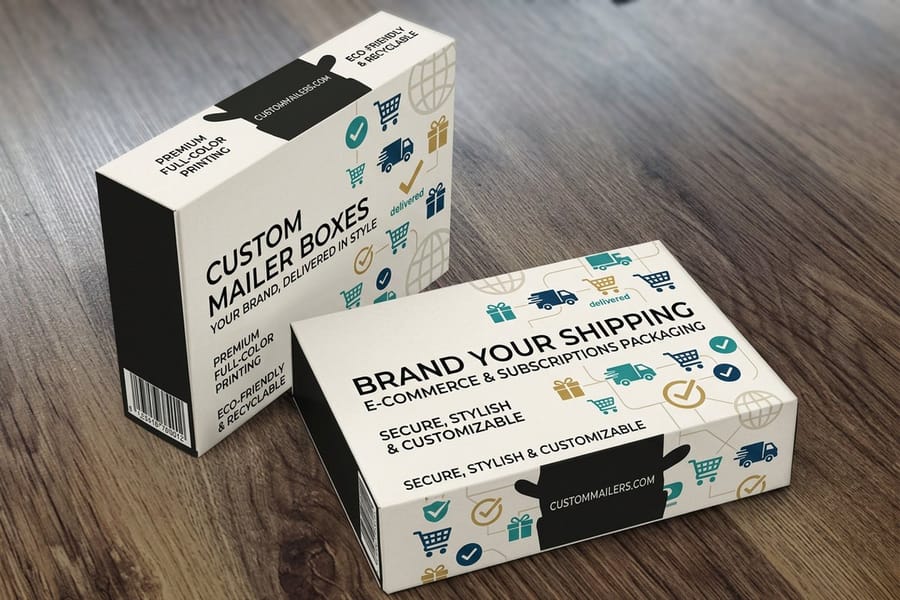
Custom logo packaging means printing your mark on the parts of an order that already ship with it: the box, the tape, the sleeve, the tissue and the tag. Pick the surface by budget, because the prices are not close. Standard Hang Tags start at $25.27, Tissue Paper at $126.32, Printed Packaging Tape at $347.11, Packaging Sleeves at $438.25 and Custom Mailer Boxes at $711.78. Packaging is quoted per production run, so the box also commits you to one size for that whole run.
Quick answer
Brand the layer that fits the budget, then climb
The logo does not have to go on the box to be on the packaging. Tape, tissue, sleeves and tags brand a parcel without a dieline, without a cutting die and without locking you into one set of dimensions, which is why they start at a fraction of a printed box. The box wins on impression and on photographs, and it is the right buy once a single size carries most of what you ship. The flat dieline below shows why the box is the fussiest of the five to design for.
The Five Surfaces That Can Carry Your Logo
A shipped order has more branded surface than most people use. Each one is a separate print job with its own price, its own minimum and its own limits, so it helps to see them side by side before you brief a designer.
| Surface | How the logo gets on it | Starts at | Pick it when |
|---|---|---|---|
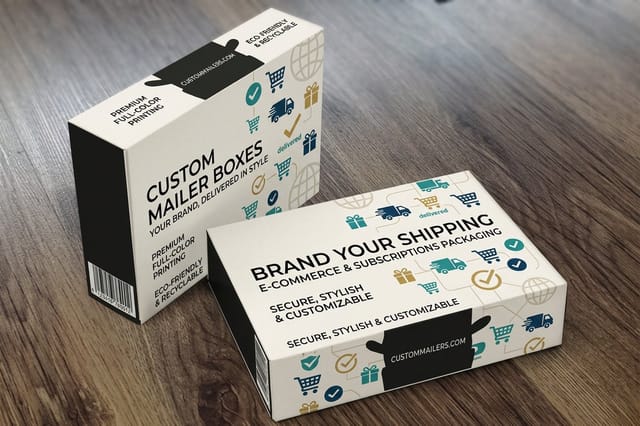
| Mailer box | Printed flat on board, die cut and scored, shipped flat for you to fold. | $711.78 | The box itself is the first impression and one size dominates your orders. |
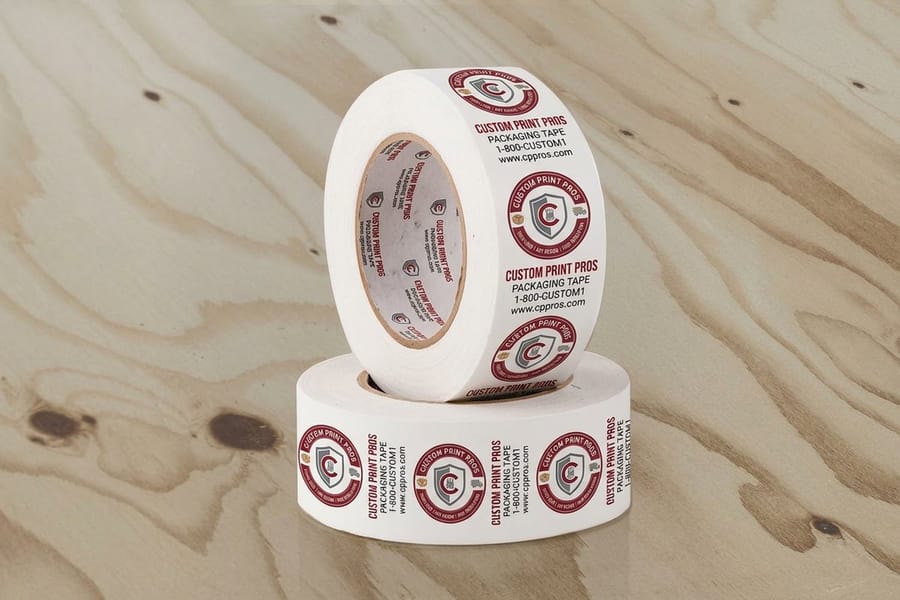
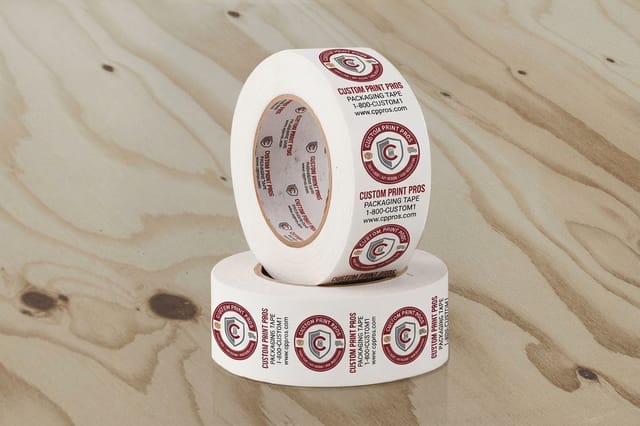
| Packaging tape | A repeating logo printed along the roll, applied to any plain box. | $347.11 | You already stock plain boxes in several sizes and want branding fast. |
| Packaging sleeve | A printed band that wraps a plain box or the product itself. | $438.25 | One blank box has to serve several products or several seasons. |
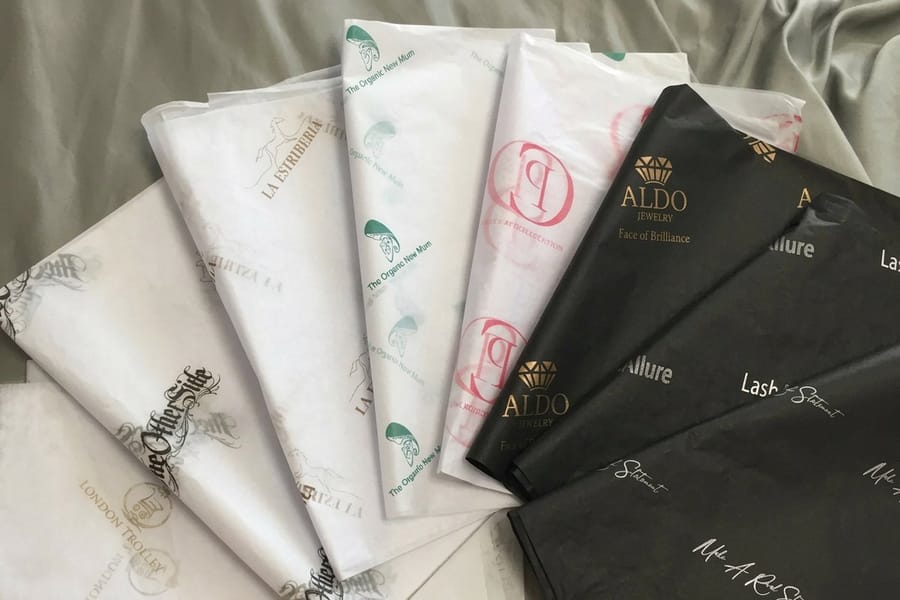
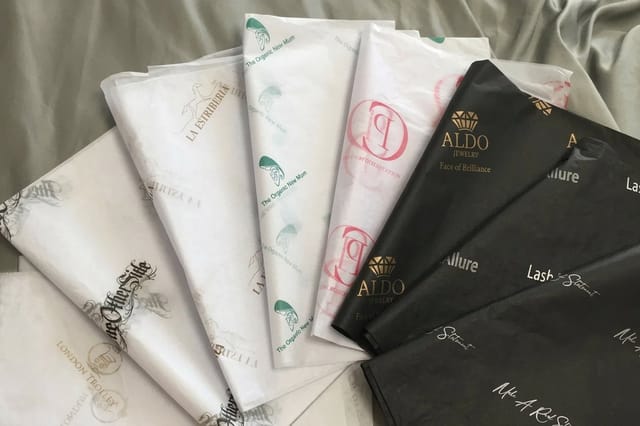
| Tissue paper | Printed wrap that sits under the lid and around the product. | $126.32 | The moment of opening matters more than the outside of the parcel. |
| Hang tag | Printed card, drilled and strung to the product or the handle. | $25.27 | You want the cheapest honest test of how the mark reads in print. |
Read the price column as a ladder rather than a menu. A hang tag proves your mark holds up at 2 inches wide on real stock for the price of a lunch. A printed mailer commits you to one set of interior dimensions for a full production run. Most brands should climb that ladder in order, and the guide to the nine types of packaging is worth reading first if you have not settled on a format at all.
What Custom Logo Packaging Actually Costs
Packaging pricing confuses people because it does not behave like business cards. The cost sits almost entirely in setup and run length, not in the number of boxes you take home.
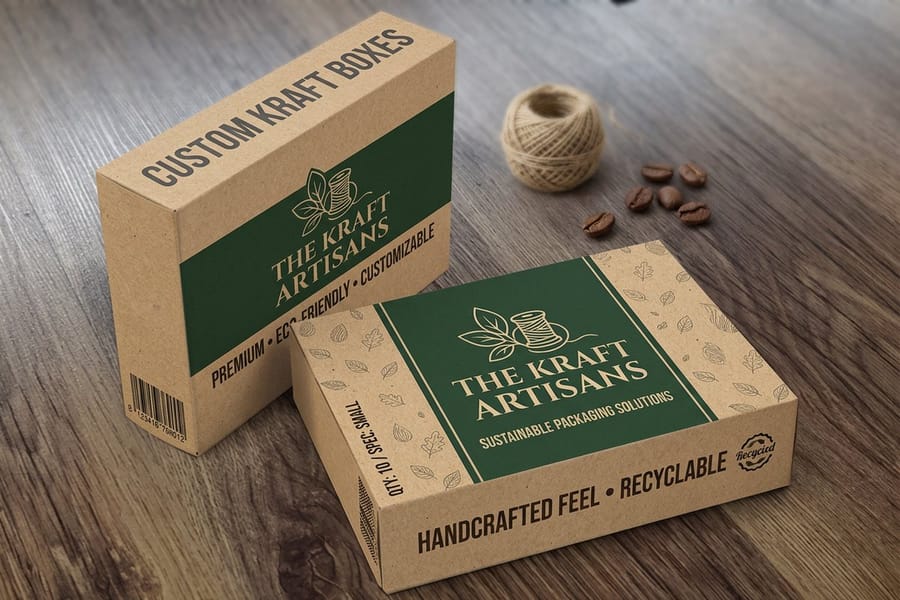
Every printed box needs a cutting die for that exact size, plates or a digital setup for the artwork, and a press make-ready before the first good sheet comes off. Those are paid once. That is why Custom Mailer Boxes and Custom Kraft Boxes both start at $711.78: the number is a production run, not a unit price. Ordering deeper on the same size barely moves the setup portion, which is why the per-box cost falls sharply as the quantity rises and why a second size is a second $711.78 rather than a discount.
The cheaper surfaces are cheaper for a structural reason, not a quality one. Tape needs no die, so Printed Packaging Tape starts at $347.11 and a single order brands a lot of parcels. Tissue paper has no cut shape at all, which is how Tissue Paper lands at $126.32. Hang tags are a small die on light stock, so Standard Hang Tags start at $25.27.
Design is a separate line item and it is the one people forget. A dieline layout is not the same work as a logo file, and a packaging designer bills for the structural drawing as well as the art. Our breakdown of packaging design cost covers what that stage should run before you add print.
Minimums, and the Commitment Nobody Mentions
The real minimum on packaging is not a quantity. It is a decision about size that you cannot undo once the die is cut.
A printed box is built around one set of interior dimensions. If your catalogue is a candle, a mug and a t-shirt, one dieline will not serve all three, and you will either pay for a second run or ship the t-shirt in a box it swims inside. Before spending anything on a box, work out which single product accounts for most of what leaves the building. The box size chart by product type is the fastest way to shortlist that dimension, and cardstock against corrugated settles whether it needs to survive a carrier or just a shelf.
Here is where the cheap layers pay for themselves twice. Tape, tissue, sleeves and tags carry no dimension, so they keep working when the product line changes.
- Tape brands every box you already buy, in every size, from one order.
- Tissue works inside a box, a mailer bag or a retail bag without alteration.
- Sleeves let one blank box carry three products by swapping the printed band.
- Hang tags and packaging labels apply to anything with a flat surface.
The trade-off is honest and worth stating plainly. Tape and tissue never look as considered as a fully printed box in a photograph, and a brand whose packaging is part of the product should print the box. Everyone else gets more branded surface per dollar from the layers that do not need a die.
How to Order It Without a Reprint
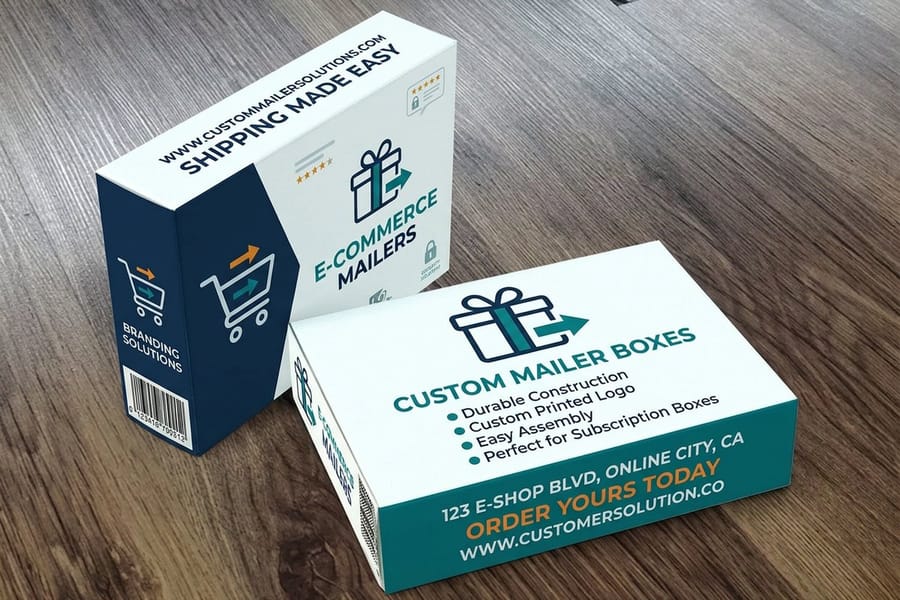
Most packaging reprints trace back to artwork that was built on a picture of a box instead of the flat dieline. The order below avoids that.
One, choose the product and the exact size, then take the template. Pick the size on the product page and download the matching flat layout from the blank template library. That file carries the panel positions, the score lines and the glue tab as they will actually be cut.
Two, build the art flat and respect the folds. Place your mark inside a single panel, keep type and fine detail away from the dashed score lines, and put nothing you need to see on the glue tab, because adhesive covers it. Heavy dark coverage that crosses a crease cracks along the fold on corrugated and shows a hairline of bare board. Let the fold land somewhere light.
Three, supply it as print-ready CMYK. Fonts converted to outlines, artwork at full size, bleed extending past the trim on every edge. On kraft, remember there is no white ink under the build, so reversed white type comes out brown and pale tints go muddy. Supply the single-colour version of the mark for brown board.
Four, read the proof like it is the last chance, because it is. Check the fold direction, the panel that faces the customer, and the size of the mark at real scale rather than on screen. Our packaging proof checklist lists what people miss. Boxes then arrive flat and you fold them, which keeps freight sane.
If you are still choosing between formats rather than files, how to choose the right packaging for your product works through it from the product outward, and the full custom box printing range shows every style we cut.
Wally explains logo packaging
Tape first, box later, and never art across a fold
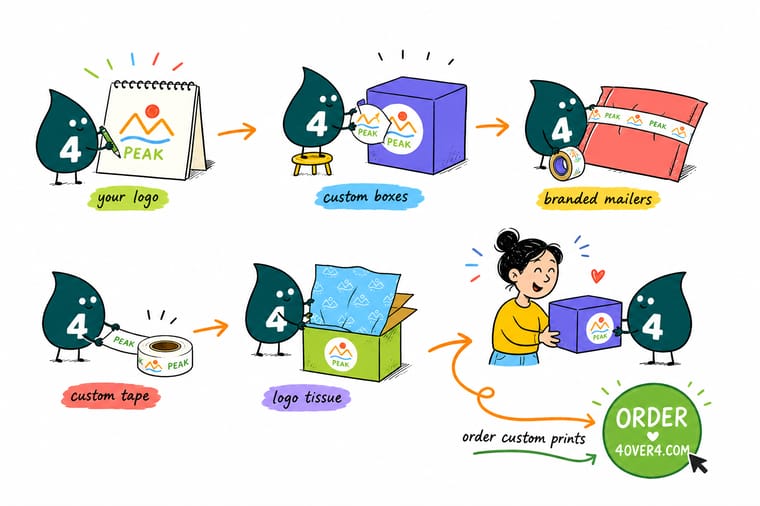
Wally does not print a box on day one. He prints tape, because one roll brands every size of box he already stocks and it needs no cutting die. Tissue goes inside for the opening. A hang tag proves the mark still reads at two inches. When one box size starts carrying most of his orders, he cuts the die and prints the mailer, and he keeps the heavy ink off the score lines so the fold does not crack.
Order printed packaging tape →Specs and pricing
Sizes, options and starting prices
Configure the three surfaces most brands start with, with live sizes and starting prices straight from the 4OVER4.COM configurator.
Print it
Put the logo on the order
Explore more
Where to go next
By the numbers
Packaging you can count on at 4OVER4
Common Questions
Your logo packaging questions, answered
What is custom logo packaging?
It is any part of the shipped or shelved package that carries your mark instead of a plain surface. In practice that means five things: the printed box or mailer, the packaging tape that seals it, the sleeve that wraps it, the tissue paper inside it, and the hang tag attached to the product. They are separate print jobs on separate machines, so you can brand one of them, all five, or start with the cheapest and add the rest later.
Is it cheaper to print the box or print the tape?
Tape, by a wide margin at the entry point. Printed Packaging Tape starts at $347.11 and Custom Mailer Boxes start at $711.78, and the tape brands whatever plain box you already stock rather than locking you into one size. The box wins on impression: a fully printed mailer reads as a designed product, while tape reads as a business that pays attention. If the package gets photographed or unboxed on camera, print the box. If it just needs to stop looking anonymous on a doorstep, print the tape.
Will my logo print well on brown kraft?
A solid one or two colour mark will look excellent. A logo built on white knockouts, pale tints or photographic detail will not, because there is no white ink in a standard CMYK build and the brown board shows through every light tone. The usual fixes are to supply a single-colour version of the mark for kraft, to move the detailed version onto a white-surface box, or to print the detailed version on a sleeve or a label and apply it to the kraft box.
What file do I need to send for a printed box?
A flat dieline layout, not a picture of a box. Download the template for the exact size you ordered from the blank template library, place your artwork on the flat panels, keep critical elements clear of the dashed score lines and off the glue tab, then supply CMYK with fonts converted to outlines and bleed extending past the trim. Send it as a print-ready PDF. A 3D mock-up is useful for approval internally but it cannot be printed from.
How many boxes do I have to order?
Packaging is quoted as a production run, so the starting price on each product page is the smallest run we print rather than a per-piece price. That is why ordering one box costs the same as ordering the minimum quantity. The practical advice is to pick the single size that fits your best selling product, order that size deep, and use tape and tissue to cover everything that does not fit it.
Can I put my logo on packaging without ordering printed boxes?
Yes, and it is the route most brands should take first. Printed Packaging Tape at $347.11, Tissue Paper at $126.32 and Standard Hang Tags at $25.27 all brand a shipment without a dieline, a die or a committed box size. They also survive a product change, which a printed box with a fixed dimension does not. Add the printed box once one size accounts for most of what you ship.
Get Started
Ready to put your mark on the parcel?
Start with tape and tissue this week, or configure a printed mailer box in the size that carries most of your orders. Both ship from our Queens plant.
Legal Disclaimer
Gold Standard guarantees apply to all standard orders placed through 4over4.com. Price match requires verifiable proof of a competitor's published price for an equivalent product with matching specifications and turnaround time. Satisfaction guarantee covers manufacturing defects and print quality issues. Contact support with order number and documentation. On-time delivery rate based on tracked orders 1999 to 2026. Individual results may vary based on shipping carrier performance.
